Artificial intelligence is changing the way people search for information. Instead of typing a query into Google, more users are asking AI tools like
ChatGPT, Perplexity, and Gemini to find answers. If you run a website, the big question is:
are you being mentioned or cited in these AI-generated results?In this guide, we’ll show you how to find out whether your website is ranking in AI search and how to optimize your content for better visibility.
Why AI Search Rankings Matter for Your Website
AI-powered search engines work differently from Google or Bing. Instead of serving a list of blue links, they generate conversational answers, often pulling from trusted websites, citations, and knowledge graphs.
If your website appears in these AI answers:
- You gain increased authority in your niche.
- Users are more likely to trust and visit your site.
- You stay ahead of competitors who aren’t optimizing for AI search.
Ignoring AI search visibility could mean losing traffic and brand recognition to competitors who are being cited in these new engines.
Step 1: Understand How AI Search Results Work
Before checking your rankings, it helps to understand how AI models select content:
LLMs Source From Trusted Content
AI models often reference domains with strong E-E-A-T (Experience, Expertise, Authoritativeness, Trustworthiness).
Mentions vs. Citations
Sometimes your website is referenced with a direct link, while other times your brand or content is mentioned without attribution.
Dynamic Results
Unlike Google, where rankings stay fairly stable, AI search answers can change from query to query.
Step 2: Use LLMRefs to Check if Your Website is Ranking
The easiest way to find out if your website appears in AI search is by using
LLMRefs.
How to Use LLMRefs
- Go to LLMRefs.com.
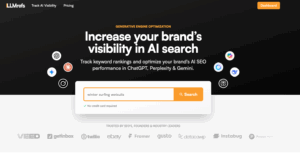
- Enter your domain name, brand, or target keyword.
- Review the results to see whether your website is being cited or mentioned in AI-generated answers.
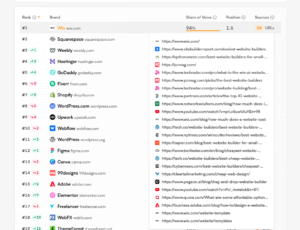
LLMRefs scans results across multiple AI platforms, saving you the time of checking each one individually. Knowing whether your website is cited in AI search is only the first step — the more useful question is which prompts are surfacing your content, and where competitors are being cited instead of you. Tools like AirOps let you track which prompts are triggering citations and where competitors appear instead, continuously monitoring your citation patterns across ChatGPT, Perplexity, and Google AI Overviews at the topic level. Rather than running one-off checks, you get an always-on view of your AI visibility, with gaps and opportunities surfaced automatically — so you can act on them before competitors do.
Step 3: Analyze Your AI Search Performance
Once you’ve run a check, you’ll want to evaluate how your website is appearing in AI results:
Citations With Links
Best-case scenario. Your site is cited as a trusted source.
Mentions Without Links
Good visibility, but you’ll want to optimize for stronger attribution.
Competitor References
If competitors appear more frequently, study their content and structure to improve your strategy.
Tracking these patterns helps you identify where you stand and what actions to take next.
Step 4: Optimize Your Website for AI Search Rankings
AI search optimization overlaps with traditional SEO but has its own nuances. To improve your chances of being referenced in AI answers:
Strengthen E-E-A-T Signals
Show real expertise through author bios, credentials, and trust indicators.
Publish Fact-Rich Content
AI models favor clear, verifiable information over vague content.
Add Schema Markup
Structured data helps AI systems understand your content contextually.
Build Authoritative Backlinks
High-quality links still matter for both Google and AI visibility.
Get Cited by Trusted Sources
The more third-party credibility you earn, the more likely you’ll be referenced.
Step 5: Monitor and Update Regularly
AI search visibility is fluid—results may shift daily. That’s why ongoing monitoring is crucial.
Check AI Rankings Weekly
Use LLMRefs consistently to track changes.
Track Keyword Mentions
Monitor your presence across different AI platforms.
Refresh and Update Content
Keep your content current to remain reference-worthy.
Make Your Website Competitive.
Leverage our expertise in Website Design + SEO Marketing, and spend your time doing what you love to do!
Common Questions About AI Search Rankings
Does Ranking in AI Search Help With Google SEO?
Not directly, but the same optimization principles (E-E-A-T, authority, backlinks) improve both AI and traditional search visibility.
How Often Should I Check My AI Search Rankings?
At least once a week, since AI-generated results change more frequently than Google’s search rankings.
What if My Site Isn’t Showing Up in AI Search Yet?
Don’t panic—start optimizing your content and monitoring with LLMRefs to improve your chances of being cited.
Consider Multiple Monitoring Approaches
While LLMRefs offers a solid foundation for citation tracking, you might want to explore additional monitoring tools as your AI search strategy develops. Some businesses find value in platforms like
AirOps that track performance across different answer engines and provide competitive analysis.
Look for Performance Patterns
Pay attention to which types of content from your site get referenced most often. This data can help inform your content strategy moving forward.
Stay Ahead With AI Search Optimization
AI-powered search engines are rewriting the rules of online visibility. If you want your website to stay competitive, you need to know whether you’re being cited in AI answers—and take steps to optimize for it.
That’s why eSEOspace has introduced two cutting-edge services designed for the future of search:
AEO focuses on optimizing your website content so it’s more likely to appear in direct answers from AI tools, voice assistants, and answer engines. This means structuring your content so that when users ask AI-powered platforms questions, your site is positioned as the authority providing the solution.
GEO goes a step further by optimizing your site to be referenced within generative AI outputs like ChatGPT, Gemini, and Perplexity. By strengthening E-E-A-T, structured data, and authoritative citations, GEO ensures your brand is woven into the content AI engines generate—keeping you front and center in the emerging AI-first search era.
Using tools like
LLMRefs to monitor your AI visibility, combined with eSEOspace’s
AEO and GEO strategies, you can ensure your website not only keeps up with AI search but thrives in it.