



Blog
Key Takeaways
- Therapists can ethically use reviews and testimonials as social proof, but only through a careful, compliant, client-centered approach that protects privacy.
- Under Google's E-E-A-T framework, mental health is a YMYL topic, so authentic reviews strengthen your authoritativeness, trustworthiness, and demonstrated experience.
- Ethical codes like APA 3.05 discourage soliciting testimonials from current clients because the therapeutic power dynamic prevents truly voluntary feedback.
- A client testimonial is Protected Health Information under HIPAA, and sharing it publicly without proper written authorization is a clear violation.
- The compliant strategy focuses on former clients and requires detailed, HIPAA-compliant written authorization before using any of their words publicly.
For therapists, the concepts of marketing and confidentiality often exist in a delicate, sometimes tense, balance. While you want to grow your practice and reach people who need your help, your ethical duty to protect client privacy is paramount. This tension is never more apparent than when dealing with online reviews and testimonials. In a world where consumers rely on reviews for everything from restaurants to doctors, how can a therapist leverage this powerful form of social proof without crossing ethical and legal lines?
The answer lies in a thoughtful, compliant, and client-centered approach. It is possible to use reviews and testimonials to build trust and authority, but it must be done with the utmost care. This is especially true when considering Google's E-E-A-T (Experience, Expertise, Authoritativeness, and Trustworthiness) framework, which scrutinizes mental health content with extreme prejudice. This guide will provide a clear roadmap for navigating the complex world of therapist reviews, helping you build a trustworthy online presence while upholding your professional integrity.
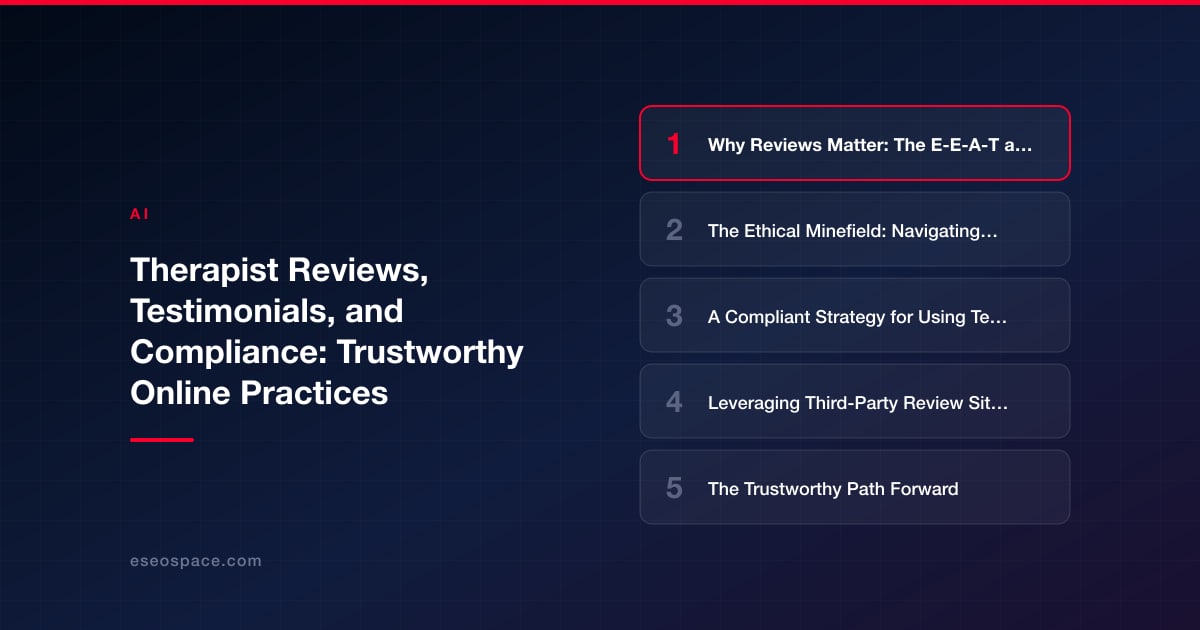
Why Reviews Matter: The E-E-A-T and Trust Connection
Before diving into the "how," it's essential to understand "why" reviews and testimonials are so impactful. Under Google's E-E-A-T framework, mental health is a "Your Money or Your Life" (YMYL) topic, meaning the quality of your online presence is held to the highest standard. Reviews and testimonials are powerful signals that directly contribute to your E-E-A-T profile:
- Authoritativeness: A collection of positive reviews on reputable, third-party sites acts as a strong signal that your practice is recognized and respected by the community.
- Trustworthiness: Authentic feedback from past clients provides "social proof" that you are a credible, effective professional. It helps potential clients overcome their hesitation by seeing that others have had a positive experience with you.
- Experience: While a review is from the client's perspective, it implicitly validates your experience. A testimonial that says, "Dr. Smith helped me develop tools to manage my anxiety," is a direct reflection of your ability to apply your clinical experience effectively.
Done right, leveraging client feedback can significantly boost your online credibility. Done wrong, it can lead to ethical violations, legal trouble, and a loss of client trust.
The Ethical Minefield: Navigating HIPAA and Professional Guidelines
The biggest hurdle for therapists is the strict set of rules governing testimonials and client confidentiality. The two most important frameworks to consider are your professional code of ethics and HIPAA.
Your Professional Code of Ethics
Most mental health professions have ethical codes that strongly discourage or prohibit soliciting testimonials from current clients. For example, the American Psychological Association (APA) Ethics Code Standard 5.05 states that psychologists do not solicit testimonials from current therapy clients or other persons who, because of their particular circumstances, are vulnerable to undue influence. This is because the power dynamic in a therapeutic relationship makes it impossible for a current client to give truly voluntary feedback without feeling pressured.
HIPAA (Health Insurance Portability and Accountability Act)
HIPAA’s Privacy Rule protects all individually identifiable health information, known as Protected Health Information (PHI). A testimonial from a client is PHI because it links a specific person to your mental health services. Sharing this information publicly without proper authorization is a clear HIPAA violation. A simple email or verbal "okay" from a client is not sufficient.
A Compliant Strategy for Using Testimonials
Despite these challenges, it is possible to use testimonials ethically and legally. The key is to focus on former clients and obtain explicit, HIPAA-compliant authorization.
1. Focus on Former Clients
The ethical concerns about undue influence are significantly reduced once the therapeutic relationship has terminated. It may be appropriate to reach out to clients who have successfully completed therapy and with whom you have a positive, established rapport. This should be done thoughtfully and without any pressure.
2. Obtain HIPAA-Compliant Written Authorization
If a former client agrees to provide a testimonial, you must have them sign a detailed, HIPAA-compliant authorization form before you use their words anywhere. This form is more than just a simple consent; it must include specific elements:
- A clear description of the information to be used (e.g., their name, a quote, a photo).
- The purpose of the disclosure (e.g., "for use on the practice website and marketing materials").
- The person or entity authorized to make the disclosure (your practice).
- The person or entity to whom the disclosure is being made (the general public).
- The client's right to revoke the authorization in writing at any time.
- An expiration date for the authorization.
- A statement that you cannot condition treatment on their signing of the authorization.
It is highly recommended to consult with a healthcare attorney to draft a compliant authorization form for your practice.
3. Let the Client Control the Narrative
When asking for a testimonial, allow the client to guide what they share. Provide them with prompts that focus on their experience of the process and the results, rather than sensitive details of their condition.
- Good prompt: "What was most helpful about our work together?" or "What changes have you noticed in your life since beginning therapy?"
- Risky prompt: "How did therapy help with your depression?"
Give the client final approval over the exact text before it is published.
Leveraging Third-Party Review Sites Ethically
While testimonials on your own website require rigorous compliance, reviews on third-party directories like Google, Yelp, or Psychology Today operate differently. You cannot control who leaves a review on these platforms, but you can—and must—control how you respond.
Do Not Solicit Reviews on Public Platforms
Actively encouraging clients (even former ones) to leave reviews on public sites like Google or Yelp is a risky practice. Because these platforms are not secure, you cannot control what PHI a client might accidentally disclose. A well-meaning client could share personal details that violate their own privacy in a public forum.
How to Respond to Reviews: The Golden Rule
The cardinal rule for responding to any review on a public platform—whether positive or negative—is you can neither confirm nor deny that the person is or was a client.
Your response must be generic and should not acknowledge any therapeutic relationship.
- For a positive review:
-
- Bad response: "Thank you, Jane! It was a pleasure working with you, and I'm so glad to hear you're doing well." (This is a HIPAA violation.)
- Good response: "Thank you for your kind words. I appreciate you taking the time to share your positive experience." (This is a general statement of gratitude that does not confirm a relationship.)
- For a negative review:
-
- Bad response: "I'm sorry you feel that way. We discussed the issue of payment in our last session, and you seemed to understand." (This is a major HIPAA violation.)
- Good response: "I take all feedback seriously. For privacy and confidentiality reasons, I cannot comment on specifics here. I encourage you to contact me directly through the secure channels listed on my website to discuss your concerns." (This moves the conversation offline and demonstrates responsiveness without confirming a relationship.)
Optimize Your Directory Profiles
Instead of soliciting reviews, focus on fully optimizing your profiles on these directories. A complete Psychology Today profile or a well-managed Google Business Profile with your credentials, specialties, photos, and a link to your high-E-E-A-T website can build significant trust on its own.
Get a FREE Audit
We'll perform a comprehensive SEO, AEO, GEO & CRO audit of your website — completely free — and show you exactly how to outrank your competitors.
Don't have a site yet? Get in touch →
The Trustworthy Path Forward
For therapists, building an online presence is a marathon of trust-building, not a sprint for sales. While glowing reviews can seem like a quick way to attract clients, the ethical and legal risks of mishandling them are immense.
Your most effective and compliant strategy is to focus on building a high-quality website that radiates E-E-A-T through other means: showcasing your credentials in detailed bios, publishing empathetic and expert-driven blog content, and ensuring your site is secure and transparent. If you choose to use testimonials, do so with extreme care, focusing on former clients and using ironclad, HIPAA-compliant authorizations.
By prioritizing ethical compliance and client confidentiality above all else, you create a digital presence that truly reflects the integrity of your practice. This commitment to trustworthiness is the most powerful marketing tool a therapist can have.
Frequently Asked Questions
Can therapists ask current clients for testimonials?
Why is a client testimonial considered Protected Health Information?
Is a verbal or emailed okay from a client enough to publish their review?
What must a HIPAA-compliant testimonial authorization form include?
How do reviews and testimonials support a therapist's E-E-A-T?
Put this into action with eSEOspace
We help businesses grow with website development that actually performs. Explore the services behind this guide:
Get a FREE GEO/AEO/SEO Audit
We'll analyze your site's SEO, GEO, AEO & CRO — completely free — and show you exactly how to get found across Google and AI answers.
Don't have a site yet? Get in touch →
Great — your audit is on the way!
We'll send your free SEO/GEO/AEO/CRO audit within the next few hours. Where should we send it?
You're all set! ✓
Your free audit is being prepared — check your inbox in the next few hours. Talk soon!








