



Blog
Leading Legacy System Modernization Companies

Key Takeaways
- "Legacy" now means any platform that blocks your cloud, AI, or integration goals, not just aging mainframes.
- Modernization delivers infrastructure-driven, code-driven, or business-capability-driven outcomes depending on which constraints are strangling your core.
- You likely need modernization when two or more red flags appear, such as rising maintenance costs, unpatchable security gaps, or stalled AI pilots.
- CIOs should score vendors against nine criteria, including diagnostic depth, automation assets, regulatory track record, and post-go-live support.
- KPMG's 2026 survey found 56 percent of enterprises cannot fund new innovation because their budgets are trapped by legacy technical debt.
TL;DR - What you will learn in this guide
- Why “legacy” now refers to any platform that blocks cloud, AI, or integration objectives
- Nine hard-won criteria CIOs use to evaluate vendors
- A concise, research-based legacy modernization company list of ten providers - strengths, trade-offs, and verified outcomes
- The difference between rehost, replatform, refactor, and strangler-fig techniques
- 2026 trends, such as GenAI knowledge extraction and mainframe-as-a-service
- Budget, timeline, and risk mitigation guidance you can present to the board
- Direct answers to the five most common modernization questions
Introduction
Every established enterprise eventually faces an uncomfortable reality: the software that once differentiated the business is now the very reason new digital initiatives stall. Finance wants real-time analytics, marketing wants customer-360 APIs, and operations wants predictive maintenance, yet the core still runs on dated stacks that chew through maintenance dollars. “Modernization” sounds expensive, but so is another year of lost agility.
That tension explains the rise of legacy enterprise system modernization firms that specialize in extracting value from old code while enabling fresh cloud-native capabilities. This article demystifies the landscape, clarifies evaluation criteria, and profiles the top legacy modernization companies that have proven they can reduce risks and deliver quantifiable business gains.
What Is Legacy System Modernization and When Do You Need It?
Legacy system modernization is a structured transformation of critical applications, data stores, and integration layers so they can run securely and cost-effectively in a cloud, hybrid, or event-driven world. A legacy system modernization company typically engineers one of three outcomes:
- Infrastructure driven - moving workloads from on-prem mainframes or UNIX boxes into container platforms, managed databases, or serverless runtimes.
- Code driven - refactoring or re-architecting the application so it adopts modular, API-first, DevOps-ready patterns.
- Business capability driven - selectively replacing legacy components with SaaS or bespoke microservices that align to discrete domain events.
You need modernization when at least two of the following challenges appear:
- Maintenance contracts outpace innovation budgets.
- Cyber auditors flag unpatchable OS or framework vulnerabilities.
- Product launches bypass the core, producing shadow IT and duplicated data.
- AI pilots stall because data is stuck in ISAM, VSAM, or proprietary database files.
- Expert programmers retire, and new hires show little interest in dated languages.
According to KPMG’s 2026 Technology Survey, 56 percent of enterprises report they cannot fund new innovation, including deploying AI at scale, because their budgets are trapped by legacy technical debt. Furthermore, attempting to build advanced capabilities on outdated platforms routinely leads to structural failures and operational outages. The message is clear: delay amplifies business risk.
Evaluating Legacy Modernization Providers
Selecting among legacy system modernization companies may feel like deciphering a buzzword bingo card. A disciplined scorecard brings clarity. Most CIOs weigh nine factors:
- Diagnostic depth
- Reference architectures
- Automation assets
- Regulatory track record
- Cloud partnerships
- Business outcome mapping
- Organizational change skills
- Pricing transparency
- Post-go-live support
Before diving into vendor profiles, the table below shows how each criterion connects to financial or operational benefit.
| Evaluation Criterion | Why It Matters to the Business | Typical Evidence Requested |
| Diagnostic depth | Fast fact-finding avoids six-figure discovery overruns | Two-week assessment sample, dependency diagrams |
| Reference architectures | Reduces design iterations and tech-sprawl risk | Published blueprints, repo links |
| Automation assets | Cuts manual code conversion and testing cost | Demo of GenAI tooling, automated test coverage metrics |
| Regulatory track record | Ensures compliance in banking, healthcare, public sector | Case studies with attestation letters |
| Cloud partnerships | Accelerates landing-zone provisioning and funding | AWS, Azure, GCP premier certifications |
| Business outcome mapping | Links latency or MIPS savings to EBITDA | KPI dashboards from prior programs |
| Organizational change skills | Embeds DevOps culture to sustain gains | Training agendas, change-management playbook |
| Pricing transparency | Prevents scope-creep disputes | Phased milestone plan with exit ramps |
| Post-go-live support | Maintains SLA performance after cutover | Run-operate model, onshore/offshore mix |
Using a structured matrix allows IT leaders to justify shortlist decisions in a board-facing, financially literate manner, something every firm specializing in legacy system modernization should welcome.
Best 11 Legacy System Modernization Companies
Selecting a partner from the crowded field of legacy enterprise system modernization firms is the most consequential decision you will make after the go/no-go budget vote. Below is a legacy modernization company list that aligns closely with data publicly verified through case studies and analyst notes.
Techstack
Source: Techstack
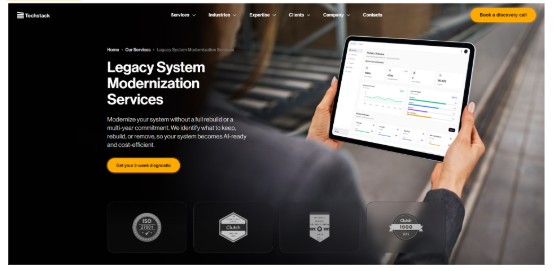
Techstack focuses on one mission: neutralize legacy drag without disrupting revenue. The partner’s engagement always starts with a two-week diagnostic, producing a cost-to-value roadmap that the CIO can circulate internally for funding approval. This is not a superficial audit; it includes API latency baselines, data-flow diagrams, and an initial AI feasibility score. We identify what to keep, rebuild, or remove, so your system becomes AI-ready and cost-efficient.
Three execution tracks flow from that roadmap. The AI Readiness Track audits data pipelines and surfaces gaps blocking large language model deployment. The Cloud Migration Track handles lift-and-shift, replatforming to AWS, Azure, or GCP, and hybrid designs for persistent mainframe workloads. The Full Modernization Track uses a strangler fig pattern backed by AI-assisted code refactoring to progressively replace brittle modules.
A five-year engagement with a California-based sales enablement vendor illustrates the approach. Techstack decomposed a fragmented monolith into a modular platform, rebuilt analytics pipelines for real-time insight, and introduced AI features such as intelligent meeting summaries, all delivered incrementally so existing sales workflows were never interrupted. The engagement delivered a significant reduction in system downtime and technical debt, measurably improved user retention through performance and UX upgrades, and accelerated deployment cycles, enabling faster, more stable production releases throughout the partnership.
Because the team overlays change management on each sprint, business stakeholders see value every four to six weeks, not at the end of a multiyear program. That cadence, plus a refusal to prescribe a single methodology, consistently lands Techstack among the top legacy system modernization companies for enterprises that want fast proof of value rather than open-ended consulting.
EPAM Systems
Source: EPAM Systems
EPAM Systems marries three decades of engineering pedigree with a maturing suite of AI accelerators. The migVisor platform automatically inventories workloads, maps upstream and downstream dependencies, and assigns an objective modernization disposition - rehost, replatform, refactor, or retire. Their AI/RUN toolkit blends deterministic and generative AI to translate COBOL or PL/I into modern languages while simultaneously generating documentation and regression tests, reducing conversion time by up to 40%.
A global food and beverage leader leveraged EPAM to migrate analytics platforms scattered across 16 geographic regions onto a unified cloud data lake, tackling over 60,000 data transformation jobs and more than 2,000 reporting workflows in the process. The project reduced batch processing overhead, cut legacy license dependencies, and accelerated time-to-insight for demand-planning teams. Mature automation, global scale (approximately 61,200 engineers), and deep vertical expertise keep EPAM on almost every legacy modernization company list circulated by Fortune 500 CIOs.
Thoughtworks
Source: Thoughtworks
Thoughtworks adopts a people-plus-platform stance toward modernization. Rather than isolate delivery teams, they embed cross-functional squads - engineers, product owners, and ops - in the client’s environment, transferring agile and DevOps habits as they tackle the code. In one widely referenced financial services engagement, a monolithic lending application was re-architected into an event-driven microservices ecosystem, enabling the client to move from slow, quarterly release cycles to continuous delivery while maintaining strict regulatory SLAs.
The company focuses on ethical technology, open-source contributions, and trunk-based development, which keeps skills within the client following the engagement, which is appreciated by procurement officers when negotiating knowledge transfer agreements. To companies that view modernization as a wider culture shift, Thoughtworks can be considered as one of the best legacy system modernization companies in 2026.
Wipro
Source: Wipro
Wipro’s FullStride Cloud Services integrates discovery, migration, and managed operations under a unified governance framework. Proprietary AI-based tools find millions of lines of undocumented COBOL, creating living documentation and discovering dead code, an essential step when institutional knowledge has disappeared.
In a single enterprise insurance engagement, Wipro helped migrate mainframe workloads to a new modern cloud platform with automated code conversion tooling, achieving quantifiable improvements in claims processing throughput and a decrease in legacy infrastructure overhead. With over 233,000 professionals in 65+ countries, Wipro has vertical depth and enterprise-level security certifications. This reliable scale places Wipro among the top legacy system modernization service providers for multinational organizations requiring geographic redundancy.
DXC Technology
Source: DXC Technology
DXC Technology functions as a modernization clean-up crew for labyrinthine IT estates. Formed from the 2017 merger of HP Enterprise Services and CSC, DXC brings deep infrastructure knowledge, especially around mainframe and midrange systems that many newer consultancies rarely touch. Their portfolio assessment model prioritizes applications based on their complexity, business urgency, and technical debt and maps them to rehost, replatform, or strangler-fig journeys.
A major logistics organization worked with DXC to migrate core transaction processing from legacy infrastructure to a containerized environment, achieving substantial MIPS cost savings while preserving the high availability thresholds mandated by supply-chain partners. Post-migration, DXC supplies run-operate services, ensuring the modernized environment evolves rather than stagnates. Clients with sprawling, risk-sensitive estates routinely label DXC a firm specializing in legacy system modernization when operational continuity is non-negotiable.
BCL (Baer Consulting)
Source:
Most firms on this list want to move you off the mainframe. BCL wants to keep it running well while you decide what to do with it, and that difference is the whole reason clients call them. The Colorado provider has spent more than 40 years inside IBM z/OS, z/VM, and z/VSE environments, running them as a managed service so companies can hand off hosting, disaster recovery, and round-the-clock support instead of staffing a shrinking pool of mainframe engineers. When modernization is the goal, they handle it through re-hosting, consolidation, and in-place optimization rather than a forced rewrite.
A state government agency brought them in to modernize legacy systems without taking citizen services offline, and came away with better scalability and lower cost while staying inside public-sector compliance rules. The workloads they take on are the ones you cannot afford to break: CICS, IMS, and DB2 batch and transaction processing for finance, healthcare, government, and retail, hosted in SOC 2 Type II and FedRAMP-aligned data centers. For an enterprise that needs its core kept stable and audit-ready while modernization happens in stages around it, BCL offers a depth of focus the big integrators spread themselves too thin to match.
SoftServe
Source: SoftServe
SoftServe blends user-centric design with hardcore engineering. Headquartered in Austin with major delivery centers in Eastern Europe, the company modernizes outdated healthcare and fintech platforms by attacking technical debt and user-experience debt in parallel.
One of the U.S. healthcare organizations approached SoftServe to refactor an old electronic health record platform, with brittle stored procedures substituted by FHIR-compliant APIs and role-based access controls, and to redesign clinician dashboards. The interaction minimized clinical staff workflow strain, aided the development of interoperability needs, and enhanced patient satisfaction outcomes. By pairing design thinking with regulatory fluency, SoftServe has secured its reputation among top legacy modernization companies for industries where usability influences compliance as much as code quality.
HCLTech
Source: HCLTech
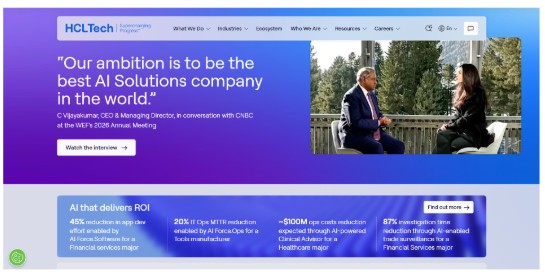
HCLTech uses the AI Force platform to speed up the process of code analysis, dependency mapping, and automated test generation. The toolset can save up to 50% of the assessment time, allowing more valuable refactoring to be done with the budget.
During a major telecom modernization engagement, the AI Force platform automated a substantial share of regression test generation, enabling the client to satisfy a hard compliance deadline tied to a critical infrastructure rollout ahead of schedule. With annual revenue exceeding $13 billion and a presence in 60+ countries, HCLTech mixes proprietary automation with the governance rigor large enterprises demand. The combination of that makes HCLTech a longtime member of the top legacy system modernization companies club, especially in regulated verticals such as banking and telecom.
Endava
Source: Endava
Endava makes legacy estates a product line that needs constant investment, rather than a project. Its engineers focus on domain-driven design and event-storming workshops, then write not a single line of code.
A European retailer facing scalability challenges during peak season engaged Endava to break down a monolithic commerce platform into microservices with Kafka event streams. The resulting architecture shifted release lead time from monthly cycles to almost continuous deployment, and the client noted better online conversion performance during the first major peak season after go-live. The collaborative nature of the delivery model (around 11,400 employees in Europe, the Americas, Asia Pacific, and the Middle East) will be attractive to mid-market businesses that need flexibility but not the complexity of a mega-sized system integrator. Endava remains on numerous lists of legacy modernization companies through that client fit up to 2026.
Get a FREE Audit
We'll perform a comprehensive SEO, AEO, GEO & CRO audit of your website — completely free — and show you exactly how to outrank your competitors.
Don't have a site yet? Get in touch →
Hexaware Technologies
Source: Hexaware Technologies
The RapidX platform by HexaWare transforms tribal knowledge that is not documented into subject-matter expertise generated by AI. In the case of a global financial institution, RapidX automatically identified thousands of entrenched business rules in a decades-old COBOL codebase, producing formal documentation that de-risked a gradual rewrite to modern Java and significantly reduced the discovery phase over manual methods.
Beyond conversion, Hexaware offers managed services to stabilize the environment after cutover, allowing in-house teams to focus on new digital features. RapidX’s ability to preserve institutional knowledge while accelerating delivery convinces risk-averse enterprises to tag Hexaware as a top legacy system modernization service provider.
Deloitte Digital
Source: Deloitte Digital
Deloitte Digital combines deep industry policy advisory with enterprise-grade engineering. In a public sector finance transformation, Deloitte re-architected core ERP modules, migrated workloads to a compliant cloud environment, and redesigned procurement workflows to align with updated regulatory directives and an end-to-end scope that few vendors could cover.
Boards appreciate the single-throat-to-choke model: strategy, change management, and code delivery sit under one contract backed by the wider Deloitte audit and tax ecosystem. This breadth secures Deloitte Digital’s place among the best legacy system modernization companies for organizations where modernization intersects with legislative or financial oversight.
Legacy System Modernization Approaches
Approach selection often dictates 80% of the cost and timeline. Yet we still see RFPs that ask vendors to “propose the right method” without baseline hypotheses. Smart CIOs narrow the field first.
- Rehost (lift-and-shift) removes infrastructure risk fast. It is ideal when aging hardware or rising MIPS costs threaten supportability. However, code remains unchanged, so agility gains are limited.
- Replatform moves the workload to managed databases, container platforms, or serverless services. This trims license fees and opens doors to cloud resilience patterns with minimal code change.
- Refactoring updates the architecture piece by piece by breaking up modules, adding REST or gRPC APIs, and setting up CI/CD. It takes more work, but it keeps business rules and makes the overnight batch less painful.
- Rewrite/Replace throws away the whole codebase and usually uses SaaS for common tasks while building custom services that set them apart. The risk and cost are highest, so governance must be perfect.
- Strangler-Fig envelops the monolith with APIs, then routes new capabilities to microservices. Modules are retired piece by piece, allowing for business value every quarter rather than at project end.
As the number of digital transactions rises, the costs of maintaining old systems and technical debt are rising even faster. The cost of technical debt and legacy maintenance is now $2.41 trillion a year for US businesses alone. This makes it very hard for them to spend money on other things. CFOs suddenly understand the hidden debts on the balance sheet when an AS/400 or VAX cluster needs a part that is no longer made.
Technologies and Trends Shaping Legacy Modernization in 2026
Modernization tooling evolves monthly, but five macro trends stand out. The table summarizes why each trend matters and identifies early-moving industries.
| 2026 Trend | Business Driver | Early Majority Industries | Sample Enablers |
| GenAI knowledge extraction | Retiring SMEs, missing docs | Banking, insurance | Hexaware RapidX, HCLTech AI Force |
| Mainframe-as-a-Service | Capex-to-opex shift, carbon mandates | Public sector, utilities | IBM z/OS Cloud, AWS Mainframe Modernization |
| Domain event modeling | Faster releases, audit trails | Retail, logistics | Kafka, EventBridge |
| Platform engineering | Developer productivity, policy-as-code | Fintech, telecom | Backstage, Port, Crossplane |
| Zero-trust integration | Supply-chain attack prevention | Healthcare, manufacturing | Apigee X, Kong Mesh |
Several factors accelerate adoption.
First, hyperscalers offer migration funding, smoothing CFO buy-in.
Second, regulators increasingly require auditable lineage for data used in AI models; event modeling and zero-trust gateways satisfy that control.
Finally, developers expect self-service platforms. Failing to provide one results in talent churn - a risk often overlooked by non-technical finance committees. Providing engineers with superior, self-service tooling is a primary driver of human capital; organizations that invest in these platforms are 20 percent more likely to retain their top engineering talent and 33 percent more likely to achieve their broader business goals.
These innovations allow legacy enterprise system modernization firms to compress assessments, mitigate data lineage risk, and increase release velocity, thereby strengthening the business case.
Choosing the Right Legacy System Modernization Partner
Partner selection should mirror capital allocation rigor. After defining non-negotiable constraints such as no changes to bank settlement windows or HIPAA compliance, publish an RFP that demands objective evidence. Vendors that truly belong to the top legacy system modernization companies' echelon will provide anonymized before-and-after code samples, cloud landing zone diagrams, and KPI dashboards.
Conduct a funded pilot. Six to eight weeks is sufficient to validate toolchains, collaboration norms, and cultural fit. Techstack’s popular two-week diagnostic can seed such a pilot with data you already own, giving both parties clarity on feasibility before large invoices hit accounts payable.
Lastly, allocate 15-20% of the total modernization budget on hypercare and optimization. Any skimming here can cancel previous profits. Enterprise transformation research from Boston Consulting Group (BCG) warns that failing to fund post-go-live operations causes massive “transformation leakage,” where initial efficiency gains and cost savings are rapidly wiped out by operational friction and unmanaged complexity.
Future Outlook: Where Legacy Modernization Is Headed
Looking beyond 2026, there are two forces that transform modernization economics. First, Gartner forecasts that in 2028, 90 percent of enterprise software engineers will rely on AI code assistants, which will radically change the role of these engineers to system orchestration instead of raw implementation. This makes code generation less of a differentiator; domain knowledge, governance, and ongoing value-stream feedback loops are the true moats.
Second, environmental, social, and governance (ESG) metrics will influence architecture decisions. Europe’s Corporate Sustainability Reporting Directive already forces Scope 3 carbon accounting. Applications running on 1980s mainframes with inefficient cooling profiles could become reporting liabilities, pushing replatform agendas even at historically conservative utilities.
Therefore, expect contracts with legacy system modernization companies to emphasize joint sustainability dashboards, policy-as-code guardrails, and continuous telemetry that updates the total cost of ownership in real time. The winners will be partners capable not only of rewriting COBOL but also of aligning platform decisions with carbon targets and shifting regulatory sands.
Summary
Legacy modernization in 2026 has matured into a board-level strategic lever. The five macro trends - GenAI knowledge extraction, platform engineering, mainframe-as-a-service, zero-trust integration, and domain event modeling - shorten timelines and reduce risk. The legacy modernization company list presented shows that each vendor has unique strengths: Techstack’s diagnostic-first model, EPAM’s automation depth, Thoughtworks’ culture focus, Wipro’s global reach, DXC’s infrastructure expertise, SoftServe’s design orientation, HCLTech’s AI accelerators, Endava’s product mindset, Hexaware’s knowledge preservation, and Deloitte Digital’s advisory breadth.
Modernization remains complex, but the cost of inertia rises faster. Enterprises that adopt a phased, metrics-driven roadmap and engage a firm specializing in legacy system modernization with proven domain knowledge will create competitive advantage while safeguarding operational stability.
FAQ
When should a company consider modernizing its legacy system?
How long does a legacy system modernization project typically take?
Can AI be used to automate legacy code modernization?
Should I modernize or rebuild from scratch?
What causes legacy modernization projects to fail?
Put this into action with eSEOspace
We help businesses grow with website development that actually performs. Explore the services behind this guide:
Get a FREE GEO/AEO/SEO Audit
We'll analyze your site's SEO, GEO, AEO & CRO — completely free — and show you exactly how to get found across Google and AI answers.
Don't have a site yet? Get in touch →
Great — your audit is on the way!
We'll send your free SEO/GEO/AEO/CRO audit within the next few hours. Where should we send it?
You're all set! ✓
Your free audit is being prepared — check your inbox in the next few hours. Talk soon!


On this page
- Key Takeaways
- Introduction
- What Is Legacy System Modernization and When Do You Need It?
- Evaluating Legacy Modernization Providers
- Best 11 Legacy System Modernization Companies
- Legacy System Modernization Approaches
- Technologies and Trends Shaping Legacy Modernization in 2026
- Choosing the Right Legacy System Modernization Partner
- Future Outlook: Where Legacy Modernization Is Headed
- Summary
- FAQ






