



Blog
SEO vs. GEO in 2026: The Dual Optimization Strategy Every Marketer

Key Takeaways
- Gartner predicts a 25% decline in traditional search traffic by 2026, while AI-referred traffic grew 527% year over year.
- SEO isn't dying, but it's no longer enough alone - it still owns the transactional funnel where users compare and buy.
- GEO optimizes content so AI models like ChatGPT, Gemini, Perplexity, and Claude cite it in their generated answers.
- Princeton research shows adding statistics lifts AI citations 33%, expert quotes 41%, and citing authoritative sources 28%.
- The smartest 2026 strategy runs SEO and GEO in parallel, since each captures a different phase of the search journey.
Gartner predicts a 25% decline in traditional search engine traffic to commercial sites by 2026. That number lands differently depending on where you sit. If you’ve built a business on organic Google traffic, it sounds like a warning. If you’re watching AI chat interfaces eat search queries, it sounds like confirmation.
The numbers back up the trend. Similarweb reports that 65% of searches now end without a click - users get their answer from the search results page itself and never visit a website. At the same time, AI-referred traffic grew 527% year over year between January and May 2025, according to data from Previsible covered by Search Engine Land.
Here’s the reality most marketing articles won’t say plainly: SEO isn’t dying, but it’s no longer enough on its own. Traditional search still dominates the transactional funnel - users who want to compare, click, and buy. Generative Engine Optimization (GEO) captures a different part of the journey: the discovery phase, where AI synthesizes answers and cites sources. The smartest strategy in 2026 runs both in parallel.
What traditional SEO still does best
A simplified visualization of how backlinks create authority signals in traditional SEO - each node represents a referring domain Traditional SEO still owns the transactional search funnel. When someone searches for “best CRM for healthcare” or “affordable payroll software reviews,” they’re looking to compare options and click through. Google’s ten blue links remain the dominant gateway for these queries, and page-one rankings still drive the majority of organic traffic.
Backlinks remain the single strongest ranking factor in traditional SEO. Data from Arvow’s 2026 GEO Statistics Report, which aggregates findings from Ahrefs and other sources, shows that referring domain count correlates with ranking position at 0.74 - higher than any other single metric. Link building has changed form, though. Cold outreach campaigns barely move the needle anymore. The tactics that work in 2026 involve digital PR, data-driven content assets, and editorial relationships that earn links naturally.
For marketers who still need to drive transactional traffic, investing in link building for higher rankings remains one of the highest-ROI SEO moves available. The methods have evolved, but the principle hasn’t: quality links from authoritative domains signal to Google that your content deserves to rank. See the full data on backlink correlation in the Arvow GEO Statistics Report.
What is GEO (Generative Engine Optimization)?
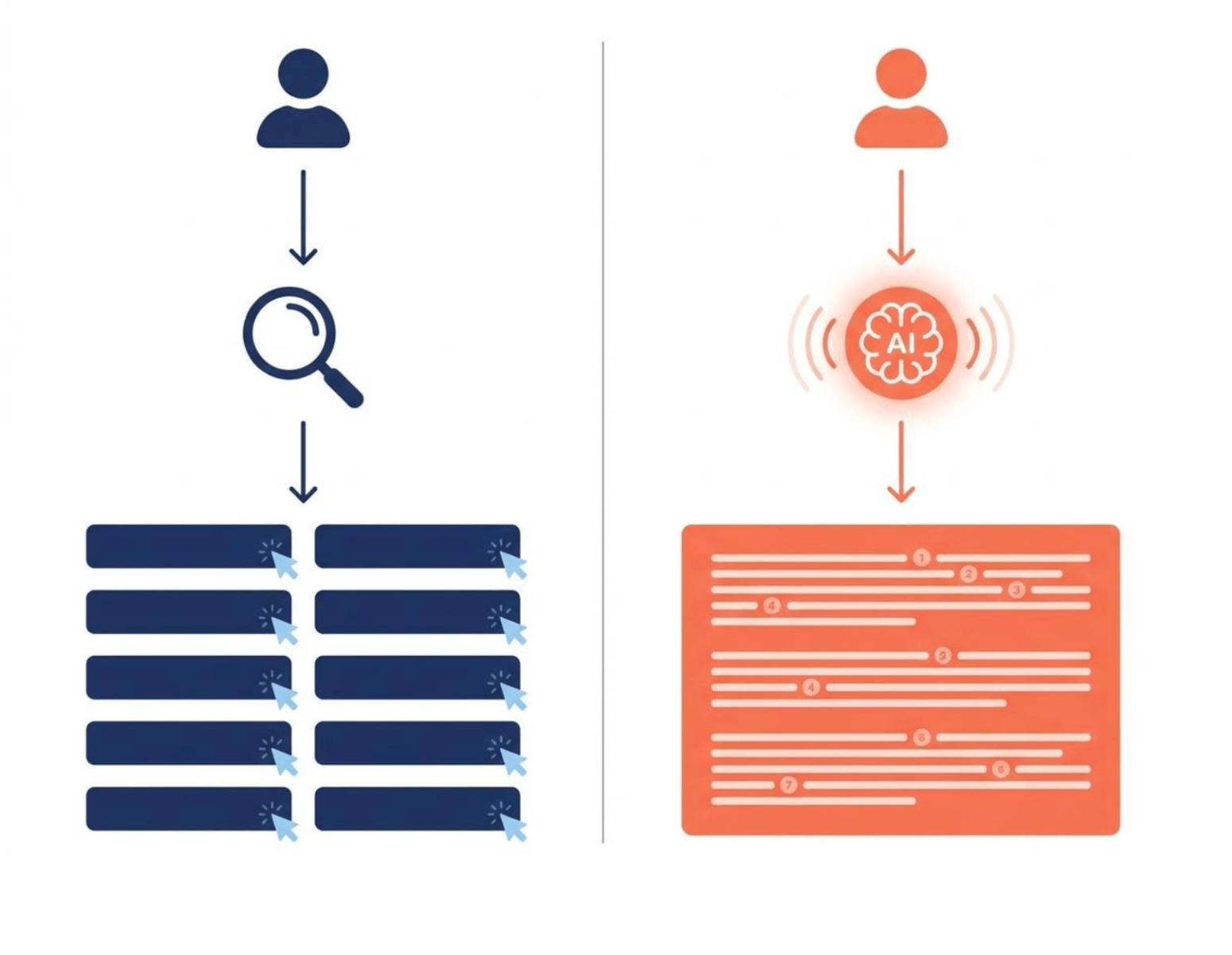 How the search journey has shifted from click-driven to answer-driven - the core driver behind GEO’s emergence Generative Engine Optimization, or GEO, is the practice of optimizing content so that AI models - ChatGPT, Gemini, Perplexity, Claude, and Google AI Overviews - cite it in their generated answers. The term and the methodology originated from research published by Princeton University. The foundational paper, by Aggarwal et al. at KDD 2024, established the first framework for understanding how AI models select sources and what makes content more likely to be cited.
The Princeton study found three tactics that significantly increase the likelihood of citations. Adding relevant statistics to content increases AI citation visibility by 33%. Including expert quotations lifts it by 41%. Citing external, authoritative sources improves visibility by 28%. These aren’t marginal gains - they’re structural advantages you can build into your content workflow.
GEO doesn’t replace SEO. It targets a different layer of the search ecosystem. Where SEO optimizes for a search engine’s algorithm and ranking function, GEO optimizes for an AI model’s citation algorithm. The two overlap in meaningful ways, but they require distinct tactics. The Princeton study on ACM Digital Library provides the most rigorous breakdown of these tactics for anyone looking to dig deeper into the methodology.
5 key differences between SEO and GEO (2026 update)
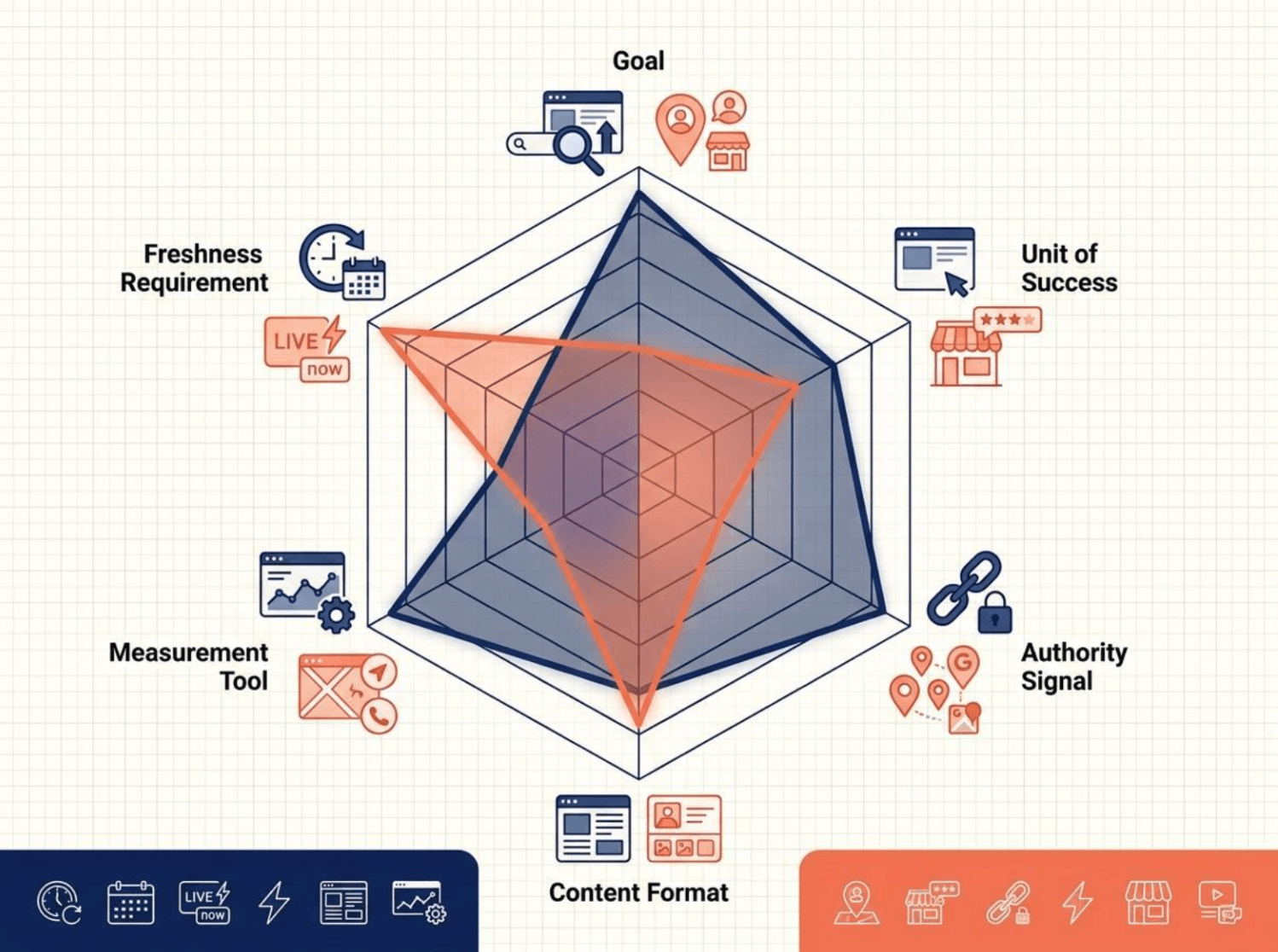 SEO and GEO serve different parts of the search funnel - understanding the divergences is critical for resource allocation Marketers who treat GEO as “SEO for AI” miss the point. The two disciplines diverge in several fundamental ways.
The unit of success differs first. SEO measures success by keyword position on a search engine results page. GEO measures success by how often an AI model cites your content in generated answers. You can rank first on Google and never appear in a ChatGPT response.
Authority signals follow a different logic, too. Google weighs backlinks and referring domains heavily. AI models pay more attention to brand mentions across the web, entity recognition in knowledge graphs, and consistent NAP data in structured formats.
Content format preferences have also split. SEO has traditionally rewarded long-form, 2000-word articles. GEO favors content that can be easily extracted and summarized - definition-first sentences, statistics embedded inline, comparison tables, FAQ blocks, and step-by-step lists.
Freshness requirements create another gap. SEO rankings can persist for months or even years with minimal updates. GEO citations decay much faster. According to a 2025 analysis by 5W PR, AI citation value drops significantly in roughly 13 weeks without content updates.
Measurement tools round out the differences. SEO has Google Search Console, Ahrefs, SEMrush, and a mature analytics ecosystem. GEO measurement is newer and less standardized - tools like Profound, Otterly, and Frase are emerging as early leaders.
For a more detailed comparison of these two approaches, the SEO vs GEO resource on AEOHub breaks down the strategic implications of each difference in the context of real marketing budgets.
Get a FREE Audit
We'll perform a comprehensive SEO, AEO, GEO & CRO audit of your website — completely free — and show you exactly how to outrank your competitors.
Don't have a site yet? Get in touch →
The overlap: what works for both SEO and GEO
Despite their differences, SEO and GEO share a substantial operational foundation. Improving one often helps the other.
Site performance is the most obvious overlap. Google uses Core Web Vitals as a ranking signal, and AI models prefer content that loads fast and renders cleanly. Schema markup - Organization, Article, FAQPage, and ItemList in JSON-LD format - helps both search engines and AI models understand your content structure and entity relationships.
Content quality standards converge, too. E-E-A-T (Experience, Expertise, Authoritativeness, and Trustworthiness) matters for Google’s algorithm and for AI citation algorithms. Clear heading hierarchies (H1 through H3), well-structured paragraphs, and original research all signal authority to both systems.
A 2026 survey by Conductor of 250 CMOs found that 97% of enterprise digital leaders say GEO already drives measurable business impact, and 94% plan to increase GEO investment in 2026. Those same leaders aren’t abandoning SEO - they’re building both strategies on the same foundation. If you’re still thinking about adapting your SEO strategy for generative engines, Eseospace’s guide walks through the tactical steps for aligning the two approaches.
Building your dual optimization playbook
 A practical dual-optimization checklist covering both traditional SEO tactics and GEO-specific tactics Running SEO and GEO in parallel isn’t complicated once you understand the shared and distinct requirements. Here’s a practical framework.
- Audit your current position: Check your existing keyword rankings with Google Search Console. Then, audit your AI citation presence using Profound or Otterly. You’ll likely find gaps - content that ranks well in Google but never appears in AI responses, or the other way around.
- Strengthen your technical foundation: Core Web Vitals, mobile readiness, and structured data are table stakes for both SEO and GEO. Implement the llms.txt standard to help AI models navigate your site’s content index. Schema markup for Organization, Article, and FAQPage types is particularly valuable for GEO because AI models parse structured data more reliably than free text.
- Build a strong link profile for traditional SEO: Links are still the primary authority signal for Google’s algorithm. But the type of links that matter has shifted. Editorial links from authoritative sites carry more weight than directory submissions or paid placements. Understanding the distinction between dofollow and nofollow links is essential for building a natural link profile that passes authority without triggering spam signals.
- Optimize content for AI extraction: Start paragraphs with definition-first sentences. Embed a statistic roughly every 150 words. Include FAQ blocks, comparison tables, and step-by-step guides - these formats are disproportionately favored by AI citation algorithms. SE Ranking’s 2025 content analysis found that content chunks of 120 to 180 words between headings perform best for both reader retention and AI extractability.
- Monitor and refresh quarterly: The 13-week citation decay window means your GEO-optimized content needs regular updates. A 2025 study by AirOps found that pages updated within the last 12 months are 70% more likely to be cited by AI models. Set a quarterly refresh calendar for your highest-value content.
For marketing teams trying to decide between content clusters versus standalone blogs for GEO, eseospace’s comparison covers the structural tradeoffs and how each format performs across both SEO and GEO metrics.
How to split your budget between SEO and GEO
The right budget split depends on your stage, industry, and current authority level. No single formula works for every business, but the data suggest clear patterns.
Early-stage brands (pre-Series B) should lean heavily into GEO. Without existing domain authority, competing on traditional SEO keywords takes 12 to 24 months of sustained investment. GEO offers a faster path to visibility because AI models care less about domain age and more about content structure, citations, and brand mentions. A roughly 70% GEO, 30% SEO split gives early-stage companies a realistic growth vector.
Mid-market brands with existing domain authority should rebalance toward GEO more aggressively. The 5W PR budget framework suggests shifting 40-50% of the traditional SEO budget to GEO for companies with established backlink profiles. These brands already have the SEO foundation - what they lack is AI-specific content optimization.
Large enterprises can afford a phased approach. Start by allocating 15 to 25% of the digital marketing budget to GEO, then scale to 30 to 40% within 12 months. A Conductor survey found that U.S. enterprises are already allocating about 12% of their digital marketing budgets to GEO, with plans to increase this allocation in 2026.
Gartner’s prediction of a 25% decline in traditional search traffic should inform budget planning, not panic decision-making. The brands that capture the most total visibility - across both search engines and AI platforms - are the ones that invest in both channels deliberately. For a deeper look at how the post-SEO era is and what it means for search visibility, eSearchspace’s analysis covers where the industry is heading.
Conclusion: the future is hybrid
SEO and GEO aren’t competing strategies. They target different stages of the same user journey. Traditional search captures intent-driven, transactional queries. Generative search captures discovery-phase, question-driven queries. Brands that optimize for both capture 60 to 70% of available visibility across all search formats - a share that neither single-strategy approach can match.
The risk of betting entirely on one is real. Focus only on SEO, and you’ll miss the growing share of users who get answers from AI without clicking a link. Focus only on GEO, and you’ll leave transactional traffic on the table for competitors who rank in Google. The hybrid approach isn’t more work - it’s smarter allocation of the same effort.
Start with an audit. Measure where you stand in both systems. Then build the dual stack - one strategy for rankings, one for citations, and a shared foundation of quality content that feeds both.
Frequently Asked Questions
Is SEO dead in 2026?
What is Generative Engine Optimization (GEO)?
How is GEO different from SEO?
What content tactics increase AI citations?
Why do backlinks still matter for SEO in 2026?
Put this into action with eSEOspace
We help businesses grow with website development that actually performs. Explore the services behind this guide:
Get a FREE GEO/AEO/SEO Audit
We'll analyze your site's SEO, GEO, AEO & CRO — completely free — and show you exactly how to get found across Google and AI answers.
Don't have a site yet? Get in touch →
Great — your audit is on the way!
We'll send your free SEO/GEO/AEO/CRO audit within the next few hours. Where should we send it?
You're all set! ✓
Your free audit is being prepared — check your inbox in the next few hours. Talk soon!


On this page
- Key Takeaways
- What traditional SEO still does best
- What is GEO (Generative Engine Optimization)?
- 5 key differences between SEO and GEO (2026 update)
- The overlap: what works for both SEO and GEO
- Building your dual optimization playbook
- How to split your budget between SEO and GEO
- Conclusion: the future is hybrid
- Frequently Asked Questions






