



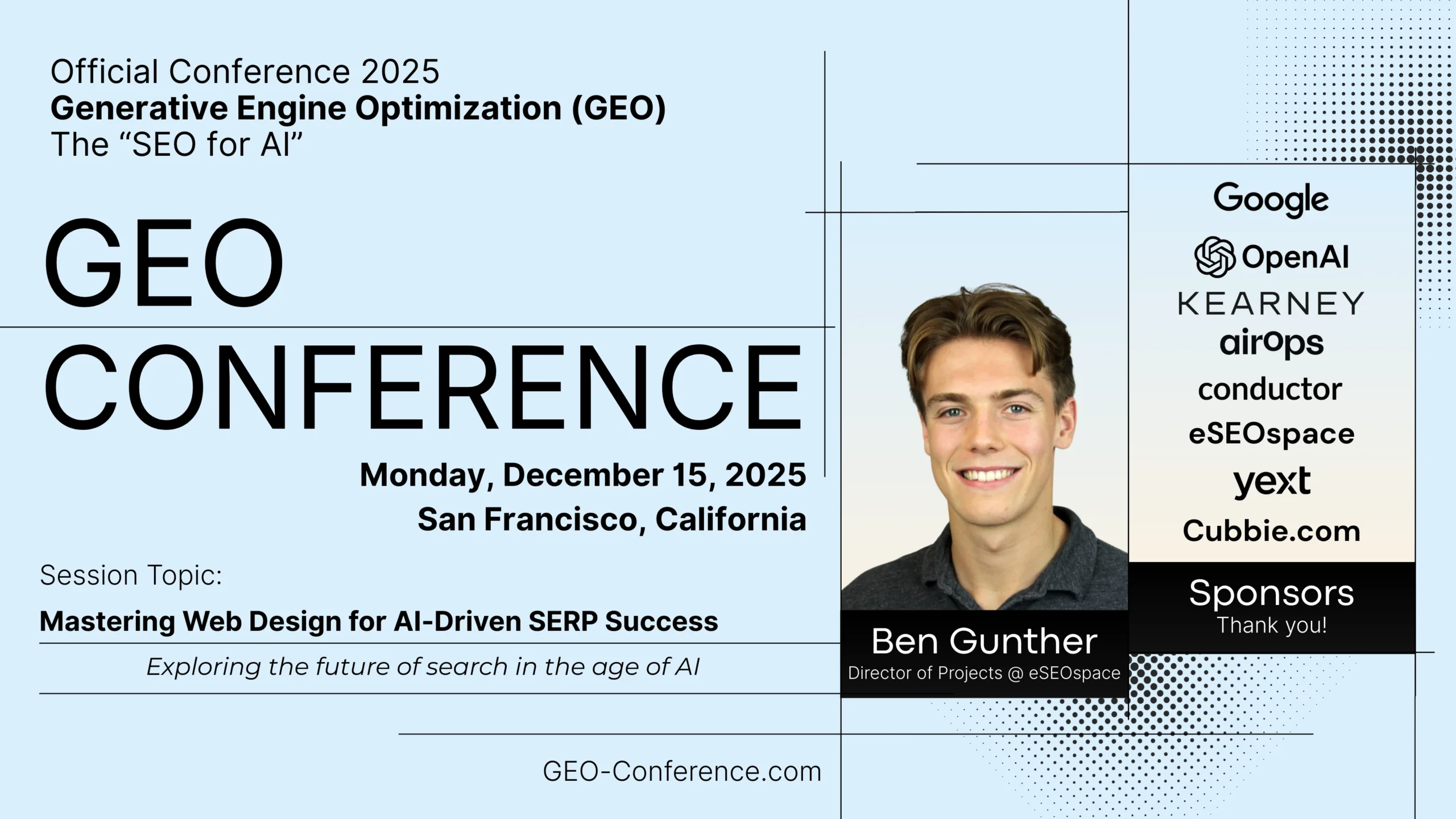
Blog
The Post-SEO Era: How GEO Is Redefining Visibility

Key Takeaways
- The rise of generative AI has broken traditional SEO, shifting visibility from ranking in blue links to influencing AI answers.
- Generative Engine Optimization (GEO) is the successor to SEO, ensuring your brand is understood, trusted, and cited by AI models.
- The old pillars of SEO—keywords, backlinks, and traffic—are losing strategic centrality as AI synthesizes answers above all rankings.
- AI evaluates authority through a brand's knowledge graph coherence, verifiable author expertise, and citations across many data sources.
- GEO demands integrated 'Visibility Pods' blending technical, content, and brand expertise, since the audience is now both human and machine.
For two decades, search engine optimization has been the bedrock of digital visibility. It was a predictable, if complex, system: conduct keyword research, create relevant content, build authority through backlinks, and climb a list of ten blue links. That era is over. The rise of generative AI has fundamentally broken the old model, ushering in a new paradigm where visibility is no longer about ranking—it’s about influence. Welcome to the post-SEO era.
This new landscape, driven by AI-powered answer engines, demands a new discipline. Generative Engine Optimization (GEO) is the successor to traditional SEO, offering a systematic approach to ensuring your brand is not just discoverable but is understood, trusted, and cited by the AI models that now mediate customer discovery. This article provides a strategic framework for understanding this shift, mastering the new metrics of GEO visibility, and implementing the AI search strategy required to win in the future of search.
The Death of Traditional SEO (and What Replaces It)
Reports of SEO’s death have been a recurring trope for years, but this time is different. This is not another algorithm update; it is a fundamental platform shift. The core pillars of traditional SEO—keywords, links, and traffic—are losing their strategic centrality.
The limitations of the old model are now starkly clear:
- The Keyword-Ranking Model is Brittle: Obsessing over ranking #1 for a specific keyword is a fool's errand when the AI synthesizes an answer above all rankings, often making the traditional SERP irrelevant.
- Backlinks as a Proxy for Authority are Insufficient: While still a signal, backlinks are just one of many. AI models are increasingly evaluating authority based on the coherence of a brand's knowledge graph, the verifiable expertise of its authors, and citations across a wide range of data sources, not just hyperlinked text.
- Traffic as a Primary KPI is Misleading: The rise of zero-click searches and direct answers on the SERP already challenged this metric. Generative AI accelerates this trend exponentially. When a user gets their answer directly from the AI, your website may receive no traffic, yet your brand could have played a crucial role. Success requires new metrics.
The replacement for this outdated model is Generative Engine Optimization (GEO). GEO is not a new set of tactics but a new operating system for visibility. It acknowledges that the primary audience is now both human and machine, and it focuses on building a machine-readable ecosystem of trust and authority around a brand. For organizations, this means a shift from siloed "SEO teams" to integrated "Visibility Pods" that combine technical, content, and brand expertise to execute a unified AI search strategy.
How Generative AI Has Rewritten Search Behavior
The most profound change in the post-SEO era is not technological; it's behavioral. Generative AI is fundamentally rewiring how users seek information and make decisions. Understanding these new patterns is the first step in building a winning strategy.
- Decision Compression: The traditional, multi-step research funnel is collapsing. A user can now ask a complex, high-intent question like, "Compare the top three CRMs for a small law firm, focusing on ease of use and document management," and receive a single, synthesized answer. This compresses the awareness, consideration, and comparison stages into a single moment. If your brand isn't part of that synthesized answer, you are invisible.
- The Rise of Conversational Journeys: Search is becoming a dialogue. Users start with a broad query, then use follow-up questions to refine their search within the AI interface. Brands must anticipate these conversational paths and structure their content to answer not just the initial question, but the entire sequence of likely follow-ups.
- The New Dynamics of Citation: Trust is paramount. Users are learning to scrutinize the sources an AI cites to verify its claims. Being the cited source for a key fact or recommendation is the new pinnacle of visibility. It confers a level of authority that a simple #1 ranking never could.
These behavioral shifts are happening across all sectors. A B2B buyer uses it to create a vendor shortlist. A D2C consumer uses it to find sustainable products. A local customer uses it to find the "best" service provider nearby. The common thread is the user's reliance on the AI to synthesize, evaluate, and recommend. GEO is the work of ensuring your brand's expertise shapes that synthesis.
What Is GEO — and Why It’s the Natural Evolution of SEO
Generative Engine Optimization (GEO) is the strategic discipline of structuring and signaling a brand's expertise to be understood, trusted, and preferentially cited by AI-driven search and answer engines. It is the natural and necessary evolution of SEO for an AI-first world.
While SEO focused on ranking pages for keywords, GEO focuses on establishing entities (your brand, products, people) as authoritative sources of truth on specific topics. It is built on the foundation of great SEO and Answer Engine Optimization (AEO), but expands it into a comprehensive system.
This system is built on four integrated layers:
- The Entity Layer: Defining and establishing your brand's core people, products, and concepts as unambiguous entities within the web's knowledge graph.
- The Content Layer: Architecting your content into a machine-readable ecosystem of verifiable facts and structured answers, not just narrative articles.
- The Technical Layer: Implementing the advanced technical signals—from nested schema to semantic HTML—that make your expertise parsable and trustworthy to AI models.
- The Analytics Layer: Measuring what matters in a post-click world, focusing on influence, citation, and sentiment within AI-generated results.
AEO, the practice of optimizing content to win direct-answer formats like featured snippets, is a crucial sub-component of GEO. The content structured for AEO is often the primary training data and retrieval source for generative models. Therefore, mastering AEO is a prerequisite for a successful generative engine optimization strategy, but GEO is the overarching system that ties it all together.
How GEO Measures Visibility in Generative Search
To manage GEO visibility effectively, you must measure it correctly. The traditional SEO dashboard, with its focus on rankings and clicks, is obsolete. The post-SEO era demands a new suite of KPIs that reflect influence, not just traffic.
The New KPIs of GEO Visibility:
- Share of Voice (SOV) in AI: For a target set of high-value queries, this metric tracks how often your brand is mentioned in the AI-generated answer compared to your competitors. This is the new market share metric for brand discovery.
- Citation Rate: This measures the percentage of AI answers for your target queries where your brand's website is explicitly cited as a source. This is a direct measure of your content's authority and utility to the AI.
- AI-Driven Sentiment: Using natural language processing (NLP) tools, this KPI analyzes the sentiment of the language used to describe your brand in AI answers. Is the AI describing you as a "leader," a "popular option," or simply "another choice"?
- Branded Search Uplift: As your brand becomes a trusted and frequently cited entity in AI answers, it builds unaided brand recall. This leads to a measurable increase in users searching directly for your brand name, which is a powerful lagging indicator of GEO success.
- AI-Assisted Revenue: This advanced metric uses marketing attribution models to connect downstream conversions back to initial discovery journeys where the brand was featured in an AI answer, even if the user didn't click.
Collecting this data requires a new set of tools and methodologies, including custom web scraping, NLP analysis, and sophisticated brand tracking. The measurement cadence also shifts from daily rank-checking to a more strategic monthly or quarterly review of influence and authority trends.
From Keyword Ranking to Entity Authority
The most fundamental mindset shift from SEO to GEO is the move from optimizing for keywords to building authority for entities. An entity is a specific, unique thing or concept, such as a person, a product, a company, or a location. Search engines are no longer just indexing strings of text; they are building a massive knowledge graph of entities and the relationships between them.
Your goal in GEO is to establish your brand and its associated concepts as trusted, authoritative entities within this graph.
- Entity Disambiguation: The first step is to ensure the AI knows exactly who you are. This involves using schema markup (
sameAsproperties) to link your website's mention of an entity (e.g., your CEO) to other authoritative profiles for that same entity (e.g., their LinkedIn profile, a Wikipedia page). This disambiguates your entity from others with similar names. - Building the Internal Knowledge Graph: You must structure your own website like a knowledge graph. Advanced schema allows you to explicitly define the relationships between your entities. For example, you can state that a specific person (
Personschema) is the author (authorproperty) of an article (Articleschema) and an employee (employeeproperty) of your company (Organizationschema). This creates a web of verifiable, interconnected facts. - Expert and Person Profiles: Establishing the E-E-A-T of your authors is critical. Creating detailed expert profiles on your site, marked up with
Personschema and linked to their social profiles and other publications, tells the AI that your content is written by credible, real-world experts.
Get a FREE Audit
We'll perform a comprehensive SEO, AEO, GEO & CRO audit of your website — completely free — and show you exactly how to outrank your competitors.
Don't have a site yet? Get in touch →
The Role of LLMs in Brand Discovery
To influence brand discovery, you must understand how Large Language Models (LLMs) at the core of these answer engines actually work. The process is not magic; it's a system called Retrieval-Augmented Generation (RAG).
- Retrieval: When a user enters a query, the LLM doesn't just "think" of an answer. It first performs a search across a vast index of web documents (and sometimes other data sources) to "retrieve" a set of relevant information. This is where traditional SEO and AEO principles are still vital.
- Ranking & Synthesis: The LLM then analyzes and "ranks" the retrieved documents based on a multitude of trust and relevance signals. It synthesizes the information from the top-ranked sources to construct a coherent, narrative answer.
- Citation: To ground the answer and provide verifiability, the system includes citations or links back to the original source documents it used.
Your GEO strategy must optimize for every stage of this process.
- For Retrieval: Your content must be discoverable and relevant to the query.
- For Ranking & Synthesis: Your content must be perceived as highly trustworthy and authoritative. Key trust signals include the use of verifiable facts, citations to other authoritative sources, clear author expertise, and the overall coherence of your site's knowledge graph.
- For Citation: Your content must be structured in a way that makes it easy for the AI to "grab" a specific fact or statement and attribute it back to you. This is where "atomic content"—small, self-contained, factual blocks—becomes critical.
The 3 Core Pillars of Visibility in the GEO Era
A successful generative engine optimization strategy is built on three interconnected pillars. Excelling at all three is what creates durable, defensible GEO visibility.
Pillar 1: Entity Authority This is about establishing your brand, products, and people as trusted, unambiguous entities. It's the foundation of all GEO efforts.
- Quick Wins Checklist:
-
- Implement
Organizationschema on your homepage with your official name, logo, and social profilesameAslinks. - Create detailed author bios for all content creators and mark them up with
Personschema. - Ensure your Google Business Profile and other core directory listings are perfectly consistent.
- For your top 3 products, create
Productschema with unique identifiers like GTINs.
- Implement
Pillar 2: Answer Surface Dominance This is about structuring your content to be the direct, definitive answer to the questions your audience asks. It combines AEO with a deeper understanding of conversational flows.
- Quick Wins Checklist:
-
- Identify 10 high-intent customer questions and create a single, dedicated FAQ page to answer them concisely.
- Mark up this page with
FAQPageschema. - Find a piece of long-form content and add a "Key Takeaways" box at the top with 3-4 bullet points.
- Convert a complex explanation in an article into a simple
<table>for easier parsing.
Pillar 3: Technical Parsability This is about ensuring your website is technically flawless, allowing AI models to crawl, render, and understand your content with perfect fidelity.
- Quick Wins Checklist:
-
- Run your site through Google's PageSpeed Insights and fix any Core Web Vitals issues.
- Use a schema validator to ensure all your structured data is error-free.
- Ensure your site uses semantic HTML5 tags (
<main>,<article>,<section>) correctly to define the structure of your content. - Check your site for broken internal links or incorrect canonical tags that could confuse crawlers.
Case Study: How GEO Increased AI-Driven Impressions by 400%
The Client: A mid-sized B2B SaaS company in the competitive cybersecurity space.
The Baseline: Before the engagement, the client had a strong traditional SEO presence, ranking on page one for many target keywords. However, a GEO audit revealed they had near-zero visibility in AI-generated answers. Their brand was mentioned in less than 5% of AI results for their top 20 commercial queries, and their sentiment score was neutral.
The Interventions (A 6-Month Engagement):
- Month 1: GEO Audit & Entity Mapping. We conducted a full audit, identifying the visibility gap and mapping their core entities: the company, their two flagship products, and their three lead security researchers.
- Month 2: Foundational Schema Deployment. We rolled out a comprehensive schema strategy, creating a knowledge graph that linked the company, products, and researchers. We used
sameAsto connect the researchers' on-site profiles to their LinkedIn pages and bylines on major industry publications. - Months 3-4: The "Threat Intelligence Hub." We worked with their team to build an "Answer Hub" focused on defining common cybersecurity threats. Instead of long articles, we created 50+ concise, "atomic" pages, each defining a single threat and linking to the relevant product solution.
- Month 5: Analytics & Reporting. We deployed a custom GEO dashboard to track their "Share of Voice in AI," Citation Rate, and Sentiment Score against three key competitors.
- Month 6: Iteration and Refinement. Using the dashboard, we identified queries where competitors were still being cited. We created new atomic content to specifically target those knowledge gaps.
The Results: After six months, the results were transformative.
- Their "Share of Voice in AI" for their target query set increased from 5% to over 45%.
- Their website's Citation Rate jumped by over 400%, becoming the most frequently cited source in their niche.
- Their AI-Driven Sentiment score shifted from "Neutral" to "Positive," with the AI frequently describing their solutions as "comprehensive" and "highly-rated."
- This led to a 35% increase in branded search volume and a 15% increase in high-quality demo requests originating from organic search.
The Lesson: Traditional SEO success does not guarantee GEO visibility. A deliberate, systematic GEO strategy focused on entities, structured content, and technical precision is required to win in the post-SEO era.
What Marketers Must Do to Stay Visible Beyond Google
While Google's SGE is a major focus, a complete AI search strategy must look beyond a single engine. The future of search is fragmented, and visibility must be managed across a portfolio of surfaces.
- Multi-Engine Strategy: Your optimization efforts must account for the different behaviors of various engines. This includes Perplexity, which prioritizes academic and direct sources; ChatGPT with browsing, which interacts with websites in unique ways; and the growing number of specialized vertical AI engines (e.g., in finance or healthcare).
- A Portfolio of Surfaces: Visibility is no longer just about your website. It's about ensuring your brand's information is consistent and authoritative wherever AI models look for it: your Google Business Profile, industry directories, knowledge panels, structured databases like Wikidata, and more.
- Centralized Governance: This multi-surface reality requires a new level of governance. A central team or leader must be responsible for ensuring the brand's core entity information (name, address, product specs, expert bios) is perfectly consistent everywhere. Inconsistency is a major red flag for AI models.
- Cross-Functional Operations: Executing this strategy is not just a marketing task. It requires tight collaboration between Marketing (strategy), IT/Engineering (technical implementation), PR (authority building), and Product (ensuring product information is accurate and structured).
How GEO Training Prepares You for the Post-SEO Economy
Navigating this new world requires new skills. The post-SEO economy will be led by professionals who have mastered the principles of Generative Engine Optimization. Investing in high-quality GEO training is the most direct path to securing your relevance and value.
A comprehensive GEO training program should equip you with:
- A New Skills Matrix: Moving beyond keywords and links to entity management, knowledge graph architecture, conversational content design, and AI analytics.
- A Framework for Org Design: The ability to lead the conversation inside your company about how to restructure teams for integrated, cross-functional GEO execution.
- A Clear ROI: The knowledge to build a business case for GEO, showing how investment in these new strategies leads to durable brand equity and measurable business outcomes.
Making a plan to learn GEO is the first step. This involves assessing your current skills, identifying your gaps, and committing to a structured learning path—whether through a formal certification program or a disciplined self-study plan.
Final Thoughts: Building Brand Relevance in an AI World
We are at a rare inflection point in the history of the internet. The familiar landscape of search is being redrawn in real time. Clinging to the old rules and metrics of traditional SEO is no longer a viable strategy; it is a recipe for irrelevance.
The post-SEO era belongs to the brands and professionals who embrace the new reality of GEO visibility. It belongs to those who shift their mindset from chasing rankings to building trust, from creating content for clicks to architecting knowledge for machines. This is a moment of immense opportunity for those willing to learn the new science of influence, authority, and relevance in an AI-powered world.
Frequently Asked Questions
What is Generative Engine Optimization (GEO)?
Why is traditional SEO no longer enough?
How does GEO evaluate brand authority differently from SEO?
Why is website traffic a misleading metric in the post-SEO era?
How should organizations structure teams for GEO?
Put this into action with eSEOspace
We help businesses grow with website development that actually performs. Explore the services behind this guide:
Get a FREE GEO/AEO/SEO Audit
We'll analyze your site's SEO, GEO, AEO & CRO — completely free — and show you exactly how to get found across Google and AI answers.
Don't have a site yet? Get in touch →
Great — your audit is on the way!
We'll send your free SEO/GEO/AEO/CRO audit within the next few hours. Where should we send it?
You're all set! ✓
Your free audit is being prepared — check your inbox in the next few hours. Talk soon!


On this page
- Key Takeaways
- The Death of Traditional SEO (and What Replaces It)
- How Generative AI Has Rewritten Search Behavior
- What Is GEO — and Why It’s the Natural Evolution of SEO
- How GEO Measures Visibility in Generative Search
- The 3 Core Pillars of Visibility in the GEO Era
- Case Study: How GEO Increased AI-Driven Impressions by 400%
- What Marketers Must Do to Stay Visible Beyond Google
- How GEO Training Prepares You for the Post-SEO Economy
- Final Thoughts: Building Brand Relevance in an AI World
- Frequently Asked Questions






