



ADA Website Lawsuits in 2026: What Every eCommerce Store Owner Needs to Know
ADA Website Lawsuits in 2026: What Every eCommerce Store Owner Needs to Know
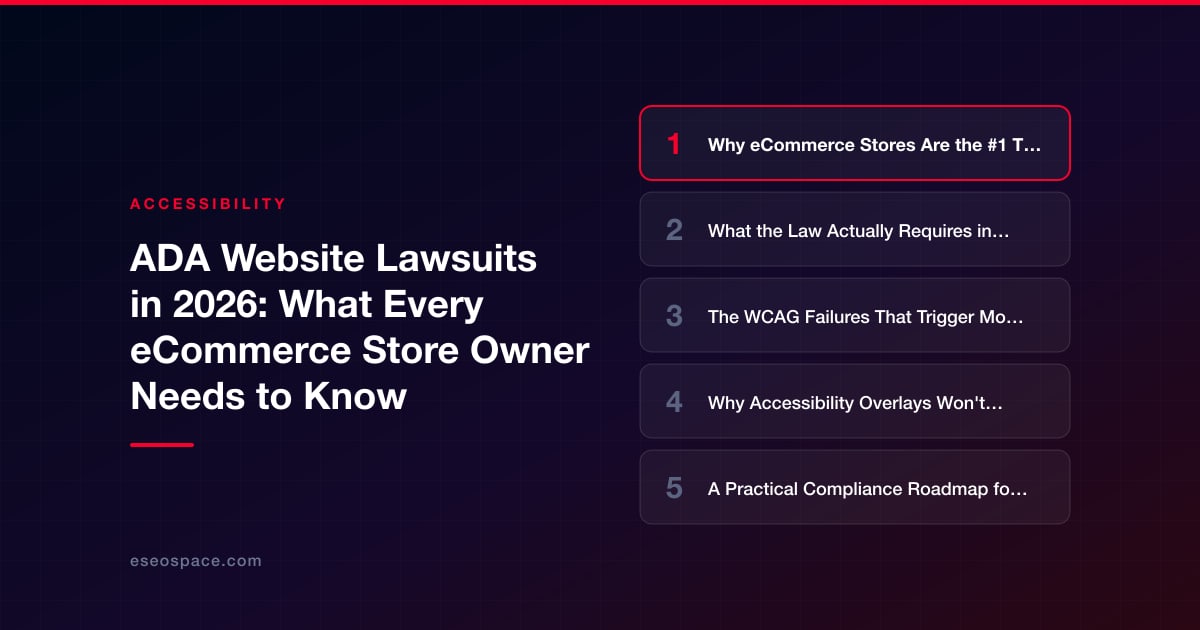
Key Takeaways
- Federal courts treat eCommerce websites as places of public accommodation under ADA Title III, making online stores the leading target for accessibility lawsuits and demand letters.
- There is no single federal technical rule for private sites, but WCAG 2.1 AA (and increasingly 2.2 AA) is the de facto standard courts and settlements use to judge compliance.
- Most complaints cite the same fixable failures: missing alt text, unlabeled forms, keyboard-inaccessible menus and modals, poor color contrast, and non-descriptive links.
- Accessibility overlay widgets do not provide a legal defense and have themselves been named in lawsuits; real protection requires remediating the actual code.
- Fix the checkout and product templates first, publish an accessibility statement, and treat compliance as an ongoing program to stay out of the litigation pool.
If you run an online store, an ADA website lawsuit is now one of the most predictable legal risks you face. Many federal courts have treated eCommerce sites as covered by Title III of the Americans with Disabilities Act, although the circuits are split: some (such as the Ninth and Eleventh) look for a connection to a physical store, while courts in New York and other districts have applied Title III to online-only businesses, which means your checkout flow, product pages, and image alt text can all become evidence in a complaint filed by a plaintiff who uses a screen reader.
The volume is not slowing down. Digital accessibility lawsuits and formal demand letters have run at record levels for several years running, and the overwhelming majority name retailers with transactional websites. The reason is simple: eCommerce sites are easy to test remotely, they process payments (so damages are plausible), and small-to-mid-size stores rarely have accessibility baked into their code.
This guide explains exactly why eCommerce stores get targeted, what the law and WCAG standards actually require in 2026, and the concrete steps that meaningfully reduce your exposure. None of this is legal advice, but all of it is the practical reality we see when store owners come to us after a demand letter lands.
Why eCommerce Stores Are the #1 Target
Plaintiffs' firms and their testers focus on online retail for structural reasons, not because your brand did anything uniquely wrong. Understanding the pattern helps you understand where your risk actually lives.
- Transactional intent is easy to prove. A screen-reader user who cannot complete a purchase has a clean, demonstrable barrier to a good or service, which is the core of a Title III claim.
- Testing is cheap and remote. A tester never has to visit a physical location. They load your site with assistive technology, try to add an item to the cart and check out, and document every point where the experience breaks.
- Templates and plugins create shared defects. Thousands of stores run the same themes, page builders, and third-party widgets, so a single known failure pattern (an inaccessible cart drawer, an unlabeled search field) can be reused across many defendants.
- Settlement math favors volume. Many cases settle for four-to-five figures plus a remediation commitment. Filing at scale is a viable business model, which is why serial filers dominate the docket.
The takeaway: you are not being singled out for malice. You are being surfaced by an automated or semi-automated process that flags sites with common, fixable barriers. That also means the fix is largely within your control.
What the Law Actually Requires in 2026
There is still no single federal regulation that spells out a technical checklist for private commercial websites. Title III of the ADA prohibits discrimination in the enjoyment of goods and services, and courts have applied it to websites, but Congress has not passed an ecommerce-specific accessibility statute. That legal ambiguity is precisely what plaintiffs exploit.
In practice, courts, the Department of Justice, and settlement agreements have all coalesced around one benchmark: the Web Content Accessibility Guidelines (WCAG) 2.1 Level AA. The DOJ's 2024 rule for state and local government entities under Title II formally adopted WCAG 2.1 AA, and while that rule does not directly bind private businesses, it has become the de facto standard that judges and opposing counsel reference. Newer guidance increasingly points toward WCAG 2.2 AA, so building to 2.2 is the safer target going into 2026.
State laws add another layer. California's Unruh Civil Rights Act, New York's civil rights statutes, and similar laws in other states allow plaintiffs to attach statutory damages to an ADA-based claim, which is why so many filings originate in those jurisdictions. If you sell into those states (and as an online store, you do), their standards effectively apply to you.
The WCAG Failures That Trigger Most Complaints
Demand letters and complaints tend to cite the same recurring barriers. If you audit your store for just these issues, you eliminate the majority of the low-hanging fruit that testers look for first.
- Missing or meaningless image alt text on product photos, so a screen reader announces "image" or a filename instead of the product.
- Unlabeled form fields in the cart, checkout, search, and newsletter signup, leaving assistive-tech users unable to know what to type.
- Keyboard traps and inaccessible interactive elements such as modal dialogs, cart drawers, dropdown menus, and image carousels that cannot be operated without a mouse.
- Insufficient color contrast on buttons, sale prices, and body text, which fails WCAG contrast thresholds.
- Non-descriptive links and buttons like repeated "click here" or "add to cart" with no product context announced.
- Content that only conveys meaning through color, such as showing an out-of-stock state with red text alone.
- Inaccessible PDFs and pop-ups, including promotional overlays and size charts that trap focus or lack proper structure.
These are engineering problems, and they are solvable in your theme and templates. Baking accessibility into how your store is built is far cheaper than retrofitting under a litigation deadline, which is why we treat it as a core part of professional website development rather than an afterthought.
Why Accessibility Overlays Won't Save You
Many store owners react to the lawsuit threat by installing a one-line accessibility "widget" or overlay that promises instant compliance. This is one of the most dangerous shortcuts you can take.
Overlays sit on top of your existing code and attempt to patch problems at runtime with JavaScript. They frequently fail to fix underlying WCAG issues, and in some cases they interfere with the very assistive technologies users already have installed. Critically, courts and plaintiffs have not accepted overlays as a defense. A substantial share of ADA web lawsuits in recent years have been filed against sites that already had an accessibility widget installed, and some suits now specifically allege that the overlay itself created barriers.
The lesson is blunt: a widget is a marketing product, not a legal shield. Real protection comes from remediating the actual HTML, ARIA, and interaction patterns in your store. There is no automated tool that makes a site compliant with a single click, and claiming otherwise in your marketing can even become its own liability.
A Practical Compliance Roadmap for Store Owners
You don't have to boil the ocean. A phased approach lets you cut risk quickly and then work toward durable, documented compliance.
- Run an audit that combines automated and manual testing. Automated scanners catch roughly a third of issues; the rest (keyboard operability, screen-reader logic, focus order) require human testing with real assistive technology.
- Fix the conversion path first. Prioritize the pages a plaintiff will actually test: home, category, product detail, cart, and checkout. A barrier in checkout is your highest-risk failure.
- Remediate at the template level. Fixing your product template once corrects every product page, rather than patching pages individually.
- Vet third-party widgets. Reviews apps, chat, discount pop-ups, and payment iframes can all introduce failures you did not write. Test them or replace them.
- Publish an accessibility statement. Document your conformance target, the standard you follow, and a contact method for users who hit a barrier. This shows good-faith effort and gives users an alternative to filing.
- Build accessibility into your development workflow. Add accessibility checks to your QA so new features and seasonal landing pages don't reintroduce old problems.
Because accessibility is a moving target as you add products, promotions, and apps, treating it as an ongoing program rather than a one-time project is what actually keeps you out of the docket. Our WCAG accessibility services are structured exactly this way: audit, remediate the templates, then monitor so regressions don't creep back in.
What to Do If You Receive a Demand Letter
If a letter or complaint has already arrived, your response in the first few weeks matters. Panic-installing a widget or ignoring it are both mistakes.
- Do not ignore it. Deadlines in these matters are real, and default judgments are worse than settlements.
- Loop in a qualified attorney who handles ADA Title III matters before you respond substantively or make admissions.
- Preserve the current state of your site, but begin genuine remediation in parallel. Demonstrable, dated progress toward WCAG conformance strengthens your position.
- Get a real audit on record. A documented conformance assessment shows the court and opposing counsel that you are addressing barriers substantively, not cosmetically.
- Fix the root causes, not just the cited examples. Settlements typically require ongoing conformance, so remediating only the three pages named in the complaint leaves you exposed to the next filer.
The store owners who fare best are the ones who convert a demand letter into a permanent accessibility upgrade. You spend the remediation money once, you make your site usable for the roughly one in four US adults living with a disability, and you remove yourself from the pool of easy targets. Accessibility done properly is not just risk management; it is a larger addressable market and a better-built store.
Get a FREE Audit
We'll perform a comprehensive SEO, AEO, GEO & CRO audit of your website — completely free — and show you exactly how to outrank your competitors.
Don't have a site yet? Get in touch →
Put this into action with eSEOspace
We help businesses grow with website development that actually performs. Explore the services behind this guide:
Frequently Asked Questions
Can an online store really be sued under the ADA?
What WCAG level do I need to meet to avoid ADA lawsuits?
Will an accessibility widget or overlay protect me legally?
Which pages should I fix first on my store?
What should I do if I get an ADA demand letter?
Get a FREE GEO/AEO/SEO Audit
We'll analyze your site's SEO, GEO, AEO & CRO — completely free — and show you exactly how to get found across Google and AI answers.
Don't have a site yet? Get in touch →
Great — your audit is on the way!
We'll send your free SEO/GEO/AEO/CRO audit within the next few hours. Where should we send it?
You're all set! ✓
Your free audit is being prepared — check your inbox in the next few hours. Talk soon!








