



B2B Lead Generation Through SEO: How to Generate More Qualified Leads
B2B Lead Generation Through SEO: How to Generate More Qualified Leads
Key Takeaways
- B2B lead generation SEO succeeds by targeting high-intent, low-volume commercial queries rather than high-traffic awareness keywords that rarely convert.
- Bottom-of-funnel assets like comparison pages, alternatives pages, and use-case content capture buyers closest to a purchase decision.
- A solid technical foundation, topic-cluster architecture, and fast pages are prerequisites, because great content can't rank on a site search engines struggle to crawl or trust.
- Because B2B traffic is low-volume and high-value, conversion rate optimization and stage-matched offers matter as much as rankings.
- Aligning SEO with sales and measuring pipeline influence, not just sessions, is what turns organic search into qualified, defensible revenue.
Most B2B companies treat SEO as a traffic game, then wonder why a spike in visitors never shows up as pipeline. The problem is rarely volume. It is intent. B2B lead generation through SEO is not about ranking for the biggest keywords in your category; it is about ranking for the specific queries a buyer types when they are evaluating vendors, comparing solutions, or trying to justify a purchase to their boss.
The B2B buying cycle is long, involves multiple stakeholders, and produces low search volumes with high commercial value. A single ranking for a phrase like "HIPAA-compliant scheduling software for clinics" might get 90 searches a month, but each one could be worth thousands in contract value. That economics is what makes SEO one of the most durable lead channels in B2B, and it is why a scattershot content approach fails.
This guide walks through how to build an SEO program that generates qualified leads, not vanity metrics. Among the different lead generation types, SEO is an inbound approach. It attracts buyers who are researching problems or comparing solutions, rather than relying on direct outreach to start the conversation. Every section is written for teams selling to other businesses, where the sales cycle, the buying committee, and the deal size all change what "good" SEO looks like.
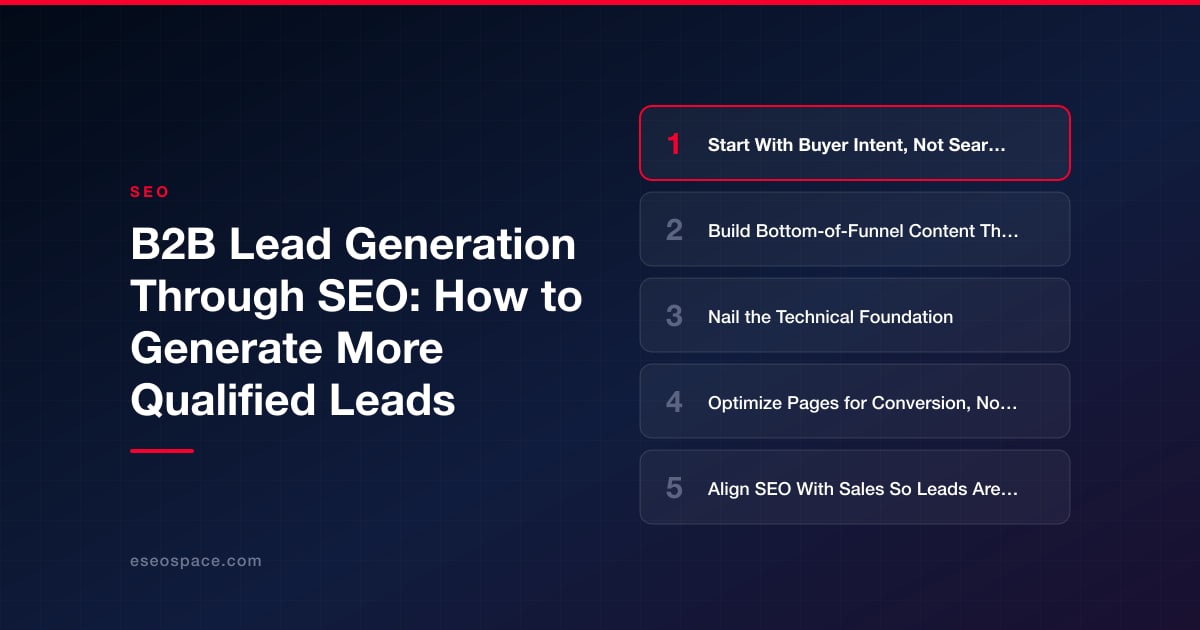
Start With Buyer Intent, Not Search Volume
The single biggest mistake in B2B SEO is chasing top-of-funnel keywords because they have impressive volume. A term like "project management" gets hundreds of thousands of searches, but the people typing it are students, curious managers, and competitors, not buyers with budget. The queries that generate qualified leads are narrower and messier.
Map your keywords to intent tiers so you know what each page is supposed to do:
- Commercial-investigation queries: "best [category] software," "[competitor] alternatives," "[product] vs [product]." These buyers are actively comparing and convert fastest.
- Solution-aware queries: "how to reduce warehouse picking errors," "software for [specific workflow]." The buyer knows the problem and is scoping options.
- Problem-aware queries: "why is our customer churn increasing," "symptoms of poor inventory management." Earlier-stage but valuable for building authority and remarketing pools.
Weight your production toward the first two tiers. A focused approach to B2B SEO prioritizes the pages closest to a purchase decision first, then backfills the awareness layer once the money pages are ranking and converting.
Build Bottom-of-Funnel Content That Sells
Bottom-of-funnel (BOFU) pages are where SEO earns its reputation as a lead channel. These are the assets that a prospect reads right before they fill out a form or book a demo, and they should be treated with the same rigor as a sales conversation.
The highest-performing BOFU formats in B2B are consistent across industries:
- Comparison pages ("you vs. competitor") that are honest about tradeoffs. Buyers trust pages that admit where a competitor is a better fit, and they reward that honesty by trusting your claims elsewhere.
- Alternatives pages targeting "[incumbent] alternatives," which capture buyers already frustrated with a known tool.
- Use-case and industry pages that speak to a specific vertical's terminology, compliance needs, and workflows rather than generic benefits.
- Pricing and ROI pages, even if you don't publish exact numbers, because "how much does [category] cost" is one of the most consistent high-intent queries in every B2B market.
Each of these pages needs a clear, contextual call to action, social proof relevant to the buyer's segment, and enough specificity that a decision-maker could forward it internally as evidence. Thin, generic BOFU content ranks poorly and converts worse. Investing in genuinely useful content marketing at this stage is what separates traffic from pipeline.
Nail the Technical Foundation
You can publish the best comparison page in your category, and it will still lose to a mediocre competitor if search engines can't crawl, render, and trust your site. Technical SEO is the unglamorous work that makes everything else possible, and in B2B it is frequently neglected because internal teams focus on content.
Prioritize the technical elements that most affect rankings and lead capture:
- Site architecture and internal linking: group related pages into topic clusters so authority flows to your money pages. A pillar page on a core problem should link down to every supporting article, and those articles should link back up.
- Page speed and Core Web Vitals: slow pages suppress rankings and quietly kill form conversions. B2B sites bloated with tracking scripts and heavy hero images are common offenders.
- Crawlability and indexation: make sure gated content, faceted navigation, and staging environments aren't wasting crawl budget or leaking duplicate URLs.
- Schema markup: implement Organization, Product, FAQ, and Breadcrumb schema so search engines understand your entities and can surface rich results.
If your team lacks the bandwidth to audit and fix these issues, dedicated SEO services can handle the technical layer while your marketing team focuses on messaging and demand.
Optimize Pages for Conversion, Not Just Rankings
Ranking is only half the job. A page that sits at position one and converts at 0.3% is worth far less than a page at position three that converts at 4%. Because B2B traffic is low-volume and high-value, conversion rate optimization (CRO) deserves as much attention as ranking.
Practical steps that consistently lift B2B lead conversion:
- Match the offer to the buyer's stage. Don't push a "book a demo" CTA on a problem-aware blog post; offer a checklist, template, or benchmark report instead and capture the email.
- Reduce form friction. Every additional field costs you leads. Ask only for what sales genuinely needs to qualify, and use progressive profiling to collect the rest later.
- Add proof near the CTA: logos, a relevant quote, a security badge, or a specific outcome framed representatively rather than an inflated stat.
- Use exit-intent and scroll-triggered offers sparingly, and always tied to the content the visitor is reading.
Segment your conversion paths. An enterprise buyer and a small-business buyer landing on the same page often need different offers and different next steps. Serving them the same generic "contact us" button flattens your funnel.
Align SEO With Sales So Leads Are Actually Qualified
SEO teams are often measured on traffic and rankings, while sales is measured on closed revenue. When those incentives don't connect, marketing celebrates a busy month while sales complains about junk leads. Closing that gap is how SEO becomes a pipeline channel instead of a reporting exercise.
Bring sales into your keyword and content planning:
- Ask reps which questions come up repeatedly on discovery calls, then build pages that answer them. These questions are pre-qualified topics because real buyers are asking.
- Have sales flag which inbound leads were genuinely sales-ready, and trace them back to the pages and queries that produced them. Double down on what works.
- Define a shared lead-quality standard so "qualified" means the same thing to both teams, and route SEO leads with the context of what content they consumed.
This feedback loop also protects you from optimizing toward the wrong audience. If a page drives volume but sales rejects every lead from it, that is a signal to re-target the keyword or rework the offer, not to celebrate the traffic.
Measure the Metrics That Predict Revenue
Reporting on rankings and sessions alone will get an SEO program defunded the moment budgets tighten. To defend and grow investment, tie SEO to metrics leadership cares about, and be patient about the timeline, because B2B SEO typically takes six to twelve months to compound.
Track the full path from query to revenue:
- Organic leads and MQLs by landing page and keyword theme, not just total sessions.
- Lead-to-opportunity and opportunity-to-close rates for organic, so you can prove qualification quality over time.
- Pipeline and revenue influenced by organic, using multi-touch attribution that credits SEO for its role in long, multi-stakeholder deals.
- Assisted conversions, since a blog post read early in the cycle rarely gets last-click credit but often starts the deal.
When you can show that organic search produced a specific number of qualified opportunities and influenced a measurable share of pipeline, SEO stops being a cost center and becomes a growth engine the whole business protects. That is the outcome a serious B2B lead generation program is built to deliver.
Get a FREE Audit
We'll perform a comprehensive SEO, AEO, GEO & CRO audit of your website — completely free — and show you exactly how to outrank your competitors.
Don't have a site yet? Get in touch →
Put this into action with eSEOspace
We help businesses grow with website development that actually performs. Explore the services behind this guide:
Frequently Asked Questions
How long does B2B lead generation through SEO take to work?
Why do high-volume keywords rarely generate qualified B2B leads?
What content types generate the most B2B leads from SEO?
How do you measure whether SEO leads are actually qualified?
Should B2B SEO focus on technical fixes or content first?
Get a FREE GEO/AEO/SEO Audit
We'll analyze your site's SEO, GEO, AEO & CRO — completely free — and show you exactly how to get found across Google and AI answers.
Don't have a site yet? Get in touch →
Great — your audit is on the way!
We'll send your free SEO/GEO/AEO/CRO audit within the next few hours. Where should we send it?
You're all set! ✓
Your free audit is being prepared — check your inbox in the next few hours. Talk soon!








