
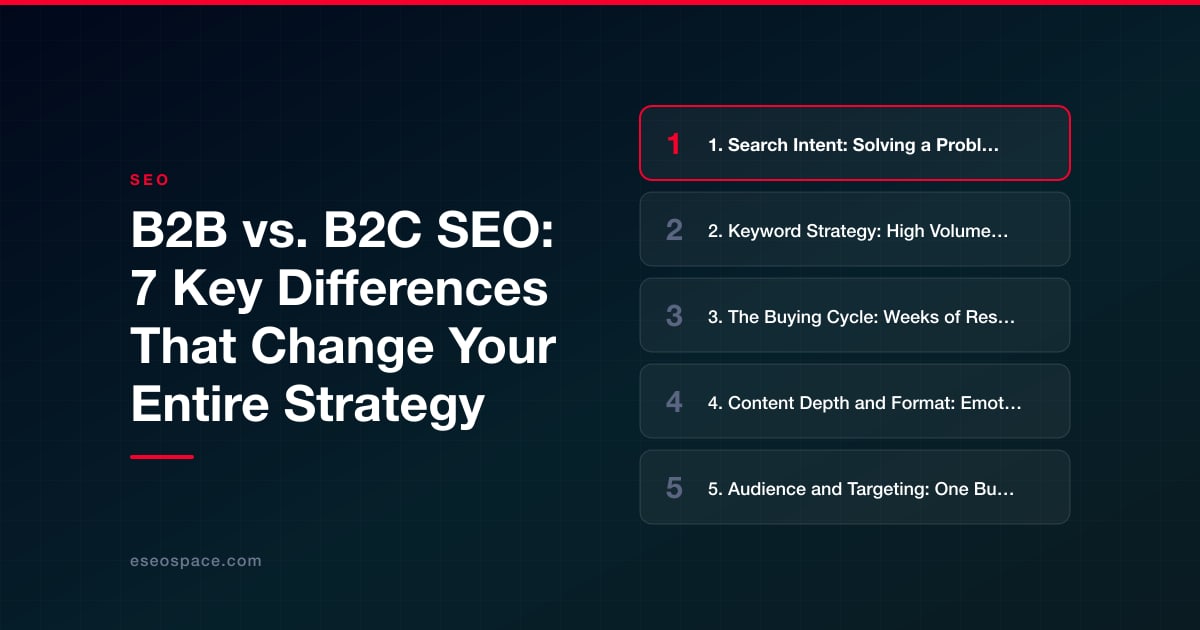
B2B vs. B2C SEO: 7 Key Differences That Change Your Entire Strategy
B2B vs. B2C SEO: 7 Key Differences That Change Your Entire Strategy
Key Takeaways
- B2C search intent is transactional and immediate, while B2B intent is problem-driven and informational, so the two require fundamentally different keyword and content strategies.
- In B2B, low-volume, high-intent keywords tied to buyer roles and revenue potential beat the high-volume terms that power B2C traffic.
- The long B2B buying cycle demands full-funnel content and multi-touch attribution, not last-click measurement built for fast consumer purchases.
- B2B content must be deep, evidence-based, and shareable across a buying committee, whereas B2C content wins on speed, emotion, and visual appeal.
- Measure B2B SEO by pipeline and lead quality (demos, downloads, influenced revenue) rather than the on-site transactions used to judge B2C.
On the surface, B2B and B2C SEO look identical: both chase rankings, both fight for clicks, both live and die by Google's algorithm. But the moment you scratch beneath the ranking report, the two disciplines diverge so sharply that a playbook built for one will quietly sabotage the other. A tactic that fills an e-commerce cart can starve a B2B pipeline, and a strategy that books enterprise demos can bankrupt a consumer brand on wasted traffic.
The core reason is who is searching and why. A B2C shopper is often one person, ready to buy, making a fast emotional decision. A B2B buyer is a committee of five to ten people researching a five-figure commitment over weeks or months. That single distinction ripples outward into keywords, content, conversion paths, and how you even define success. Below are the seven differences that should reshape how you plan, execute, and measure search.
Whether you run marketing in-house or lean on an agency partner for B2B SEO, understanding these gaps is the difference between traffic that converts and traffic that just looks good in a dashboard.
1. Search Intent: Solving a Problem vs. Buying a Product
B2C intent is usually transactional and immediate. Someone searching "wireless headphones under $100" wants to compare and buy today. The path from query to purchase can be a single session. Your job is to remove friction and win the click at the moment of desire.
B2B intent is overwhelmingly informational and problem-driven, especially early on. A procurement lead doesn't start by searching your product name; they search "how to reduce warehouse pick errors" or "SOC 2 compliance checklist." They are diagnosing a problem, not shopping. Ranking for those upstream queries plants your brand months before a purchase decision exists.
- B2C: Prioritize bottom-funnel, high-commercial-intent terms and product pages.
- B2B: Build authority on problem-aware and solution-aware queries, then guide readers down toward product and pricing pages.
2. Keyword Strategy: High Volume vs. High Value
The biggest mistake B2B teams make is chasing B2C-style volume. In B2B, the money is in low-volume, high-intent keywords. A term like "multi-entity accounting software for nonprofits" might get 40 searches a month, but the handful of people typing it are qualified buyers worth thousands each in lifetime value.
B2C keyword strategy can genuinely be a volume game because conversion is cheap and fast; even a 1% conversion rate on 50,000 monthly searches is meaningful. In B2B, you optimize for relevance and buyer fit over raw traffic. Long-tail, industry-specific, and jargon-heavy phrases that a consumer marketer would dismiss as too niche are exactly where B2B wins.
- Weight keywords by revenue potential and lead quality, not just search volume.
- Map terms to buyer roles: a CFO, an IT admin, and an end user search the same problem in different language.
- Don't ignore branded and competitor-comparison terms; B2B buyers research alternatives heavily before committing.
3. The Buying Cycle: Weeks of Research vs. Minutes of Decision
A consumer can go from discovery to checkout in ten minutes. A B2B deal can take three to twelve months and involve legal, finance, IT, and executive sign-off. This changes everything about how you structure content and measure attribution.
Because the B2B cycle is long and multi-touch, your SEO can't be judged on last-click conversions alone. A blog post that a buyer read in month one may deserve credit for a deal that closes in month six. You need content mapped to every stage, awareness, consideration, and decision, and analytics patient enough to connect early reads to eventual revenue. This is where a disciplined content marketing program earns its keep, feeding the funnel continuously rather than betting on a single high-intent page.
4. Content Depth and Format: Emotion vs. Evidence
B2C content often wins on speed, emotion, and visual appeal, short product descriptions, lifestyle imagery, social proof, and urgency. The reader is convincing themselves; you just make it easy and appealing.
B2B content wins on depth, rigor, and de-risking the decision. Buyers spending real budget need evidence they can forward to a skeptical colleague. That means:
- Long-form guides, whitepapers, and technical documentation that demonstrate genuine expertise.
- Case studies, ROI calculators, and comparison pages that quantify the value.
- Data, original research, and clear methodology, buyers trust specifics over adjectives.
- Content designed to be shared internally and defended in a meeting, not just skimmed on a phone.
Google's emphasis on experience, expertise, authoritativeness, and trust (E-E-A-T) matters in both worlds, but it is non-negotiable in B2B, where a single thin or inaccurate page can cost you a committee's trust.
5. Audience and Targeting: One Buyer vs. a Buying Committee
In B2C you typically persuade one decision-maker. In B2B you must speak to a committee where each member has different fears and priorities. The end user wants ease of use, IT wants security and integration, and finance wants ROI and predictable cost. A single landing page can't carry all of that, so your site architecture has to segment content by role and industry.
Practically, this means building dedicated pages for verticals, use cases, and personas, then interlinking them so each committee member finds their answer. It also means your SEO and sales teams must share a language, targeting the accounts and roles that actually close, not just the broadest possible audience. Aligning search strategy with the sales motion is a hallmark of mature SEO services that drive revenue rather than vanity traffic.
6. Link Building and Authority: Reach vs. Reputation
B2C link building often leans on scale and virality, product roundups, influencer coverage, deal sites, and broadly appealing content that attracts many links from consumer media. Volume and diversity of referring domains do a lot of the work.
B2B link building is about credibility within a niche. A single backlink from a respected industry publication, an analyst report, or a trade association can outweigh dozens of generic consumer links. Effective B2B tactics skew toward:
- Original research and data studies that journalists and industry blogs cite.
- Guest contributions and expert commentary in trade media.
- Partnerships, integrations, and co-marketing that earn contextual links from adjacent vendors.
- Thought-leadership from named experts, reinforcing E-E-A-T signals.
The goal isn't the most links; it's the most trusted links from the specific corner of the web your buyers respect.
7. Conversion and Measurement: Sales vs. Leads
B2C conversion is usually a purchase, so measurement is clean: traffic in, revenue out, tracked in the same session. You can optimize a page and see the impact within days.
B2B rarely converts on-site. The "conversion" is a demo request, a whitepaper download, a newsletter signup, or a contact-form submission, a lead that sales nurtures for weeks. Your SEO KPIs must therefore shift from transactions to pipeline: marketing-qualified leads, lead quality, cost per opportunity, and eventually closed revenue influenced by organic search. Optimizing purely for traffic or rankings will make you feel successful while your pipeline stays empty.
- Instrument micro-conversions (downloads, demo requests, pricing-page visits) as leading indicators.
- Connect your CRM to analytics so organic search gets credit for influenced revenue, not just first clicks.
- Judge content by the quality of leads it produces, not the quantity of sessions.
Bringing It Together
B2B and B2C SEO share the same tools but reward opposite instincts. B2C rewards speed, volume, emotion, and immediate conversion. B2B rewards patience, precision, depth, and pipeline thinking. Copy a B2C playbook into a B2B business and you'll chase traffic that never buys; force B2B rigor onto a B2C brand and you'll overthink a decision the shopper makes in seconds. The winning move is to diagnose which game you're actually playing, then build keywords, content, links, and measurement around that reality, so every ranking you earn maps to a buyer you can actually close.
Practically, that means auditing your current program against these seven axes before you write another blog post or chase another keyword. Ask whether your keyword list is weighted by buyer value or vanity volume, whether your content answers a committee's objections or just a single skimmer, and whether your reporting connects organic search to real pipeline. Fix the mismatches, and the same effort you're already spending starts compounding, because it's finally pointed at the buyer you're actually trying to reach.
Get a FREE Audit
We'll perform a comprehensive SEO, AEO, GEO & CRO audit of your website — completely free — and show you exactly how to outrank your competitors.
Don't have a site yet? Get in touch →
Put this into action with eSEOspace
We help businesses grow with website development that actually performs. Explore the services behind this guide:
Frequently Asked Questions
What is the main difference between B2B and B2C SEO?
Should B2B companies target high-volume keywords?
How do you measure B2B SEO success?
Does content marketing matter more for B2B or B2C SEO?
Is link building different for B2B versus B2C?
Get a FREE GEO/AEO/SEO Audit
We'll analyze your site's SEO, GEO, AEO & CRO — completely free — and show you exactly how to get found across Google and AI answers.
Don't have a site yet? Get in touch →
Great — your audit is on the way!
We'll send your free SEO/GEO/AEO/CRO audit within the next few hours. Where should we send it?
You're all set! ✓
Your free audit is being prepared — check your inbox in the next few hours. Talk soon!


On this page
- Key Takeaways
- 1. Search Intent: Solving a Problem vs. Buying a Product
- 2. Keyword Strategy: High Volume vs. High Value
- 3. The Buying Cycle: Weeks of Research vs. Minutes of Decision
- 4. Content Depth and Format: Emotion vs. Evidence
- 5. Audience and Targeting: One Buyer vs. a Buying Committee
- 6. Link Building and Authority: Reach vs. Reputation
- 7. Conversion and Measurement: Sales vs. Leads
- Bringing It Together