




Content Marketing for Service Businesses: How to Turn Expertise into Leads
Content Marketing for Service Businesses: How to Turn Expertise into Leads
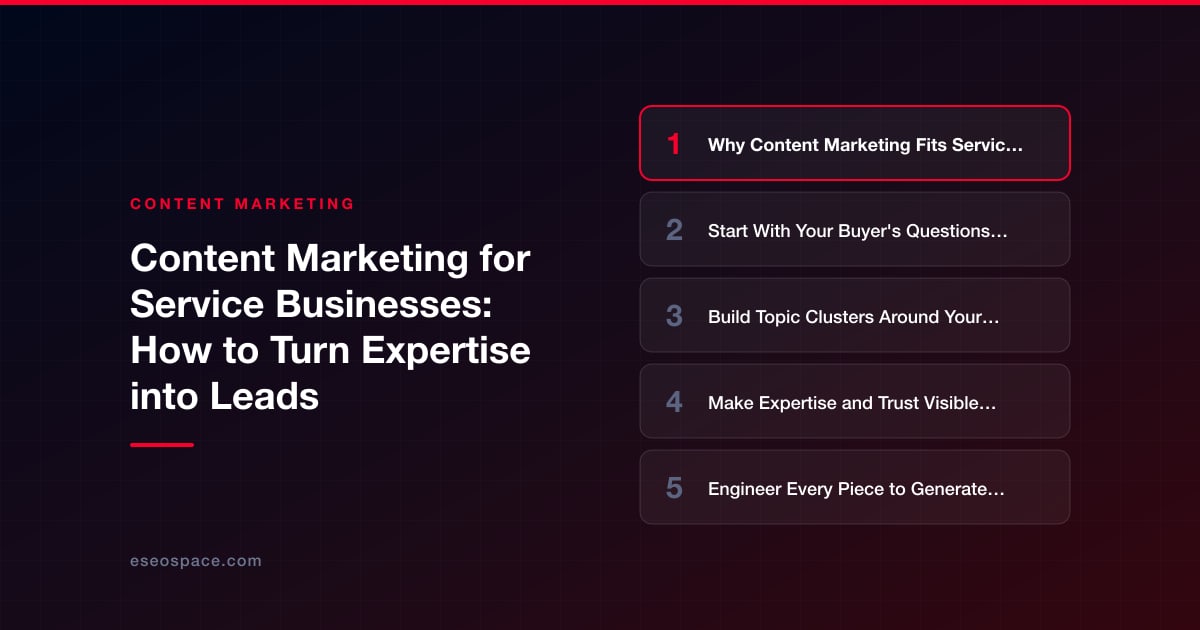
Key Takeaways
- For service businesses, content marketing works because it lets prospects experience your expertise and build trust before they ever contact you.
- Build your topic list from real buyer questions, sales calls, and search data, and cover every stage of the buying journey, not just top-of-funnel awareness.
- Organize content into topic clusters around your highest-value services so you build topical authority and guide buyers toward a reason to hire you.
- Make expertise visible with named authors, credentials, first-hand specifics, and proof, since trust signals drive both rankings and conversions.
- Engineer every piece for lead generation with stage-matched CTAs, lead magnets, and easy contact, then measure leads and revenue, not just traffic.
Service businesses sell something invisible. A prospect can't test-drive your legal advice, inspect your HVAC repair before you show up, or return your consulting engagement if it disappoints. That intangibility is exactly why content marketing works so well for service businesses: well-made content lets buyers experience your expertise before they ever fill out a form, which is the single biggest lever you have on trust and conversion rate.
Yet most service firms treat content as an afterthought. They publish a thin "Welcome to our blog" post, list a few services, and wonder why the phone doesn't ring. The problem isn't effort. It's that they're producing content for no one in particular, at no stage of the buying journey, on topics no prospect is actually searching for.
This guide walks through a system for turning the knowledge already inside your business into a steady stream of qualified leads. Not brand-awareness fluff, but content engineered to attract people with a problem you get paid to solve.
Why Content Marketing Fits Service Businesses So Well
For product companies, content competes with a shelf full of reviews and specs. For service businesses, the buying decision is almost entirely about trust and perceived competence, and content is the most scalable way to demonstrate both. When a homeowner reads a genuinely helpful article on "signs your water heater is about to fail," the plumber who wrote it has already earned an advantage over three competitors the buyer has never heard of.
Content also compounds. A cold email is dead the moment it's deleted. A strong pillar article on a topic your buyers search for can generate leads every month for years, at a cost that keeps dropping as it accumulates rankings and backlinks. That durability is why a deliberate content marketing program tends to outperform paid ads on cost-per-lead over any horizon longer than a few months.
- High-consideration buying: Services are researched carefully, so educational content meets buyers exactly where they deliberate.
- Local and niche intent: Service searches often carry clear intent ("emergency dentist near me," "CPA for real estate investors") that's easy to target.
- Expertise as inventory: Your team already knows the answers; content just packages that knowledge into a demand-generating asset.
Start With Your Buyer's Questions, Not Your Services
The fastest way to waste a content budget is to write about what you want to sell. Buyers don't search for "comprehensive managed IT solutions"; they search for "why does our office wifi keep dropping" and "how much should a small business spend on IT." Your job is to map the actual language of the problem to the service that solves it.
Build a topic list from real sources rather than a brainstorm:
- Sales and support logs: The questions prospects ask on discovery calls are your highest-converting article ideas, because answering them is literally how you close deals.
- Search data: Use keyword tools and Google's "People also ask" and autocomplete to find the exact phrasing and volume behind each question.
- Objections: "Isn't this cheaper if I do it myself?" and "How do I know you're qualified?" become articles that pre-handle objections before a sales call.
Then sort each topic by buying stage. Top-of-funnel content (symptoms, definitions, "how to") pulls in a wide audience. Middle-funnel content (comparisons, costs, how to choose a provider) attracts people actively shopping. Bottom-funnel content (your process, case examples, pricing explanations) converts them. Most service firms over-invest in top-of-funnel and starve the middle, which is where money-ready buyers actually live.
Build Topic Clusters Around Your Money Services
Random one-off posts rarely rank or convert. A topic cluster does both. You create one comprehensive "pillar" page targeting a broad, high-value term, then surround it with narrower supporting articles that each answer a specific sub-question and link back to the pillar.
For a family law firm, the pillar might be "Divorce in [State]: A Complete Guide," supported by articles on child custody factors, how assets are divided, mediation vs. litigation, and typical timelines and costs. This structure signals topical authority to search engines and gives buyers a self-guided path from a vague question to a specific reason to hire you. Pairing clusters with sound technical and on-page SEO is what turns good writing into content that actually gets found.
- Pick pillars around profit, not traffic: Target the services with the best margins and lifetime value, even if their search volume is modest.
- Interlink deliberately: Every supporting post links up to the pillar and across to siblings, concentrating authority where you want to rank.
- Cover the whole question: One thorough page usually beats five thin ones on slices of the same topic.
Make Expertise and Trust Visible on Every Page
Search engines and buyers both reward demonstrable expertise. Google's quality guidelines lean heavily on experience, expertise, authoritativeness, and trust, which matters intensely for the "your money or your life" topics many service businesses operate in (legal, medical, financial). Anonymous, generic content underperforms regardless of how well it's optimized.
Bake credibility signals into the content itself:
- Real author bylines: Attribute posts to a named practitioner with credentials, a photo, and a bio, not a faceless "admin" account.
- First-hand specifics: Include the details only a practitioner would know, real numbers, edge cases, common mistakes, and step-by-step reasoning.
- Proof and citations: Reference standards, regulations, or data, and link to authoritative sources so claims are verifiable.
- Original assets: Photos of your actual work, diagrams, or checklists beat stock imagery and are hard for competitors to copy.
The goal is content a reader finishes thinking, "These people clearly know what they're doing." That feeling, more than any keyword, is what turns a reader into a lead.
Engineer Every Piece to Generate Leads
Content that informs but never asks for anything is a hobby, not a marketing channel. The difference between a blog that entertains and one that produces pipeline is intentional conversion design. Every substantial piece should have a clear next step matched to the reader's stage.
- Relevant calls to action: A cost article should offer a free quote; a "how to choose" article should offer a consultation. Generic "Contact us" buttons convert poorly.
- Lead magnets: Trade a checklist, template, calculator, or guide for an email so you can nurture readers who aren't ready to buy today.
- Frictionless contact: Put a click-to-call number, short form, and scheduling link where the reader finishes, not buried three clicks away.
- Social proof nearby: Reviews, ratings, or representative results placed near the CTA reduce the risk of reaching out.
Think in terms of a path: the article answers the question, demonstrates competence, then makes the obvious next action effortless. When that path is deliberate, a modest amount of traffic can produce a meaningful number of leads. A well-planned content strategy treats the CTA as a first-class part of the brief, not something bolted on afterward.
Distribute, Repurpose, and Measure What Matters
Publishing is the halfway point. A service business with a small audience can't rely on search alone while a new site earns authority, so distribution has to be part of the plan. Repurpose one strong article into a LinkedIn post, an email to your list, a short video, and a set of answers to questions on industry forums. One piece of research can feed a month of touchpoints.
Just as important is measuring the right things. Traffic and rankings are inputs; leads and closed revenue are the outcomes that justify the budget. Track the full chain so you can double down on what works.
- Assisted conversions: Attribute leads to the content they read, not just the last click, so educational posts get credit.
- Lead quality: Note which topics produce prospects who actually close, then produce more like them.
- Rankings and impressions: Use Search Console to see which queries you're gaining or losing and refresh pages accordingly.
- Content decay: Revisit and update top performers on a schedule; a refreshed post often outperforms a brand-new one.
Content marketing for service businesses is not about volume. It's about capturing the expertise you already have, aiming it at the specific questions your best buyers ask, and engineering each piece to earn trust and invite the next step. Do that consistently and your content stops being a cost center and becomes the most reliable lead source you own.
Get a FREE Audit
We'll perform a comprehensive SEO, AEO, GEO & CRO audit of your website — completely free — and show you exactly how to outrank your competitors.
Don't have a site yet? Get in touch →
Put this into action with eSEOspace
We help businesses grow with website development that actually performs. Explore the services behind this guide:
Frequently Asked Questions
How is content marketing different for service businesses versus product businesses?
How long does content marketing take to generate leads for a service business?
What content topics generate the most leads for service businesses?
How often should a service business publish content?
Should I write the content myself or hire a content marketing agency?
Get a FREE GEO/AEO/SEO Audit
We'll analyze your site's SEO, GEO, AEO & CRO — completely free — and show you exactly how to get found across Google and AI answers.
Don't have a site yet? Get in touch →
Great — your audit is on the way!
We'll send your free SEO/GEO/AEO/CRO audit within the next few hours. Where should we send it?
You're all set! ✓
Your free audit is being prepared — check your inbox in the next few hours. Talk soon!


On this page






