



Blog
Key Takeaways
- Patients now ask AI assistants complex health questions directly, replacing the old search-and-scroll journey with conversational answers.
- Generative Engine Optimization is no longer optional for healthcare providers that want to stay visible, authoritative, and trusted online.
- GEO does not replace healthcare SEO; it elevates that foundational authority for a new generation of AI-powered gatekeepers.
- GEO shifts focus from keywords to concepts, entities, and questions, mirroring how patients explore health topics conversationally.
- Because health queries are YMYL, generative engines validate authority through credentialed experts, reputable institutions, and cross-source consensus.
Introduction
The way patients seek health information is undergoing its most significant transformation in a generation. The familiar journey of typing symptoms into a search bar and scrolling through links is being replaced by direct conversations with AI assistants. This shift to generative search places an immense responsibility on healthcare organizations. Now, the challenge is not just to rank, but to become a trusted source for the AI models that are increasingly the first point of contact in a patient's journey to care.
Why Healthcare Websites Must Adapt to Generative Search
Patients are asking AI assistants complex health questions, from "What are the early signs of diabetes?" to "What should I expect during chemotherapy?". The AI synthesizes an answer by consulting various web sources. If your hospital's, clinic's, or medical group's content is not structured for AI consumption, you risk becoming invisible. Adapting to Generative Engine Optimization (GEO) is no longer optional; it is a critical mandate for any healthcare provider that wants to be present, authoritative, and trusted at the moment a patient needs information most.
How GEO Improves Trust and Patient Discovery
A well-executed GEO strategy does more than just increase visibility; it builds trust at scale. By providing clear, structured, and factually accurate information, you signal to AI models that you are an authoritative source. When an AI cites your content in a health-related answer, it acts as a powerful, third-party endorsement. This digital-age referral builds patient confidence and directs them toward your services, improving discovery and connecting them with the care they need. It transforms your website from a passive brochure into an active participant in patient education and acquisition.
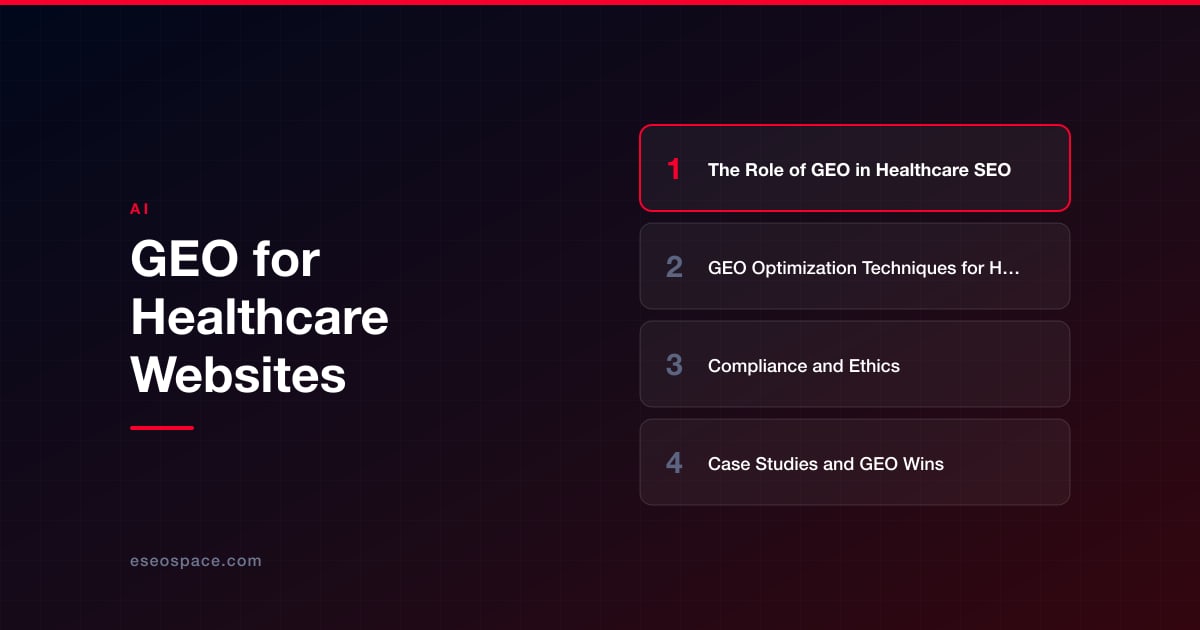
The Role of GEO in Healthcare SEO
GEO does not replace traditional healthcare SEO; it elevates it. SEO builds the foundational authority, while GEO optimizes that authority for a new generation of AI-powered gatekeepers. This evolution is particularly crucial in the medical field, where the stakes for accuracy and trust are higher than in any other industry.
Moving Beyond Keyword Search to AI Discovery
Traditional SEO focused on aligning content with specific keywords. GEO shifts the focus to optimizing for concepts, entities, and questions. Instead of just targeting the keyword "cardiologist in New York," a GEO strategy aims to make your practice the definitive source for answers about the entity "Dr. Jane Smith," her relationship to "Cardiology," and her expertise in treating "[Condition A]." This entity-based approach mirrors how patients are beginning to explore health topics conversationally with AI.
How Generative Engines Validate Medical Authority
Generative AI models are programmed to be extremely cautious with health-related queries, a category often referred to as "Your Money or Your Life" (YMYL). To validate authority, these engines look for specific signals of trustworthiness far beyond a simple keyword match. They cross-reference information across multiple trusted sources, looking for consensus. They prioritize content written by credentialed experts and published by reputable institutions. Your GEO strategy must focus on providing these signals clearly and consistently.
E-E-A-T (Experience, Expertise, Authority, Trust) in Health Content
The principles of Experience, Expertise, Authoritativeness, and Trust (E-E-A-T) are the bedrock of GEO for healthcare.
- Experience: Showcase firsthand experience. Feature patient testimonials (with consent) or content from physicians who have direct experience treating a condition.
- Expertise: Clearly display the credentials of your medical authors. Link author names to detailed bios that list their degrees, board certifications, and affiliations.
- Authoritativeness: Demonstrate your institution's authority. Link to published research, clinical trial involvement, and recognition from major medical bodies.
- Trust: Be transparent. Have clear contact information, a detailed about us page, and an easily accessible editorial policy outlining your content review process.
Failing to meet these E-E-A-T standards will almost certainly disqualify your content from being considered a source for AI-generated health answers.
GEO Optimization Techniques for Healthcare
Optimizing for healthcare GEO requires a meticulous approach to structuring data, implementing specific schema, and writing patient-facing content with a unique blend of empathy and machine-readability.
Structuring Medical Data for AI Understanding
AI models need structured information to confidently provide answers. Walls of text are inefficient.
- Use Tables for Data: Present clinical data, symptom comparisons, or treatment success rates in simple HTML
<table>formats. This makes the data easily extractable for the AI. - Employ Bulleted and Numbered Lists: Use
<ul>and<ol>tags to list symptoms, risk factors, or steps in a process (e.g., "5 Steps to Prepare for Your MRI"). - Create Definitional "Hubs": Have a single, definitive page for each core service line, condition treated, and medical procedure offered. This gives the AI a canonical source to reference. This is a core part of the Answer Graph Optimization process.
Schema for Physicians, Clinics, and Conditions
Schema markup describes your physicians, clinics, and services in a machine-readable way. Google says its AI features need no special markup, but these types can still help search engines and other AI tools understand your pages.
PhysicianSchema: On every doctor's bio page, usePhysicianschema to mark up their name, medical specialty (medicalSpecialty), affiliations, and educational background.HospitalorMedicalClinicSchema: On your location pages, use this schema to clearly define your services, opening hours, and departments.MedicalConditionandMedicalProcedureSchema: On patient education pages, use these schema types to define the condition or procedure, including associated symptoms (signOrSymptom), causes (cause), and common treatments (possibleTreatment).
|
Schema Type |
Where to Use |
Key Use Case for GEO |
|---|---|---|
|
|
Doctor Bio Pages |
Establishes the expertise and credentials of your authors. |
|
|
Location Pages |
Helps AI surface your clinic for local "near me" health queries. |
|
|
Health Library Articles |
Allows AI to pull structured data about symptoms and causes for summaries. |
|
|
Treatment & Service Pages |
Explains what a procedure is and what it treats in a machine-readable format. |
|
|
Any Patient Ed Page |
Directly answers common patient questions, making content highly citable. |
Writing AI-Compliant Patient Education Content
Your patient education content must achieve a difficult balance: it must be empathetic and accessible to a worried patient while also being clear and factual for a machine.
- Start with the Answer: Begin articles with a clear, concise, and simple definition of the topic.
- Use Clear, Simple Language: Avoid overly technical jargon where possible. Aim for a reading level that is accessible to the general public.
- Be Fact-Driven and Unambiguous: Every claim should be rooted in evidence. Avoid promotional language or subjective claims. State facts clearly.
- Show, Don't Just Tell: Include a visible medical review process. A line at the top or bottom of an article like "Medically reviewed by Dr. Jane Smith, MD on [Date]" is a powerful trust signal.
Patient Education Standards
- Does the article begin with a direct definition or summary?
- Is the author a credentialed medical expert, with a link to their bio?
- Is there a visible "medically reviewed by" date?
- Are complex data points presented in tables or lists?
- Is the language clear, empathetic, and free of marketing fluff?
- Does the page use the correct medical schema (
MedicalCondition,FAQPage, etc.)?
Compliance and Ethics
In healthcare, GEO is not just a marketing function; it's a matter of public health and legal compliance. Your strategy must be built on a foundation of ethical responsibility.
Get a FREE Audit
We'll perform a comprehensive SEO, AEO, GEO & CRO audit of your website — completely free — and show you exactly how to outrank your competitors.
Don't have a site yet? Get in touch →
Maintaining HIPAA and Data Privacy Standards
While GEO focuses on public-facing content, it's critical to ensure your underlying website infrastructure is HIPAA compliant. Never use patient-identifiable information in examples or testimonials without explicit, documented consent. Ensure any user interaction tracking for analytics, as part of your Data-Driven GEO Decisions, is fully anonymized and compliant with privacy regulations. The trust an AI places in your content is a reflection of the trust your patients place in your organization.
Handling Sensitive Content with Integrity
When writing about sensitive topics like mental health, terminal illness, or addiction, your content must be handled with the utmost care.
- Empathetic Tone: The language must be supportive and non-judgmental.
- Provide Resources: Always include links to crisis hotlines, support groups, and other resources for patients in distress.
- Avoid Over-promising: Be realistic and evidence-based about treatment outcomes. Do not present any information as a guarantee of a cure.
AI models are being trained to identify and prioritize content that is responsible and helpful, especially for sensitive queries. Demonstrating this integrity in your content is a powerful GEO signal.
Case Studies and GEO Wins
The examples below are illustrative. Results vary, and no provider can guarantee AI citations or patient growth.
How Medical Brands Gain AI Visibility
Case Study Example 1: The Regional Hospital System
- Challenge: A multi-location hospital system was struggling to get visibility in AI answers for its specialized service lines, like oncology and cardiology, often losing out to national publications like WebMD.
- Action: They launched a GEO initiative based on their GEO Content Lifecycle. They created detailed hub pages for each service line, built out comprehensive
Physicianprofiles with schema, and rewrote their patient education guides to be more structured and fact-dense. They focused heavily on E-E-A-T, adding clear medical review dates and author bios to every article. - Result: After six months, they began tracking their inclusion in AI results. They saw a 40% Summarization Inclusion Rate (SIR) for prompts related to their key service lines within their geographic region. AI models like Google's AI Overviews started citing their local doctors and treatment pages, recognizing them as the regional authority.
Example GEO-Driven Patient Acquisition Results
Case Study Example 2: The Specialized Orthopedic Clinic
- Challenge: A specialized clinic wanted to attract more patients for a specific, high-value surgical procedure. Their traditional SEO rankings were good, but they were not being featured in AI answers.
- Action: They created an ultimate guide to the procedure, structured for multi-turn conversational context. It included sections on "Who is a good candidate?", "What to expect during the procedure," and "Recovery timeline." They used
MedicalProcedureandFAQPageschema and embedded a video testimonial from a former patient. - Result: The clinic's inclusion rate for questions about this procedure jumped to over 60%. They were able to use their analytics to correlate a rise in "request an appointment" form submissions with clicks originating from AI summary source links. They measured a 15% increase in qualified patient inquiries for the procedure within the first quarter after their GEO optimizations went live. This demonstrated a clear, positive ROI on their GEO investment.
Frequently Asked Questions
What is GEO for healthcare websites?
How is GEO different from traditional healthcare SEO?
Why must healthcare websites adapt to generative search now?
How does GEO build patient trust?
How do generative engines validate medical authority?
Put this into action with eSEOspace
We help businesses grow with website development that actually performs. Explore the services behind this guide:
Get a FREE GEO/AEO/SEO Audit
We'll analyze your site's SEO, GEO, AEO & CRO — completely free — and show you exactly how to get found across Google and AI answers.
Don't have a site yet? Get in touch →
Great — your audit is on the way!
We'll send your free SEO/GEO/AEO/CRO audit within the next few hours. Where should we send it?
You're all set! ✓
Your free audit is being prepared — check your inbox in the next few hours. Talk soon!








