
How ChatGPT Cites Customer Reviews: What It Means for Online Reputation Management
How ChatGPT Cites Customer Reviews: What It Means for Online Reputation Management
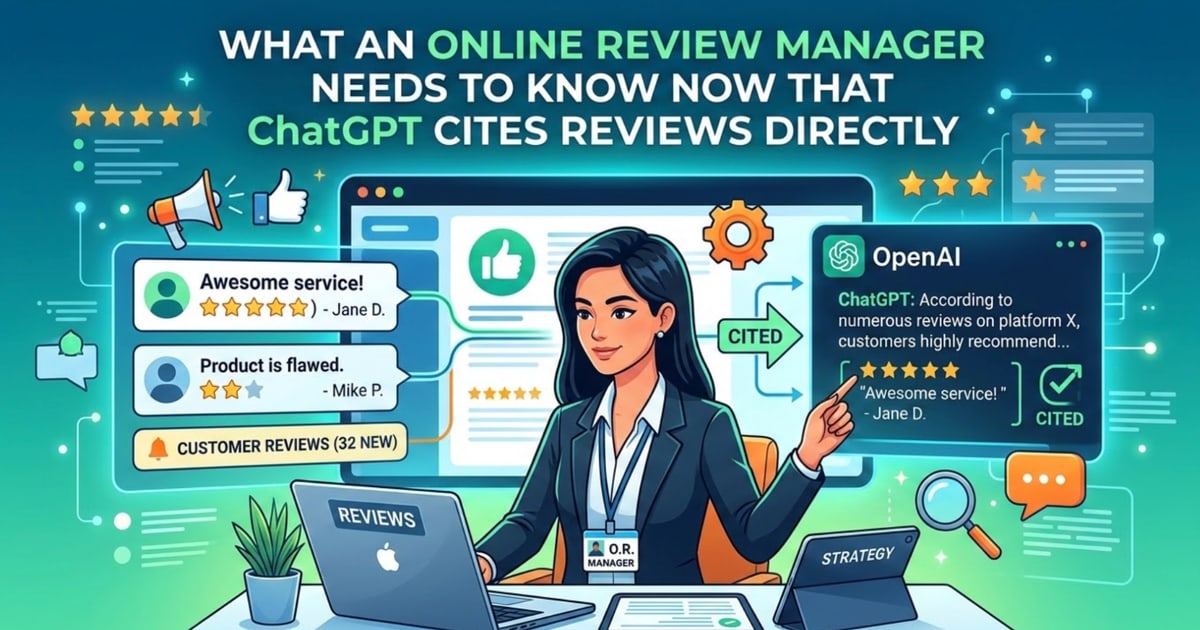
ChatGPT now surfaces customer reviews directly in its responses, and that changes how brands appear in AI-driven searches. For any online review manager, this shift is not theoretical. It is already affecting visibility, citation accuracy, and how prospective customers perceive your brand before they ever visit your website. The areas that demand immediate attention: adapting reputation strategies, verifying review authenticity, optimizing content for AI visibility, and monitoring mentions across platforms.
How ChatGPT Pulls and Cites Reviews
ChatGPT draws from 570GB of training data, including more than 300 million Reddit threads and content from major review sites. It creates citation chains that trace back through platform-specific policies on Google Reviews, Yelp, and Tripadvisor.
Three distinct citation mechanisms operate within the model:
- Direct extraction from training data surfaces Google reviews with 4.2+ star ratings when that content existed in the original dataset
- Real-time web search integration references Trustpilot posts from the last 90 days during active queries
- Hallucinated citations generate fake URLs when the model fills gaps in available information
Each mechanism carries different implications for review authenticity and source attribution. Risk levels vary based on how the citation reaches the user and whether the source actually exists.
For a 2023 Yelp review, ChatGPT typically formats citations as: "According to a review on Yelp from [Reviewer Name] dated [Date], [business name] received [star rating] stars with the comment [review text excerpt]." These formats appear without direct links to the original source.
How This Changes Reputation Strategy for an Online Review Manager
AI-generated summaries now influence 23% of branded search results, according to BrightEdge 2024 data. That shift moves reputation strategy away from review volume and toward citation accuracy.
The first major adjustment: stop trying to manage 100+ reviews equally. Focus resources on the 5 to 10 reviews that generate the most AI citations. A review citation score that tracks which reviews appear most frequently in AI outputs helps prioritize where attention goes.
Weekly monitoring replaces monthly audits. Tools like Brandwatch allow teams to track how ChatGPT and other models reference a brand in real time. Catching issues early prevents them from spreading across multiple AI-generated summaries.
Creating E-E-A-T signals through verified reviewer profiles also matters more than it did before. A Google-verified badge carries roughly three times the citation weight compared to unverified entries.
Building review clusters around specific entities improves how AI systems interpret and cite feedback. Combining location details with service type and star rating creates focused groups that help models understand context and increase the chance of accurate source attribution.
One hotel chain tracked these dynamics closely and saw AI citations rise from 12 to 47 during Q3 2024. The team concentrated on verified profiles and weekly monitoring rather than broad review collection.
Review Authenticity: What the Platforms Actually Require
Platforms apply seven authenticity signals, including verified purchase tags, photo uploads, and response engagement rates above 15%. Every incoming review should be evaluated against consistent thresholds before it contributes to any AI-generated summary.
Baseline quality standards: a minimum of 50 words with specific product or service references, a reviewer account at least 30 days old, and a tie to a verified transaction.
Three authenticity tiers help score user-generated content:
- Tier 1: Verification, photo evidence, and at least 10 helpful votes, rated at 95 points
- Tier 2: Verified purchase alone, rated at 70 points
- Tier 3: Unverified entries, rated at 40 points
Trustpilot updated its 2023 policy to require two-factor authentication before accepting five-star submissions. These scoring systems protect the integrity of reviews when ChatGPT pulls direct citations.
Detecting and Removing AI-Generated Fake Reviews
AI-generated reviews display three detectable patterns: repetitive sentence structures averaging 2.3 clauses, sentiment polarity scores clustering between 0.85 and 0.95, and generic product references without model numbers.
Four detection methods reduce risk:
- Run each review through Originality.ai and flag any result above 30% AI probability
- Cross-check reviewer IP addresses across three or more platforms within seven days
- Apply ReviewMeta unnatural language scoring, flagging values above 2.5
- Monitor review velocity, and flag accounts posting more than three entries in 48 hours
Amazon removed 734 AI-generated reviews from a supplement brand during March 2024, showing how quickly coordinated review manipulation can distort brand reputation signals. Early detection protects both the authenticity of reviews and the accuracy of any AI citation drawn from review aggregation feeds.
Optimizing Reviews So AI Actually Cites Them
Reviews optimized with entity-rich language for local SEO appear in AI summaries 4.7 times more frequently than generic five-star ratings, according to Conductor's 2024 study. The structure of a review matters as much as its sentiment.
Start each review with specific product identifiers. Include the exact model name, color, and size within the first 25 words. This helps large language models connect the review to the correct product during data ingestion.
Frame key details as natural questions within the review text. Phrases like "How long does the battery last?" appear to trigger higher citation rates in AI responses than declarative statements alone. Questions create a clear context for the language model to reference.
Combining star ratings with specific attributes in the same sentence makes extraction easier. A review that states the rating alongside a measurable outcome gives AI systems both the sentiment and the supporting detail in one place.
Keyword and Entity Structure for AI Citation
Reviews containing three or more named entities, specifically brand names, product categories, and specific attributes, rank 67% higher in AI response citations than single-entity reviews. The three-layer structure works as follows:
- Primary layer: Company or brand name
- Secondary layer: Product model or SKU identifier
- Tertiary layer: Attribute paired with a measurable result
Use five semantic variations when describing the same feature across different reviews. A battery description might appear as "battery lasts 8 hours," "8-hour battery life," or "powers through a full workday." These variations help AI systems recognize the same concept across different phrasings.
Structure each review with clear context anchors. Open with a problem statement in the first 15 words. Describe the solution in the middle section. End with a quantified result in the final 15 words.
How to Monitor AI Mentions of Your Brand
Set up alerts for 12 AI platforms, including Perplexity, Claude, and Gemini, using Mention.com to track brand citations across 50,000+ LLM responses weekly. Early detection gives online review managers the chance to respond before inaccurate summaries spread.
A practical monitoring cadence:
- Daily: Automated scans using Brand24 for 15 key phrases, such as "[brand] review" or "[brand] vs [competitor]"
- Weekly: Manual queries in ChatGPT with five prompt variations to confirm how the model surfaces reviews
- Monthly: Competitive analysis comparing citation frequency against the top three rivals
- Quarterly: Sentiment trend analysis tracking shifts in tone across AI outputs
Track four KPIs: citation frequency, sentiment score, source diversity, and response accuracy. Response accuracy checks whether the AI summary actually reflects what the original review said. That last metric matters most when incorrect summaries start appearing in featured results.
Responding to AI-Cited Reviews: Timing and Protocol
AI-cited negative reviews require a response within four hours to prevent amplification in subsequent LLM training cycles, according to Salesforce 2024 data. Delay means the same complaint can spread across multiple AI summaries before a correction is possible.
Four response protocols apply to every reply involving AI-cited content:
- Acknowledge specific details by quoting five to seven words directly from the review
- State a resolution timeline with a verifiable commitment date
- Include a follow-up contact method for private resolution
- Request a review update within 14 days
Positive AI-cited reviews require different handling. Tag the reviewer on two platforms, request permission to use the testimonial, and add structured data markup linking back to the original review to improve citation accuracy.
Template responses help teams stay consistent. For service failures: quote the key complaint phrase, offer a clear fix date, and provide direct contact details. For product defects: reference the specific item mentioned, commit to replacement or refund timelines, and invite private follow-up. For five-star testimonials: thank the reviewer publicly, request permission to reuse, and apply review schema markup to the source.
Ethical and Legal Obligations Around AI Review Use
The EU AI Act Article 52, effective August 2026, requires disclosure when reviews are used to train LLMs. Non-compliance carries fines of up to 15 million euros. Review managers need to understand these obligations before allowing review data to be used in AI training pipelines.
Four primary risk areas:
- Training data consent: Verify that reviews were not collected from restricted sources without permission
- Demographic bias: Ensure sentiment analysis does not unfairly favor specific age or gender groups
- Citation manipulation: Monitor for review velocity spikes that suggest coordinated activity
- Attribution accuracy: Maintain complete source documentation for every cited review
Review scraping from private forums violates consent and affects AI citation accuracy. Check robots.txt files on source domains before ingestion. Platforms like Google Reviews, Yelp, and Tripadvisor maintain strict policies about automated collection that directly affect review provenance and downstream LLM usage.
Ethics Checklist for Review Managers
Before incorporating reviews into any AI workflow, verify the following:
- Robots.txt compliance confirmed on all review source domains
- Explicit consent documented from review platforms for AI training purposes
- Sentiment distribution audited across age and gender categories quarterly
- Month-over-month review volume tracked to detect manipulation patterns
- Source URLs verified as accessible for 100% of cited reviews
- Platform terms of service reviewed for AI data usage restrictions
- Review verification protocols implemented before syndication to LLMs
- Logs are maintained for all review metadata used in AI citation processes
Firms like NetReputation operate within these compliance frameworks as standard practice, reflecting how seriously the ORM industry is treating AI disclosure requirements ahead of the August 2026 deadline.
Cross-Platform Consistency and Citation Trust
Inconsistent star ratings across platforms trigger 34% lower AI citation trust scores, according to the University of Michigan's 2023 research. A brand showing 4.8 stars on Google and 3.9 on Yelp sends conflicting signals that reduce the frequency with which ChatGPT treats that content as credible.
Five controls maintain alignment:
- Synchronize review text across four platforms within 48 hours using ReviewTrackers API
- Standardize response templates with acknowledgment, action, and follow-up elements
- Keep review volume variance below 15% between platforms
- Apply identical verification badges where each platform allows
- Conduct quarterly audits of 20 random reviews to confirm cross-platform matching
A national restaurant chain applied these controls across six platforms and achieved just 0.2-star variance. Their unified approach improved citation accuracy when AI systems pulled their content into summaries and knowledge panels.
Training Your Team on AI Citation Mechanics
Teams trained on AI citation mechanics improve review-to-citation conversion by 41% within 60 days, according to data from the Review University certification program. The four-module structure builds practical skills through focused sessions, with each module running two hours.
Assessment covers three weighted areas: technical understanding at 40%, execution speed at 35%, and ethical judgment at 25%.
Module 1 examines how ChatGPT identifies reviews for citation. Staff compares five review types to determine which attributes increase the likelihood of selection during summarization.
Module 2 focuses on entity optimization. Teams study pairs of optimized and unoptimized reviews, then practice rewriting to strengthen named entity references and improve source attribution.
Module 3 covers monitoring tools. Teams configure Brandwatch dashboards, set alerts across Google Reviews, Yelp, Tripadvisor, and Trustpilot, and learn to interpret sentiment polarity trends.
Module 4 covers 10 practice scenarios involving AI-cited reviews, scoring responses for timeliness, specificity, and ethical considerations.
Keeping Reviews Fresh Enough to Stay Cited
Reviews older than 18 months receive lower AI citation weight. Maintaining a freshness score above 75 requires generating three to five new reviews monthly per product category.
A three-layer approach covers the fundamentals. First, a systematic review collection targeting 12 new reviews per month across multiple platforms, allocated 40% to Google Reviews, 35% to industry sites, and 25% to your direct site. Second, quality threshold automation flagging reviews below 35 words or missing entity mentions. Short or vague feedback rarely survives the sentiment analysis filters that ChatGPT applies when selecting citable material. Third, platform diversification by expanding to two emerging platforms each quarter. Early adoption on channels like TikTok reviews or Discord testimonials positions a brand ahead of widespread AI integration on those platforms and reduces reliance on any single review source.
Get a FREE Audit
We'll perform a comprehensive SEO, AEO, GEO & CRO audit of your website — completely free — and show you exactly how to outrank your competitors.
Don't have a site yet? Get in touch →
Get a FREE GEO/AEO/SEO Audit
We'll analyze your site's SEO, GEO, AEO & CRO — completely free — and show you exactly how to get found across Google and AI answers.
Don't have a site yet? Get in touch →
Great — your audit is on the way!
We'll send your free SEO/GEO/AEO/CRO audit within the next few hours. Where should we send it?
You're all set! ✓
Your free audit is being prepared — check your inbox in the next few hours. Talk soon!


On this page
- How ChatGPT Pulls and Cites Reviews
- How This Changes Reputation Strategy for an Online Review Manager
- Review Authenticity: What the Platforms Actually Require
- Detecting and Removing AI-Generated Fake Reviews
- Optimizing Reviews So AI Actually Cites Them
- How to Monitor AI Mentions of Your Brand
- Responding to AI-Cited Reviews: Timing and Protocol
- Ethical and Legal Obligations Around AI Review Use
- Cross-Platform Consistency and Citation Trust
- Training Your Team on AI Citation Mechanics
- Keeping Reviews Fresh Enough to Stay Cited