




How Often Should You Publish Blog Posts for SEO? Data-Backed Publishing Frequency Guide
How Often Should You Publish Blog Posts for SEO? Data-Backed Publishing Frequency Guide
Key Takeaways
- There is no universal ideal publishing frequency; the right cadence depends on your site's size, stage, and realistic capacity to maintain quality.
- Data shows more publishing correlates with more traffic, but with steep diminishing returns and a heavy dependence on quality, not raw volume.
- Consistency matters more than bursts: a steady rhythm trains crawlers, builds topical authority, and compounds audience trust over time.
- Updating existing posts often delivers a higher ROI than new content and should be a deliberate part of your publishing schedule.
- Choose the fastest cadence at which you can sustain genuine quality without going dark, typically one post per week to one per month for most businesses.
"How often should I publish?" is the wrong first question, and it's the one nearly every business asks. The honest answer to blog publishing frequency for SEO is that cadence is a lever, not a goal. Google does not rank a site because it published on Tuesday; it ranks pages because they satisfy searchers better than the alternatives. Frequency matters only insofar as it lets you cover more of the topics your audience searches for, refresh what's aging, and signal that the site is actively maintained.
That said, "it depends" is a cop-out. There are defensible ranges backed by how crawling, indexing, and topical authority actually work. Studies from HubSpot's annual blog benchmarks have repeatedly shown that companies publishing 11-16+ posts per month generate several times the traffic and leads of those publishing four or fewer. But those numbers describe correlation among mature content operations, not a rule that a five-person business should force-feed 16 posts a month at the expense of quality.
This guide gives you concrete cadence ranges by situation, explains the mechanics behind them, and shows how to build a schedule you can actually sustain, because an abandoned blog hurts more than a slow one.
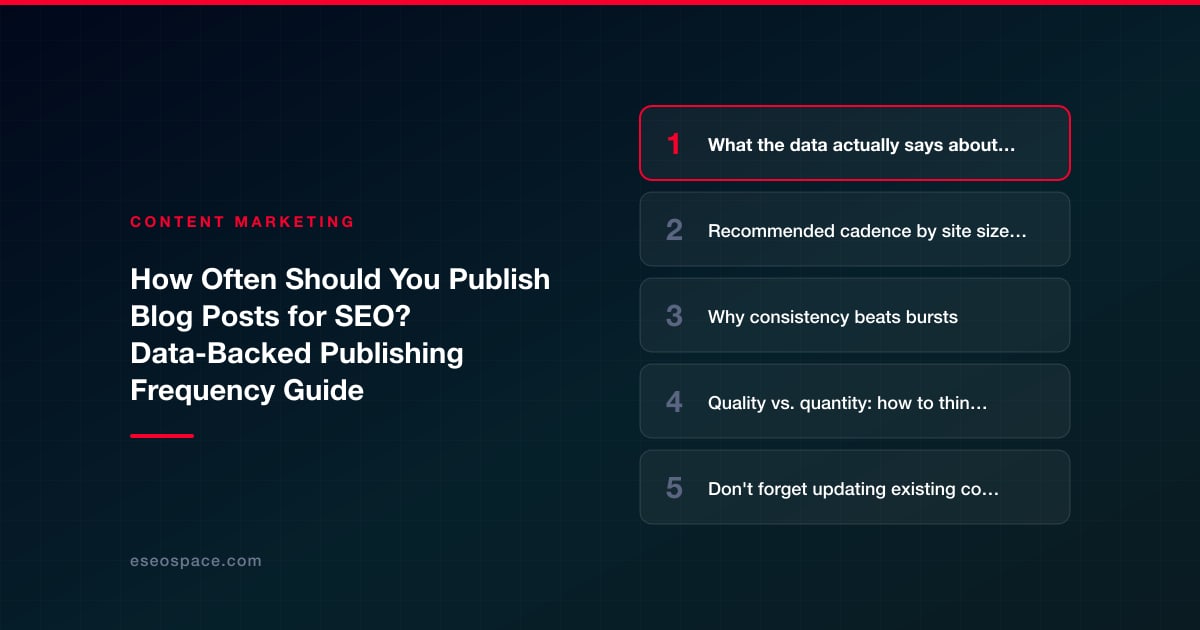
What the data actually says about publishing frequency
The widely cited benchmarks paint a consistent picture: more publishing correlates with more organic traffic, but with sharply diminishing returns and a heavy dependency on quality. Here's how to read the research without being misled by it:
- HubSpot's data found sites publishing 16+ posts per month got roughly 3.5x the traffic of those publishing 0-4. But these are typically funded content teams, not solo founders.
- Correlation is not causation. High-frequency publishers also tend to have bigger budgets, better writers, stronger backlink profiles, and more mature sites. Frequency is often a symptom of investment, not the sole cause of results.
- Quality thresholds dominate. Backlinko and Ahrefs analyses consistently find that the vast majority of published pages get little to no organic traffic. Publishing more low-value posts simply produces more zero-traffic pages.
- Freshness matters for some queries. Google's freshness signals reward recency on time-sensitive topics (news, annual guides, pricing) but are nearly irrelevant for evergreen how-to content.
The practical takeaway: consistency and quality beat raw volume. A site that publishes one genuinely excellent, comprehensive post per week for two years will almost always outperform one that dumps 20 thin posts in a month and then goes quiet.
Recommended cadence by site size and stage
Your right frequency depends far more on your resources and site maturity than on any universal number. Use these ranges as starting points:
- New site (0-6 months, few pages): 2-4 quality posts per month. Your priority is building a foundation of cornerstone content and earning your first indexed, ranking pages. Don't sprint before you can crawl.
- Growing site (6-24 months): 4-8 posts per month. This is where consistent momentum compounds. Focus on filling topic clusters and building internal links between related posts.
- Established site with a team: 8-16+ posts per month, but only if you can maintain quality. At this scale, a dedicated writer or agency and a real editorial process are non-negotiable.
- Small business / solo founder: 1-2 excellent posts per month is completely legitimate. Sustainability wins. A well-planned content marketing strategy at a modest cadence beats an ambitious plan you abandon in month three.
Notice that even the low end of these ranges assumes consistency. Publishing four posts one month and zero for three months is worse for both readers and search engines than a steady two per month.
Why consistency beats bursts
Search engines allocate crawl budget partly based on how frequently a site produces new or updated content. A site that publishes on a predictable rhythm trains Googlebot to return often, which means new posts get discovered and indexed faster. Erratic bursts followed by silence do the opposite: crawl frequency drops, and your next flurry takes longer to get picked up.
Consistency also builds two things that compound over time:
- Topical authority. Regularly covering related subtopics tells Google your site is a comprehensive resource on a subject, which lifts rankings across the entire cluster, not just individual posts.
- Audience habit and links. Readers, subscribers, and other publishers reward reliability. The blogs people link to and share are the ones that show up dependably, not the ones that appear and vanish.
A realistic weekly or biweekly cadence you can hold for years will beat a heroic monthly output that burns out your team. When you plan a schedule, plan for your worst month, not your best.
Quality vs. quantity: how to think about the tradeoff
The frequency question is really a resource-allocation question. Every hour spent producing a mediocre post is an hour not spent making an existing post genuinely competitive. Before adding to your cadence, pressure-test each planned piece against these questions:
- Does a real search query exist for this, with intent I can satisfy better than page one currently does?
- Can I bring genuine expertise, original data, examples, or a clearer explanation, rather than paraphrasing what already ranks?
- Will this earn links or engagement, or is it filler to hit a number?
If you can't clear that bar consistently at your target frequency, lower the frequency. Thin, redundant content can actively drag down a domain by diluting relevance signals and wasting crawl budget on pages nobody wants. Aligning cadence with real search demand is core to effective search engine optimization: publish to cover the queries your audience actually has, not to satisfy an arbitrary quota.
A useful mental model: it is better to own one topic completely with five deep, interlinked posts than to touch fifteen topics shallowly.
Don't forget updating existing content
One of the most overlooked levers in publishing strategy is that updating counts as publishing activity, and often delivers a higher ROI than a brand-new post. Refreshing a post that already has some authority and rankings can produce faster, larger gains than starting from a blank page.
Build content refreshes directly into your cadence:
- Audit quarterly for posts that have slipped in rankings, contain outdated stats or years, or reference deprecated tools.
- Update the highest-potential first: pages ranking positions 5-15 that a refresh could push onto page one deliver the best return.
- Substantively improve rather than change a date. Add new sections, fresh data, better examples, and updated internal links so the refresh genuinely serves searchers.
A mature strategy might dedicate 30-40% of content hours to updates rather than net-new posts. This is why a raw "posts per month" number understates a healthy program's real output.
How to build a sustainable publishing schedule
Turn all of this into a plan you can actually run:
- Start from capacity, not ambition. Honestly estimate how many quality pieces you (or your writer) can produce per month at a level you're proud of, then commit to the low end of that.
- Build an editorial calendar organized by topic cluster, not random ideas, so each post reinforces a broader theme and internal linking structure.
- Batch the workflow (research, outline, draft, edit, publish) so you're not context-switching, and keep a buffer of two to three finished posts ahead of your publish date.
- Track leading indicators, indexed pages, impressions, and keyword coverage in Google Search Console, not just traffic, which lags by months.
- Reassess quarterly. If quality is holding and you have bandwidth, increase cadence. If quality is slipping, cut back without guilt.
If producing consistent, high-quality content in-house isn't realistic, that's exactly where partnering with a team makes sense. eSEOspace's content marketing services exist to keep a reliable, quality-first cadence running so your blog compounds instead of stalling.
The best publishing frequency for SEO is the fastest cadence at which you can maintain genuine quality and never go dark. For most businesses that's somewhere between one post a week and one post a month, paired with disciplined updates to what you've already published. Pick a number you can defend for a year, then focus your energy on making each post the best answer to a real question.
Get a FREE Audit
We'll perform a comprehensive SEO, AEO, GEO & CRO audit of your website — completely free — and show you exactly how to outrank your competitors.
Don't have a site yet? Get in touch →
Put this into action with eSEOspace
We help businesses grow with website development that actually performs. Explore the services behind this guide:
Frequently Asked Questions
How often should a small business publish blog posts?
Does publishing more blog posts improve SEO?
Is it better to publish weekly or daily?
Does updating old posts count toward publishing frequency?
How long does blog publishing take to affect SEO rankings?
Get a FREE GEO/AEO/SEO Audit
We'll analyze your site's SEO, GEO, AEO & CRO — completely free — and show you exactly how to get found across Google and AI answers.
Don't have a site yet? Get in touch →
Great — your audit is on the way!
We'll send your free SEO/GEO/AEO/CRO audit within the next few hours. Where should we send it?
You're all set! ✓
Your free audit is being prepared — check your inbox in the next few hours. Talk soon!








