



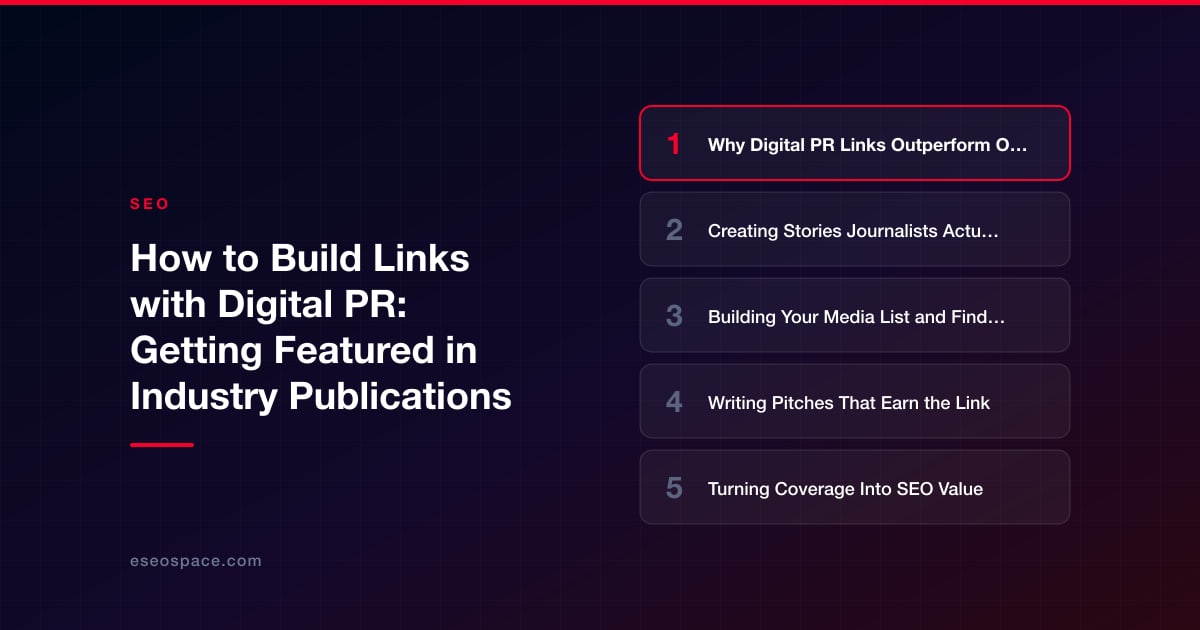
How to Build Links with Digital PR: Getting Featured in Industry Publications
How to Build Links with Digital PR: Getting Featured in Industry Publications
Key Takeaways
- Digital PR link building earns editorial backlinks from real journalists and publications, making them far more valuable and durable than manufactured links.
- The most linkable assets are original data, surveys, expert commentary on breaking news, and genuinely useful how-to expertise packaged for a reporter's audience.
- Precision targeting the specific journalist who covers your exact beat beats mass outreach; a focused list of 30 to 50 relevant contacts outperforms thousands.
- Winning pitches lead with the story not the sender, state the news in the first sentence, include proof, and make the reporter's next step effortless.
- Capture full value after publication by confirming link attributes, reclaiming unlinked mentions, amplifying coverage, and measuring referring domains and rankings.
Digital PR link building is the practice of earning editorial backlinks from journalists, editors, and industry publications by giving them something genuinely worth writing about. Unlike guest posting or link exchanges, a digital PR link comes embedded in real news coverage, expert commentary, or a data story that a reporter chose to publish because it served their audience. That editorial context is exactly why these links carry so much weight with search engines.
For most businesses, the hard part is not understanding that press coverage helps SEO. It is knowing how to consistently produce stories publications want, find the right journalists, and pitch them in a way that earns a link instead of a polite decline. This guide walks through the full workflow we use to turn subject-matter expertise into featured placements and durable backlinks.
Whether you are a founder doing your own outreach or an in-house marketer building a repeatable program, the principles below apply the same way. The goal is not one lucky hit. It is a system that reliably converts your knowledge into coverage that both drives referral traffic and strengthens your broader SEO performance.
Why Digital PR Links Outperform Other Link Types
Search engines have spent years learning to distinguish links that were earned from links that were manufactured. Editorial links from established publications are the gold standard because they are hard to fake: a real editor with a reputation to protect chose to reference you. That editorial judgment is a signal no link scheme can replicate at scale.
Digital PR links tend to outperform other tactics for several concrete reasons:
- Topical and domain authority. Industry publications typically have strong, relevant authority. A single link from a respected trade outlet can move the needle more than dozens of low-quality directory links.
- Contextual relevance. When a journalist links to you inside an article about your exact field, the link sits in perfectly relevant context, which reinforces your site's topical relevance.
- Compounding coverage. One strong story often gets syndicated or picked up by secondary outlets, multiplying the links from a single pitch.
- Brand signals beyond the link. Even unlinked mentions build recognition. Our approach to digital PR and brand mentions treats these citations as valuable SEO and trust signals in their own right.
This is the difference between chasing links and earning them. A sustainable program built around genuine newsworthiness ages far better than any shortcut, and it rarely triggers the risk that comes with manipulative link building tactics.
Creating Stories Journalists Actually Want
The single biggest reason pitches fail is that they lead with what the company wants instead of what the publication's readers need. Journalists are not looking for your product news. They are looking for stories that inform, surprise, or help their audience. Your job is to package your expertise into that shape.
The most reliable digital PR angles include:
- Original data and surveys. Proprietary data is the most linkable asset you can create. Survey your customers, analyze anonymized platform data, or aggregate public datasets into a fresh finding. Journalists link to the source of a statistic, and that source can be you.
- Expert commentary on breaking news. When something happens in your industry, reporters need credible voices fast. Being reachable and quotable within hours is often the entire game.
- Contrarian or trend-defining takes. A well-argued position that challenges conventional wisdom gives editors a reason to feature you as a distinct point of view.
- Practical how-to expertise. Deeply useful, specific guidance that a writer can cite as an authoritative explanation of how something works.
Before you pitch anything, pressure-test the angle with one question: would a reader who has never heard of your company still find this interesting? If the answer is no, keep refining until it is yes.
Building Your Media List and Finding the Right Journalists
A great story sent to the wrong person goes nowhere. Precision targeting is what separates programs that land coverage from those that only generate ignored emails. You want the specific reporter who covers your exact beat, not a generic tips inbox.
To build a high-quality media list:
- Read the publication first. Identify writers who have covered adjacent topics in the last few months. Their recent bylines tell you what they care about right now.
- Find verified contact details. Use tools like a media database, the reporter's own social profiles, or their publication bio. Many journalists list a preferred contact method or pitch guidelines directly.
- Track beats, not just outlets. A reporter may move publications; following the person keeps your relationships intact.
- Use journalist request services. Platforms where reporters actively request sources are a fast way to earn coverage because the demand already exists. Answer quickly, specifically, and with credentials.
Keep your list organized in a simple spreadsheet or CRM with the journalist's name, outlet, beat, last relevant article, and pitch status. A well-maintained list of even 30 to 50 truly relevant contacts will outperform a blast to thousands of unqualified addresses.
Writing Pitches That Earn the Link
Your pitch is a sales document with a five-second window. Editors receive dozens or hundreds of emails a day, so structure and brevity are everything. The best pitches read like the reporter could almost publish them as-is.
A strong pitch follows a tight formula:
- A subject line that promises the story, not the sender. Lead with the hook or the data point, not your company name.
- A first sentence that states the news. Give the finding or angle immediately. Do not bury it under introductions.
- Proof and specifics. Include the key statistic, the sample size, or the concrete detail that makes the story credible and quotable.
- An easy next step. Offer the full dataset, an interview, images, or a ready quote. Reduce the reporter's effort to near zero.
- A short, credible signature. Establish why you are a legitimate source in one line.
Personalize the opening line to reference the journalist's recent work, keep the entire email under 200 words, and never attach large files on the first touch. Follow up once, politely, after three to five business days. Persistence is fine; pestering is not. When you do earn coverage, a quick, genuine thank-you sets up the next story down the line.
Turning Coverage Into SEO Value
Landing the placement is not the finish line. To capture the full search value, you need to make sure the link is actually working for you and that you are amplifying it. Not every mention becomes a followed link automatically.
After a story publishes:
- Confirm the link and its attributes. Check whether you received a followed link, a nofollow, or an unlinked brand mention. If you were mentioned without a link, a courteous request to add one often succeeds.
- Point links to the right pages. Where you have influence over the destination, direct authority toward pages that need it, such as key service or resource pages, so the equity flows where it helps rankings most.
- Amplify the coverage. Share the piece on your channels and reference it in future pitches. Social traction can encourage additional pickups.
- Pursue syndication. Many outlets republish content across a network. Track those secondary versions, as each can carry its own link.
Reclaiming unlinked mentions is one of the highest-return activities in the entire process because the editorial trust already exists. You are simply asking to formalize a citation the writer already made.
Measuring and Scaling a Digital PR Program
A digital PR effort only becomes a program when you can measure it and repeat what works. Vanity metrics like raw placement counts tell you little on their own. Focus on the outcomes that connect coverage to business and search results.
Track these core metrics:
- Referring domains earned. The number of new, unique domains linking to you is the clearest measure of link-building impact.
- Link quality and relevance. Weight coverage by the authority and topical fit of the linking publication, not just volume.
- Pitch-to-placement rate. Knowing how many pitches it takes to earn one link tells you where to improve your angles or targeting.
- Referral traffic and conversions. Coverage that sends engaged visitors who convert proves value beyond SEO.
- Ranking movement. Watch how target pages that received links move over the following weeks and months.
To scale, document your winning angles into repeatable campaign templates, build a content calendar around predictable data releases, and nurture relationships with the journalists who have covered you before. A reporter who has published your work once is far more likely to do so again. Over time, this compounds into a steady stream of authoritative links that feeds directly into your organic growth, making digital PR one of the most durable investments in modern SEO.
Get a FREE Audit
We'll perform a comprehensive SEO, AEO, GEO & CRO audit of your website — completely free — and show you exactly how to outrank your competitors.
Don't have a site yet? Get in touch →
Put this into action with eSEOspace
We help businesses grow with website development that actually performs. Explore the services behind this guide:
Frequently Asked Questions
What is digital PR link building?
How is digital PR different from traditional link building?
What kind of content earns the most media links?
How do I find the right journalists to pitch?
How do you measure digital PR link building success?
Get a FREE GEO/AEO/SEO Audit
We'll analyze your site's SEO, GEO, AEO & CRO — completely free — and show you exactly how to get found across Google and AI answers.
Don't have a site yet? Get in touch →
Great — your audit is on the way!
We'll send your free SEO/GEO/AEO/CRO audit within the next few hours. Where should we send it?
You're all set! ✓
Your free audit is being prepared — check your inbox in the next few hours. Talk soon!








