Link Building for Small Business Websites: Budget-Friendly Strategies That Work
Link Building for Small Business Websites: Budget-Friendly Strategies That Work
Key Takeaways
- Small businesses win at link building through a small number of relevant, trusted links, not high volume or big budgets.
- Claim foundational citations first: business listings, niche directories, supplier pages, and local sponsorships you already qualify for.
- One genuinely useful asset (original data, a definitive guide, or a free tool) becomes the reason other sites link to you.
- Personalized, small-scale outreach and expert commentary for journalists earn higher-authority links than any paid package.
- Avoid bulk link packages, paid do-follow links, and exact-match anchors; measure referring domains and stay consistent over quarters.
For a small business, backlinks feel like a rich-competitor problem. The agencies with five-figure retainers seem to buy their way to page one while you are trying to justify spending anything at all on link building. The good news is that Google does not rank the biggest budget. It ranks the site that has earned relevant, trustworthy references from other sites, and a focused small business can earn those with time, a bit of hustle, and almost no cash.
The trap most small businesses fall into is either doing nothing (hoping great content magically attracts links) or buying cheap packages of spammy directory and forum links that do more harm than good. The middle path is a small number of deliberate, high-quality links from sites your customers and Google already trust. This guide covers exactly where to find those links, how to earn them without a big budget, and how to avoid the tactics that waste money or trigger penalties.
Below are the strategies that actually move the needle for a local plumber, a boutique law firm, a specialty ecommerce shop, or a two-person SaaS. None of them require an enterprise budget. All of them require consistency.
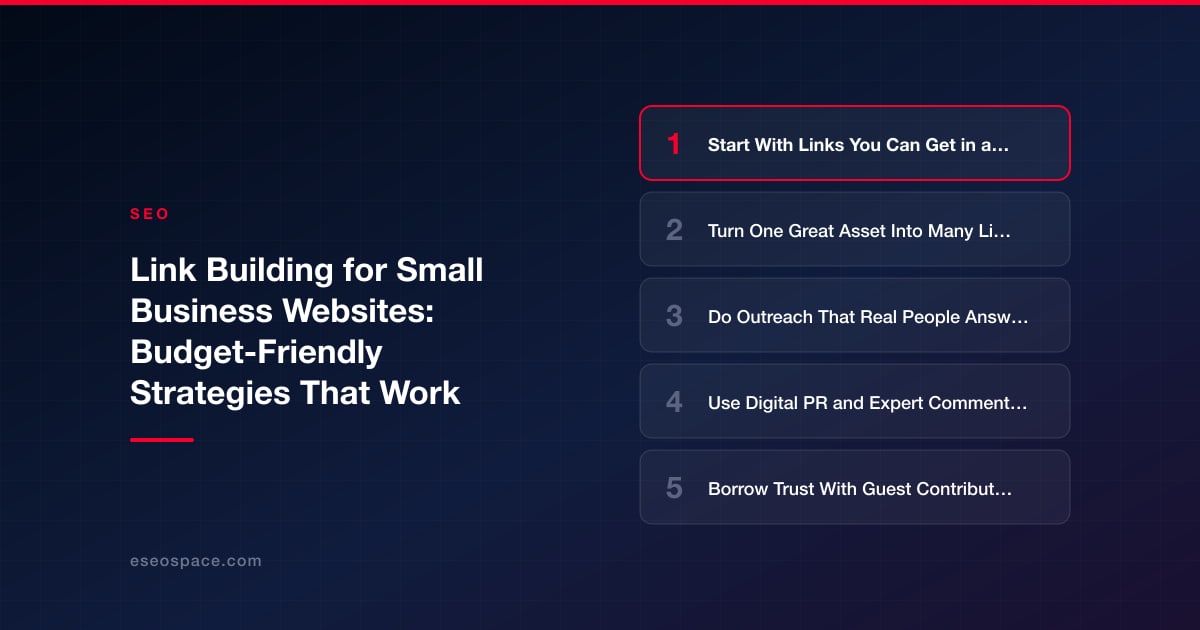
Start With Links You Can Get in an Afternoon
Before any outreach, claim the links that are yours by right. These are free, fast, and foundational for local and small-business SEO. Most competitors never fully complete this list.
- Core business listings: Google Business Profile, Bing Places, Apple Business Connect, and your Yelp and Facebook business pages. These carry citation and reference value even where links are nofollow.
- Industry and niche directories: Your chamber of commerce, trade associations you belong to, and reputable vertical directories (Avvo for lawyers, Houzz for home services, Clutch for agencies). Pay only where the directory sends real referral traffic.
- Supplier and partner pages: The brands you sell, the software you use, and the vendors you partner with often maintain "where to buy" or "partners" pages. Ask to be listed.
- Local sponsorships and memberships: A youth team, a nonprofit, a local event you already support usually links to sponsors. If you are giving money anyway, ask for the link.
Aim to complete 15 to 30 of these foundational citations. They rarely move rankings on their own, but they establish the baseline trust and consistency (name, address, phone) that everything else builds on.
Turn One Great Asset Into Many Links
You do not need a content team to earn editorial links. You need one genuinely useful asset that other people in your niche want to reference. Small businesses have an advantage here: you own real data and firsthand expertise that big brands only guess at.
Effective link-earning assets tend to be one of these:
- Original local or industry data: average pricing in your city, seasonal demand patterns, a survey of your customers. Journalists and bloggers link to a source, and your data can be the source.
- A definitive how-to or checklist that genuinely outdoes what currently ranks, complete with specifics only a practitioner would know.
- A free tool or calculator, even a simple one: a cost estimator, a sizing guide, a template download.
Build the asset once, then spend the next few months promoting it. The asset is the reason someone links; the outreach is how they find out it exists. A well-structured content and SEO strategy treats these assets as long-term link magnets rather than one-off blog posts, and pairs each one with a short list of sites likely to reference it.
Do Outreach That Real People Answer
Cold outreach has a bad reputation because most of it is lazy and mass-blasted. Small-scale, personalized outreach still works remarkably well precisely because the inbox competition is so bad. Your advantage is that you can send 20 thoughtful emails a week rather than 2,000 generic ones.
A few outreach angles that consistently earn links on a small budget:
- The resource-page pitch: Search for pages that already curate links in your niche ("best resources for [topic]", "helpful links"). Suggest your asset as an addition, briefly explaining why it fits.
- The broken-link fix: Find a dead link on a relevant page, tell the site owner, and offer your working resource as the replacement. You are doing them a favor first.
- The unlinked-mention claim: If someone names your business without linking, a two-line email asking them to make the mention clickable converts often.
Keep emails short, name the specific page you are writing about, and lead with what is in it for them. Personalize the first line so it is obvious you actually read their site. Expect a response rate in the low double digits when you do this well, which is plenty when each link compounds over time. If outreach is not something you have hours for, a specialized link building service can run these campaigns at a predictable cost while you keep serving customers.
Use Digital PR and Expert Commentary
You are an expert in your field, and journalists need experts to quote. Signing up for reporter-query services and pitching yourself as a source is one of the highest-return activities available to a small business, because a single placement can land a link on a genuinely authoritative news or industry site.
To make it work:
- Respond fast. Reporters work on deadlines, and the first few useful replies usually win the quote.
- Answer only queries where you have real, specific expertise. Generic quotes get ignored.
- Give a quotable, complete answer in the email itself so the reporter can copy and paste.
Beyond reactive queries, proactive digital PR and brand mentions such as commenting on a local news story, offering seasonal safety tips, or reacting to an industry development can earn coverage that no directory link ever matches in authority. For a local business, a single link from a city newspaper or a respected trade publication can outweigh dozens of low-value links combined.
Borrow Trust With Guest Contributions and Partnerships
Writing for other sites is still legitimate when the goal is reaching a relevant audience, not stuffing keyword-rich anchor text into low-quality blogs. The distinction matters, and Google has gotten precise about it.
Do it the right way:
- Target sites your customers actually read, not networks that publish anything for a fee. A link from one respected niche blog beats ten from generic "write for us" farms.
- Contribute genuinely useful content with your expertise front and center. The link in your bio or context should feel earned, not bolted on.
- Trade audiences with non-competing local businesses. A wedding photographer, a florist, and a venue can cross-reference each other on resource pages and in blog posts. These partnerships are free and durable.
Co-marketing is underrated. A joint guide, a webinar, or a case study with a partner gives both sites a natural reason to link, and neither party pays for it.
Avoid the Tactics That Waste Money or Cause Harm
Just as important as knowing what to do is knowing what to skip. Small budgets get drained by tactics that promise volume and deliver risk. Steer clear of the following:
- Bulk link packages promising hundreds of backlinks for a flat fee. These are almost always spun-content, private-network, or spammy-directory links that Google discounts or penalizes.
- Paid links that pass PageRank without a nofollow or sponsored tag. Buying rankings directly violates Google's guidelines and can trigger manual actions.
- Comment and forum spam, which wastes hours for links that carry essentially no value.
- Exact-match anchor text at scale. Natural link profiles use branded and varied anchors; a wall of keyword-rich anchors is a classic spam signal.
If a service cannot tell you which specific sites your links will come from, that is your answer to walk away. Quality is verifiable; volume for its own sake is a red flag.
Measure What Matters and Stay Consistent
Link building is a compounding activity, not a campaign with an end date. Track a small set of metrics so you know it is working and can double down on what performs.
- Referring domains (the count of unique sites linking to you) matters more than raw link count. Ten links from ten sites beat fifty links from one.
- Relevance and traffic of linking sites. A link that sends real visitors is doing double duty.
- Rankings and organic traffic for your target pages over quarters, not weeks. Links take time to be credited.
Set a realistic pace: a handful of quality links per month, earned through the methods above, will outperform any shortcut over a year. The businesses that win at link building on a budget are simply the ones that keep showing up, keep pitching, and keep publishing things worth linking to. Consistency, not cash, is the real budget here.
Get a FREE Audit
We'll perform a comprehensive SEO, AEO, GEO & CRO audit of your website — completely free — and show you exactly how to outrank your competitors.
Don't have a site yet? Get in touch →
Put this into action with eSEOspace
We help businesses grow with website development that actually performs. Explore the services behind this guide:
Frequently Asked Questions
How much should a small business spend on link building?
How many backlinks does a small business website need to rank?
Are free directory links still worth getting?
How long does link building take to affect rankings?
Can buying backlinks hurt my small business site?
Get a FREE GEO/AEO/SEO Audit
We'll analyze your site's SEO, GEO, AEO & CRO — completely free — and show you exactly how to get found across Google and AI answers.
Don't have a site yet? Get in touch →
Great — your audit is on the way!
We'll send your free SEO/GEO/AEO/CRO audit within the next few hours. Where should we send it?
You're all set! ✓
Your free audit is being prepared — check your inbox in the next few hours. Talk soon!


On this page
- Key Takeaways
- Start With Links You Can Get in an Afternoon
- Turn One Great Asset Into Many Links
- Do Outreach That Real People Answer
- Use Digital PR and Expert Commentary
- Borrow Trust With Guest Contributions and Partnerships
- Avoid the Tactics That Waste Money or Cause Harm
- Measure What Matters and Stay Consistent