



PPC vs. SEO vs. GEO: Where Should Your Marketing Budget Go in 2026?
PPC vs. SEO vs. GEO: Where Should Your Marketing Budget Go in 2026?
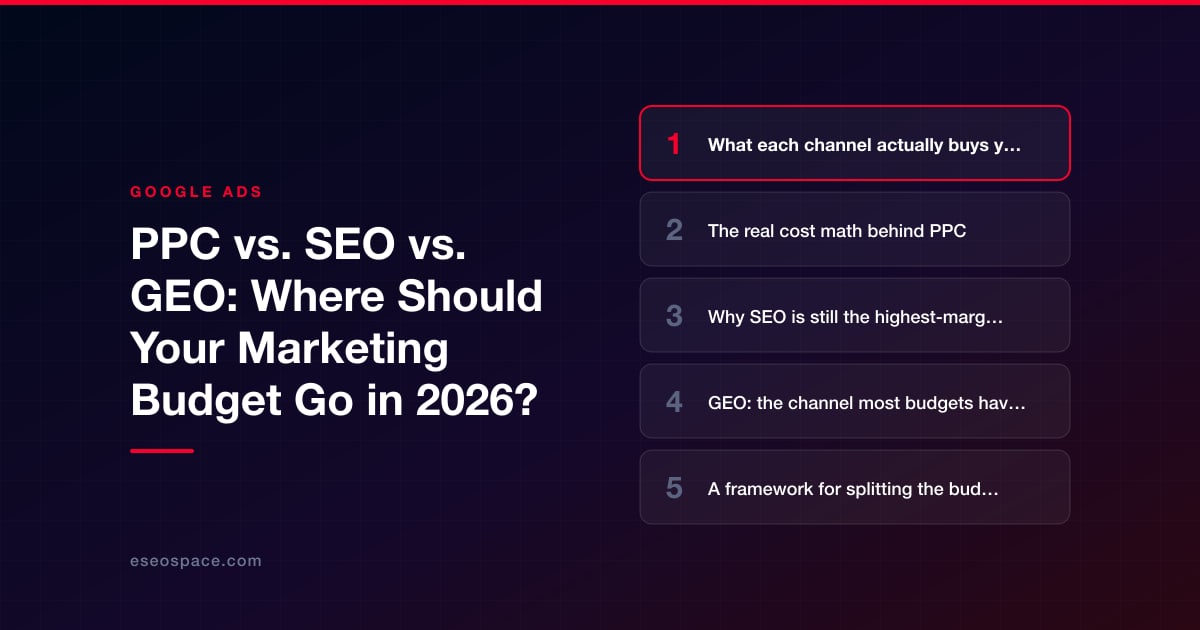
Key Takeaways
- PPC, SEO, and GEO are a portfolio with different time horizons, not competing vendors - PPC rents immediate demand, SEO builds an owned asset, and GEO claims presence inside AI-generated answers.
- PPC costs rise every year and the traffic stops the moment you stop paying, so use it for demand you need this quarter, not as your only channel.
- SEO is the highest-margin channel because its cost per visit trends toward zero over time, but its delayed payback makes it the easiest line item to wrongly cut.
- GEO is the least-competitive discovery surface in 2026; establishing presence in AI answers is cheap now and gets more expensive as competitors catch on.
- Weight the split to your constraints: PPC-heavy when you need revenue now, SEO-heavy for a 12-month horizon, and GEO up to 25-30% in categories already dominated by AI-assisted search.
Every marketing budget conversation eventually collapses into the same argument: pay for clicks now, or invest in rankings later? For years that was the whole debate. In 2026, a third line item has forced its way onto the spreadsheet: GEO, or generative engine optimization. When a growing share of your buyers are asking ChatGPT, Google's AI Mode, Perplexity, and Gemini for recommendations instead of scrolling ten blue links, the old PPC-versus-SEO math no longer describes the whole market.
The honest answer to "where should my budget go" is that it depends on your sales cycle, your margins, your cash position, and how much of your category has already moved to AI-assisted search. But "it depends" is useless without a framework. This post gives you one: how each channel actually spends money, what payback looks like, and how to divide a finite budget so you are not starving the channel that will matter most 18 months from now.
We build and run all three of these channels for clients, and the pattern is consistent. The businesses that win treat PPC, SEO, and GEO as a portfolio with different risk and time horizons, not as three vendors competing for the same dollar.
What each channel actually buys you
Before you can allocate a budget you have to be precise about what you are purchasing. These three channels are not interchangeable traffic sources. They occupy different points on the timeline and the funnel.
- PPC (paid search and paid social) buys immediate, controllable volume. You turn it on today and get clicks tomorrow. You stop paying, the traffic stops. It is rented demand capture.
- SEO buys a durable asset. Rankings and content compound, cost per visit trends toward zero over time, and the traffic keeps arriving after you stop actively investing. It is owned demand capture that takes months to build.
- GEO buys presence inside AI-generated answers. When someone asks an assistant "who's the best commercial roofer in Denver" or "compare project management tools for agencies," GEO is the work that improves the odds that your brand is named, cited, and recommended in that synthesized response.
PPC gives you speed and precision. SEO gives you durability and margin. GEO gives you visibility in the fastest-growing, least-competitive discovery surface. A budget that only funds one of these is optimizing for a single variable and ignoring the other two.
The real cost math behind PPC
PPC's appeal is that the math is legible on day one. You can calculate a cost per acquisition within a week and scale up or shut off based on hard numbers. That transparency is exactly why it is easy to over-index on it.
The problem is that paid search costs have climbed relentlessly. In competitive B2B and legal, insurance, or home-services verticals, cost per click routinely runs from a few dollars into the tens or even hundreds of dollars, and those bids only move one direction over time. Every dollar you spend today buys slightly less than it did last year. You are also renting the audience: the moment your card declines, your pipeline goes to zero.
PPC earns its place in the budget when:
- You need leads this quarter, not next year, to hit a number or prove a new offer.
- You are launching a product or entering a market with no ranking history to lean on.
- Your unit economics can absorb the cost per acquisition profitably, even as CPCs rise.
- You want to test messaging, offers, and landing pages fast before committing to organic content around them.
A well-run paid search and SEM program is the right tool for demand you need to capture immediately. It is the wrong tool to be your only tool, because you are permanently paying rent on traffic that better-positioned competitors get for free.
Why SEO is still the highest-margin channel
SEO inverts the PPC cost curve. The investment is front-loaded and the payoff is back-loaded. You spend for three to nine months building content, earning links, and fixing technical foundations before meaningful traffic arrives, and then the effective cost per visit falls quarter after quarter as that content keeps ranking.
That delayed payback is exactly why undisciplined budgets underfund it. When cash is tight, the channel that pays off in month seven is the easiest one to cut, which is precisely how companies stay dependent on ever-more-expensive clicks. The businesses with the healthiest customer acquisition costs are almost always the ones that funded organic search consistently through the slow early months.
SEO deserves the largest share of a growth-oriented budget when:
- Your buyers research before they purchase and your category has real search volume.
- You can commit to at least a two- to three-quarter horizon without panicking over month-one results.
- You want to lower blended acquisition cost over time rather than watch it climb.
- You are building a brand asset you own, not one you rent from an ad platform.
Strong SEO services also do double duty in 2026: the same authoritative, well-structured content that ranks in classic search is the raw material AI engines pull from when they generate answers. Which is the bridge to the newest line item.
GEO: the channel most budgets haven't accounted for yet
Generative engine optimization is the practice of getting your business cited, quoted, and recommended inside AI-generated answers. As users increasingly start their research inside ChatGPT, Perplexity, Gemini, and Google's AI Mode, a meaningful slice of your potential traffic never reaches a traditional results page at all. The AI answers the question directly, and apart from the clearly labeled ads ChatGPT now shows to Free and Go users in the US, the brands that benefit are the ones the model chose to name.
GEO is not a separate content factory bolted onto your SEO. For Google's AI Overviews and AI Mode, Google's May 2026 guide says optimizing for generative AI search is still SEO, and Search Console's Generative AI performance report now shows how your pages perform there. For ChatGPT, Perplexity, and other assistants, GEO also pays attention to how large language models retrieve and synthesize information. In practice that means:
- Writing content that answers questions directly and completely, in the phrasing real people use, so models can lift clean, quotable passages.
- Building entity authority: consistent mentions of your brand, expertise, and specifics across the web that models associate with your name.
- Structuring pages with clear headings, FAQs, and comparison tables so readers and machines can parse and cite them, with schema as an optional extra (Google says no special markup is needed for its AI features).
- Earning citations and mentions on the third-party sources these engines trust and pull from.
The strategic argument for funding GEO now is simple: the competition is still thin. Many smaller competitors have not yet reallocated budget toward it, which means the cost of establishing presence may be lower today than it will be as the surface matures. Under-investing here in 2026 is the same mistake companies made by ignoring organic search in 2011.
A framework for splitting the budget
There is no universal percentage, but there is a defensible way to reason about the split. Start with your constraints, then weight the channels against them.
If you need revenue immediately (new business, tight runway, quarterly pressure), weight toward PPC: roughly 50-60% paid, 25-30% SEO, 10-15% GEO. You buy time with paid clicks while the compounding channels build in the background. The mistake is spending 100% here and never funding an exit from the rent.
If you have stable revenue and a 12-plus-month horizon, flip it: roughly 25-35% PPC to hold demand capture, 40-50% SEO to drive down blended acquisition cost, and 20-25% GEO to claim the emerging surface early. This is the allocation that lowers your cost per customer year over year.
If your category has already moved heavily to AI-assisted search (software, professional services, considered B2B purchases), pull GEO up to 25-30% even at the expense of PPC, because that is where your buyers' first questions are increasingly being answered.
Two rules cut across every scenario. First, never let one channel be your only channel - single-channel dependency is a business risk, not a budget efficiency. Second, protect the compounding channels from short-term cuts; SEO and GEO only pay off if you fund them through the quiet early months, and the discipline to do that is what separates companies with falling acquisition costs from companies trapped on the paid treadmill.
The right answer for 2026 is not PPC or SEO or GEO. It is a deliberate portfolio: paid for the demand you need today, organic for the margin you want tomorrow, and generative optimization for the discovery surface that is quietly becoming the front door to your entire market.
Get a FREE Audit
We'll perform a comprehensive SEO, AEO, GEO & CRO audit of your website — completely free — and show you exactly how to outrank your competitors.
Don't have a site yet? Get in touch →
Put this into action with eSEOspace
We help businesses grow with website development that actually performs. Explore the services behind this guide:
Frequently Asked Questions
What percentage of my budget should go to PPC vs SEO?
Is PPC or SEO better for a small business in 2026?
What is GEO and why does it matter for my budget?
How long before SEO pays off compared to PPC?
Can GEO and SEO share the same budget and content?
Get a FREE GEO/AEO/SEO Audit
We'll analyze your site's SEO, GEO, AEO & CRO — completely free — and show you exactly how to get found across Google and AI answers.
Don't have a site yet? Get in touch →
Great — your audit is on the way!
We'll send your free SEO/GEO/AEO/CRO audit within the next few hours. Where should we send it?
You're all set! ✓
Your free audit is being prepared — check your inbox in the next few hours. Talk soon!








