What to Expect When You Hire a Website Development Agency: A Client's Guide
What to Expect When You Hire a Website Development Agency: A Client's Guide
Key Takeaways
- Reputable agencies begin with a discovery phase of interviews and research, and a firm price quoted before any questions is a warning sign.
- Design proceeds from grayscale wireframes to polished visuals in a fixed number of revision rounds, so consolidate feedback to protect the timeline.
- Content and timely decisions are the client's responsibility, and they are the most common cause of stalled projects, so budget for copywriting if your team can't produce it.
- Confirm platform fit, a staging environment, SEO foundations, and a 301 redirect plan before launch to avoid losing search rankings.
- Get code, domain, hosting ownership, revision limits, and a maintenance plan in writing before you sign, not after the invoice is paid.
Deciding to hire a website development agency is a meaningful commitment of budget, time, and trust. Whether you're launching a first site or replacing an aging one, the biggest source of frustration isn't the code or the design; it's the gap between what clients imagine the process will be and how it actually unfolds. Missed expectations around timelines, revisions, content, and ownership sink more projects than technical problems ever do.
This guide walks through what genuinely happens once you sign, from the first discovery call to the weeks after launch. Knowing the rhythm of a real engagement helps you show up prepared, ask sharper questions, and get far more value from the agency you choose. The goal here isn't to sell you on a process; it's to help you recognize a good one when you see it.
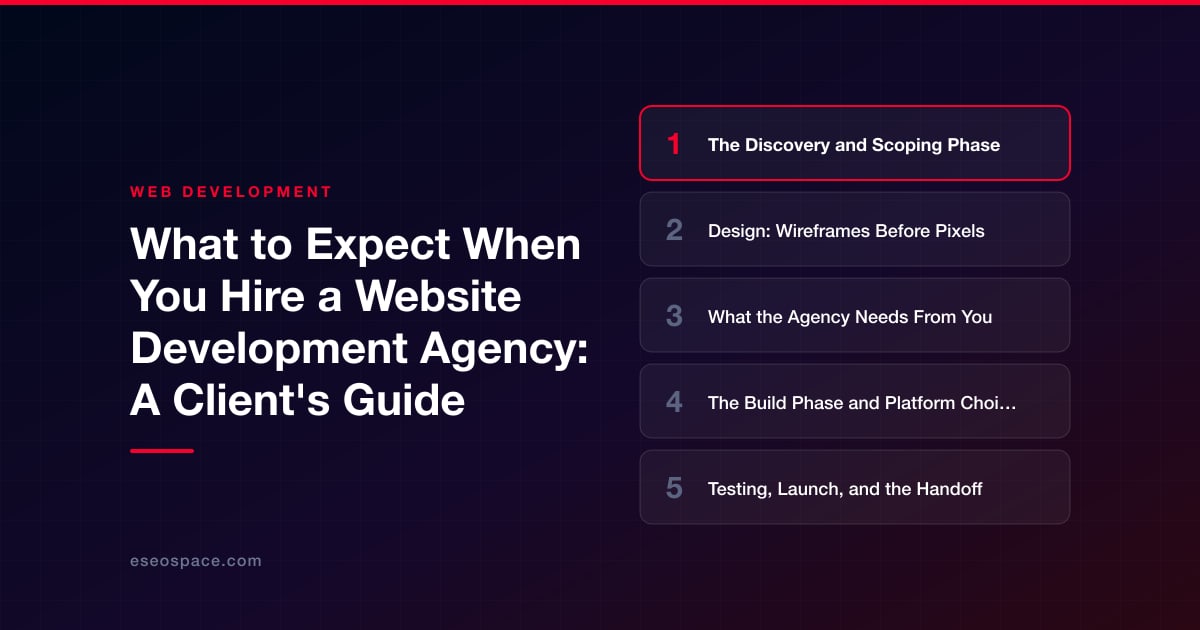
The Discovery and Scoping Phase
Before anyone touches a design or writes a line of code, a competent agency invests time understanding your business. Expect a discovery phase that includes stakeholder interviews, a review of your current analytics, competitor benchmarking, and a frank conversation about goals. If an agency quotes you a firm price and timeline in the first email without asking about your customers, conversion goals, or existing tech stack, treat that as a warning sign.
During discovery you should expect to be asked about:
- Your primary business objective for the site (leads, sales, bookings, credibility)
- Who your ideal customer is and how they currently find you
- Which existing pages, content, or integrations must be preserved or migrated
- Third-party tools you rely on (CRM, email platform, payment processor, booking systems)
- Brand assets you already have versus what needs to be created
The deliverable at the end of this phase is usually a scope document or proposal that spells out pages, features, milestones, and what is explicitly not included. Read the exclusions as carefully as the inclusions. A clear scope is your best protection against the dreaded mid-project surprise where a "simple" request turns out to be a paid change order.
Design: Wireframes Before Pixels
A frequent misunderstanding is that the agency will immediately show you a polished, colorful mockup. Good custom design and development work usually starts with low-fidelity wireframes: grayscale layouts that focus on structure, hierarchy, and user flow before anyone debates fonts or colors. This sequencing is deliberate. Approving structure first prevents you from re-litigating the entire layout after visual polish has been applied, which wastes everyone's time and budget.
Expect to review designs in rounds. Most agencies build a fixed number of revision cycles into the contract, commonly two or three rounds per major deliverable. Consolidate your feedback: gather input from all decision-makers and deliver one unified list rather than drip-feeding contradictory notes over several days. Scattered, conflicting feedback is the single most common cause of blown timelines, and it is almost always avoidable on the client's side.
What the Agency Needs From You
Here is the part that catches most first-time clients off guard: the project's speed depends heavily on you. Agencies can design and build quickly, but they cannot invent your content, and content is where projects stall. When you decide to hire a website development agency, plan to supply, or explicitly pay the agency to create:
- Written copy for each page, or approval of drafts the agency provides
- High-quality photos, logos, and brand guidelines
- Timely feedback within the agreed review windows
- Access credentials for your domain registrar, hosting, and any tools being integrated
- A single empowered point of contact who can make decisions
If your team cannot produce polished copy, say so upfront. Many agencies offer copywriting and content strategy as an add-on, and it is almost always worth the cost. A beautiful site wrapped around weak, placeholder-heavy content will underperform. Budget for content the same way you budget for design and development, because in practice it carries equal weight.
The Build Phase and Platform Choices
Once designs are approved, development begins. This is typically the longest and quietest stretch of the engagement, and silence here is normal, not a red flag. During the build, the agency converts approved designs into working, responsive pages, wires up forms and integrations, and configures your content management system. Expect a staging environment, a private preview URL where you can watch the site come together before it goes public.
Platform choice matters more than many clients realize. A WordPress development approach gives you a familiar, editable CMS with a vast plugin ecosystem, which suits content-heavy or frequently updated sites. Custom-coded or headless builds offer more performance and flexibility for complex, application-like needs. A trustworthy agency recommends the platform that fits your maintenance capacity and goals, not simply the one it prefers to build in. Ask directly why they're recommending a given stack and what it means for your ability to make edits later.
Throughout the build, watch for how the agency handles the fundamentals that don't show up in a pretty mockup:
- Performance: optimized images, fast load times, and clean code
- Responsiveness: proper behavior on phones, tablets, and desktops
- Accessibility: readable contrast, keyboard navigation, and alt text
- SEO foundations: clean URLs, metadata, structured headings, and a sitemap
Testing, Launch, and the Handoff
Before launch, expect a structured quality assurance phase. The agency should test forms, cross-browser rendering, mobile behavior, page speed, and broken links. You'll typically get a period of user acceptance testing (UAT) where you and your team click through everything and log issues. Treat this seriously; it is far cheaper to catch a broken contact form on staging than after your ad campaign is live and sending traffic to it.
Launch day itself is usually anticlimactic when planned well. A professional website development team coordinates DNS changes, sets up redirects from old URLs so you don't lose search rankings, installs analytics, and monitors for issues in the first hours after going live. Ask specifically about a 301 redirect plan if you're replacing an existing site; skipping this is one of the most common and damaging launch mistakes, quietly erasing years of accumulated SEO value.
Just as important is the handoff. Confirm before you sign who owns the code, the domain, the design files, and the hosting account. You should receive administrator access, not be locked into an arrangement where only the agency can touch your site. Clarify these ownership terms in the contract, not in a hopeful conversation after the invoice is paid.
Costs, Contracts, and Ongoing Support
Pricing models vary, and understanding them prevents sticker shock. Agencies commonly work on fixed-price arrangements for well-defined scopes, or hourly rates for open-ended or evolving work. Transparent hourly billing, in the range of many quality US agencies, makes it easy to reason about the cost of additions. Whatever the model, insist on a written contract that specifies deliverables, milestones, payment schedule, revision limits, and what happens if either party wants to pause or exit.
Finally, plan for life after launch. A website is not a one-time purchase; it is software that needs updates, security patches, and occasional fixes. Ask every agency you're evaluating:
- Do you offer a maintenance or care plan, and what does it cover?
- What is your response time for urgent issues like a site going down?
- Will you train our team to make basic content edits ourselves?
- What are your hourly rates for future enhancements outside a retainer?
The agencies worth hiring are the ones thinking about your success six months out, not just collecting a launch check. When you interview candidates, the quality of their questions tells you as much as the quality of their portfolio. An agency that pushes you to clarify goals, warns you about content timelines, and explains its process without being asked is one that has run this play many times and wants your project to actually work.
Get a FREE Audit
We'll perform a comprehensive SEO, AEO, GEO & CRO audit of your website — completely free — and show you exactly how to outrank your competitors.
Don't have a site yet? Get in touch →
Put this into action with eSEOspace
We help businesses grow with website development that actually performs. Explore the services behind this guide:
Frequently Asked Questions
How long does it take to build a website with an agency?
What does it cost to hire a website development agency?
Who owns the website after the project is finished?
What do I need to provide to the agency?
What happens after my new website launches?
Get a FREE GEO/AEO/SEO Audit
We'll analyze your site's SEO, GEO, AEO & CRO — completely free — and show you exactly how to get found across Google and AI answers.
Don't have a site yet? Get in touch →
Great — your audit is on the way!
We'll send your free SEO/GEO/AEO/CRO audit within the next few hours. Where should we send it?
You're all set! ✓
Your free audit is being prepared — check your inbox in the next few hours. Talk soon!