



Blog
Why High-Level Marketers Are Investing in GEO Education
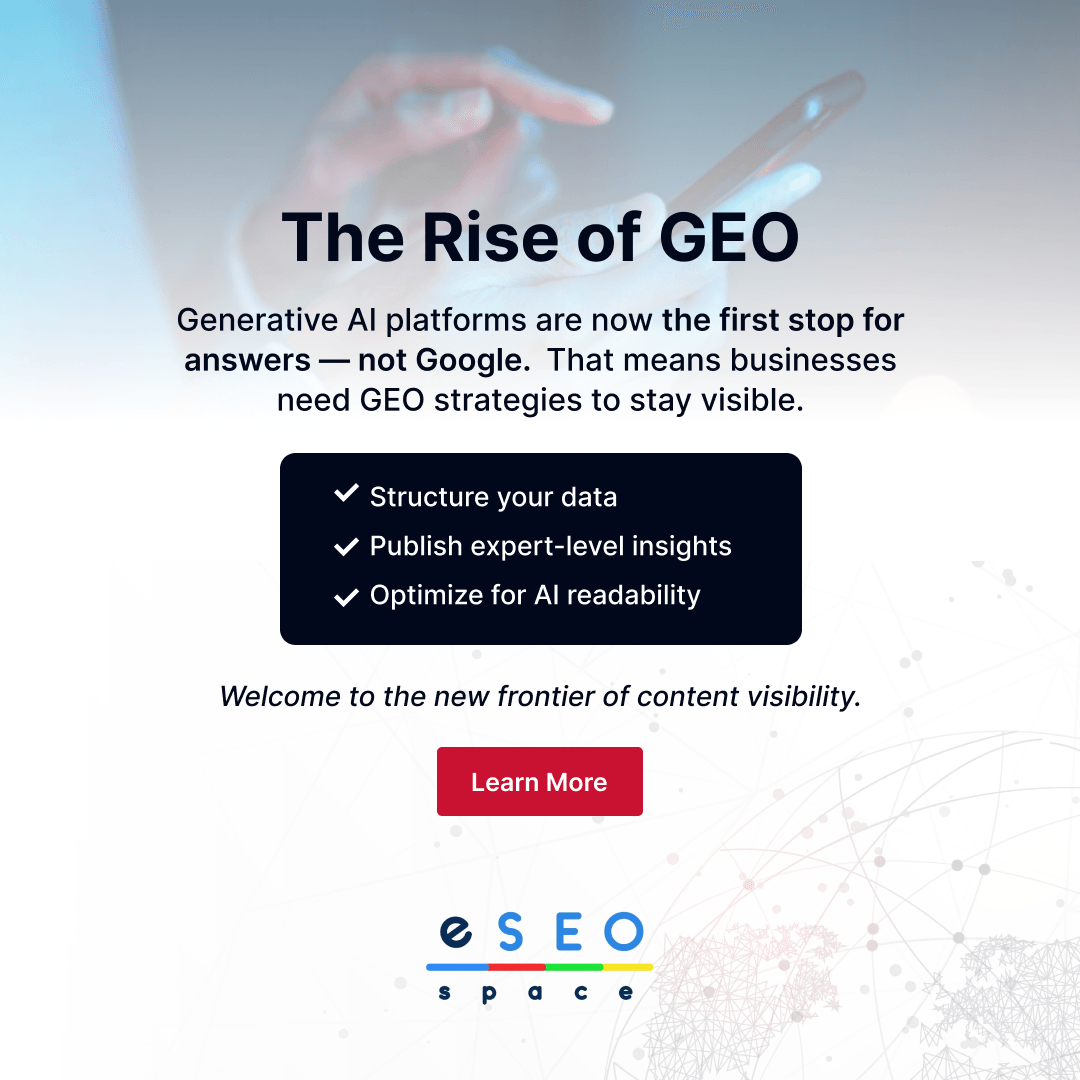
Key Takeaways
- Generative AI is re-architecting how customers discover and evaluate brands, making GEO education the most critical strategic move for CMOs.
- AI search engines like Google's AI Overviews and Perplexity synthesize direct conversational answers instead of link lists, breaking the traditional traffic-to-conversion model.
- Clicks are becoming an unreliable success metric, so budgets must shift from driving traffic toward becoming the trusted source of truth for AI.
- The disruption demands a new skills matrix and roles like GEO Strategist, plus clear, well-sourced content that states facts plainly.
- New KPIs such as share of voice in AI answers, source citations, and brand sentiment are replacing rankings, impressions, and click-through rates.
The most significant platform shift since the advent of mobile search is happening right now, and it demands your immediate attention. The rise of generative AI is fundamentally re-architecting how customers discover, evaluate, and interact with brands. For chief marketing officers and growth leaders, this isn't a distant technological trend; it's a present-day disruption to the core principles of brand visibility and customer acquisition. The strategic leaders who recognize this are no longer asking if they should adapt, but how. The definitive answer is through targeted, high-level Generative Engine Optimization (GEO) education.
This article is written for executives. It is not a tactical SEO guide. Instead, it provides a strategic framework for understanding why investing in GEO education for your team—and yourself—is the most critical move you can make to secure a competitive advantage for the next decade. We will explore the tangible ROI of this marketing innovation, unpack how it future-proofs your organization, and explain why traditional search optimization, while still necessary, is dangerously incomplete on its own. The question of why learn GEO is a question of market leadership.
Get a FREE Audit
We'll perform a comprehensive SEO, AEO, GEO & CRO audit of your website — completely free — and show you exactly how to outrank your competitors.
Don't have a site yet? Get in touch →
The AI Disruption in Search and Marketing
For twenty years, the digital marketing playbook has been relatively stable: create content, optimize it for search engines, build authority, and drive traffic to a owned property where conversion occurs. Generative AI shatters this linear model. AI-powered search engines like Google's AI Overviews and Perplexity are not just presenting a list of links; they are synthesizing information from across the web to provide a single, direct, conversational answer.
This has profound implications for your marketing organization:
- Budget Allocation: Your multi-million dollar investment in content marketing and SEO is at risk if it’s not designed to influence these new AI-driven results. Clicks, the primary currency of organic search, are becoming a less reliable metric of success. How do you reallocate budget when the goal shifts from driving traffic to becoming the source of truth for the AI?
- Organizational Design: Your SEO team may be experts at ranking for keywords, but are they equipped to structure data for machine learning models? Your content team writes for human readers, but can they create "atomic" content that serves as verifiable facts for an AI? The disruption necessitates a new skills matrix and potentially new roles, such as a "GEO Strategist" or "Head of AI Optimization."
- Measurement and KPIs: Traditional dashboards focused on rankings, impressions, and click-through rates are becoming obsolete. The new metrics of influence are "share of voice" within AI answers, source citations, and brand sentiment in generated text. This requires a complete overhaul of your analytics and reporting framework. Start with Google's own data: Search Console's Generative AI performance report (rolled out globally in August 2026) shows how often your pages appear in AI Overviews and AI Mode.
Ignoring this shift is not an option. It's the equivalent of a retail giant in the late '90s dismissing e-commerce as a niche experiment. GEO for executives is about understanding this disruption at a strategic level and steering the ship before it hits the iceberg.
The GEO Advantage: Future-Proofing Marketing Teams
Investing in high-level GEO education is not about adding a new tactic; it's about building a resilient, future-proof marketing function. It equips your team with a new operating model designed for the AI era. This transformation can be viewed through the lens of an organizational capability map.
A future-ready marketing team requires competency across three integrated layers:
- Foundational Layer (SEO): This includes traditional technical SEO, on-page optimization, and authority building. It's the cost of entry, ensuring your digital assets are discoverable and technically sound. Your team likely has these skills today.
- Answer Layer (AEO): This is the ability to optimize content to directly answer specific user questions, targeting formats like featured snippets and "People Also Ask." This is a bridge skill, crucial for both current SERPs and for feeding AI models with concise facts.
- Influence Layer (GEO): This is the new, strategic frontier. It involves architecting your entire digital ecosystem—your website content, your schema markup, your expert profiles, your product data—to be understood and trusted by Large Language Models (LLMs). This is the skill that ensures your brand's narrative is woven into the AI's synthesized answers.
Without the Influence Layer, your marketing is perpetually reactive. GEO education builds this capability. It transforms your team's mindset from "How do we rank for this keyword?" to "How do we become the definitive entity on this topic?"
Resourcing this new model involves upskilling, not just hiring. By providing your top performers with GEO education, you retain institutional knowledge while layering on the critical new skills. Your best SEO Manager becomes a GEO Strategist. Your sharpest Content Lead becomes an AI Content Architect. This is a far more efficient and effective approach than trying to hire for roles that have only existed for a year.
How Generative Search Is Changing Brand Visibility
Brand visibility is no longer about being #1 on a list of ten blue links. In the world of generative search, visibility means being an integral part of the answer itself.
Consider these real-world scenarios:
- High-Consideration B2B Purchase: A user asks, "What is the best CRM for a small manufacturing business?" Instead of a list of review sites, the AI provides a synthesized paragraph comparing three leading CRMs, highlighting features relevant to manufacturing, and citing sources for its claims. If your brand is not mentioned—or worse, if a competitor's narrative about you is included—you have lost a potential customer at the most critical stage of their journey. GEO is the work of ensuring your key value propositions are what the AI references.
- E-commerce Product Discovery: A consumer searches, "Show me durable, eco-friendly running shoes for trail running." The AI generates a carousel of products, complete with summary descriptions pulled from various sources. Visibility here depends not just on your product page ranking, but on whether your product data, reviews, and related content are structured in a way that the AI can parse and validate claims like "durable" and "eco-friendly."
- Reputation Management: A user asks, "Is [Your Brand's Product] safe?" The AI will synthesize information from news articles, forum discussions, and your own website to form an answer. A single negative source, if it’s more easily understood by the AI, can disproportionately influence the generated response. GEO is a defensive necessity to ensure your official, accurate information is the most authoritative and accessible source.
The new KPIs for brand visibility reflect this shift. Your team must track:
- Citation Frequency: How often is your brand cited as a source in AI answers for your core topics?
- Share of Mention: In competitive queries, what percentage of AI responses include your brand versus competitors?
- Sentiment Analysis: Is the language used in the AI's description of your brand positive, neutral, or negative?
- Branded Search Uplift: As your brand becomes a trusted entity in AI, does this lead to an increase in direct navigational searches?
What Leading CMOs Are Saying About GEO
While many are still in the early stages, forward-thinking marketing leaders are already reorienting their strategies around AI search optimization. We've spoken with dozens of executives in our network, and their insights paint a clear picture.
"We realized our content strategy was built for a world that was quickly disappearing. We were producing high-volume, keyword-targeted articles, but we had no framework for ensuring our core brand narrative was actually being understood by AI. GEO education gave us that framework. It's shifted our focus from volume to verifiability." — VP of Marketing, Fortune 500 Financial Services Company
"As an agency principal, my biggest fear is becoming irrelevant. Clients don't just pay us for execution; they pay us for strategic guidance. Investing in GEO for executives was about being able to lead the conversation on AI search, not react to it. It has already paid for itself in our ability to pitch and win higher-value retainers." — Founder & CEO, 150-Person Digital Marketing Agency
"The 'aha' moment for me was understanding that GEO is a form of brand building for the machine age. We spend millions on brand campaigns to shape human perception. GEO is the discipline of shaping machine perception, which in turn influences human perception. It's the most important new tool in the CMO's toolkit." — Chief Marketing Officer, High-Growth B2B SaaS Company
These leaders have a common understanding: GEO is not a tactical problem for the SEO team to solve. It is a strategic imperative that impacts brand, demand generation, and competitive positioning, requiring leadership from the top.
GEO Education ROI: The Strategic Advantage
Investing in a premium GEO education program requires a significant financial commitment, and the return must be measured in clear business outcomes. The ROI is not just incremental improvement; it's about building a sustainable competitive moat in the new search landscape.
Faster AI Adaptation
The biggest risk in a platform shift is inaction. The companies that fall behind are not the ones who make the wrong moves, but the ones who fail to move at all. High-level GEO education drastically reduces your organization's "time to competency."
- Risk Mitigation: Without a formal framework, your team will resort to guesswork, wasting months on tactics that don't work. A structured GEO program provides a proven methodology, allowing your team to start implementing effective strategies from day one.
- Example Metrics:
-
- Reduce time to launch first GEO-optimized content pillar from 9 months (unstructured) to 3 months (structured).
- Decrease budget wasted on ineffective "AI SEO" tactics by 75% in the first year.
- Timeline: A dedicated GEO program can upskill your core team in 12-16 weeks, enabling you to have a fully functional GEO strategy in place within six months—a timeline that is impossible to achieve through ad-hoc learning.
Better Organic Visibility in AI Search
The primary goal of GEO is to influence generative results. A properly trained team can systematically increase your brand's presence in the answers AI provides to your most valuable customer queries.
- Strategic Impact: This directly impacts brand perception and consideration. Being the brand the AI trusts makes you the brand the customer trusts.
- Example Metrics:
-
- Increase citation frequency for core commercial topics by 50% within 6 months post-implementation.
- Achieve a 25% "share of mention" in competitive AI-generated product comparisons within 9 months.
- Shift sentiment score in AI responses from neutral to positive for key brand attributes.
Higher Lead Conversion Through AEO
GEO includes a mastery of Answer Engine Optimization (AEO), the foundational skill of providing concise, direct answers. This has an immediate impact on lead quality and conversion, as it captures users with high intent.
- Strategic Impact: By answering specific, long-tail questions, you capture users further down the funnel who are closer to a purchase decision. These are often the highest quality leads.
- Example Metrics:
-
- Increase conversion rate from organic traffic by 15% by optimizing for high-intent, question-based queries.
- Generate a measurable increase in "request a demo" or "contact sales" form fills originating from AEO-optimized content pages.
Case Studies: Executives Who Adopted GEO Early
The theory becomes tangible when you see how leaders are applying it.
Case Study 1: The B2B Tech Unicorn
- The Leader: The CMO of a $1.2B valuation SaaS company in the data analytics space.
- The Challenge: Despite having a dominant SEO presence and ranking #1 for many core keywords, their brand was frequently omitted from AI-generated answers comparing data analytics platforms. Competitors with weaker traditional SEO were being cited more often.
- The Decision: The CMO sponsored two senior team members—the Head of Content and the SEO Director—to attend an intensive GEO certification program. The goal was to build an in-house center of excellence for AI optimization.
- The Roadmap:
-
- Months 1-3 (Education & Audit): The team completed their GEO education while simultaneously conducting a full GEO audit of their digital ecosystem. They identified a critical weakness: their content was long-form and narrative-driven, but lacked the structured data and atomic, factual statements that AI models favor.
- Months 4-6 (Strategic Re-architecture): They launched "Project Verity." They did not delete old content. Instead, they enriched their top 50 articles and product pages with advanced schema, created dedicated "Answer Hubs" with factual, AEO-optimized content, and built out a knowledge graph connecting their products to key industry concepts and experts.
- The Outcome (illustrative): Within eight months, the brand was cited far more often in relevant AI answers. They now consistently appear in the top 3 recommendations for queries like "best data analytics platform for enterprise," which has led to a 30% increase in MQLs from organic search, attributed to higher-intent traffic.
Case Study 2: The Direct-to-Consumer Challenger Brand
- The Leader: The founder of a fast-growing D2C wellness brand.
- The Challenge: The brand relied heavily on paid social for growth, and rising acquisition costs were threatening profitability. Their organic search presence was weak, and they had zero visibility in generative AI results for health-related queries.
- The Decision: The founder personally participated in a GEO for executives program to understand the strategic landscape. Armed with this knowledge, they hired a fractional GEO strategist to lead the charge.
- The Roadmap:
-
- Phase 1 (Entity & Authority Building): The focus was not on ranking for keywords, but on establishing the founder and the brand's scientific advisors as trusted entities. They created comprehensive expert profiles, linked them with
sameAsschema to university pages and LinkedIn, and launched a digital PR campaign to get them cited on authoritative health websites. - Phase 2 (Content for Trust): They developed a content pillar around "The Science of..." their product category, filled with citable facts, expert quotes, and links to scientific studies. Every claim was structured for machine readability.
- Phase 1 (Entity & Authority Building): The focus was not on ranking for keywords, but on establishing the founder and the brand's scientific advisors as trusted entities. They created comprehensive expert profiles, linked them with
- The Outcome (illustrative): This "entity-first" approach was a breakthrough. The AI began referencing their founder and citing their "Science of..." hub in answers to user questions. This drove a significant increase in brand trust and direct traffic. Within a year, organic search became one of their largest acquisition channels, at a lower cost per acquisition than paid social.
Why Traditional SEO Training Is No longer Enough
Sending your team to a standard SEO conference or course is no longer sufficient. While essential, traditional SEO training focuses on a different problem set.
|
Competency Area |
Traditional SEO Focus |
GEO Focus |
|---|---|---|
|
Unit of Optimization |
The Webpage |
The Entity (Brand, Person, Product) |
|
Primary Goal |
Rank in a list of links (Clicks) |
Become part of the synthesized answer (Influence) |
|
Core Tactic |
Keyword optimization |
Knowledge graph construction & schema markup |
|
Content Strategy |
Create comprehensive, long-form articles |
Create atomic, verifiable factual statements |
|
Measurement |
Rankings, Traffic, CTR |
Citations, Share of Voice, Sentiment |
GEO augments, not replaces, SEO. It adds the strategic "Influence Layer" on top of a solid technical and on-page foundation. Without dedicated GEO education, your team is fighting a new war with old maps. They may be excellent at winning battles on the old terrain (ranking on Google), but they are unprepared for the new battlefield (influencing the AI).
How GEO Skills Translate Into Market Leadership
Mastering GEO is more than a marketing advantage; it's a vehicle for market leadership. It gives you the power to shape your category's narrative in the primary channel where your future customers are forming their opinions.
- Defining Category Entry Points: When a potential customer is first learning about your category, their initial queries are broad and informational. GEO allows you to be the source the AI uses to define the problem, explain the solutions, and frame the evaluation criteria—often before the customer is even aware of specific brands.
- Narrative Power: GEO is the mechanism for embedding your unique point of view into the AI's "worldview." If your company's core mission is sustainability, GEO is how you ensure that "sustainability" is presented as a key purchasing criterion by the AI when users research your product category.
- Building Partner Ecosystems: By strategically linking to and structuring data about your integration partners, you can influence the AI to present your solution as part of a broader, more valuable ecosystem, strengthening your position against standalone competitors.
A team with GEO skills is not just a marketing team; it's a strategic asset capable of shaping the market itself. This is why a deep investment in GEO education is one of the highest-leverage decisions a leader can make today.
How to Join the Next Cohort of GEO Professionals
The window of opportunity to gain a first-mover advantage is now. At ESEOSPACE ACADEMY, our GEO Certification Program is designed specifically for experienced professionals and the teams they lead. It is not a beginner's course; it is an intensive, hands-on program for those who intend to lead the future of search.
Eligibility: This program is for senior marketing and SEO professionals with a minimum of 5 years of experience. It is ideal for VPs, Directors, Heads of SEO/Content, and Agency Principals.
The Process:
- Submit an Application: Complete our detailed online application, which allows us to understand your experience, goals, and strategic context.
- Strategic Review: Our admissions committee, comprised of senior GEO practitioners, will review your application to ensure a strong fit.
- Admissions Interview: Shortlisted candidates will be invited to a brief one-on-one interview to discuss their objectives and ensure the program's rigor and time commitment are aligned with their expectations.
- Enrollment: Successful candidates will receive an invitation to enroll in the next cohort.
Time Commitment: This is a deep-work program. Expect to dedicate 10-15 hours per week to video lessons, hands-on assignments, and mandatory live labs.
The future of your brand's visibility is being decided in the algorithms of today. Investing in GEO education is the definitive step to ensure you are an author of that future, not just a subject within it.
Frequently Asked Questions
What is Generative Engine Optimization (GEO)?
Why should executives, not just SEO specialists, care about GEO?
How does generative AI change traditional search marketing?
What new metrics matter in a GEO world?
What happens if a company ignores the shift to GEO?
Put this into action with eSEOspace
We help businesses grow with website development that actually performs. Explore the services behind this guide:
Get a FREE GEO/AEO/SEO Audit
We'll analyze your site's SEO, GEO, AEO & CRO — completely free — and show you exactly how to get found across Google and AI answers.
Don't have a site yet? Get in touch →
Great — your audit is on the way!
We'll send your free SEO/GEO/AEO/CRO audit within the next few hours. Where should we send it?
You're all set! ✓
Your free audit is being prepared — check your inbox in the next few hours. Talk soon!


On this page
- Key Takeaways
- The AI Disruption in Search and Marketing
- The GEO Advantage: Future-Proofing Marketing Teams
- How Generative Search Is Changing Brand Visibility
- What Leading CMOs Are Saying About GEO
- GEO Education ROI: The Strategic Advantage
- Case Studies: Executives Who Adopted GEO Early
- Why Traditional SEO Training Is No longer Enough
- How GEO Skills Translate Into Market Leadership
- How to Join the Next Cohort of GEO Professionals
- Frequently Asked Questions






