Your Marketing Agency is Likely Using Outdated Metrics to Justify Their Biased Stance on SEO vs PPC
Your Marketing Agency is Likely Using Outdated Metrics to Justify Their Biased Stance on SEO vs PPC
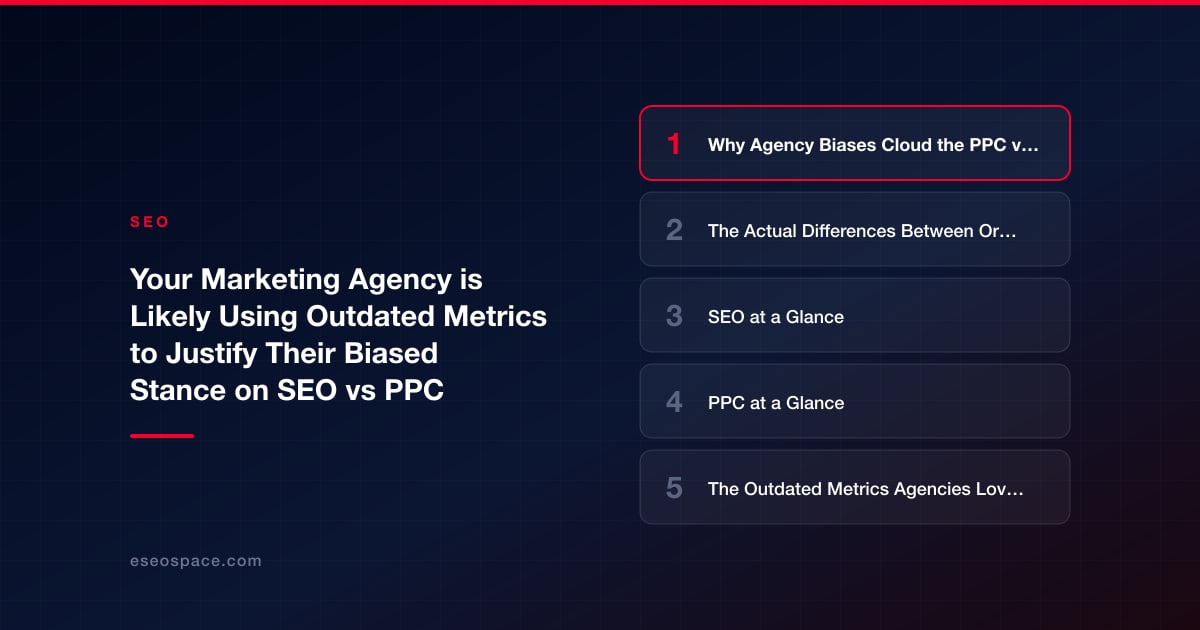
Allocating your marketing budget is always a complex puzzle. If you speak to an agency, you'll likely get caught up in a tense SEO vs paid ads (PPC) debate. One SEO specialist will inform you that natural growth is the best option, while a paid media expert will claim that advertising is far more effective.
It's true that most of this advice is biased. A lot of agencies use outdated metrics to steer you toward the option that makes them the highest profit, rather than what actually benefits your business. To make the right decision, it is important to understand the actual difference between SEO and PPC without an agency's spin.
Why Agency Biases Cloud the PPC vs SEO Debate
Marketing firms are rarely neutral. They tend to focus heavily on either technical optimization or running paid ads. Naturally, a company staffed by link-builders and writers will advocate for organic SEO instead of pay-per-click campaigns. However, a dedicated media-buying shop will insist that paid search is the only way to see real traction.
This mindset forces companies into a false dilemma. Instead of showing how both methods can be used together, agencies view SEO vs PPC as a zero-sum game. They use vanity metrics, such as how many people clicked your site's URL, to make their preferred setup appear attractive even if it doesn't result in real sales.
A similar false dilemma often happens outside of marketing, too. For instance, busy students with strict school deadlines often fall into this all-or-nothing mindset each semester. Instead of balancing their own work with strategic outside help, they assume they must write every paper entirely on their own. To break this cycle and lighten the burden, many choose to outsource. Utilizing a well-established platform such as EssayService.com allows them to safely delegate complicated writing tasks to professionals and give themselves space to focus on the classes they care about most.
Just as smart students look past these rigid choices to protect their performance, savvy business owners must look past agency spin to see how search channels truly interact.
The Actual Differences Between Organic SEO vs PPC
To see through the hype surrounding marketing firms, you need to understand the difference between PPC and SEO. Both channels are geared toward putting your company in front of active online searchers, but they utilize completely different strategies and timelines.
SEO at a Glance
- The Growth Model: Focuses on winning permanent, organic placements on search result pages.
- The Upfront Investment: Requires fixing your site, improving the user experience, and creating great content.
- The Timeline Advantage: Builds value over time. Articles written months ago can continue to generate free leads for businesses today.
PPC at a Glance
- The Growth Model: Functions as an auction where you bid on sponsored placements directly on platforms like Google.
- The Upfront Investment: Requires a regular cash budget to pay for ads, along with excellent writing and strong landing pages.
- The Timeline Advantage: Delivers immediate visibility on the first page of results within minutes of launch.
When you compare the advantages of SEO vs paid search advertisements, the issue isn't whether one is superior to the other in all respects. It's about recognizing that SEO creates an asset that you own, whereas PPC rents targeted traffic for a specific fee.
The Outdated Metrics Agencies Love to Use
If you inquire about an agency's services to find out SEO vs PPC which is better, typically, they'll present you with a custom dashboard designed to protect their monthly retainer. Paid media companies will show a low Cost-Per-Click (CPC) or massive traffic figures. Organic agencies will boast about keyword rankings and impressions on Google Search Console.
Both approaches employ metrics that don't reveal the full story. In today's privacy-focused world of technology, tracking raw clicks or keyword rankings doesn't reflect real business success. A high ranking isn't worth anything if people aren't buying. Also, low-cost clicks are useless if users leave your website immediately. Agencies hide behind these old statistics because they look attractive in a monthly report and are easy to manipulate.
What the Latest Data Actually Shows
If you examine the real SEO vs PPC statistics, the data proves that people don't just click on a specific kind of link. Modern search behavior is extremely complex. Users frequently switch between results from organic search and advertisements before buying anything.
According to research conducted by major search companies, paid ads receive around 65% of the clicks on keywords with high intent where users are eager to buy a particular item right away. For informational searches, where prospects are researching a problem, organic results get about 53% of all traffic.
This implies that treating SEO and paid search as distinct adversaries ignores how people actually shop. If your company cuts off one pathway completely to spend money on the other, you blind your business to half of the journey customers take.
Why You Need Integrated SEO and PPC Services
The most successful companies do not choose between organic rankings and paid advertisements. They blend SEO and PPC to create a single search strategy. Instead of having your teams work in separate silos, your paid advertisements should guide your organic efforts, and vice versa.
For instance, running a short PPC campaign lets you test new keywords in real time. If a sponsored keyword generates a lot of sales over a period of two weeks, you can confidently allocate resources toward building long-term organic content around that exact keyword. On the other hand, you can use paid ads to dominate the search results for your most popular organic keywords, completely crowding out your competitors.
If your current marketing partner treats SEO and PPC as two distinct departments that don't communicate, it's time to start asking tough questions. Insist that the agency moves from tracking only basic traffic to analyzing real revenue. When you are able to judge each option based on its real impact on your finances, the skewed arguments vanish and you can create an effective search strategy for your company.
The smartest move is not picking a side — it is demanding a partner who measures what matters. Look for integrated organic SEO and paid search (PPC) tied to a clear marketing strategy and real conversion rate optimization, not vanity traffic numbers.
Put this into action with eSEOspace
We help businesses grow with seo, geo & aeo that actually performs. Explore the services behind this guide:
Get a FREE Audit
We'll perform a comprehensive SEO, AEO, GEO & CRO audit of your website — completely free — and show you exactly how to outrank your competitors.
Don't have a site yet? Get in touch →
Get a FREE GEO/AEO/SEO Audit
We'll analyze your site's SEO, GEO, AEO & CRO — completely free — and show you exactly how to get found across Google and AI answers.
Don't have a site yet? Get in touch →
Great — your audit is on the way!
We'll send your free SEO/GEO/AEO/CRO audit within the next few hours. Where should we send it?
You're all set! ✓
Your free audit is being prepared — check your inbox in the next few hours. Talk soon!