Email List Building for Service Businesses: Lead Magnets, Opt-In Forms, and Strategies
Email List Building for Service Businesses: Lead Magnets, Opt-In Forms, and Strategies
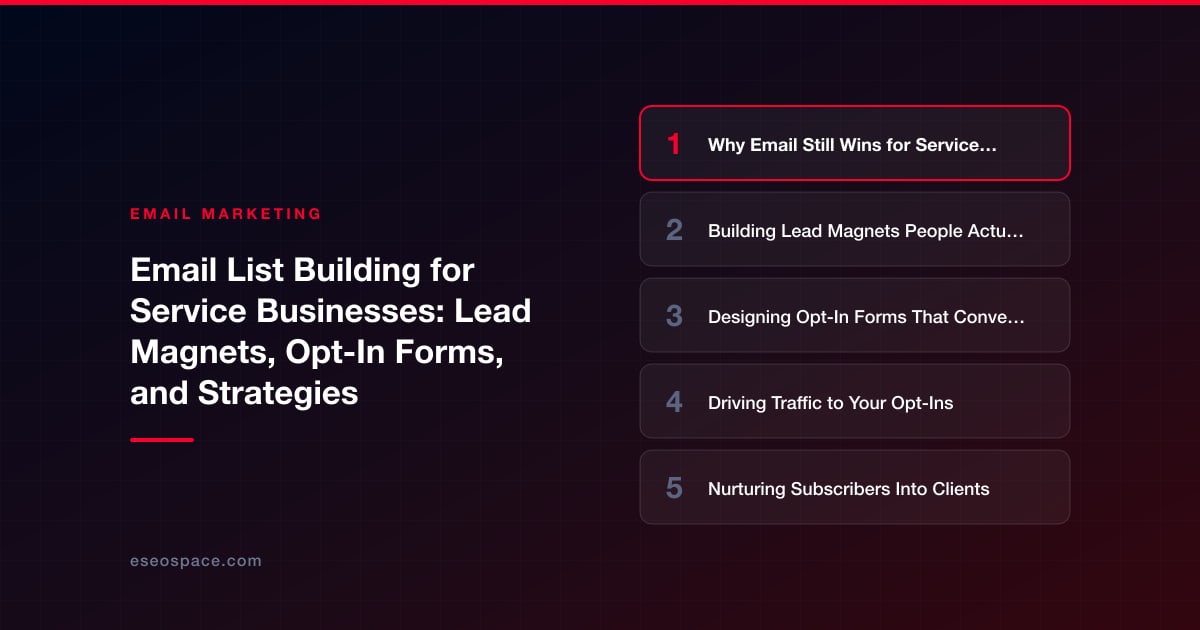
Key Takeaways
- An email list is one of the few marketing assets a service business fully owns, offering a direct, low-cost line to people who have already expressed interest.
- Effective lead magnets solve a narrow, urgent problem for your ideal customer, such as checklists, pricing guides, or free consultations, rather than offering a generic newsletter.
- Opt-in forms convert best when placed contextually (inline, exit-intent, landing pages), ask for minimal information, and load fast on mobile.
- A welcome sequence and ongoing segmented, automated nurture emails are what actually turn subscribers into booked clients.
- Permission-based practices, domain authentication, and regular list cleaning protect deliverability and keep your emails landing in the inbox.
For a service business, an email list is one of the few marketing assets you actually own. Social followers live on rented land, ad costs climb every quarter, and organic rankings shift with every algorithm update. A permission-based email list, by contrast, is a direct line to people who have already told you they want to hear from you. For plumbers, law firms, dental practices, consultants, agencies, and home-service companies alike, that list is where slow-season revenue, repeat bookings, and referral momentum come from.
The challenge is that most service businesses treat list building as an afterthought: a lonely "Subscribe to our newsletter" box in the footer that nobody fills out. Nobody wakes up wanting a newsletter. They want the leaky faucet fixed, the tax deadline handled, or the anxiety about a diagnosis relieved. Effective email list building trades something genuinely useful for an email address, then earns the right to sell by being helpful first. This guide walks through the lead magnets, opt-in forms, and nurture strategies that actually grow a list for a service business.
Why Email Still Wins for Service Businesses
Service businesses have long sales cycles and high-consideration purchases. A homeowner might research a roofer for weeks; a prospective client might follow a law firm for months before an incident forces them to call. Email is the ideal medium for that patient, trust-building window because it reaches people repeatedly, on their schedule, without paying per impression.
The economics are compelling too. Once someone is on your list, the marginal cost of reaching them again is close to zero, which is why email consistently ranks among the highest-ROI channels in marketing surveys. For a local service provider, that means a single well-timed email during a slow month can fill a schedule that ads would cost hundreds of dollars to fill. It also compounds: every new subscriber is added to an asset you keep forever, unlike an ad click that vanishes the moment the budget runs out. This is why we build email into the broader content marketing strategy for the service businesses we work with, rather than treating it as a standalone tactic.
Building Lead Magnets People Actually Want
A lead magnet is the specific, valuable thing you offer in exchange for an email address. The best ones solve a narrow, urgent problem for your ideal customer and can be consumed in a few minutes. Vague offers ("our newsletter") convert poorly; specific offers tied to a real decision convert far better.
Strong lead magnets for service businesses tend to fall into a few reliable categories:
- Checklists and buyer's guides: "10 Questions to Ask Before Hiring a Contractor" or "The Pre-Listing Home Prep Checklist." These help prospects make a decision they are already trying to make.
- Instant estimates or pricing tools: A ballpark cost calculator or a "What does a kitchen remodel cost in [city]?" guide. Pricing anxiety is a huge barrier, so easing it earns the opt-in.
- Templates and swipe files: A budget worksheet from a financial advisor, a consultation-prep sheet from a law firm, an intake form a client can complete ahead of time.
- Seasonal or diagnostic content: "Spring HVAC Maintenance Checklist" or a short quiz that helps someone self-diagnose whether they need your service.
- Exclusive discounts or priority booking: A first-appointment offer or early access to limited seasonal slots, which works especially well for high-volume, transactional services.
The format matters less than the promise. A one-page PDF that saves someone a stressful decision outperforms a 40-page ebook nobody finishes. Match the magnet to the buying stage: a top-of-funnel quiz attracts a wide audience, while a pricing guide or free-consultation offer attracts people much closer to booking.
Designing Opt-In Forms That Convert
Even the best lead magnet fails if the form asking for the email is buried or clumsy. Opt-in form design is equal parts placement, copy, and friction reduction. The goal is to present the right offer at the moment a visitor is most interested, and to ask for as little as possible.
Placement is the biggest lever. Rather than relying on a single footer box, service businesses should deploy multiple, context-appropriate forms:
- Inline forms within blog posts that offer a related download right where the reader is already engaged.
- A hero or above-the-fold offer on high-traffic landing pages, especially service and location pages.
- Exit-intent popups that trigger when a visitor moves to leave, offering the lead magnet as a last-chance value exchange.
- Sticky bars or slide-ins that stay visible without blocking content.
- Dedicated landing pages for the lead magnet that you can link to from ads, social, and your email signature.
On the form itself, ask only for what you need. For most service businesses, an email address alone is enough to start; every additional field measurably lowers conversion. Write button copy that restates the value ("Send Me the Checklist" beats "Submit"), reassure visitors you won't spam them, and make sure forms load fast and work flawlessly on mobile, where most local-service traffic originates. Because form speed and mobile usability also affect rankings, we treat opt-in performance as part of a site's overall SEO and technical health, not a separate concern.
Driving Traffic to Your Opt-Ins
Forms only convert the traffic they see, so list growth depends on feeding qualified visitors to your offers. Service businesses have several dependable channels for this. Organic search is the workhorse: blog posts and service pages that rank for buyer-intent queries deliver visitors who are already problem-aware and receptive to a relevant lead magnet.
Beyond search, promote your lead magnet everywhere your audience already is:
- Google Business Profile posts and your website's primary calls to action for local visibility.
- Social media, linking to the lead magnet landing page rather than a generic homepage.
- Your email signature and invoices, which quietly reach every person you already correspond with.
- Paid search or social ads pointed at a dedicated opt-in page when you want to accelerate growth.
- Existing customers, who should be invited to join at the point of service or in follow-up messages.
One underused tactic: add a checkbox to your existing intake, quote, and booking forms inviting people to receive helpful tips and offers. These are your warmest prospects, and many will happily opt in when asked at the right moment.
Nurturing Subscribers Into Clients
Collecting emails is only half the job. What turns a list into revenue is the sequence of messages that builds trust and stays top of mind until the prospect is ready to buy. The moment someone subscribes is the moment of peak interest, so a well-crafted welcome sequence matters enormously.
A simple, effective welcome flow for a service business might look like this: deliver the promised lead magnet immediately, then over the next few emails introduce who you are and why you're credible, address the most common objections or questions, share a representative example of the results your service delivers, and finally make a clear, low-pressure invitation to book a consultation or estimate. After the welcome sequence, a steady cadence of genuinely useful emails, such as seasonal tips, answers to common questions, and occasional offers, keeps you present without exhausting the list.
Segmentation sharpens all of this. Even basic tags, like which lead magnet someone downloaded or which service page they came from, let you send more relevant messages and dramatically improve response. Automation carries the load so a busy owner doesn't have to send everything by hand. Building and maintaining these sequences is a core part of our email marketing services, because the automation is what makes a list pay off month after month.
Staying Compliant and Protecting Deliverability
List building only works if your emails actually reach the inbox, and that depends on doing things the legitimate way. Permission is the foundation. Never buy or scrape lists; they hurt deliverability, damage your sender reputation, and violate the trust your brand depends on. Every subscriber should have knowingly opted in.
A few practices keep you compliant and in the inbox:
- Honor CAN-SPAM and, where relevant, GDPR requirements: include a real physical address, a clear unsubscribe link, and honest subject lines.
- Use confirmed or double opt-in when list quality matters more than raw size; it filters out fake addresses and confirms genuine interest.
- Authenticate your domain with SPF, DKIM, and DMARC so mailbox providers trust your messages.
- Clean your list regularly by removing chronically unengaged subscribers, which protects your sender reputation.
- Make unsubscribing easy; a frictionless exit is better for deliverability than a trapped subscriber who marks you as spam.
Treated this way, an email list becomes a durable, compounding asset. For a service business, the formula is consistent: offer something genuinely valuable, ask for the opt-in at the right moment with a clean form, drive qualified traffic to it, and nurture patiently until the prospect is ready. Do that steadily and you build a channel you own outright, one that quietly fills your calendar long after any single ad campaign ends.
Get a FREE Audit
We'll perform a comprehensive SEO, AEO, GEO & CRO audit of your website — completely free — and show you exactly how to outrank your competitors.
Don't have a site yet? Get in touch →
Put this into action with eSEOspace
We help businesses grow with website development that actually performs. Explore the services behind this guide:
Frequently Asked Questions
What is the best lead magnet for a service business?
How many opt-in forms should my website have?
How often should I email my list?
Is it legal to buy an email list for my business?
How do I get my emails to land in the inbox instead of spam?
Get a FREE GEO/AEO/SEO Audit
We'll analyze your site's SEO, GEO, AEO & CRO — completely free — and show you exactly how to get found across Google and AI answers.
Don't have a site yet? Get in touch →
Great — your audit is on the way!
We'll send your free SEO/GEO/AEO/CRO audit within the next few hours. Where should we send it?
You're all set! ✓
Your free audit is being prepared — check your inbox in the next few hours. Talk soon!