Google Business Profile Optimization: The Complete Guide for Local Businesses
Google Business Profile Optimization: The Complete Guide for Local Businesses
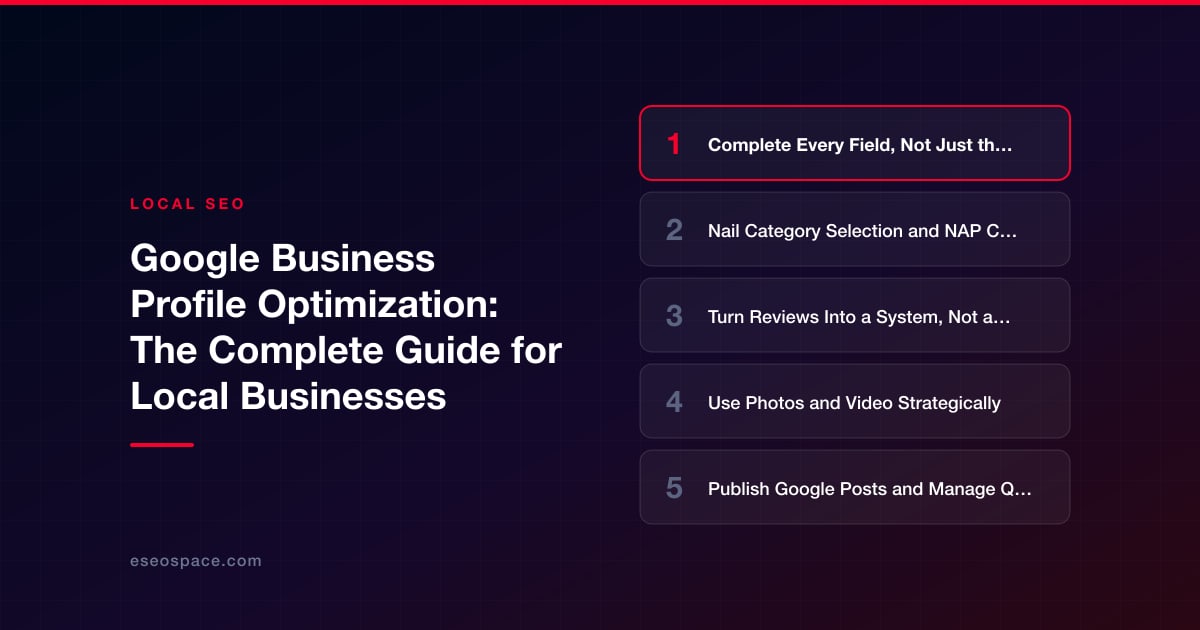
Key Takeaways
- Your Google Business Profile is often the first and most influential touchpoint for local customers, appearing in the map pack, Maps, and knowledge panel before your website does.
- Completeness is a ranking signal: fill in every field, especially your primary category, services, attributes, and a keyword-rich 750-character description.
- Reviews drive both rankings and conversions, so build a system to earn them steadily, respond to every one, and never buy or gate them.
- Photos, short videos, weekly Google Posts, and a self-seeded Q&A section keep your profile active and signal a legitimate, engaged business to Google.
- Optimization is ongoing: track calls, direction requests, and website clicks in your insights, then iterate with a recurring monthly maintenance routine.
For local businesses, your Google Business Profile (formerly Google My Business) is often the single most valuable piece of digital real estate you own. It appears in the local map pack, in Google Maps, and in the knowledge panel to the right of branded searches, frequently reaching customers before they ever visit your website. Yet the majority of profiles are set up once, verified, and then quietly ignored.
That neglect is expensive. Google's local ranking algorithm rewards profiles that are complete, active, and consistent, and it demotes those that sit stale. A fully optimized profile can be the difference between showing up in the top three map results, where the overwhelming share of clicks land, and being buried on page two where almost no one looks.
This guide walks through the specific, repeatable levers that move the needle, from category selection and NAP consistency to reviews, photos, Google Posts, and the Q&A section. These are the same fundamentals we apply in our Google Business Profile optimization work, translated into steps you can execute yourself.
Complete Every Field, Not Just the Obvious Ones
Google has stated plainly that businesses with complete information are easier to match to relevant searches. Completeness is a ranking and conversion signal, so treat every field as required, not optional.
- Business name: Use your real-world name exactly as it appears on your signage. Do not stuff keywords or city names into it; this violates Google's guidelines and risks suspension.
- Primary and secondary categories: Your primary category carries the most ranking weight. Choose the most specific option that describes your core business, then add secondary categories for additional services.
- Services and products: List individual services with descriptions. This adds keyword-rich, structured content Google can index.
- Business description: Use all 750 characters to describe what you do, who you serve, and what makes you different. Lead with your most important terms.
- Hours, including special hours: Keep regular hours accurate and set holiday hours in advance. Incorrect hours are a top driver of negative reviews.
- Attributes: Enable relevant attributes such as "wheelchair accessible," "free Wi-Fi," "women-owned," or "online appointments." These power filtered searches.
Nail Category Selection and NAP Consistency
Category choice is one of the highest-leverage decisions you will make, because it defines the searches you are eligible to appear for at all. A dentist listed only under "Dentist" may miss traffic that a "Cosmetic Dentist" or "Emergency Dental Service" secondary category would capture. Audit competitors ranking in your map pack to see which categories the leaders use, then match and refine.
NAP stands for Name, Address, and Phone number, and consistency across the web is foundational to local trust. Google cross-references your profile against directories, your website, and data aggregators. When your address is formatted three different ways across the internet, that ambiguity erodes confidence and rankings. Standardize the exact spelling, abbreviations, and suite formatting everywhere, and make sure your profile matches your website's contact page and schema markup. Cleaning up citations is a core part of any serious local SEO effort.
Turn Reviews Into a System, Not an Afterthought
Reviews influence rankings and conversions simultaneously. Review quantity, velocity (how steadily new reviews arrive), recency, and keyword content all feed the local algorithm, while star ratings and written detail shape whether a searcher chooses you over a competitor.
- Ask consistently: Build a habit of requesting a review at the natural moment of satisfaction, after a completed job, a positive interaction, or a delivered product.
- Make it frictionless: Share your short review link (available in your profile dashboard) via text or email. Every extra click loses reviewers.
- Respond to all of them: Reply to positive and negative reviews alike. Google confirms that responding shows you value customers, and thoughtful replies to criticism reassure future readers far more than a defensive silence.
- Never buy or gate reviews: Fake reviews and "review gating" (only soliciting happy customers) violate Google's policies and can trigger removal or suspension.
Aim for a steady drip of authentic reviews rather than a one-time burst. A sudden spike of ten reviews in a day followed by silence looks unnatural; two or three per week signals a healthy, active business.
Use Photos and Video Strategically
Profiles with photos receive meaningfully more requests for directions and clicks to their websites than those without. Images are not decoration; they are proof of legitimacy and quality.
- Cover and logo: Choose a strong cover image and a clean logo, since these anchor your visual identity in the knowledge panel.
- Interior, exterior, and team: Help customers recognize your storefront and picture themselves being served. Exterior shots from multiple angles aid navigation.
- Products and work samples: Show what you actually deliver. A contractor's before-and-after photos or a restaurant's plated dishes do more selling than any description.
- Fresh uploads: Add new photos regularly. Ongoing activity signals an operating, engaged business, and geotagged, well-named image files reinforce relevance.
Short videos, up to 30 seconds, further boost engagement and give searchers a richer sense of your space and service.
Publish Google Posts and Manage Q&A
Google Posts let you publish updates, offers, events, and announcements directly to your profile, where they appear to searchers actively evaluating you. Posts expire (offers and standard updates typically after seven days), so a consistent cadence, roughly weekly, keeps your profile visibly active and gives Google fresh content to work with.
Effective posts include a clear image, a concise message, and a call-to-action button such as "Call now," "Book," or "Learn more." Use them to promote seasonal offers, new services, or timely news rather than generic filler.
The Questions and Answers section is public and, critically, anyone can answer, including competitors or misinformed passersby. Get ahead of it by seeding your own frequently asked questions and answering them accurately. Monitor the section and respond quickly to new questions, because an unanswered or wrongly answered question can cost you a customer at the decision moment.
Track the Right Metrics and Iterate
Optimization is not a one-time project; it is an ongoing discipline measured against real data. Your profile's performance insights show how customers find and interact with you.
- Search queries: See the actual terms triggering your profile, and use them to refine your services, description, and posts.
- Calls, direction requests, and website clicks: These conversion actions matter far more than raw impressions. Track trends month over month.
- Discovery vs. direct searches: A rising share of discovery searches (people finding you without knowing your name) indicates your local visibility is growing.
- Photo and post engagement: Identify what resonates and produce more of it.
Set a recurring monthly review to update hours, add photos, refresh services, respond to every review and question, and publish new posts. That maintenance rhythm is what separates profiles that climb and hold the map pack from those that fade. If managing it alongside running your business becomes too much, a dedicated partner can own the cadence for you, but the levers themselves are entirely within reach for any owner willing to work them consistently.
Get a FREE Audit
We'll perform a comprehensive SEO, AEO, GEO & CRO audit of your website — completely free — and show you exactly how to outrank your competitors.
Don't have a site yet? Get in touch →
Put this into action with eSEOspace
We help businesses grow with website development that actually performs. Explore the services behind this guide:
Frequently Asked Questions
What is Google Business Profile optimization?
How long does it take to see results?
How many reviews do I need to rank well?
Do Google Posts actually help rankings?
Can keyword-stuffing my business name boost visibility?
Get a FREE GEO/AEO/SEO Audit
We'll analyze your site's SEO, GEO, AEO & CRO — completely free — and show you exactly how to get found across Google and AI answers.
Don't have a site yet? Get in touch →
Great — your audit is on the way!
We'll send your free SEO/GEO/AEO/CRO audit within the next few hours. Where should we send it?
You're all set! ✓
Your free audit is being prepared — check your inbox in the next few hours. Talk soon!