



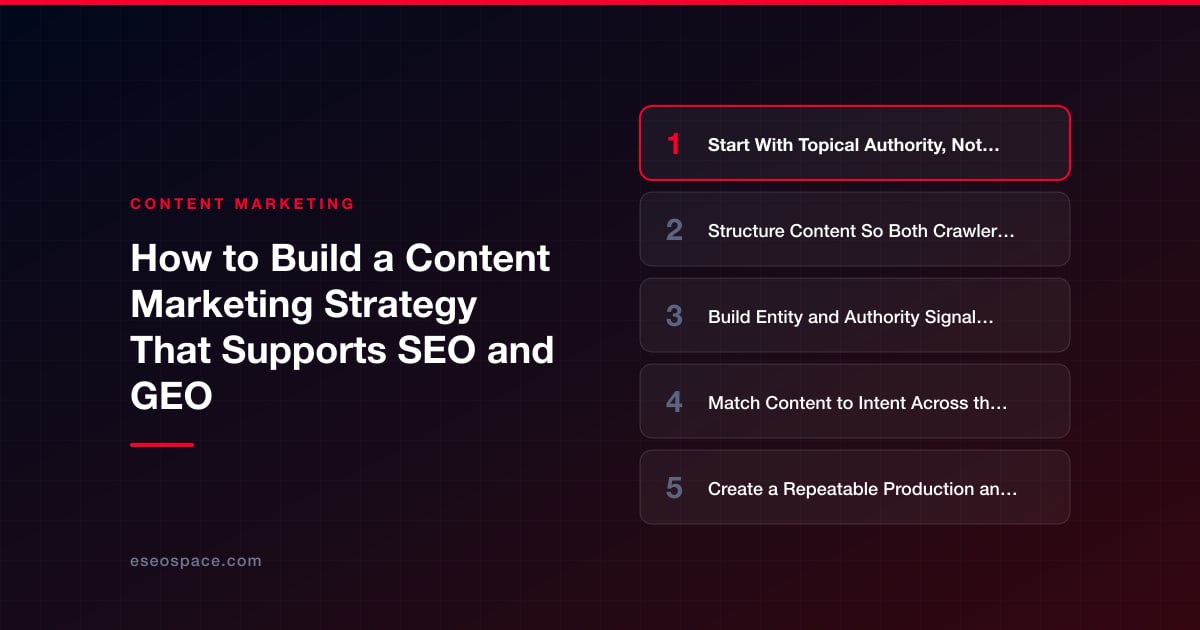
How to Build a Content Marketing Strategy That Supports SEO and GEO
How to Build a Content Marketing Strategy That Supports SEO and GEO
Key Takeaways
- SEO and GEO draw from the same foundation of authoritative, well-structured content, so a single unified strategy serves both rather than requiring separate teams.
- Topical authority built through interconnected content clusters, not scattered keyword targeting, is what earns both high rankings and AI citations.
- Answer-first structure, descriptive question-based headings, lists, tables, and schema markup make content easy for both crawlers and language models to extract.
- Generative engines preferentially cite sources with strong E-E-A-T signals: real authors, original data, sourced claims, and consistent entity information across the web.
- GEO demands new measurement, tracking brand mentions and citations in AI answers alongside traditional rankings, since many users now get answers without ever clicking.
For most of the last decade, a content marketing strategy SEO plan meant one thing: publish pages that rank in Google's ten blue links. That job hasn't disappeared, but it now shares the stage with a second audience that never clicks a link at all. Generative engines like ChatGPT, Google's AI Overviews, Perplexity, and Gemini increasingly answer users directly, summarizing and citing the content they trust most. Optimizing to be that cited source is called Generative Engine Optimization (GEO).
The good news is that SEO and GEO are not competing disciplines requiring two separate content teams. They draw from the same well: authoritative, well-structured, genuinely useful content. But the emphasis shifts. Where classic SEO rewards keyword coverage and link authority, GEO rewards clarity, extractability, and demonstrable expertise that a language model can quote with confidence. A modern strategy has to serve both, and the framework below shows how to build one that does.
This guide walks through the practical steps: defining your topical territory, structuring content so both crawlers and models can parse it, building the entity and authority signals that earn citations, and measuring results across two very different surfaces.
Start With Topical Authority, Not Isolated Keywords
Both search algorithms and language models reward depth over scattershot coverage. A site with fifteen thin posts loosely touching a subject loses to a site with a tightly connected cluster that answers every reasonable question in a domain. This is topical authority, and it is the foundation of a strategy that works for SEO and GEO simultaneously.
Instead of chasing individual keywords, map your subject into topic clusters: a comprehensive pillar page targeting a broad head term, surrounded by supporting articles that each answer a specific sub-question and link back to the pillar. This structure signals to Google that you cover a subject exhaustively, and it gives generative engines a dense, internally consistent body of material to draw from.
- Pick 3 to 6 core topics your business should genuinely own, tied to what you sell and the questions your buyers actually ask.
- Under each, list every real question a prospect might type or ask an AI assistant, mining Google's People Also Ask, Reddit threads, and sales-call notes.
- Assign each question a content format: pillar, how-to, comparison, definition, or FAQ.
- Interlink aggressively so authority flows through the cluster and models can trace relationships between concepts.
If mapping and producing that volume of connected content is a stretch for your team, this is exactly the kind of program our content marketing services are built to run end to end.
Structure Content So Both Crawlers and Models Can Parse It
SEO has always favored clean structure, but GEO makes it non-negotiable. Language models extract information in chunks, and they favor passages that state a fact, answer, or definition cleanly without forcing the model to infer it from surrounding prose. Content that buries its answer three paragraphs deep rarely gets quoted.
Write so that any single section can stand alone and be understood out of context, because that is often how a model will encounter it. Practical structural habits that serve both goals include:
- Answer-first paragraphs: Open each section with a direct one-to-two-sentence answer, then elaborate. This wins featured snippets and gives models a clean pull quote.
- Descriptive H2s and H3s phrased as the questions users actually ask, so the heading itself matches a query.
- Lists, tables, and definition blocks for anything comparative or step-based; structured data is disproportionately likely to be extracted verbatim.
- Schema markup (FAQPage, HowTo, Article, Organization) that removes ambiguity about what your content is and who published it.
- Short, scannable sentences that reduce the chance a model mangles your meaning when summarizing.
These same practices raise your standing in traditional rankings too, which is why a structural foundation aligned with professional SEO services pays off across both surfaces rather than forcing a trade-off.
Build Entity and Authority Signals That Earn Citations
Generative engines are far more citation-conscious than the old ranking algorithms. They preferentially quote sources that carry recognizable authority signals, and they lean heavily on how your brand, authors, and claims are corroborated across the wider web. This is where E-E-A-T (Experience, Expertise, Authoritativeness, Trust) stops being an abstract Google guideline and becomes a concrete GEO tactic.
To be treated as a trustworthy entity, your content needs to demonstrate first-hand knowledge and be backed by verifiable signals:
- Real author bylines with credentials, linked bios, and a consistent presence across your site and third-party platforms.
- Original data, examples, and firsthand experience that a model cannot find in ten other places; unique material is disproportionately cited.
- Statistics and claims backed by named, linkable sources, which increases the odds an engine treats your page as authoritative.
- Consistent entity information, your organization name, description, and area of expertise stated the same way everywhere so models resolve you to one confident entity.
- Off-site corroboration through mentions, quality backlinks, and citations that reinforce your topical reputation.
Note that GEO rewards being mentioned and quoted, not just linked. Digital PR, expert commentary, and being referenced on authoritative industry sites all feed the corpus these models learn from, even when no clickable link is involved.
Match Content to Intent Across the Full Funnel
A strategy that only produces top-of-funnel awareness content generates traffic that never converts, while one that only produces bottom-funnel sales pages never gets discovered. Both SEO and GEO reward covering the complete journey, because search and AI assistants get used at every stage of a decision.
Map your content to the questions people ask at each phase:
- Awareness: broad educational content answering "what is" and "why does this matter" questions, ideal for AI Overviews and informational queries.
- Consideration: comparisons, buying guides, and "how to choose" content where you can earn trust and get cited when someone asks an assistant to weigh options.
- Decision: case-study-style proof, pricing transparency, and detailed service or product pages that answer the final objections.
Crucially, decision-stage buyers now ask AI assistants for vendor recommendations directly. If your comparison and evaluation content is thorough, honest, and well-structured, you become the material those recommendations are built from, an outcome pure keyword targeting never captured.
Create a Repeatable Production and Refresh Workflow
Strategy fails without a system to execute it consistently. Content marketing that supports SEO and GEO is a compounding asset, but only if you publish on a reliable cadence and keep existing pages current. Both Google and language models favor content that is fresh and accurate, and stale pages quietly lose both rankings and citations over time.
Build a workflow with these components:
- An editorial calendar tied to your cluster map, so every piece has a defined role rather than being written on a whim.
- A clear brief template covering target query, intent, required structure, internal links, and the unique angle or data the piece must include.
- A quality bar that checks for answer-first structure, schema, sourced claims, and genuine expertise before anything publishes.
- A quarterly refresh cycle that updates statistics, adds newly emerged questions, and reworks underperforming pages instead of endlessly chasing net-new posts.
The refresh habit matters more than most teams realize: a single well-established page that you deepen over time often out-earns a dozen shallow new ones, on both search and generative surfaces.
Measure the Right Signals for SEO and GEO Separately
You cannot manage what you do not measure, and GEO requires new metrics alongside the familiar SEO dashboard. Organic rankings, impressions, and click-through remain essential, but they miss the growing share of users who get their answer from an AI engine and never visit your site.
Track two layers of performance:
- Traditional SEO metrics: keyword rankings, organic sessions, featured-snippet ownership, backlinks, and conversions from organic traffic.
- GEO visibility metrics: how often your brand and content are cited or mentioned in ChatGPT, Perplexity, Gemini, and AI Overviews for your priority queries, which you can spot-check manually or monitor with emerging AI-visibility tools.
- Brand and demand signals: direct and branded search volume, which often rises even when AI answers reduce clicks, because being the cited source builds recognition.
Interpret them together. A page whose clicks dip but whose brand searches climb may be winning in the AI layer rather than losing. If you want a partner to build the strategy, produce the content, and instrument this kind of dual measurement, our content marketing team can architect the whole program around your goals.
Ultimately, a content marketing strategy that supports both SEO and GEO is not two strategies bolted together. It is one disciplined system, deep topical coverage, clean extractable structure, verifiable authority, full-funnel intent, and consistent measurement, aimed at a world where sometimes a human reads your page and sometimes a machine quotes it. Build for both, and you are ready for however search continues to evolve.
Get a FREE Audit
We'll perform a comprehensive SEO, AEO, GEO & CRO audit of your website — completely free — and show you exactly how to outrank your competitors.
Don't have a site yet? Get in touch →
Put this into action with eSEOspace
We help businesses grow with website development that actually performs. Explore the services behind this guide:
Frequently Asked Questions
What is the difference between SEO and GEO?
Can one content strategy support both SEO and GEO?
How do I get my content cited by AI engines?
How is content marketing for GEO measured differently?
How often should I update content for SEO and GEO?
Get a FREE GEO/AEO/SEO Audit
We'll analyze your site's SEO, GEO, AEO & CRO — completely free — and show you exactly how to get found across Google and AI answers.
Don't have a site yet? Get in touch →
Great — your audit is on the way!
We'll send your free SEO/GEO/AEO/CRO audit within the next few hours. Where should we send it?
You're all set! ✓
Your free audit is being prepared — check your inbox in the next few hours. Talk soon!


On this page
- Key Takeaways
- Start With Topical Authority, Not Isolated Keywords
- Structure Content So Both Crawlers and Models Can Parse It
- Build Entity and Authority Signals That Earn Citations
- Match Content to Intent Across the Full Funnel
- Create a Repeatable Production and Refresh Workflow
- Measure the Right Signals for SEO and GEO Separately






