How to Migrate from GoDaddy Website Builder to WordPress
How to Migrate from GoDaddy Website Builder to WordPress
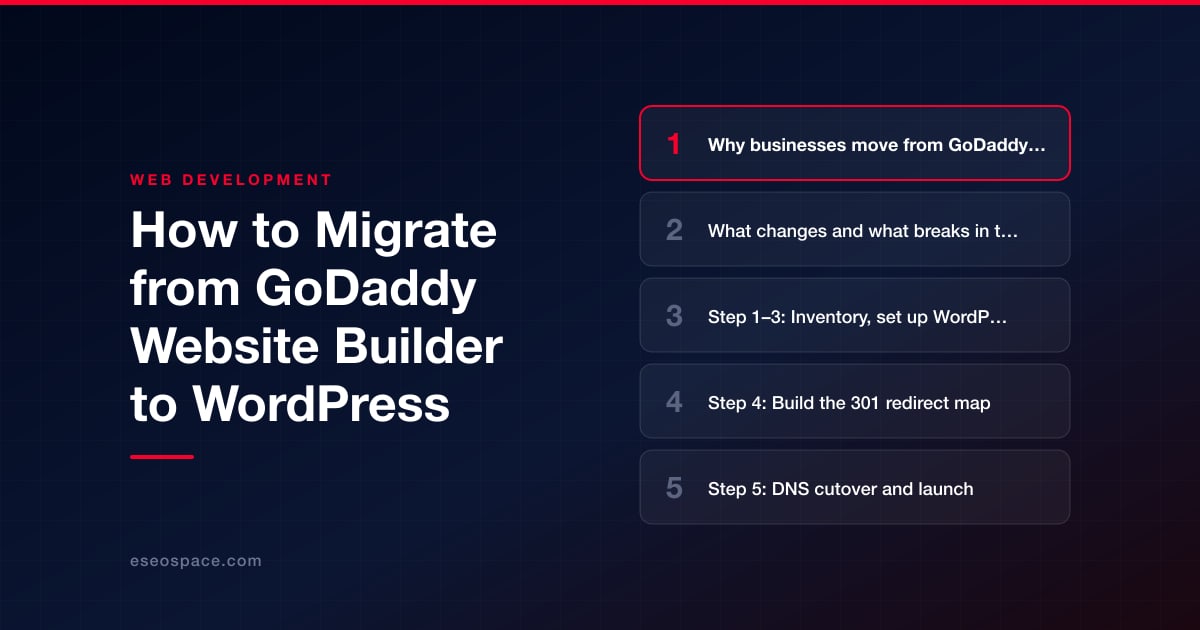
Key Takeaways
- GoDaddy Website Builder has no clean export, so migrating to WordPress is a structured content-and-design rebuild rather than an automated import.
- Businesses switch primarily for real SEO control, design freedom, the WordPress plugin ecosystem, and full ownership of their code and content.
- URLs, GoDaddy apps, forms, and blog metadata do not transfer automatically and must be recreated or replaced with WordPress equivalents.
- A complete one-to-one 301 redirect map, built before launch, is the single most important step for preserving rankings and link equity.
- Realistic timelines run 2 to 12 weeks depending on page count and redesign scope, with cost driven mainly by manual content migration.
GoDaddy Website Builder (marketed as Websites + Marketing) is a closed, template-driven editor. It gets a small business online fast, but it hides your HTML, locks you out of the database, offers no real plugin ecosystem, and gives you almost no control over technical SEO. Once you outgrow those limits, the natural next step is WordPress—the open-source CMS that powers over 40% of the web and lets you own your code, your content, and your growth roadmap.
The catch is that GoDaddy gives you no clean export. There is no “download my whole site” button, no WXR file, no database access. That means migrating to WordPress is really a structured rebuild: you recreate the content and design on a proper platform, then carefully preserve every URL and ranking you already earned. Done carelessly, this is exactly how sites lose traffic. Done deliberately, it is how they finally get faster, more flexible, and more visible.
This guide walks through the full process—why teams switch, what changes and breaks, the step-by-step migration, how to protect SEO with 301 redirects, and a realistic take on timeline and cost.
Why businesses move from GoDaddy to WordPress
Most GoDaddy Website Builder migrations are driven by the same handful of ceilings:
- SEO control. GoDaddy limits how you edit title tags, meta descriptions, structured data (schema), redirects, and robots directives. WordPress plus a plugin like Yoast or Rank Math exposes all of it.
- Design freedom. You are boxed into GoDaddy’s sections and themes. WordPress supports fully custom themes, the block editor, and page builders like Elementor.
- Functionality. There is no meaningful app/plugin marketplace. WordPress has tens of thousands of plugins for e-commerce (WooCommerce), memberships, bookings, forms, and CRM connections.
- Ownership and portability. On GoDaddy you rent a proprietary system. On WordPress you own the files and database and can host anywhere.
- Performance and scale. Self-hosted WordPress with quality hosting and caching typically outperforms Website Builder on Core Web Vitals once tuned.
If any of those are the reason you are reading this, WordPress is the right destination. If you also want custom functionality beyond off-the-shelf plugins, plan for custom development and CRM integration from the start rather than bolting it on later.
What changes and what breaks in the move
Because GoDaddy content cannot be exported cleanly, assume almost everything is recreated. Know in advance what is at risk:
- Content. Text, images, and page copy must be moved manually or via scraping. There is no native import into WordPress, so nothing carries over automatically.
- URLs. GoDaddy’s URL structure rarely matches how you will organize WordPress permalinks. Every changed URL needs a redirect (more below).
- Design. Your GoDaddy theme does not transfer. You rebuild the look in a WordPress theme—an opportunity to modernize, but budget for it.
- GoDaddy apps and widgets. Appointment scheduling, GoDaddy Payments, email signup forms, and pop-ups are proprietary. Each must be replaced with a WordPress plugin equivalent and reconfigured.
- Blog posts. Publish dates, categories, and authors must be recreated manually so your archive and internal links stay intact.
- Forms and analytics. Contact forms need rebuilding (WPForms, Gravity Forms), and you will reinstall Google Analytics 4 and re-verify Search Console.
The single biggest SEO risk is broken URLs. Map them before you launch, not after.
Step 1–3: Inventory, set up WordPress, and rebuild content
Start with a full inventory. Crawl your existing GoDaddy site with a tool like Screaming Frog to capture every live URL, title tag, meta description, and image. Export that crawl to a spreadsheet—it becomes your master checklist and the backbone of your redirect map.
Next, stand up WordPress. Choose quality hosting (Kinsta, WP Engine, SiteGround, or Cloudways are common), install WordPress, and build on a staging domain or subdomain so the live GoDaddy site keeps running until you cut over. Configure permalinks early—Settings → Permalinks → Post name is the standard, SEO-friendly choice.
Then recreate content and design. Rebuild each page and blog post, matching your best-performing pages closely so you do not lose the on-page signals that already rank. Reproduce headings, body copy, image alt text, and internal links. This manual rebuild is the bulk of the labor, which is why many teams hand it to a partner offering WordPress development rather than doing it piecemeal in-house. If you would rather modernize the design entirely instead of cloning it, fold that into a broader website design and development engagement.
Step 4: Build the 301 redirect map
This is the step that protects your rankings, and the one most often skipped. A 301 redirect is a permanent server instruction that sends both users and search engines from an old URL to its new equivalent, passing along the accumulated link equity. If you change a URL and do not redirect it, that page’s rankings and backlinks are lost, and visitors hit a 404.
Using the crawl from Step 1, build a two-column map: every old GoDaddy URL on the left, its new WordPress URL on the right. Match pages by intent, not just by title—the old “/services” page maps to the new “/services/,” the old blog post maps to its rebuilt counterpart. Where no equivalent exists, redirect to the closest relevant page rather than the homepage.
- Implement redirects in WordPress with the free Redirection plugin, or at the server level in your .htaccess file (Apache) for speed.
- Redirect old-to-new one-to-one; avoid chains (A→B→C) that dilute equity and slow crawling.
- Preserve HTTPS and the correct www/non-www version to prevent redirect loops.
Our 301 redirect map guide walks through the exact spreadsheet structure and testing method, and the full website migration process we run for clients centers on getting this map complete before anything goes live.
Step 5: DNS cutover and launch
When staging is fully built, content is proofed, and redirects are loaded, you launch by pointing your domain at the new WordPress host. If your domain is registered with GoDaddy but WordPress is hosted elsewhere, you update the A record (and often the CNAME for www) in GoDaddy’s DNS settings to your new host’s IP address. DNS changes can take up to 24–48 hours to propagate globally, so schedule the cutover during low-traffic hours.
Before you flip DNS:
- Install an SSL certificate on the new host so the site serves over HTTPS from minute one.
- Remove any noindex setting or password protection you used on staging—forgetting this is a classic way to accidentally deindex a brand-new site.
- Keep the GoDaddy subscription active for a short overlap so nothing goes dark mid-propagation.
Step 6: Test, verify, and monitor
Launch is the start of QA, not the end. Immediately after the cutover, work through a structured verification pass:
- Redirects: spot-check dozens of old URLs and confirm each returns a single 301 to the right destination.
- Crawl again: re-run Screaming Frog on the live WordPress site to catch 404s, broken internal links, and redirect chains.
- Search Console: verify the property, submit your new XML sitemap, and use the URL Inspection tool on key pages.
- Analytics: confirm GA4 is firing and form submissions and e-commerce events are tracking.
- On-page SEO: confirm title tags, meta descriptions, canonical tags, and schema carried over on priority pages.
Then watch Search Console and analytics for four to eight weeks. A brief ranking wobble during reindexing is normal; a sustained drop signals a redirect gap or an indexing issue to fix fast. Working through a structured website migration SEO checklist catches the vast majority of these before they cost you traffic.
Realistic timeline and cost
Because GoDaddy has no clean export, timeline scales with page count and how much design you rebuild versus redesign. A small brochure site (5–10 pages) is often a 2–4 week project. A content-heavy site with a large blog and e-commerce can run 6–12 weeks, driven mostly by manual content migration and redirect mapping.
Cost follows the same logic. A straightforward DIY-plus-hosting move can be a few hundred dollars in hosting and plugin costs plus your own time. A professionally handled migration—where the redirect map, content rebuild, design, and QA are done for you—typically lands in the low-to-mid four figures depending on scope. Most small-business GoDaddy-to-WordPress migrations fall in a predictable, scoped range once the page inventory is known. The value is not just speed; it is launching without the traffic loss that an unmapped migration almost guarantees.
Get a FREE Audit
We'll perform a comprehensive SEO, AEO, GEO & CRO audit of your website — completely free — and show you exactly how to outrank your competitors.
Don't have a site yet? Get in touch →
Put this into action with eSEOspace
We help businesses grow with website development that actually performs. Explore the services behind this guide:
Frequently Asked Questions
Can I export my GoDaddy Website Builder site directly into WordPress?
Will I lose my Google rankings when I move to WordPress?
How long does a GoDaddy to WordPress migration take?
What happens to my GoDaddy appointment, payment, and form apps?
Do I have to move my domain away from GoDaddy too?
Get a FREE GEO/AEO/SEO Audit
We'll analyze your site's SEO, GEO, AEO & CRO — completely free — and show you exactly how to get found across Google and AI answers.
Don't have a site yet? Get in touch →
Great — your audit is on the way!
We'll send your free SEO/GEO/AEO/CRO audit within the next few hours. Where should we send it?
You're all set! ✓
Your free audit is being prepared — check your inbox in the next few hours. Talk soon!