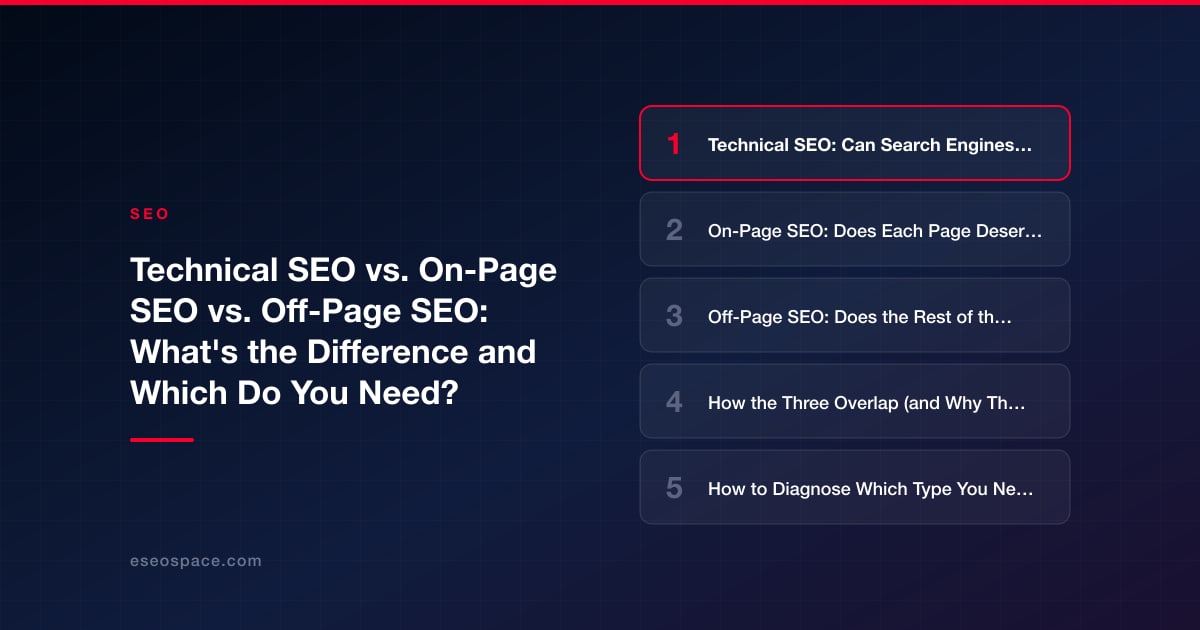
Technical SEO vs. On-Page SEO vs. Off-Page SEO: What's the Difference and Which Do You Need?
Technical SEO vs. On-Page SEO vs. Off-Page SEO: What's the Difference and Which Do You Need?
Key Takeaways
- Technical SEO ensures search engines can crawl, render, and index your site; without it, on-page and off-page work cannot pay off.
- On-page SEO makes each page match search intent and clearly signal relevance through titles, headers, content depth, and internal links.
- Off-page SEO builds authority and trust from outside your site, primarily through earning high-quality, topically relevant backlinks.
- The three categories overlap heavily — schema, internal linking, and page experience all straddle boundaries — so treat SEO as one connected system.
- Diagnose your bottleneck before acting: indexation issues are technical, page 3-5 rankings are usually on-page, and stalled competitive terms point to off-page authority.
Search engine optimization is not one discipline. It is three tightly related but distinct workstreams, and the fastest way to waste a marketing budget is to pour effort into one while ignoring the other two. When people ask about technical SEO vs on-page SEO vs off-page SEO, they are usually trying to answer a very practical question: given limited time and money, where should I focus first?
The short version is that technical SEO makes sure search engines can crawl, render, and index your site. On-page SEO makes sure each page clearly signals what it is about and deserves to rank for a query. Off-page SEO builds the authority and trust signals, mostly from other websites, that convince Google your page is the best answer. Miss any one of the three and the other two underperform.
Below we break down exactly what each category covers, how they overlap, how to diagnose which one is holding you back, and a realistic order of operations for a site that wants to grow organic traffic in 2026.
Technical SEO: Can Search Engines Access and Understand Your Site?
Technical SEO is the foundation. It has nothing to do with your words or your backlinks and everything to do with whether a crawler can reach your content, render it correctly, and store it in the index. If Google cannot crawl a page, no amount of great writing or link building will help it rank.
Core technical SEO tasks include:
- Crawlability and indexation — a clean XML sitemap, a sane robots.txt, and no accidental
noindextags or blocked resources. - Site architecture — a logical URL structure and internal linking so important pages sit within a few clicks of the homepage.
- Core Web Vitals and page speed — Largest Contentful Paint, Interaction to Next Paint, and Cumulative Layout Shift within Google's thresholds.
- Mobile-first rendering — because Google indexes the mobile version of your site, not the desktop one.
- Canonicalization — telling search engines which version of a duplicate or near-duplicate URL is authoritative.
- HTTPS, structured data, and log-file health — secure connections, valid schema markup, and crawl budget spent on pages that matter.
Technical problems are often invisible on the surface. A site can look beautiful and still have a JavaScript rendering issue that hides half its content from crawlers, or a faceted-navigation setup that generates thousands of thin duplicate URLs. This is why a formal technical SEO audit is usually the first thing an experienced team runs on a new client. You cannot optimize what the search engine cannot see.
On-Page SEO: Does Each Page Deserve to Rank?
On-page SEO covers everything you control on the page itself to match a searcher's intent and make relevance unmistakable. If technical SEO is the plumbing, on-page SEO is the message flowing through the pipes.
The elements that matter most:
- Search intent alignment — matching the page format (guide, comparison, product, local landing page) to what actually ranks for the query.
- Title tags and meta descriptions — the title still carries real ranking weight and drives click-through from the results page.
- Header hierarchy — a single clear H1 and descriptive H2/H3 sections that map to subtopics people actually search for.
- Content depth and entity coverage — thoroughly answering the question and covering the related concepts Google expects to see.
- Internal linking — passing relevance and authority between related pages with descriptive anchor text.
- Image optimization, alt text, and on-page schema — helping both users and machines parse the page.
A common mistake is treating on-page SEO as keyword stuffing. Modern search engines understand topics and entities, not just exact-match strings. The goal is comprehensive, genuinely useful content that reads naturally while covering the subtopics a searcher cares about. On-page work is also the highest-leverage area for most established sites because you fully control it and can iterate quickly. Our SEO services typically start here for sites that already have a solid technical base.
Off-Page SEO: Does the Rest of the Web Vouch for You?
Off-page SEO is everything that happens away from your website to build authority, relevance, and trust. Its centerpiece is link building — earning links from other reputable sites, which Google still treats as votes of confidence.
Off-page signals include:
- Backlink quality and relevance — a handful of links from authoritative, topically-related sites outweighs hundreds of low-quality directory links.
- Digital PR and content promotion — earning coverage, mentions, and citations through genuinely link-worthy assets.
- Brand signals — branded searches, unlinked mentions, and reviews that establish real-world credibility.
- Local citations and Google Business Profile — consistent name, address, and phone data for local and map-pack rankings.
- Guest posting on relevant publications — placing expert content where your audience already reads.
Off-page SEO is the hardest of the three to control because it depends on other people. You cannot simply write a link into existence; you have to earn it. This is also where the most spam and risk live. Buying links or spinning up private blog networks can trigger penalties that erase months of progress. Sustainable off-page work is slower but compounds, building the domain authority that lets your on-page efforts rank for competitive terms.
How the Three Overlap (and Why They Are Not Fully Separate)
The three-bucket model is useful for planning, but the edges blur in practice. Structured data is technically a technical-SEO task, yet it directly enhances how your on-page content appears in rich results. Internal linking is an on-page tactic that also shapes technical crawl paths. Brand mentions are off-page signals that improve how Google interprets your on-page relevance.
A few overlaps worth remembering:
- Schema markup sits between technical and on-page — it is code you add, but it amplifies content meaning and can win rich snippets.
- Internal linking is both on-page relevance and technical architecture.
- Page experience (speed, stability, mobile usability) is technical but strongly influences on-page engagement metrics.
- Content is the raw material for on-page optimization and the reason other sites link to you off-page.
The takeaway is that these categories reinforce each other. Great content earns links (off-page) more easily when it loads fast (technical) and clearly answers the query (on-page). Treating SEO as three isolated projects rather than one connected system is a recipe for diminishing returns.
How to Diagnose Which Type You Need First
Rather than guessing, diagnose the bottleneck. Here is a practical way to figure out where your site is losing:
- Pages not indexed or crawl errors in Search Console? That is a technical problem. Fix it before anything else, because unindexed pages cannot rank at all.
- Indexed but ranking on page 3-5 for relevant terms? That usually points to on-page gaps — weak intent match, thin content, or poor titles.
- Strong content stuck behind competitors for high-value keywords? That is typically an authority gap, which means off-page link building.
- Traffic dropped suddenly? Check for a technical regression (a site migration, a stray noindex) or an algorithm update affecting content quality.
- Local business not showing in the map pack? Prioritize off-page local citations and Google Business Profile alongside on-page location signals.
A quick heuristic: if you are a newer site, expect to spend early effort on technical fundamentals and on-page content, then layer in off-page authority as your foundation solidifies. If you are an established site with clean technicals and thin rankings, the gap is usually content depth or backlinks.
The Right Order of Operations
For most sites, the sequence looks like this. First, fix technical foundations so search engines can crawl, render, and index everything that matters. There is no point promoting pages that Google cannot access. Second, build strong on-page content that matches search intent and covers topics thoroughly, since this is the highest-leverage work you fully control. Third, earn off-page authority through links, digital PR, and brand building to compete for the terms your on-page work targets.
That said, the order is not rigid. A local service business with a small, healthy site might spend most of its energy on off-page citations and reviews. A large e-commerce catalog might live and die by technical crawl efficiency. The three-workstream framework tells you what to check; your specific diagnosis tells you where to start.
The most important principle is that SEO is cumulative and interconnected. Technical health makes on-page work effective. Strong on-page content makes off-page links easier to earn and more valuable when they land. And authority from off-page signals lets your optimized pages finally rank for the competitive terms that drive revenue. Neglect any single layer and you cap the return on the other two.
Get a FREE Audit
We'll perform a comprehensive SEO, AEO, GEO & CRO audit of your website — completely free — and show you exactly how to outrank your competitors.
Don't have a site yet? Get in touch →
Put this into action with eSEOspace
We help businesses grow with website development that actually performs. Explore the services behind this guide:
Frequently Asked Questions
What is the main difference between technical, on-page, and off-page SEO?
Which type of SEO should I focus on first?
Is schema markup technical SEO or on-page SEO?
Can good content rank without backlinks?
How do I know if a technical SEO issue is hurting my rankings?
Get a FREE GEO/AEO/SEO Audit
We'll analyze your site's SEO, GEO, AEO & CRO — completely free — and show you exactly how to get found across Google and AI answers.
Don't have a site yet? Get in touch →
Great — your audit is on the way!
We'll send your free SEO/GEO/AEO/CRO audit within the next few hours. Where should we send it?
You're all set! ✓
Your free audit is being prepared — check your inbox in the next few hours. Talk soon!


On this page
- Key Takeaways
- Technical SEO: Can Search Engines Access and Understand Your Site?
- On-Page SEO: Does Each Page Deserve to Rank?
- Off-Page SEO: Does the Rest of the Web Vouch for You?
- How the Three Overlap (and Why They Are Not Fully Separate)
- How to Diagnose Which Type You Need First
- The Right Order of Operations