
Here is what it makes, how a program works and what to ask.
Aerora Technology is an eSEOspace client: we work on its search marketing and website content. This guide uses the company's own published information, checked on 19 October 2026, plus one public business record, and every source is listed at the end. We don't rate or score our clients. Specifications and programs change, so confirm details on aeroratech.com before you rely on them.
The short answer
Aerora Technology (branded Aerora) is an original design manufacturer, or ODM, for drones and robotics. It works with OEMs (companies that sell products under their own brand) to design, prototype, validate, manufacture and support hardware for aerial, ground and maritime systems. Its site describes U.S.-led engineering, program management and RMA support, with products manufactured in the USA. Its pages name Santa Clara, California and Portland, Oregon as home bases. Its own products include the GS7 ground control station, the D64TR dual-sensor AI camera, gimbal payloads and drone motors. Pricing, minimum orders and lead times are not published. You start with the inquiry form on its contact page.
| Business | Aerora Technology (Aerora) |
|---|---|
| What it does | Design, engineering, manufacturing and lifecycle support for drone and robotics hardware, as an ODM partner to OEMs |
| Based in | Santa Clara, California and Portland, Oregon (both named on the site; see where it is) |
| Manufacturing | USA, with U.S. engineering leadership |
| People named | Ghel Ghedh, chief technology officer (named in the company's June 2025 news post) |
| Markets | Aerial systems, ground robotics, maritime systems, agriculture and forestry, security and inspection, smart devices and vision systems |
| Own products | GS7 ground control station, D64TR dual-sensor AI camera, gimbal camera payloads, remote data link, UAV motors and propulsion sets |
| Price range | Not published; quoted per program |
| Hours / phone | Not published |
| Contact | Inquiry form on the contact page; customerservice@aerora.us appears on its product data sheets |
| Website | aeroratech.com |
What is Aerora Technology?
Aerora Technology is a business-to-business engineering and manufacturing company. It does not sell drones to hobbyists or to the public. Its customers are OEMs: companies that want to put a drone, robot, camera system or other autonomous product on the market under their own name, and need a partner to design and build all or part of it.
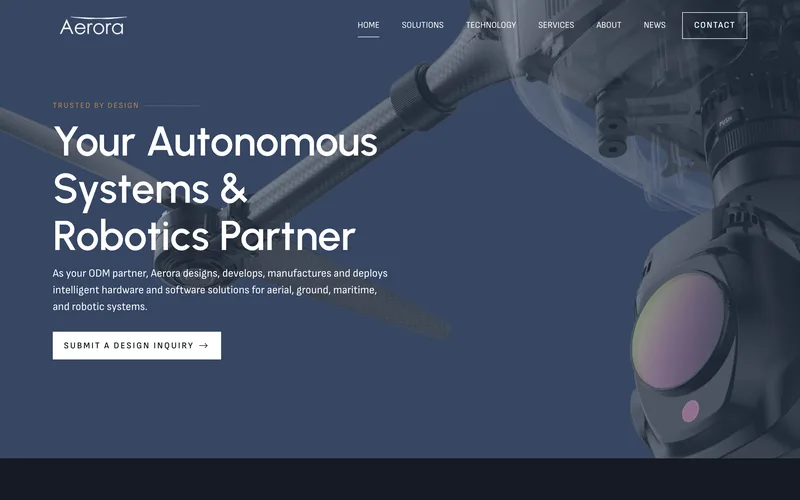
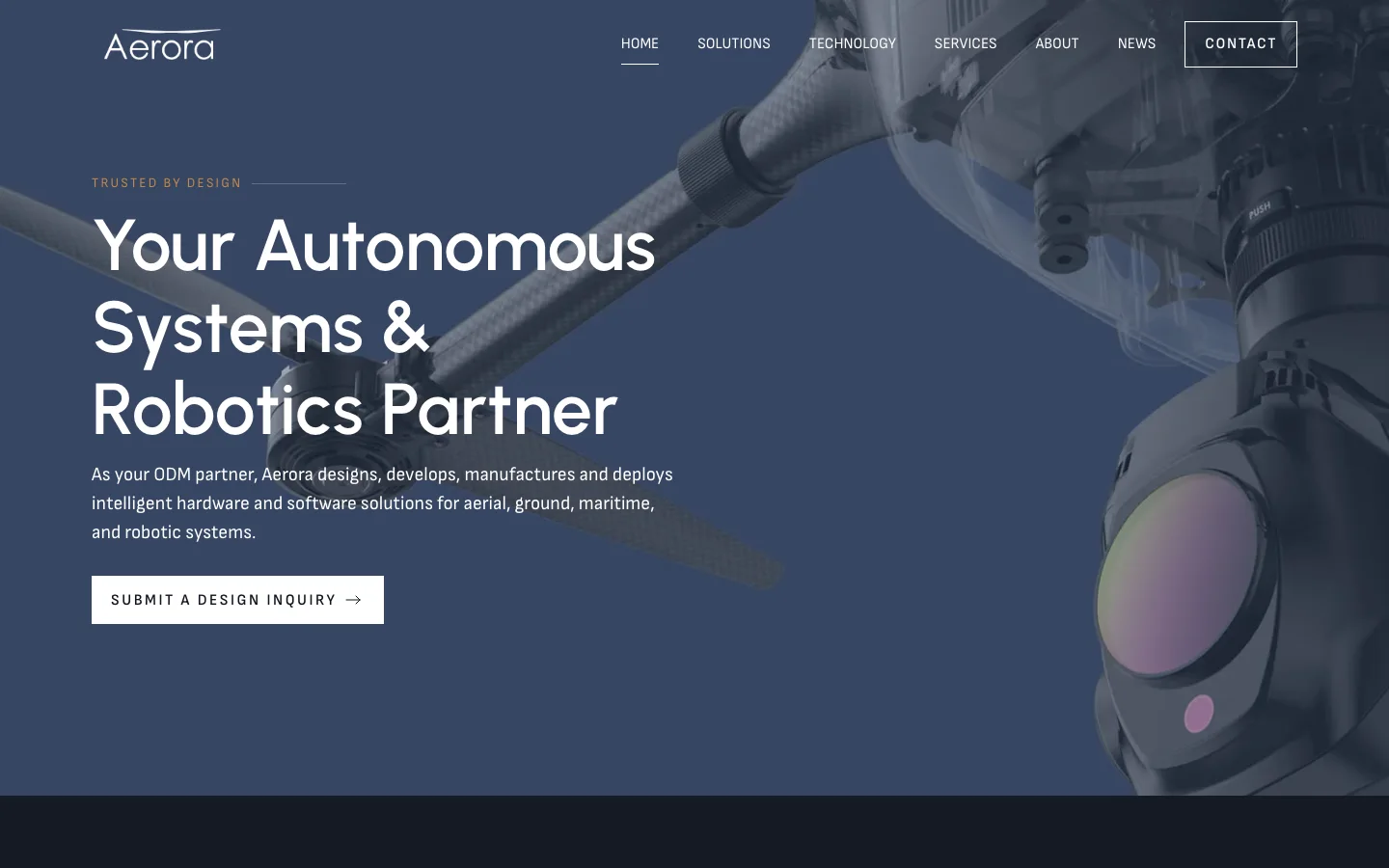
The site sums up its role in one line: "As your ODM partner, Aerora designs, develops, manufactures and deploys intelligent hardware and software solutions for aerial, ground, maritime, and robotic systems." Its footer describes it as "an engineering-led Original Design Manufacturer specializing in autonomous systems and robotics technologies," and its tagline is "Trusted by Design."
In practice, the site shows three kinds of work:
- Full programs. Taking an OEM from requirements through design, prototypes, testing, volume manufacturing and after-sales support.
- Subsystems. Designing or supplying a part of the product, such as the motors and propellers, the battery pack, the flight controller electronics, the gimbal camera or the radio link.
- Ready-made building blocks. Its own products (a ground control station, a dual-sensor AI camera and a motor range) that an OEM can integrate and, according to the data sheets, white-label with its own branding.
The company's About text says Aerora "accelerates UAV and robotics innovation by offering fully integrated, NDAA-compliant propulsion, smart controllers, and precision AI payload systems," and that it manages "the entire supply chain." NDAA compliance is the company's own description; see the compliance section for what that does and does not cover.
What does "ODM partner" mean here?
An original design manufacturer designs a product and also manufactures it, while the customer (the OEM) sells it under its own brand. That differs from a contract manufacturer, which builds to a design the customer already has, and from an engineering consultancy, which designs but does not manufacture at volume.
Aerora's home page describes the relationship this way: "As an Original Design Manufacturer (ODM) Aerora partners with OEMs to design, develop, manufacture, and scale advanced technology products. We provide the engineering expertise, production capabilities, and lifecycle support needed to transform innovative concepts into market-ready solutions." It then splits the offer into three modes:
| Mode | How Aerora describes it | Typical situation |
|---|---|---|
| 01 Design & Develop | "Clean-sheet engineering from operational goals and performance requirements." | You have a product idea and requirements but no design yet |
| 02 Customize & Differentiate | "Proven architectures adapted to your market, payload, and brand." | You want to start from an existing platform and make it yours |
| 03 Build & Scale | "Validation, volume manufacturing, and long-term program support." | You have a design and need it tested, produced and supported |
For a buyer, the practical point is that one partner can hold the design, the supply chain and the factory relationship. That can save handoffs. It also means questions about intellectual property, tooling ownership and exit terms matter more than with a build-to-print shop. Aerora does not publish its IP or tooling terms, so ask (see questions to ask).
Who runs Aerora?
The website does not have a team or leadership page. The one person it names in a company role is Ghel Ghedh, described as Aerora's chief technology officer in the June 2025 news post about its collaboration with Lantronix. In that post he is quoted as saying the company's "core mission is to deliver rapid integration, flexible sensor solutions and fully NDAA-compliant manufacturing at scale." The same quote appears in Lantronix's own press release.
A public record adds a little more. The Oregon Secretary of State business registry lists Aerora North America, Inc., a Delaware corporation registered in Oregon as a foreign business corporation on 18 May 2026, with a principal place of business in Portland and a mailing address in care of Ghel Ghedh. The website does not mention this entity name, so if the legal contracting entity matters to you (for purchase orders, NDAs or supplier onboarding), ask Aerora which entity you will contract with.
The site does not publish an owner, founder, founding year or headcount. Its footer reads "Copyright © 2025 - Aerora Technology."
Where is Aerora, and where does it manufacture?
The site names two U.S. locations, on different pages:
- Santa Clara, California. The contact block on the Solutions, Services, Technology and Privacy pages says "Headquartered in Santa Clara, CA., our team is ready to assist you." The "About Aerora" paragraph in the 2025 news post also says it is based in Santa Clara.
- Portland, Oregon. The About page ends: "Aerora™ is based in Portland, Oregon." The company's own guides FAQ says it has locations in both Santa Clara and Portland, and the Oregon business record above lists a Portland principal place of business.
No street address, phone number or office hours are published on the site. Meetings, site visits and design reviews are arranged through the contact form.
Manufacturing. Aerora manufactures in the USA. Its model, as the home page lays it out under "Manufacturing & Supply Chain":
- U.S. Engineering Leadership: "Program management, architecture, design, customer engagement and full RMA support programs."
- Manufacturing: Aerora's data sheets state products are "Assembled, tested, and manufactured in the USA."
- Supply Chain Resilience: "Diversified sourcing, production flexibility, and long-term program support."
Is Aerora legit? What can be checked
For a B2B engineering partner, "legit" usually means: is this a real company, does it have real products and real partners, and can I check its claims? Here is what is on the public record:
- A registered business. The Oregon Secretary of State registry shows Aerora North America, Inc., registered 18 May 2026, with a registered agent and a Portland principal place of business.
- A named technology partner that confirms the relationship. Lantronix, a Nasdaq-listed company (LTRX), announced a collaboration with Aerora in a 17 June 2025 press release on its own site, describing Aerora as "a provider of integrated NDAA-compliant propulsion, ground control and precision AI payload systems."
- Published data sheets. The Solutions page links three PDF data sheets with detailed specifications: the GS7 ground control station, the D64TR camera and the UAV motor range. Detailed specs are something you can test against samples.
- A named executive. The CTO is named and quoted in both the company's post and the partner's release.
- Stated certifications on specific products. The GS7 data sheet lists IC, FCC and CE for the controller and IC, PTCRB and GCF for its LTE module. The D64TR data sheet lists FCC and IP44. You can ask for the certificates or FCC IDs.
What is not on the site: customer names (the case studies say "an OEM"), a founding date, a street address, a phone number, independent reviews or ratings, and the name of any quality certification behind its "Certified Quality Management" service. None of that means something is wrong, since many ODMs keep customers confidential, but it does mean your due diligence will happen in conversation: ask for references, certificates, a facility visit and sample units.
What Aerora builds: the six capability areas
The home page groups its work into six areas, each with a one-word role:
| Area | Role | How the site describes it |
|---|---|---|
| Smart Controllers | Think | "Mission-critical command and control systems." |
| AI Cameras & Vision Systems | See | "Intelligent sensing and edge processing." |
| Flight & Motion Control | Move | "Control technologies for aerial and robotic platforms." |
| Power & Propulsion | Move | "Motors, ESCs, batteries, and energy systems." |
| Payload & Sensor Integration | Perform | "Custom subsystems and mission equipment." |
| Manufacturing & Scale | Deliver | "From prototype to production." |
The site footer also lists solution lines (multirotor drone platforms, VTOL platforms, payloads, remote data link and propulsion system). The multirotor and VTOL links lead to the general Solutions page, which does not have a separate section on airframes, so ask if a complete platform is what you need.
Aerora's own products and data sheets
The Solutions page presents three product families, each with a downloadable data sheet. All three data sheets carry the line "Specifications subject to change without notice" or similar, and list customerservice@aerora.us as the contact.
GS7 ground control station and remote data link
The GS7 is a handheld ground control station (the controller a pilot or operator uses). The data sheet says it is "designed to meet the demanding needs of enterprise and first responder applications," that its modular design "allows you to select a radio vendor for your drone," and that it offers white-labeling. Published specifications include:
| Spec | Published value |
|---|---|
| Size | 288 x 179 x 81 mm (11.3 x 7.0 x 3.2 in) |
| Operating system | Android 14 |
| Processor | Qualcomm QCS6490 |
| Display | 7-inch 1080p touch screen, 2000 nits |
| Storage and memory | 128 GB UFS, 8 GB RAM, microSD up to 128 GB |
| Battery | 2S 10,200 mAh, 4 to 5 hours, hot-swappable; PD 2.0 charging in under 3 hours |
| Transmission distance | 10 km+ (6 miles) |
| Frequency | 2.4 GHz (2.4 GHz + 5.8 GHz optional) |
| Security | AES 256-bit encryption and anti-interference |
| Flight control compatibility | PX4, MAVLink, ArduPilot |
| Positioning | GPS, GLONASS, Galileo, QZSS, SBAS |
| Connectivity | Wi-Fi (2.4/5.8/6 GHz), Bluetooth 5.2, optional LTE module (CAT 7) listed for T-Mobile, AT&T, Verizon, US Cellular, Telus and SouthernLINC |
| Ports | USB-C, HDMI-compatible output, RJ-45, 3.5 mm headphone jack, SIM slot, USB-A |
| Network types | Point-to-point and point-to-multipoint by default; star, chain and mesh options |
| Environment | 0 to 45 °C (32 to 113 °F); IP55 |
| Certifications listed | Controller: IC, FCC, CE. LTE module: IC, PTCRB, GCF |
The Solutions page adds that its data link carries 1080p HD video at data rates up to 40 Mbps, uses OFDM and MIMO, and supports dual-band 2.4 and 5 GHz operation with AES-256 encryption.
D64TR dual-sensor AI camera and gimbal payloads
The payload data sheet describes the D64TR as a "Dual Sensor AI Camera" that "combines 64MP RGB and FLIR thermal imaging with real-time AI processing," aimed at first responders and industrial inspection, among other uses. Published specifications:
| Spec | Published value |
|---|---|
| Visible camera | 64 MP (1/2-inch sensor), 67° horizontal field of view, 4K video at 60 or 30 fps |
| Thermal camera | FLIR Boson 640 x 512, 32° horizontal field of view |
| Processing | Qualcomm QRB5165, 15 TOPS AI engine for real-time object detection |
| Gimbal | 3-axis, ±0.02° stabilization; pan/yaw ±90°, tilt -90° to +10°, roll ±45° |
| Wind resistance | Level 6 (max 14 m/s; the sheet also says up to 31 mph) |
| Size and weight | 101 x 110 x 90.64 mm; 262 g, aluminum; 12 V |
| Interfaces | CAN, UART, SBUS, PPM, Ethernet, USB 3.0, HDMI, MAVLink |
| Environment | -10 to 50 °C; IP44 enclosure, IP54 camera |
| Certification listed | FCC, IP44 |
| Branding | White-labeling available |
Beyond the D64TR, the Solutions page says its payload lineup covers LiDAR, multi-sensor RGB and thermal cameras, laser range meters, oblique camera systems and multispectral imaging, powered by "a 7nm Qualcomm processor capable of ultra-high resolution image processing up to 200 Megapixels," with AI object tracking and plug-and-play gimbals for small to mid-sized UAVs.
UAV motors and propulsion
The motor data sheet ("UAV Power Motors") lists five families. The figures below are the ranges printed on the sheet.
| Series | Models | Drone class (per the sheet) | Max thrust range |
|---|---|---|---|
| Nano | BL0805, BL1105, BL1106, BL1206, BL1404 (1S to 2S) | Mini and micro drones under 1 kg | 70 g to 250 g |
| Enterprise | BL2408, BL2808, BL2414, BL3212, BL4006, BL4808, BL5006 (mostly 6S) | Lightweight to mid-range drones under 15 kg | 0.8 kg to 3.5 kg |
| Heavy Lift | BL6009, BL6508, BL8708, BL8710, BL10015 (12S) | Heavy drones, 15 to 40 kg | 5 kg to 14 kg |
| Gimbal motors | GM1502, GM2904, GM3204, GM3906 (12 V) | Camera gimbals | Torque 10 to 138 mNm |
| Combo (arm sets) | 4006 (6S, 20 A FOC ESC, 12-inch carbon prop) and 8710 (12S, 50 A, 32-inch foldable prop) | Mid-range to heavy-lift drones | 1.5 kg and 10 kg |
The combo sets are described as a modularized propulsion system with field-oriented control (FOC) by default (BLDC for custom options), a proprietary quick-release propeller design and carbon fiber arms. The gimbal motors are listed with "angle precision of 0.01 degree" and a choice of digital encoder or hall-effect sensor.
The engineering behind it, area by area
The Technology page lists nine engineering disciplines. These are the capabilities Aerora offers on custom programs, described in its own words where it gives specifics.
- Aerodynamic and mechanical design. Experience in aerodynamics and CFD (computational fluid dynamics) and composite materials, aimed at light, strong platforms with good wind stability.
- Algorithms. Its flight and system control uses Active Disturbance Rejection Control (ADRC), which the company says mitigates errors inherent in the common PID approach by observing disturbances and adapting quickly, and which it says has been used on multirotor, fixed-wing and tilt-rotor platforms and in its gimbals.
- Batteries. Custom packs from industrial drones to lightweight FPV setups, using LiPo, Li-ion, LiFePO4, 18650 and pouch cells, with cell-level and pack-level testing for capacity, cycle life, discharge and thermal behavior, from design and cell sourcing through mass production.
- Electronics design. Flight controllers, battery management systems (BMS), sensors and image modules, with redundant backups for critical controllers and sensors. It lists design experience on Intel, Rockchip, Qualcomm, Hisilicon, Nvidia, Amba, TI and ST platforms, and real-time simulation for high-speed PCB design.
- Electronic speed controllers (ESCs). Sensorless FOC algorithms the company calls "patent pending," running 60,000 calculations per second. It claims 50% higher RPM than "industry standard limits" and a "worry-free" mode that switches from 1,000 RPM to reverse 1,000 RPM within 200 ms for emergencies.
- Embedded software. Full-system customization on Android and Linux, from board support packages to apps, including onboard image acquisition, visual computing and portable ground station software, with low-latency video streaming.
- Gimbals. The page states stabilization precision of ±0.005° for gimbals with 30x optical zoom, brushless motors built to reduce cogging, magnetic encoders and a 100-microsecond FOC response time. (The D64TR data sheet lists ±0.02° for that camera.)
- Motor design. Motors from its "08 series to robust 95 series," plus gimbal motors for loads up to 3 kg, sized through electromagnetic and thermal analysis rather than trial and error.
- Propellers. Rotor design using blade element and momentum theory, 2D and 3D CFD, and a database of past projects, then prototype validation. The company says this process typically halves development time and cost.
Performance figures here are the company's own claims. If a number matters to your program (gimbal precision, ESC response, thrust), ask how it was measured and request test data or sample units.
Services: design, NPI and manufacturing
The Services page lists three groups. It names each service without longer descriptions, so the short notes below explain the standard meaning of each term.
| Group | Services listed | What that usually covers |
|---|---|---|
| Design & Development | Tailored or Custom Solutions; System Integration; Advanced Engineering and Testing; Tooling Design and DFM | Engineering the product, making the subsystems work together, and designing it so it can be manufactured efficiently (DFM) |
| New Product Introduction | Rapid Prototyping; Design Validation Testing; Engineering Validation Testing; Production Validation Testing; Third Party and Regulatory Compliance Testing | Building prototypes and running the EVT, DVT and PVT test stages before mass production, plus outside certification testing |
| Sourcing & Manufacturing | Trusted Supply Chain Network; Vendor Management; Contract Manufacturing; Certified Quality Management | Finding and managing suppliers, building the product at volume, and running a quality system |
The site does not name the quality standard behind "Certified Quality Management." If you need a specific certification (for example an ISO quality management standard), ask for the certificate and its scope.
How a program works, step by step
The home page sets out a seven-step process under "Proven ODM Processes: From Prototype To Scalable Production":
- Discover: "Requirements, constraints, and mission definition."
- Design: "Architecture, mechanical, electronic, and software."
- Prototype: "Rapid builds and design iteration."
- Validate: "Test, qualify, and prove out in the field."
- Manufacture: "DFM, tooling, and production ramp."
- Deploy: "Launch support and program rollout."
- Support: "Sustaining engineering across the lifecycle."
In practical terms, the first contact is the inquiry form. The site's buttons call it a "Design Inquiry" and a "Consultation." The form asks for your name, email, company, city, country, state or province and a message. The company's guides FAQ suggests including a short description of the product, its key requirements, target volumes and timeline, and says a requirements document and any existing designs speed up the first conversation.
After launch, Aerora lists "full RMA support programs" (handling returns and repairs) as part of its U.S. engineering role, and Support as the last stage of the process. Warranty length and turnaround times are not published.
Case studies and the Lantronix collaboration
The site shows two case studies, without naming the customers.
1. Rapid integration and manufacturing for EO/IR camera systems. An OEM needed a dual optical and thermal (EO/IR) camera for its drone, quickly. According to the site, Aerora selected a FLIR Hadron camera (640 x 512 thermal and 64 MP optical), used Lantronix system-on-module (SOM) hardware and engineering support with Qualcomm processing, and integrated it all on a 3-axis gimbal. The company says this "significantly reduced the OEM's development timeline and resource allocation."
2. Smart camera integration program. This one describes the next step: reusing the same SOM-based integration model for other sensors, including multispectral cameras for agricultural monitoring and optical gas imaging (OGI) sensors for methane detection, deployed on drones and ground robots.
The Lantronix collaboration. On 17 June 2025, Lantronix announced a collaboration with Aerora on edge AI for drones, robotics and surveillance. Aerora reposted the release on its News page (the post shows 24 June 2025). Per the release, Aerora's solution runs on Lantronix Open-Q system-on-modules powered by Qualcomm chipsets and incorporates the Teledyne FLIR Hadron 640R module and Prism software. The release says Aerora's full-stack solution pre-integrates the camera, gimbal, gimbal motors, housing, telemetry and interface, streaming 4K video alongside thermal video, and that Aerora "is working with multiple OEM drone manufacturers." The release mentions a white paper; the "Download Our White Paper" button on the Solutions page did not lead to a file when we checked, so ask the company for a copy.
Which markets Aerora serves
The home page lists six markets under "Enabling Innovation Across Autonomous Industries":
- Aerial Systems: commercial UAVs and industrial drones.
- Ground Robotics: mobile robotic and automated systems.
- Maritime Systems: surface and subsea autonomy.
- Agriculture & Forestry: precision sensing and automated detection.
- Security & Inspection: drones for security and inspection work.
- Smart Devices & Vision Systems: connected products and edge AI.
The product material is concrete about aerial use (first responders, industrial inspection, mapping-style payloads, heavy-lift and delivery motors). Ground and maritime work appear mostly as capability statements and in the second case study, so if you are building a ground or maritime product, ask for examples of comparable past work.
How much does Aerora cost?
Aerora does not publish prices, minimum order quantities (MOQs) or lead times, for its own products or for engineering programs. Its guides FAQ says these "depend on each program's scope, volumes and requirements," and that IP and tooling terms are set per agreement. That is normal for an ODM.
What usually drives the cost of an ODM program:
- Where you start. A clean-sheet design costs more than adapting an existing architecture (Aerora's "Customize & Differentiate" mode), which costs more than building a finished design.
- Non-recurring engineering (NRE). Design hours, prototypes, test rounds (EVT, DVT, PVT) and certification testing are often billed separately from unit prices.
- Tooling. Molds, fixtures and test stations, and who owns them afterwards.
- Volume. Unit price normally falls as committed volume rises.
- Components. Thermal cores, compute modules and radios can dominate a bill of materials.
- Compliance needs. Sourcing documentation, country-of-origin requirements and certifications add work.
To get a number, send a design inquiry with your requirements, target volumes and timeline. For the GS7, D64TR or motors, ask for unit pricing at your volume, sample pricing and whether white-labeling changes the price.
NDAA, Blue UAS and FCC questions
Buyers of drone hardware in the U.S. often ask three separate compliance questions. Here is what Aerora's own pages say on each. This is a summary of the company's statements, not legal or regulatory advice; confirm your own requirements with the agency or a compliance advisor.
- NDAA. Aerora describes its products and manufacturing as NDAA-compliant throughout the site and data sheets (the data sheets say "100% NDAA Compliant"). Its guides FAQ notes that this is "Aerora's own description, not a third-party certification." NDAA rules restrict certain components and sources in drones bought with federal money. Ask for a bill of materials showing the maker and country of origin of covered parts for the configuration you are buying.
- Blue UAS. The company's guides FAQ states plainly: "Aerora is not on the Blue UAS Cleared List or the Blue UAS Framework." Blue UAS is a separate Defense Department review program. If your buyer requires Blue UAS listed hardware, Aerora's products are not listed today.
- FCC equipment authorization. Aerora's guides FAQ discusses the FCC's December 2025 action adding foreign-produced drones and critical drone components to its Covered List, and recommends that buyers ask for each product's FCC authorization status. Raise it early, for each product and configuration.
How an ODM compares with other ways to build
| Option | What you get | Typical trade-off |
|---|---|---|
| An ODM such as Aerora | Design, prototypes, validation, sourcing, volume manufacturing and RMA support from one partner; ready-made subsystems to start from | Less direct control of the factory; IP, tooling and exit terms need care |
| A contract manufacturer (build to print) | Volume production of a design you already own | You need your own engineering team and finished design files |
| An engineering design consultancy | Design and prototypes | You still need a separate manufacturer, and a handoff between them |
| Buying off-the-shelf modules and integrating in-house | Fast start using existing cameras, controllers and motors | Less differentiation; integration work stays with you |
| Building an in-house factory | Full control of production and compliance | High cost and years to set up quality systems and supplier networks |
Who it suits, and who should look elsewhere
A good fit if you…
- Are an OEM or startup building a drone, robot or camera product to sell under your own brand
- Want one partner to carry a program from requirements through manufacturing and after-sales RMA
- Need a specific subsystem: propulsion, ESCs, batteries, a gimbal camera, a ground station or a data link
- Want a white-label ground control station or dual-sensor camera to integrate
- Want U.S.-based engineering, program management and manufacturing
Look elsewhere if you…
- Want to buy one finished drone for your own use: Aerora works with OEMs, not consumers
- Need hardware on the Blue UAS Cleared List or Framework today
- Require products manufactured in the U.S. for procurement rules: confirm country of origin first
- Need published pricing or a self-service online store
- Already have a finished design and only want the lowest build-to-print price
Questions to ask before you sign
- Which legal entity will we contract with, and where will engineering, assembly and testing of our product happen?
- Who owns the design IP, firmware and tooling at the end of the program, and what happens if we move production later?
- What is the NRE estimate, the sample price and the unit price at our volumes? What are the MOQs and lead times?
- What FCC authorization or exemption applies to our product configuration, and can you show NDAA sourcing documentation for each covered part?
- Which quality certification sits behind "Certified Quality Management," and what is its scope?
- Can we see test data for the performance figures we care about (gimbal precision, ESC response, thrust, battery cycle life)?
- What do warranty, RMA turnaround and sustaining engineering look like after launch?
- Can you share references from OEMs with a similar product, and can we visit the facility?
How to get started
- Review the Solutions page and download the data sheets for the GS7, the D64TR camera and the motor range.
- Read the Technology page to match your needs to its engineering areas.
- Prepare a short brief: what the product does, key requirements, target volumes, timeline, and any compliance needs (NDAA, FCC, country of origin).
- Submit it through the contact form, or email customerservice@aerora.us as listed on the data sheets.
Terms you'll see on the site
- ODM (original design manufacturer): a company that designs and manufactures a product that another company sells under its own brand.
- OEM (original equipment manufacturer): here, the brand owner that sells the finished drone or robot.
- NPI (new product introduction): the stage that takes a design through prototypes and testing into production.
- EVT, DVT, PVT: engineering, design and production validation tests, the three test stages before mass production.
- DFM (design for manufacturing): adjusting a design so it can be built reliably and economically at volume.
- RMA (return merchandise authorization): the process for returning and repairing faulty units.
- GCS (ground control station): the controller and screen an operator uses to fly a drone and view its video.
- EO/IR: electro-optical (visible light) and infrared (thermal) imaging, often combined in one gimbal camera.
- ESC (electronic speed controller): the electronics that drive each motor.
- FOC (field-oriented control): a motor control method that gives smoother, quieter and more efficient control than basic BLDC drive.
- ADRC (active disturbance rejection control): a control method that estimates and cancels disturbances such as wind in real time.
- SOM (system-on-module): a small board carrying the processor, memory and core electronics, built into a larger product.
- TOPS: trillions of operations per second, a common measure of AI processing capacity.
- OGI (optical gas imaging): camera technology that makes gas leaks, such as methane, visible.
- NDAA: the National Defense Authorization Act, whose provisions restrict certain drone components and sources in federal purchases.
Frequently asked questions
What does Aerora Technology do?
Aerora Technology is an original design manufacturer (ODM) that designs, develops, manufactures and supports drone and robotics hardware for OEMs. It covers aerial, ground and maritime systems, and also sells its own ground control station, AI camera and motors for integration.
Where is Aerora located?
Aerora's site names Santa Clara, California as its headquarters on several pages and says on its About page that it is based in Portland, Oregon; its FAQ says it has locations in both. No street address or phone number is published.
Where does Aerora manufacture its products?
In the USA. Aerora pairs U.S. engineering leadership with U.S. manufacturing; its data sheets state products are "Assembled, tested, and manufactured in the USA."
Who is the CTO of Aerora?
Aerora's June 2025 news post and Lantronix's press release name Ghel Ghedh as Aerora's chief technology officer. The site has no team page and does not name an owner or founder.
Is Aerora a real company?
Yes. The Oregon Secretary of State lists Aerora North America, Inc., registered in Oregon on 18 May 2026, and Lantronix, a Nasdaq-listed company, announced a collaboration with Aerora in June 2025. Aerora also publishes detailed product data sheets.
How much does Aerora charge?
Aerora does not publish prices, minimum order quantities or lead times. They are quoted per program based on scope, volumes and requirements, so you send a design inquiry through its contact page.
Is Aerora NDAA compliant?
Aerora describes its products and manufacturing as NDAA-compliant. Its own FAQ notes this is the company's description, not a third-party certification, so ask for sourcing documentation for the configuration you buy.
Is Aerora on the Blue UAS list?
No. Aerora's own FAQ states that it is not on the Blue UAS Cleared List or the Blue UAS Framework.
Does Aerora sell drones to consumers?
No. Aerora works with OEMs and product companies building drones, robots and camera systems, not with individual drone buyers.
What is the Aerora GS7?
The GS7 is Aerora's handheld ground control station: Android 14, a Qualcomm QCS6490 processor, a 7-inch 2000-nit screen, 4 to 5 hours of hot-swappable battery life, a stated 10 km+ range and compatibility with PX4, MAVLink and ArduPilot. It can be white-labeled.
What is the Aerora D64TR camera?
The D64TR is Aerora's dual-sensor AI gimbal camera, pairing a 64 MP visible camera with a FLIR Boson 640 x 512 thermal sensor, a Qualcomm QRB5165 processor with a 15 TOPS AI engine, and a 3-axis gimbal. It weighs 262 g according to its data sheet.
Can Aerora white-label products for my brand?
Yes, according to its data sheets: the GS7 ground control station and the D64TR camera both list white-labeling with customizable branding.
Does Aerora work on ground robots and boats, or only drones?
Aerora says it works across aerial, ground, maritime and robotic systems. Its published products and specs are mostly for drones, so ask for comparable ground or maritime examples.
Does Aerora provide support after launch?
Aerora lists full RMA support and sustaining engineering as part of its process. Warranty length and turnaround times are not published and are set per program.
How do I contact Aerora?
Use the inquiry form on Aerora's contact page at aeroratech.com/contact-us. Its product data sheets also list customerservice@aerora.us.
Sources
All pages checked on 19 October 2026.
- Aerora Technology, home page: aeroratech.com
- About: aeroratech.com/about/
- Drone Solutions: aeroratech.com/drone-solutions/
- Technology: aeroratech.com/drone-technology/
- Services: aeroratech.com/drone-services/
- Contact: aeroratech.com/contact-us/
- News post, "Next-Gen Edge AI Solutions for the Real World": aeroratech.com news
- Data sheets: GS7 ground control station (PDF), D64TR payload (PDF), UAV motors (PDF)
- Drone and robotics OEM FAQ (company questions): aeroratech.com/guides/faq/
- Privacy policy: aeroratech.com/privacy-policy/
- Lantronix press release, 17 June 2025: lantronix.com
- Oregon Secretary of State business registry, Aerora North America, Inc. (registry no. 257661398): data.oregon.gov



