
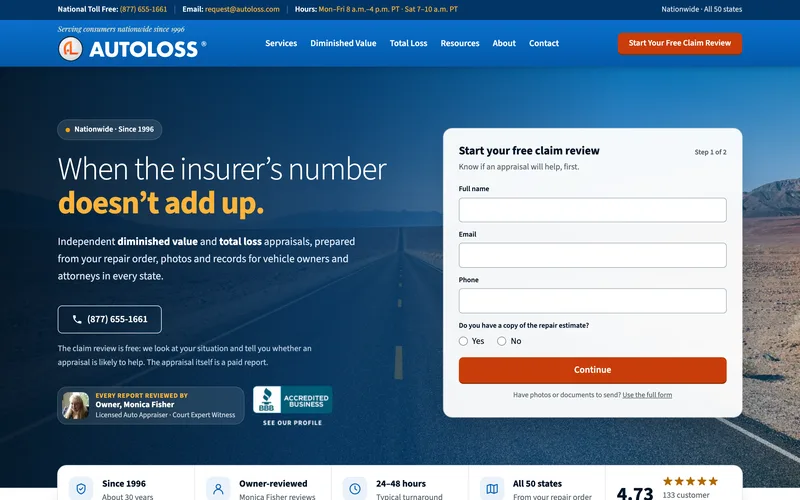
Here is what it offers, costs and how it works.
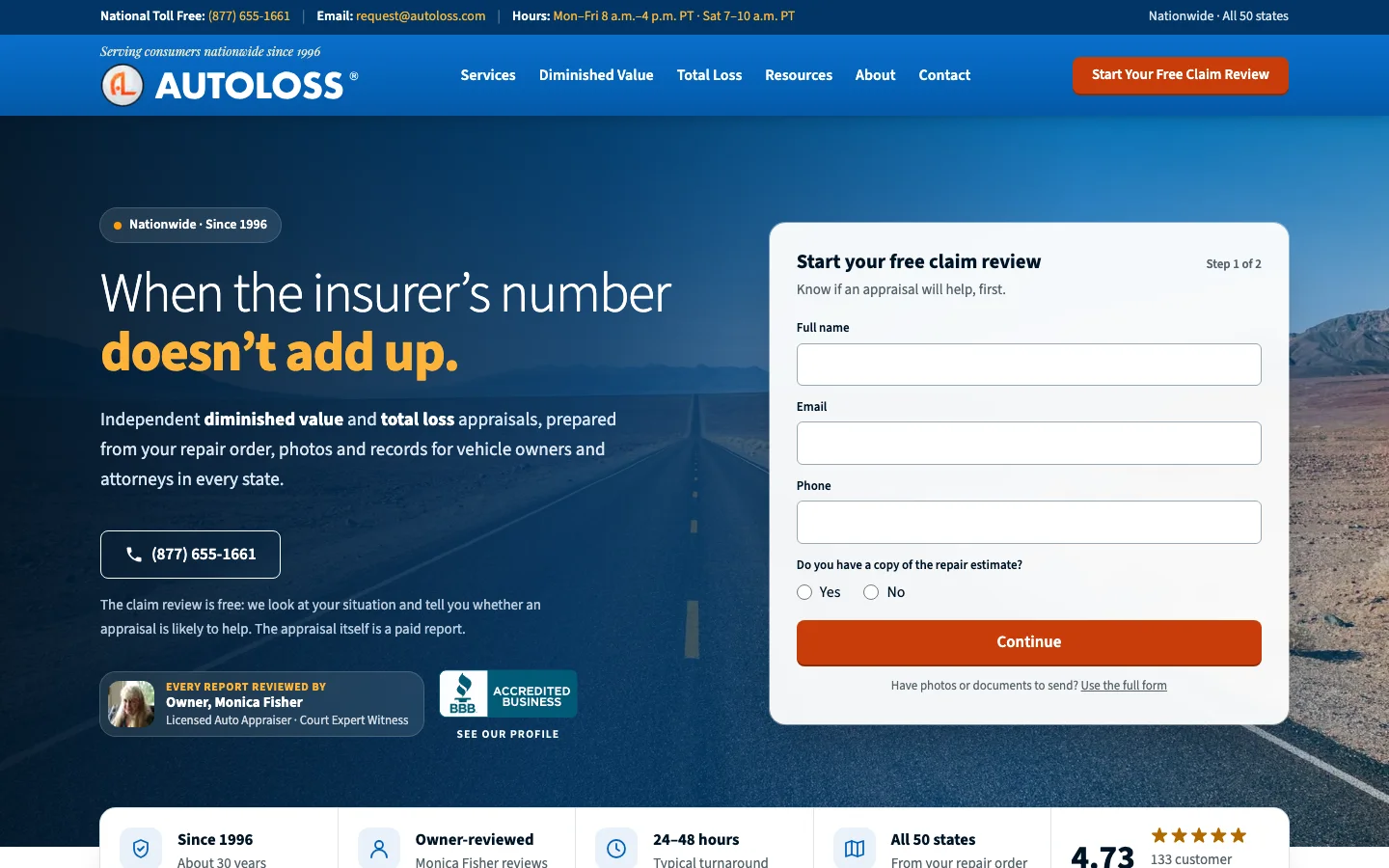
Autoloss is an eSEOspace client: we work on its website and search marketing. This guide uses the company's own published information, checked on 19 October 2026 and every source is listed at the end. We don't rate or score our clients. Fees and policies change, so confirm them on autoloss.com before you order. This guide is general information, not legal, insurance or tax advice.
The short answer
Autoloss is an independent vehicle-appraisal company based in Oregon and owned by Appraisal Group of America. It prepares diminished value appraisals (the resale value a car loses after an accident, even with good repairs) and total loss appraisals (a second opinion on an insurer's offer for a totaled car), plus stated value, loss of use, lease-end, luxury and donation appraisals. It works for vehicle owners and attorneys in every state, from the repair order, photos and records. A typical diminished value appraisal costs $250 to $350; other work is quoted. The first claim review is free. Call (877) 655-1661 or email request@autoloss.com. It is not a law firm.
| Business | Autoloss (autoloss.com), owned by Appraisal Group of America |
|---|---|
| What it does | Independent diminished value, total loss and specialty vehicle appraisals, with a demand letter for diminished value claims; expert-witness work for attorneys |
| Based in / service area | Oregon; serves all 50 states and Washington, DC (no total loss work in seven states, see below); does not serve Canada |
| In business since | 1996, according to the company |
| Owner | Monica Fisher, who the company says reviews every report |
| Licenses listed | Oregon DMV vehicle appraiser certificate V26-105; North Carolina appraiser license 7941001 (as listed on the site) |
| Price range | Diminished value: $250 to $350 typical, more for exotic vehicles. Other appraisals: quoted. Attorney testimony: from $2,500 |
| Turnaround | Typically 24 to 48 hours after all required information is received |
| Hours | Mon to Fri 8 a.m. to 4 p.m. PT; Sat 7 to 10 a.m. PT |
| Phone / email | (877) 655-1661 (toll-free) · request@autoloss.com |
| Website | autoloss.com |
What is Autoloss?
Autoloss is a vehicle-appraisal company that works for the vehicle owner rather than the insurance company. Its own summary: insurers hire their own appraisers and valuation vendors, and Autoloss "works for the vehicle owner, or for the owner's attorney, and prepares an independent valuation supported by comparable vehicles rather than price-guide figures alone."
Most of its work falls into two kinds of claim:
- Diminished value. Your car was repaired after an accident that wasn't your fault, but it now has an accident on its history report, so buyers and dealers will pay less for it. Autoloss measures that lost market value and writes a demand letter you send to the at-fault driver's insurer.
- Total loss. Your insurer declared the car a total loss and offered what it calls actual cash value. If that offer looks low, Autoloss prepares an independent valuation you can use to dispute it, or in your policy's appraisal process if it has one.
It also appraises vehicles for stated-value insurance and lenders, loss-of-use claims, lease returns, luxury and collector vehicles, and charitable donations, and it provides reports and expert testimony for attorneys. The company says it will look at "anything with wheels," and lists motorcycles, RVs and motorhomes, food carts and fleet vehicles among the things it appraises.
Its customers are mainly individual drivers, plus the attorneys, lenders, credit unions, insurers and government agencies that need an independent vehicle value. The site says past matters have involved federal agencies, a state government, auto finance companies, insurers and claims administrators, and adds that naming an organization "describes past work only and does not imply its endorsement."
Who owns and runs Autoloss?
Monica Fisher owns Autoloss and its parent company, Appraisal Group of America. The site describes her as a licensed auto appraiser and court expert witness and says she personally reviews every appraisal before it goes out. Her profile lists:
- Owner and appraiser, Appraisal Group of America; owner of Autoloss; owner of United States Claims Advisors
- National total-loss umpire since 2008
- Formerly a licensed public adjuster
- Approved for lease-termination appraisals for three named automaker finance companies
- Expert appraisal services, depositions and testimony in Texas, Washington, Florida, Idaho, Oregon, Ohio and Arizona, in arbitrations, municipal courts and federal bankruptcy court
- Licenses: Oregon DMV vehicle appraiser certificate V26-105 and North Carolina appraiser license 7941001
- Education: Oregon State University graduate, with graduate study at Marylhurst
The site is clear that she is an appraiser, not an attorney. She also reviews the court decisions cited on the site "from an appraisal perspective."
The company says it was founded in 1996 by Terry M. Fisher, who had more than thirty years in the wholesale and retail automotive business and was often called as an automobile expert in arbitrations, municipal courts and bankruptcy court. He died in 2013, and Monica Fisher has run the company since.
The site also mentions appraisers and a support staff you can call during your claim, but it does not publish a staff list.
Is Autoloss legit?
People usually ask this before paying a few hundred dollars to a company they found online. Here is what can be checked:
- BBB accredited. The Better Business Bureau lists AutoLoss.com as a BBB Accredited Business since 24 March 2015.
- Review figures the company shows. The Autoloss home page shows "4.73" from "133 customer reviews on BBB" and quotes recent BBB reviews from 2026. Its testimonials page also shows reviews collected through a review service. Those are the company's own selections, and the site notes that client comments "describe individual experiences, not typical results."
- Published license numbers. The site lists an Oregon DMV vehicle appraiser certificate and a North Carolina appraiser license, with numbers. We did not look them up in a state registry, so treat them as the company's statement. You can ask for copies; the lease-termination page says each report includes the appraiser's license information.
- A named owner who signs off. A named person, with stated court experience, takes responsibility for every report.
- Clear limits. The site repeatedly says it is not a law firm or public adjuster, that it does not negotiate for you, and that "an appraisal is evidence supporting your claim, not a promise of payment." It also says its fee does not depend on the value in the report.
- Contact details. A toll-free number, an email address and posted hours. The site does not publish a street address; it says the company is based in Oregon and asks you to call first if you need to come to the office.
Diminished value appraisals
This is the service most people call about. Autoloss defines diminished value as "the market value a vehicle loses because it now has an accident history, even after good repairs." Your repair payment covers fixing the car; it usually does not cover that lost resale value. A diminished value claim asks the responsible driver's insurer to pay the difference as part of your property damage claim, where state law allows it.
The site explains three types:
| Type | What it means (per the site) |
|---|---|
| Inherent | The loss that remains after proper repairs, simply because the car now has an accident history. Most claims are about this. |
| Repair-related | Extra loss from incomplete or poor repairs, such as mismatched paint, panel gaps or unfinished structural work. |
| Immediate | The drop in value right after the accident, before repairs. Mostly relevant when a damaged car is sold or traded in unrepaired. |
What the report includes, according to the service page:
- Vehicle identification, mileage, trim and equipment
- A review of the repair estimate or final invoice and the damaged areas
- Pre-loss market value, supported by comparable vehicles
- Post-repair market value, supported by comparable vehicles that have accident history
- The diminished value figure and how it was reached
- A custom demand letter written for your claim, to send with the report
- Monica Fisher's review before release
If the insurer asks how the report was prepared, Autoloss answers those questions, and it will amend a report that contains an accidental error or omission. It does not negotiate the claim for you.
The site also offers a free diminished value calculator. It applies a simple percentage to a pre-accident value you enter, based on whether the damage was minor, moderate or extensive. The company is direct that this is "a starting point, not an appraisal" and not a figure to send to an insurer. It also explains the "17c" formula some insurers use, which it describes as an insurer method that "tends to produce low figures" and that a market-based appraisal does not use.
Total loss appraisals
When an insurer totals your car, it offers what it calls actual cash value, usually based on a valuation vendor's report of similar vehicles. Autoloss lists four places it says those valuations go wrong:
- Wrong trim or options: a base model priced instead of the trim you own, or factory packages left out.
- Condition marked down: generic deductions that don't match your car's condition and records.
- Weak comparables: vehicles from distant markets, with higher mileage, or a different trim.
- Upgrades ignored: aftermarket equipment, recent major repairs and new tires.
The total loss appraisal is an independent valuation of your car's market value just before the loss, built from comparable vehicles and your records. You can give it to the adjuster, or use it if your policy has an appraisal clause: a provision many auto policies include that lets either side demand an appraisal when you disagree on the amount, with each side hiring an appraiser and an umpire settling the difference. Autoloss's suggested sequence is to get the insurer's full valuation report (not just the offer), start a free claim review, have the appraisal prepared, then present it.
Two limits matter here. First, Autoloss does not take total loss claims in Alabama, Connecticut, New Jersey, New York, Rhode Island, South Carolina or Wyoming; its diminished value and other appraisals are available everywhere. Second, the site warns that policies and states set time limits for disputing a valuation and for invoking an appraisal clause, so check them before waiting for a report. Total loss fees are not published; they are quoted after the free review.
Other appraisals: stated value, loss of use, lease, luxury, donation
| Appraisal | What it's for, per the site |
|---|---|
| Stated value | Documents a vehicle's value for an agreed- or stated-value insurance policy, a bank or a credit union. Notes whether the vehicle is stock or upgraded or restored, with a detailed breakdown of components and upgrades. Once you approve it, Autoloss can send it to your lender or insurance agent. |
| Loss of use | Puts a value on the use of a vehicle while it was out of service after an accident, for example a vehicle you use for work, to support a claim against the at-fault party where your state allows it. |
| Lease termination | An independent condition and value report at lease end, as evidence if you dispute turn-in charges or before deciding on a buyout. Autoloss can send it to the leasing company's lease-end department; it includes supporting documents and the appraiser's license information. |
| Luxury, exotic and collector | Valuation where comparables are scarce and options, mileage and history move the price a lot. Uses listed: insurance claims, financing, bankruptcy, setting insurance coverage, and estate valuations. Exotic vehicles may cost extra. |
| Vehicle donation | A signed appraisal for donors who need a qualified appraisal to support a charitable deduction. Autoloss says it can sign the appraiser declaration on IRS Form 8283 when that applies. It is "an appraiser, not a tax advisor." |
The donation page is a useful read before you pay for anything: it explains that most donated cars don't need an appraisal, because if the charity sells the car your deduction is generally limited to the sale price. Per IRS Publication 4303, which the page cites, a written appraisal is needed when you claim more than $5,000 and the deduction is not limited to the sale proceeds, and it must be made no more than 60 days before the donation. Ask a tax professional whether yours qualifies.
Services for attorneys
Autoloss provides appraisal reports, depositions and expert-witness testimony for attorneys in diminished value, total loss and other vehicle-value disputes. It describes these as non-legal support services. The published terms:
| Item | Published terms |
|---|---|
| Expert-witness fee | Starts at $2,500 per testimony, with hourly rates charged on top |
| Direct time | $300 per hour (investigation, conference, research, analysis, travel, written and oral reporting) |
| Court time | $550 per hour (trial time including testimony, conference and waiting) |
| Deposition | $2,500 minimum, payable 60 days ahead plus expenses and travel; most can be done by telephone |
| Expenses | At actual cost (travel, lodging and case-specific costs) |
| Retainer | 80% of anticipated fees and expenses, 60 days ahead, to hold dates |
| Travel | Must be arranged 60 days in advance; call to confirm availability first |
| Late cancellation | $1,000 administrative fee with less than 7 days' notice |
Payment is not contingent on the outcome of the case, and engagements are subject to Autoloss's written engagement terms.
How much does Autoloss cost?
These are the figures published on the site when we checked on 19 October 2026.
| What you buy | Published price | Notes |
|---|---|---|
| Free claim review | $0 | A preliminary review, not an appraisal; tells you whether an appraisal is likely to help |
| Diminished value appraisal | $250 to $350 typical | Includes the report and a custom demand letter; exotic vehicles may cost more |
| Total loss, stated value, loss of use, lease, luxury, donation | Not published | Quoted after the free claim review, before you commit |
| Credit-card payment | +$10 | Processing fee added to card payments |
| Cancelling before you receive the report | $75 | Any refund is issued after the fee is paid |
| Expert testimony (attorneys) | From $2,500 | Plus $300/hour direct time and $550/hour court time |
The fee is flat. The site says report fees "are not contingent on any value shown in the report," and explains why: an appraiser paid more for a higher number has a reason to inflate it, and an insurer can say so. You pay before the report is delivered.
Can you get the fee back from the insurer? The company says insurers sometimes reimburse appraisal costs as part of a settlement and you can ask for it in your demand, but nothing requires it in most situations, so treat the fee as your own cost when deciding.
Is it worth it? That depends on the car and the claim. The site's own advice is that newer, lower-mileage, higher-value cars and cars with structural repairs lose the most, while older, high-mileage cars or cars with earlier damage may not justify the fee, and that the free review is where it tells you which applies. The calculator can give you a rough number to compare with the fee first.
The site does not mention financing or insurance coverage for its fees.
How it works, step by step
- Free claim review. Fill in the online form or call. The form asks for the state where the car is registered, the type of appraisal, year, make, model, mileage, ownership (owned, financed, leased), fault, prior damage, repair status, insurer, any offer and repair cost. You can attach repair invoices, photos and the insurer's valuation (JPG, PNG, HEIC or PDF, up to 15 MB each). Autoloss says it usually replies within one business day and will tell you if an appraisal is unlikely to be worth the fee.
- Get a quote and decide. If an appraisal makes sense, it quotes the fee. There is no obligation.
- Order and send documents. You pay and upload photos and records (checklist below).
- Research. The appraiser finds comparable vehicles and reviews the damage, repairs, mileage, equipment, condition and your local market.
- Owner review. Monica Fisher reviews the report before release.
- Delivery. Typically 24 to 48 hours after all required information is received. The clock starts once Autoloss has what it needs.
- You present the claim. You send the report and demand letter to the insurer. If the insurer questions it, Autoloss explains how it was prepared, and its support staff can be reached by phone throughout.
No inspection appointment is needed. The site says physical inspections are "no longer normally required" and reports are prepared from the repair order, photos and records. Its own guide notes that an in-person inspection adds something mainly when repair quality is in doubt, records are missing, the vehicle is unusual, or a court asks for it.
What to send
| Diminished value | Total loss |
|---|---|
| Final repair invoice (or the estimate if repairs aren't finished) | The insurer's full valuation report and settlement offer |
| Photos of the damage and of the repaired vehicle | Photos of the vehicle before and after the loss, if you have them |
| Year, make, model, trim, mileage and VIN | Maintenance, upgrade and recent-repair records |
| At-fault insurer's name, claim number and adjuster contact | Window sticker or build sheet, if available |
| Accident date and a short description | Your policy's appraisal provision, if you have a copy |
For photos, the site suggests daylight shots of all four sides, close-ups of each damaged or repaired area, the odometer and the VIN plate, plus any visible repair problems such as paint mismatch or panel gaps. If you're missing something, send what you have and it will tell you what's needed.
How the value is worked out
Autoloss publishes its method. In short, it values the vehicle "from market evidence," not "a formula applied to a price guide":
- Comparables. Vehicles of the same year, make, model and trim with similar mileage and equipment, in markets relevant to the owner. For diminished value it compares vehicles with and without accident history. It prefers current retail listings and actual sale data over price-guide values alone.
- Adjustments. Mileage, equipment and options, condition, the type and severity of damage (structural and frame damage weigh more than cosmetic), repair quality, prior damage and local market.
- The figure. Diminished value compares pre-loss and post-repair market value. Total loss establishes market value just before the loss. Every adjustment is written into the report so a reader can follow it.
- Sources. Public vehicle listing sites, a dealer retail chain, a vehicle-history report service and a price guide, together with your photos and records. The site notes these sources do not sponsor or endorse Autoloss.
- Review. Monica Fisher checks the vehicle identification, the comparables, each adjustment and the final figure, and reports "that don't hold up are revised before delivery."
Where Autoloss works
Autoloss serves vehicle owners and attorneys in every U.S. state. Because reports are built from records and photos, there is no need to bring the car anywhere, and comparables come from the market where your vehicle would actually be sold. It does not serve Canada.
- Office: in Oregon. The site does not publish a street address; the contact page asks you to call first if you need to come in.
- Total loss exclusions: no total loss claims in Alabama, Connecticut, New Jersey, New York, Rhode Island, South Carolina or Wyoming.
- State pages: the site has a diminished value page for each state and DC, showing whether claims against the at-fault driver's insurer and your own insurer are allowed and the deadline to sue, plus city guides for 16 metro areas from Atlanta to Tucson.
- Hours: Monday to Friday 8 a.m. to 4 p.m. Pacific, Saturday 7 to 10 a.m. Pacific. If you're on the East Coast, that's 11 a.m. to 7 p.m. on weekdays.
Do you have a diminished value claim?
Autoloss's eligibility page lists eight factors. In its words, you "likely have a claim worth checking" if another driver caused the accident, your vehicle needed significant repairs, and it is newer or valuable enough that an accident history hurts its resale price.
| Factor | Stronger | Weaker |
|---|---|---|
| Fault | The other driver caused it | You were mostly or fully at fault |
| Damage | Structural, frame or unibody work, airbags, several panels | A bumper cover or single panel |
| Vehicle | Newer, low mileage, higher value, luxury or collectible | Older, high mileage, low value |
| Prior history | First reported damage | Earlier accidents already reported |
| Repairs | Complete, with a final invoice | Not finished yet |
| Releases | Nothing signed | A full release of the property damage claim |
| Deadline | Well within your state's time limit | Close to it (talking to the insurer doesn't pause it) |
| Ownership | Owned or financed | Leased (the leasing company may have rights) |
The site also explains the difference between a third-party claim (against the at-fault driver's insurer, the usual route) and a first-party claim (against your own insurer, which many standard policies exclude). Its state-by-state table sorts states into first-party claims recognized, depends on policy wording, usually excluded, and unsettled. This is general information; for your own claim, the site says to consult a licensed attorney in your state.
What happens after you get the report
The company's guide describes four steps:
- Send it. Email or mail the appraisal and demand letter to the adjuster with the claim number, and ask for written confirmation of receipt. Keep copies.
- Expect one of four responses. The insurer accepts, counteroffers (sometimes using its own formula), asks questions about the report (call Autoloss's support staff), or denies the claim.
- If you can't agree, options depend on your state and the amount, and can include small claims court, an attorney, or a complaint to your state insurance department. The deadline to sue keeps running.
- Before signing anything, make sure a release covers only what you mean to settle.
What Autoloss does not do
The site is unusually explicit about this, and it's worth knowing before you order:
- It is not a law firm and gives no legal advice or representation. It does not employ attorneys for clients.
- It does not act as a public adjuster and does not negotiate your claim. You (or your attorney) present the claim.
- It gives no tax advice on donation appraisals.
- It does not promise a result. "No specific settlement, full settlement or insurer payment is guaranteed, verbally or in writing." Insurers, arbitrators and courts make their own decisions.
Payment, cancellation and the money-back guarantee
- Payment: fees are paid before the report is delivered. A $10 processing fee is added to card payments.
- Cancellation: you can cancel any time before you receive the appraisal; a $75 cancellation fee applies. The site also says Autoloss can cancel a claim at any time and refund the client's fee.
- Corrections: Autoloss may amend a report that contains an accidental error or omission.
- Conditional Money-Back Guarantee: for diminished value appraisals only. In outline, you may be eligible for a refund if your final settlement is less than the appraisal fee after you follow Autoloss's instructions and pursue collection. The published conditions are strict: among them, the car must be four years old or newer, repaired, not leased, with no prior damage, you must not have been at fault, you must request it within 12 months, and you must show a small-claims filing and the court's result (unless the owner grants a written exception). It does not apply if you hire an attorney or sign a release, among other exclusions, and it does not apply at all in Massachusetts, Michigan, Rhode Island, New York or Tennessee. Read the full terms on the legal disclaimer page before ordering. Refund checks typically take 30 days.
- Governing law: the site's terms are governed by Oregon law.
- Uploads: the claim form says files are stored privately and deleted after they reach the company's inbox.
How it compares with other options
| Option | What you get | Typical trade-off |
|---|---|---|
| Autoloss appraisal | An owner-reviewed report with comparables, a demand letter, answers to insurer questions, flat fee | You pay up front and present the claim yourself; it doesn't negotiate for you |
| Accept the insurer's figure | Fastest, no cost | The insurer's own valuation, with no independent check |
| Online calculator or formula estimate | A quick rough number, often free | Not evidence; the site itself says its calculator is not an appraisal |
| A letter from a local dealer | A trade-in opinion | Usually brief, without documented comparables |
| A local appraiser who inspects in person | Hands-on inspection | Useful when repair quality is disputed; availability and price vary |
| A public adjuster | Someone who negotiates the claim for you | Usually paid a share of the recovery; licensing rules vary by state |
| An attorney | Legal advice and representation, including court | Higher cost; may still need an appraisal as evidence |
Who it suits, and who should look elsewhere
A good fit if you…
- Had a newer or higher-value car repaired after an accident someone else caused
- Had structural or frame repairs, or damage across several panels
- Think a total loss offer missed your trim, options, condition or upgrades (outside the seven excluded states)
- Want a flat-fee written report and are willing to send it to the insurer yourself
- Are an attorney who needs a vehicle-value report or expert testimony
- Need a stated value, lease-end, luxury or donation appraisal without bringing the car in
Look elsewhere if you…
- Want someone to negotiate or litigate the claim for you: that's a public adjuster or an attorney
- Have an older, high-mileage car with minor damage: the loss may be smaller than the fee
- Need a total loss appraisal in Alabama, Connecticut, New Jersey, New York, Rhode Island, South Carolina or Wyoming
- Are in Canada
- Need a hands-on inspection to prove a bad repair
- Want legal or tax advice
Questions to ask before you order
- Based on my car, damage and state, is an appraisal likely to be worth the fee?
- What exactly will my appraisal cost, including the card fee?
- Does my state allow a claim against my own insurer, or only the at-fault driver's?
- What deadlines apply to my claim or my policy's appraisal clause?
- Does my situation meet the conditions of the money-back guarantee?
- Who will prepare my report, and can I see the license information included with it?
- What happens if the insurer challenges the comparables?
How to get started
- Try the diminished value calculator for a rough number, or read do you have a claim?
- Gather your repair invoice, photos and the insurer's claim or valuation details.
- Submit the free claim review form, or call (877) 655-1661 during business hours.
- If Autoloss recommends an appraisal, get the quote, decide, then pay and send your documents.
Terms you'll see on the site
- Diminished value (DV): the market value a vehicle loses because it has an accident history.
- Actual cash value (ACV): what an insurer says a vehicle was worth just before the loss; the basis of a total loss offer.
- Total loss: when the insurer decides repairs would cost too much compared with the car's value.
- Comparables: similar vehicles for sale or sold, used as evidence of market value.
- Appraisal clause: a policy provision letting either side demand an appraisal when you disagree on the amount of a covered loss, with an umpire settling differences.
- Umpire: the neutral person who settles a disagreement between the two appraisers under an appraisal clause.
- First-party / third-party claim: a claim against your own insurer / against the at-fault driver's insurer.
- 17c formula: a formula some insurers use for diminished value that starts at 10% of the car's value and applies damage and mileage multipliers.
- Demand letter: the letter you send the insurer with the appraisal, setting out the amount you're claiming.
- Release: a document you sign when settling; a full release can end the rest of your property damage claim.
- Stated or agreed value: an insurance policy that covers a vehicle for a value set in advance, common for collector cars.
Frequently asked questions
What does Autoloss do?
Autoloss prepares independent vehicle appraisals, mainly diminished value appraisals after an accident repair and total loss appraisals to check an insurer's offer. It also does stated value, loss of use, lease-end, luxury and donation appraisals, and expert-witness work for attorneys.
How much does an Autoloss diminished value appraisal cost?
Autoloss says a typical diminished value appraisal costs $250 to $350, and exotic vehicles may cost more. Card payments add a $10 processing fee. Other appraisals are quoted after a free claim review.
Is the Autoloss claim review really free?
Yes. The claim review is free and is not an appraisal: Autoloss looks at your situation and tells you whether an appraisal is likely to help before you pay for one.
How long does an Autoloss appraisal take?
Reports are typically delivered 24 to 48 hours after Autoloss has all the required information. The claim review reply usually comes within one business day.
Does Autoloss need to inspect my car?
Not normally. Autoloss prepares reports from your repair order, photos and records, so there is no inspection appointment.
Where is Autoloss located?
Autoloss is based in Oregon and serves clients in every U.S. state. It does not publish a street address; call (877) 655-1661 first if you need to visit the office.
Who owns Autoloss?
Monica Fisher owns Autoloss and its parent company, Appraisal Group of America, and the company says she reviews every report. Terry M. Fisher founded the company and died in 2013.
Is Autoloss BBB accredited?
Yes. The Better Business Bureau lists AutoLoss.com as accredited since 24 March 2015.
Will Autoloss negotiate with my insurance company?
No. Autoloss prepares the appraisal and a demand letter and answers the insurer's questions about how the report was prepared, but it does not negotiate as a public adjuster or attorney. You or your attorney present the claim.
Does Autoloss guarantee I'll get paid?
No. Autoloss says no settlement or insurer payment is guaranteed and an appraisal is evidence, not a promise of payment. It offers a Conditional Money-Back Guarantee on diminished value appraisals with strict conditions and state exclusions.
Does Autoloss do total loss appraisals in every state?
No. Autoloss does not take total loss claims in Alabama, Connecticut, New Jersey, New York, Rhode Island, South Carolina or Wyoming. Its diminished value and other appraisals are available in every state.
Can I cancel an Autoloss appraisal?
Yes, any time before you receive it. A $75 cancellation fee applies, and any refund is issued after that fee is paid.
Is Autoloss a law firm?
No. Autoloss is an independent vehicle-appraisal company. It does not give legal advice or representation; for advice about your claim, talk to a licensed attorney in your state.
What are Autoloss's hours?
Monday to Friday 8 a.m. to 4 p.m. Pacific time and Saturday 7 to 10 a.m. Pacific time. You can also use the online claim review form or email request@autoloss.com at any time.
How much does Autoloss charge attorneys for expert testimony?
Autoloss lists expert-witness fees starting at $2,500 per testimony, plus $300 an hour for direct time and $550 an hour for court time, with a retainer of 80% of anticipated fees 60 days ahead.
Sources
All pages checked on 19 October 2026.
- Autoloss home page: autoloss.com
- About Autoloss: autoloss.com/about-us/
- About the founders: autoloss.com/about-us/about-the-founders/
- Monica Fisher profile: autoloss.com/about-us/monica-fisher/
- Our clients: autoloss.com/about-us/our-clients/
- Client testimonials: autoloss.com/about-us/client-testimonials/
- Appraisal methodology: autoloss.com/about-us/appraisal-methodology/
- Legal disclaimer (fees, cancellation, guarantee): autoloss.com/about-us/legal-disclaimer/
- Terms of use: autoloss.com/terms/
- Services: autoloss.com/our-services/
- Diminished value appraisals: autoloss.com/diminished-value/
- Do you have a claim?: autoloss.com/diminished-value/do-you-have-a-claim/
- Diminished value calculator: autoloss.com/diminished-value/diminished-value-claim-calculator/
- Diminished value state laws: autoloss.com/diminished-value/diminished-value-state-laws/
- First-party vs third-party diminished value: autoloss.com/consumer-advocacy/first-vs-third-party-dv/
- After your appraisal: autoloss.com/diminished-value/after-your-appraisal/
- Appraisal cost guide: autoloss.com/diminished-value/appraisal-guide/diminished-value-appraisal-cost/
- Inspection or records guide: autoloss.com/diminished-value/appraisal-guide/in-person-inspection-or-records/
- Total loss appraisals: autoloss.com/total-loss/ and autoloss.com/total-loss/total-loss-appraisals/
- Other appraisals: overview, stated value, loss of use, lease termination, luxury, vehicle donation
- Attorney and expert-witness services: autoloss.com/legal-services/
- How it works: autoloss.com/how-it-works/
- FAQs: autoloss.com/faqs/
- Service areas: autoloss.com/service-areas/
- Contact: autoloss.com/contact/
- Free claim review form: autoloss.com/auto-appraisals/appraisal-request-form/
- Better Business Bureau profile, AutoLoss.com: bbb.org



