
Here is what it makes and how ordering works.
DENCO Fuses is an eSEOspace client: we work on its website and search marketing. This guide uses the company's own published information, checked on 19 October 2026, and every source is listed at the end. We don't rate or score our clients. Ratings, lead times and contact details change, so confirm them on dencofuses.com or with DENCO before you specify or order. This guide is not engineering advice: have a qualified engineer confirm any fuse selection.
The short answer
DENCO Fuses, Inc. is a family-owned fuse manufacturer at 8244 SW 103 Ave in Miami, Florida. It was incorporated in Florida in 1988 as DenMar Transit Engineering, building DC fuses for metro rail, and has used the DENCO name since 2007. It makes medium and high voltage fuses (E-rated transformer, PT, R-rated motor, C-rated capacitor, loadbreak elbow and oil-immersed designs), international BS88, NH and Type HH fuses, ultra-rapid semiconductor fuses, solar, EV and DC fuses, and custom or discontinued fuses built to order. It sells to utilities, OEMs, contractors, transit operators and distributors. Prices are not published: you request a quote. The company quotes a 30-day lead time. Call (305) 273-6226 or 1-800-305-FUSE (3873).
| Business | DENCO Fuses, Inc. (formerly DenMar Transit Engineering, Inc. and DenMar Fuses, Inc.) |
|---|---|
| What it does | Designs and manufactures medium and high voltage, international, semiconductor, solar, EV and DC fuses, plus custom and discontinued replacements |
| Based in | 8244 SW 103 Ave, Miami, FL 33173 |
| Who it sells to | Utilities and power companies, OEMs, electrical contractors, public transit, distributors; US, Canada and export |
| In business since | 1988 (incorporated in Florida, company's figure) |
| Ownership | Family-owned and operated, according to the company; the owner is not named on the site |
| Quality wording | "Manufactured in an ISO 9001:2015 certified facility" (the site says the certificate is held by its manufacturing partner) |
| Price range | Not published; quoted per request |
| Lead time | 30 days across all products (company's figure) |
| Hours | Office line answered 8am to 5pm Eastern, Monday to Friday |
| Phone / email | (305) 273-6226 · 1-800-305-FUSE (3873) · Fax (305) 273-4335 · Info@dencofuses.com |
| Website | dencofuses.com |
What is DENCO Fuses?
DENCO Fuses is a Miami company that designs and builds electrical fuses for industrial, utility and transit equipment. Its home page sums it up as "Medium and high voltage fuses, built to your specification," and adds: "If the original is discontinued, we can still make it." It is not a retailer of household fuses. Its customers are the people who specify, maintain and buy protection for transformers, motor starters, capacitor banks, switchgear, rectifiers, solar arrays and rail systems.
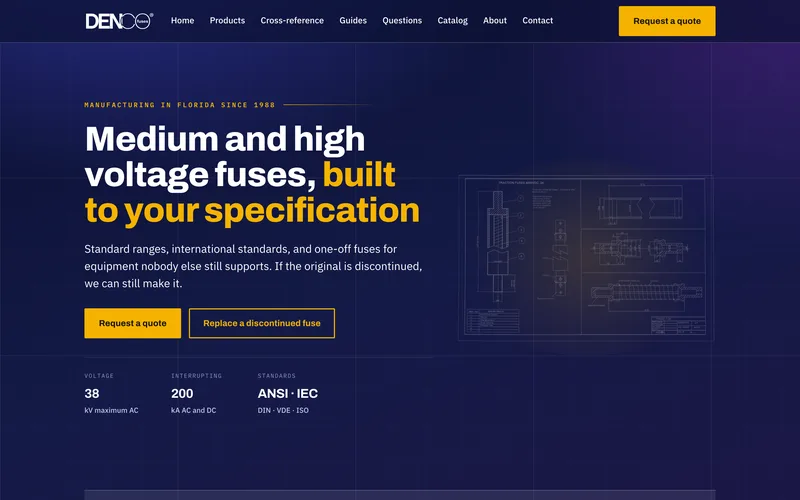
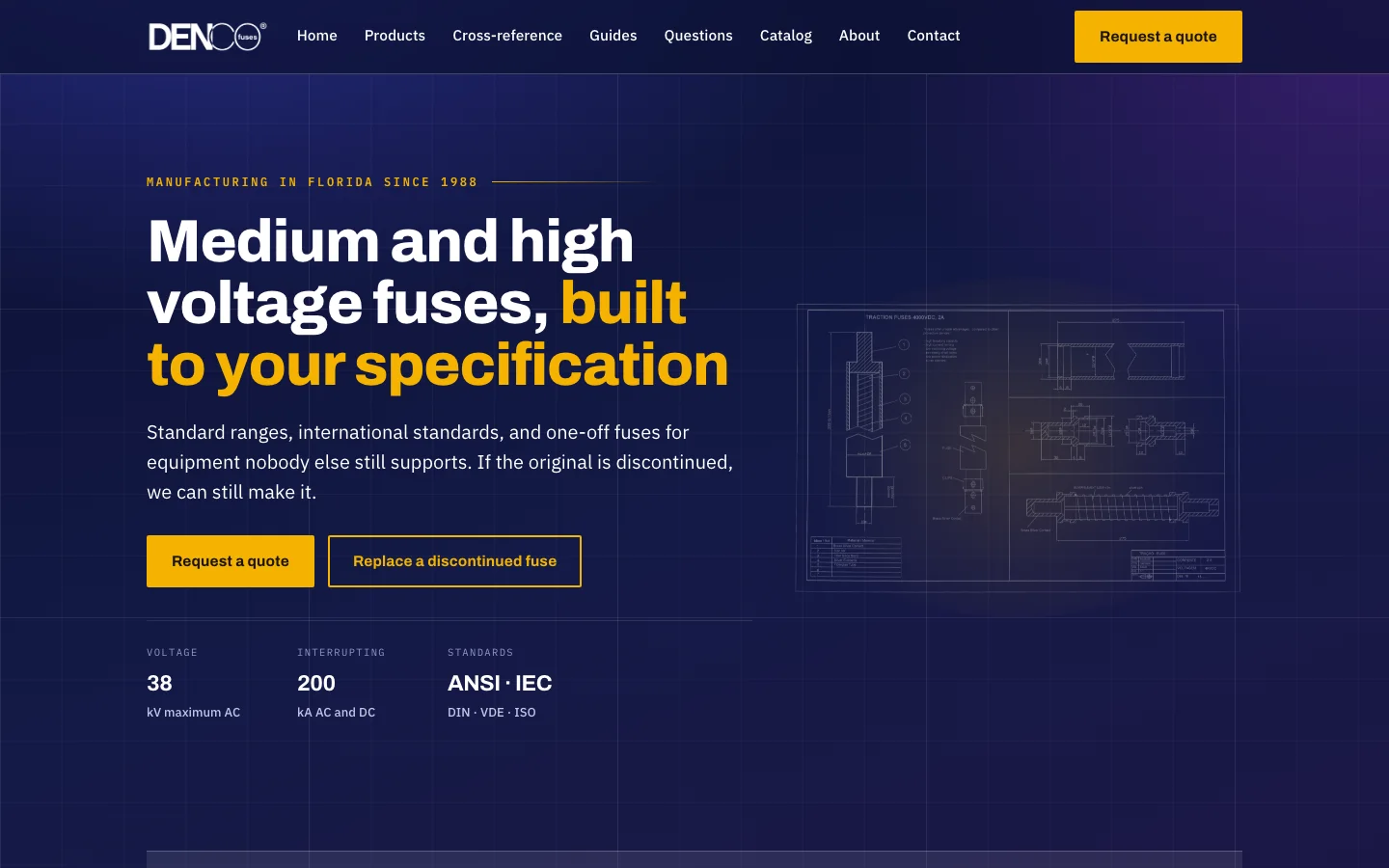
The headline figures on the home page are a maximum of 38kV AC, interrupting ratings up to 200kA AC and DC, and design references to ANSI, IEC, DIN, VDE and ISO. The range is organized into fourteen product families in four groups:
- Medium and high voltage distribution fuses: E-rated transformer, potential transformer (PT), DHS and DHHS current-limiting dropout, R-rated motor, C-rated capacitor, loadbreak elbow and oil-immersed transformer fuses.
- International fuses: BS88 British Standard, Type NH square body (with bases) and Type HH high-voltage HRC fuse-links.
- Ultra-rapid semiconductor fuses: Form 101 cylindrical, NH square body and ferrule types.
- Renewable and special purpose: gPV photovoltaic fuses and bases, electric vehicle DC fuses, network protector fuses, underground cable protectors, DC transit fuses and one-off custom designs.
The company says a large part of its work is replacing fuses that are no longer made by anyone, and it does not require exclusivity agreements from the distributors that carry its products.
Who owns DENCO, and what is its history?
The About page describes DENCO Fuses, Inc. as "a family-owned and operated manufacturer of high-quality, handcrafted electrical and industrial fuses." The owner is not named on the site, although the distributor section on the contact page is written in the owner's voice ("I the owner, will personally get back to you").
The company's published timeline:
| Year | Name | What the company says happened |
|---|---|---|
| 1988 | DenMar Transit Engineering, Inc. | Incorporated in Florida, designing and manufacturing DC fuses for metro transit rail cars and substations |
| 1990s | DenMar Fuses, Inc. | Renamed as the range widened to AC and DC circuit protection |
| 2007 | DENCO Fuses, Inc. | Became DENCO Fuses, specializing in medium to high voltage ranges |
| 2019 | Second plant | A second manufacturing facility, "built from the ground up," in full operation since January 2019 |
That history explains two things buyers sometimes notice. Older equipment and paperwork may carry the DenMar name, and some pages of the current catalog head their part tables "DENMAR Order #" while others say "DENCO Order #." The site's FAQ says these are the same ordering reference. The transit roots also show in the product list: DC fuses for third rail feeders, overhead catenary, rectifiers, substations, collector shoes and propulsion equipment are still described as among the most demanding things it builds.
Is DENCO Fuses legit?
For an industrial buyer, "legit" usually means: is this a real manufacturer with a traceable address, real products and honest claims? Here is what the site lets you check:
- A street address and phone lines. 8244 SW 103 Ave, Miami, FL 33173, a main line, a toll-free line, a fax number and an email address are printed on every page.
- A long, specific history. Incorporation in 1988 under a different name, and a name change in 2007, are stated on the About page and repeated in the FAQ.
- A 141-page catalog. The company publishes the structure of its January 2025 catalog page by page and lists hundreds of catalog numbers on its family pages (342 E-rated numbers alone).
- Named test reports and a named lab. Some family pages cite specific third-party test reports by number (for example the loadbreak elbow range, "Tested to CESI-IPH test report Nr. 23152130449.0258"), and the About page says third-party testing at IPH Berlin is available at customer request.
- Careful claims. The site separates "designed to," "conforms to," "tested to" and "certified" and says it does not use them interchangeably. It also says plainly that the ISO 9001:2015 certificate is held by its manufacturing partner rather than by DENCO itself.
- Cautious cross-references. It publishes only the equivalences printed in its own catalog and says any substitution needs review by its engineering team before you rely on it.
We were not able to load Florida's corporate records site (Sunbiz) when we checked, so this guide does not quote a state filing. You can search "DENCO Fuses" there yourself, and ask DENCO for the supplier documents your qualification process needs (quality documents, test reports, references).
What fuses does DENCO make?
This table summarizes the fourteen families as their own pages describe them. Ranges are the published family ranges, not a promise that every combination exists, so confirm the specific part with DENCO.
| Family | What it protects | Published range |
|---|---|---|
| E-rated transformer fuses | Distribution transformers, primary protection | 625V to 36kV AC; 0.5E to 400E; 31kA to 120kA |
| Potential transformer (PT) fuses | Primary windings of potential transformers | 0.625kV to 15.5kV (extended to 38kV); 0.25A to 5A, 0.5E to 200E; 50kA to 120kA |
| DHS and DHHS dropout fuses | Overhead distribution, replacing cutout expulsion links | 15.5kV to 24kV; 1A to 80A |
| R-rated motor fuses | Medium-voltage motor starters and soft starters | 2.5kV, 4.8kV, 7.2kV; 1R to 36R; 63kA/65kA sym, 100kA asym |
| C-rated capacitor fuses | Capacitors, capacitor banks, power factor and harmonic filter equipment | 1000V to 38kV; 1C to 200C; 40kA to 80kA |
| Loadbreak elbow fuses | 25kV class underground distribution | 20A at 15.5kV, 50kA (single published rating) |
| Oil-immersed transformer fuses | Oil-filled distribution transformers | Bayonet fuse holders, fault-sensing links 10A to 140A, oil-submersible backup fuses |
| BS88 fuses | UK-specified equipment, North American UPS | 250V to 1000V; 2A to 600A; 200kA and 300kA |
| Type NH square body fuses and bases | Drives, converters, rectifiers, starters, mining | 500V to 1300V; 2A to 2000A; sizes NH000 to NH5 |
| Type HH HRC fuse-links | MV/HV networks, transformers, capacitors (German style) | 7.2kV to 36kV; 2A to 400A |
| Ultra-rapid semiconductor fuses | Thyristors, diodes, rectifiers, DC drives, UPS, inverters | 130V to 1500V; 1A to 2000A; 200kA AC, 100kA DC |
| gPV photovoltaic fuses and bases | Solar strings and combiner boxes | 600VDC to 1500VDC |
| Electric vehicle DC fuses | EV DC power and charging circuits | 500V to 1500V DC; 50A to 400A; 20kA |
| Network protector fuses | Circuit breakers in underground networks | 600VAC; 800A to 3000A; 200kA |
Underground cable protectors, DC transit fuses and custom designs are listed on the products page as special purpose items and quoted directly.
Medium and high voltage fuses, family by family
E-rated transformer protection fuses. DENCO's main transformer range. The family page describes them as current-limiting fuses for primary protection of distribution transformers, in DENCO's EJ-1 and EJO-1 types, a general purpose clip-on series, a bolt-on series and the Clip Lock 14 (CL-14) series. Voltages run 625V, 1500V, 2.75kV, 5.5kV, 8.25kV, 12kV, 15.5kV, 24kV, 25.8kV and 36kV, ampere ratings 0.5E to 400E, and interrupting ratings from 31kA to 120kA. They come with or without a visual trip indicator or microswitch, in clip-on, bolt-on, clip-lock or custom mountings, for indoor use or outdoors in an enclosure. The page lists 342 catalog numbers from catalog pages 25 to 44 and says the standards wording is "Designed to ANSI C37."
Potential transformer (PT) fuses. Compact ferrule-type, non-venting, current-limiting fuses that fit standard mounting clips and protect the primary winding of a potential transformer. Published voltages run from 0.625kV to 15.5kV (with an extended range to 38kV), currents from 0.25A to 5A or 0.5E to 200E, and interrupting ratings of 50kA to 120kA RMS symmetrical. The label carries the catalog number and the manufacturing date, which the FAQ suggests photographing when you need to identify an installed fuse. The page lists 52 catalog numbers.
DHS and DHHS current-limiting dropout fuses. Offered as replacements for cutout expulsion fuse-links on overhead distribution, rated 1A to 80A at 15.5kV to 24kV. The page states conformity with NBR 8124, IEC 60282-2 and ANSI/ABNT, and says replacement suitability needs DENCO's review of the existing installation, because a current-limiting fuse changes the let-through energy the rest of the system sees.
R-rated motor and soft-starter fuses. Current-limiting fuses for short-circuit protection of medium-voltage motor starters and soft starters, at 2.5kV (1R to 36R), 4.8kV (2R to 36R) and 7.2kV (2R to 24R), in single, double and triple barrel configurations. The site is explicit that R-rated fuses give short-circuit protection only, not overload protection, and must be paired with the starter's overload relay. It lists 39 catalog numbers in the RA, RC and RD series.
C-rated capacitor protection fuses. Fuses that protect capacitors and capacitor banks against case rupture and dielectric failure, described as current-limiting with "silent operation with no discharge." The family spans 1000V to 38kV and 1C to 200C. Within it:
- Types 1 to 9 cover 1kV to 5.5kV, and the catalog notes they can be designed to customer specifications.
- DNX fuses are clip-style, 2.8kV to 38kV, 1C to 140C, 50kA asymmetrical, with threaded end studs available.
- DNXC fuses are full-range, bus bar to lead mounting, 8.3kV to 23kV and 10A to 65A at 50kA, with a temperature derating rule above 25°C ambient. The catalog says they were tested at IPH to IEC 60282-1 and IEC 60282-2.
The site also runs a capacitor fuse guide with 42 articles on sizing, voltage classes and selecting a DNX or DNXC fuse by kvar.
Loadbreak elbow and load break disconnect fuses. Current-limiting fuses built into a fused elbow for 25kV class underground distribution, with a silver element in silica sand inside a fiberglass body. The single published rating is 20A at 15.5kV maximum with a 50kA interrupting rating. The page lists a time-current curve, an I²t correction curve and a watts-loss correction curve, and asks you to confirm other ratings with DENCO.
Oil-immersed transformer fuses. Bayonet-style fuse holders, fault-sensing fuse links (published currents 10, 15, 25, 40, 65, 100 and 140A) and oil-submersible current-limiting backup fuses for oil-filled distribution transformers. The page stresses that the holder, the link and the backup fuse are separate parts selected together, with DENCO engineering sign-off. The FAQ names DENCO's DCLF and DEFTH backup fuses in this range.
International fuses: BS88, NH and Type HH
BS88 British Standard fuses are described as semiconductor-type, ultra-rapid fuses with high breaking capacity and low power dissipation, used in UK and British-specified equipment and in North American UPS applications. Published ranges: 250V (2A to 100A), 300V (125A to 600A), 450V (5A to 600A), 550V (8A to 200A), 690V (5A to 600A) and 1000V (400A to 600A), with 200kA and 300kA interrupting ratings. The page cautions that the ultra-rapid characteristic should be checked before using one for general-purpose duty.
Type NH square body fuses and bases are knife-blade fuses in sizes NH000 to NH5, from 2A to 2000A at 500V/660V up to 1000V/1300V, with 80kA and 120kA interrupting ratings. They come to German, French and American standards and in press-pack form, in utilization categories aR (semiconductor), gL/gG (general purpose), aM (motor), gTR (transformer), gB (mining) and gR. Matching NH bases are listed from 2 to 2000A at 690V, with visual indicator, microswitch or pin options.
Type HH high-voltage HRC fuse-links are German-style, current-limiting fuses for medium and high voltage networks, transformers and capacitors, at 7.2kV, 8.3kV, 17.5kV, 24kV and 36kV, 2A to 400A, in lengths of 192mm, 292mm, 442mm and 537mm. Indoor, outdoor and oil-submerged variants exist, for primary, back-up or full-range duty, and the page asks you to confirm which application you have.
Ultra-rapid semiconductor fuses
These protect thyristors, triacs, diodes, rectifiers and other solid-state devices, with very low I²t let-through. The range comes in three formats:
- Form 101 cylindrical (American standard): 130V to 1500V, 1A to 2000A.
- NH square body: to DIN 43620, DIN 43653, French and American (BS88-style) standards, and press-pack, 500V/660V to 1000V/1300V.
- Ferrule: sizes 10x38, 14x51, 22x58, 27x60, 20x76 and 20x127 mm, 2A to 200A.
The family page gives interrupting ratings of 200kA AC and 100kA DC and lists 98 catalog numbers. Applications named are electrochemical rectifiers, DC drives, UPS, inverters, motor drives and heavy traction. The catalog's semiconductor application notes run across pages 9 to 20. The page notes these fuses are not a substitute for general-purpose overload protection.
Solar, EV, DC transit and special purpose fuses
- gPV photovoltaic fuses and bases: full-range DC fuses for solar strings and combiner boxes, 600VDC to 1500VDC, with matching bases. The page states conformity with IEC 60269-1, IEC 60269-6 and DIN VDE 0636-2, and notes gPV is not interchangeable with gG or aR fuses. A separate Solar Fuse RFQ guide lists the information needed for a quote.
- Electric vehicle DC fuses: compact current-limiting fuses at 500V, 700V, 1000V and 1500V DC, 50A to 400A, 20kA. The page says no automotive certification, OEM approval or safety-critical platform use is claimed.
- Network protector fuses: high breaking capacity fuses protecting circuit breakers in underground networks, 600VAC, 800A to 3000A, 200kA, citing a CESI-IPH test report. The page itself asks buyers to confirm current manufacture and documentation, so ask before you plan around this range.
- Underground cable protectors (CP): fuses for underground power distribution, rated by cable size (2 up to 1000kcmil) and by conductor material, copper or aluminum, with five mounting types (cable to cable, offset bus to cable, offset bus to bus, mole to cable, offset bus to mole). The page cites conformity with NBR IEC 60269-1.
- DC transit fuses: the products page lists fuses for third rail, overhead catenary, auxiliary power, substations, rectifiers, converters, high-speed DC breakers, line filter capacitors, propulsion blower motors and collector shoes, and invites a call to select the right one.
- Custom designs: "Custom made, one-off fuses to your specs and dimensions." Send the ratings, dimensions and a photograph and DENCO says it will tell you "what it takes."
Older UL classes (Class J, RK1, RK5 and K5) are no longer offered. The FAQ says they were withdrawn from the range in 2026.
Can DENCO replace a discontinued fuse?
That is one of the main reasons people contact DENCO. The home page says "A large part of our work is replacing fuses that are no longer manufactured," and the cross-reference page says DENCO makes replacements for fuses that are "obsolete, discontinued, or no longer supported by their original maker."
How DENCO handles it:
- Published equivalences are few on purpose. The cross-reference page lists only the equivalences printed in DENCO's own catalog (for example its DCLF and DEFTH oil-immersed fuses and its EJ-1 E-rated type, each matched to legacy series from other makers). The FAQ explains why there is no table for every brand: "a wrong equivalence on a fuse does not produce a returns ticket, it produces a device that fails to interrupt a fault."
- Everything else is reviewed case by case. The company says it can cross-reference all major manufacturers, but any suggestion is "a candidate for review, not a guarantee of interchangeability." Ratings, physical fit, standards and the application are all checked by its engineering team first.
- A fuse that fits is not automatically a match. The site repeats that voltage, interrupting rating, melting characteristic, barrel count, mounting centres and any striker or microswitch all have to match too.
What to send for a cross-reference: the original maker and part number exactly as marked; system voltage and whether it is AC or DC; continuous current and required interrupting rating; overall dimensions and mounting; any indicator or microswitch need; the standard or approval the installation must meet; and a photograph or drawing. If the label is unreadable, send a photo of the fuse in its mounting plus what it protects (the transformer, starter or panel) and the system voltage.
How much do DENCO fuses cost?
DENCO does not publish prices on its website. Every product page leads to a quote request instead. That is normal for medium-voltage and custom fuses, where the price depends on the exact part and order.
What will affect your quote, based on what DENCO asks for:
- The family and the exact rating (voltage class, ampere or E/R/C rating, interrupting rating).
- Mounting, barrel count and options such as a blown-fuse indicator, striker or microswitch.
- Whether it is a catalog part or a custom or discontinued design.
- Quantity, from a single replacement to production runs.
- Any third-party testing or specific documents you need with the shipment.
- The delivery country.
On price in general, the company makes its own marketing claims, such as "Quality & Affordability" and, to distributors, "substantially lower prices." It also mentions customer loyalty programs with "special pricing and service programs" for repeat customers. None of this is quantified on the site, so ask for a written quote. Payment terms, warranty terms and return policies are not published either; ask about them with your quote.
Lead time, minimum order and shipping
- Lead time: the FAQ says the standard lead time is 30 days "and it applies across all products," compared with what the About page calls 90 days or more for many fuse makers. If you need fuses sooner, the FAQ asks you to say so in the enquiry, not after ordering. For custom designs, the schedule is set during quoting.
- Stock: most products are built to order. The company says it holds stock on request for repeat customers and has expanded its warehousing for frequently requested fuses.
- Minimum order: no minimum is published. The FAQ says orders range "from a single replacement fuse to production quantities, and both are normal."
- Where it ships: the United States and Canada, plus export enquiries beyond North America. Include the delivery country so shipping and documents are quoted with the fuses.
- Packaging: the About page says each fuse is sealed in heat-shrink wrap, bubble wrapped, and boxed in a sealed individual box, for shelf life and shipping protection.
- Offices: DENCO has no UK or European office. International customers are served from Miami.
How a quote works, step by step
- Pick your route. Use the quote form on the contact or cross-reference page, call the office line during Eastern business hours, or email Info@dencofuses.com. The FAQ says the form is often quicker for technical questions because you can describe the job in detail.
- Say what you need. The form asks you to choose: standard product inquiry, custom design, cross-reference an existing part, discontinued or obsolete replacement, distributor inquiry, or general question.
- Fill in what you know. Only name, email and message are required. Company, country and phone are optional, and DENCO says it will follow up on missing technical details.
- Add the technical details. Voltage (AC or DC), continuous current, interrupting rating, dimensions and mounting, indicator needs, the standard you must meet, and a photo or drawing.
- Engineering review. DENCO's engineering team checks the request. For replacements, it confirms the equivalence before you rely on it.
- Quote and documents. You receive a quote. Ask for curves, data sheets, drawings or test evidence at this stage if your submittal needs them.
- Build and ship. Most products are built to order, with the quoted 30-day lead time as the standard.
- Support after purchase. If a fuse operates unexpectedly, the FAQ invites you to get back in touch with the application details.
Form enquiries sent outside office hours are picked up the next working day, according to the FAQ. The privacy notice says quote requests are delivered to DENCO by email and are not stored in a database on the website.
Standards, testing and quality wording
How DENCO words standards. Each family page lists its standards with a qualifier, and the site explains: "'Designed to' a standard is not the same as certified or listed to it; where a certification exists we publish the certificate number." Examples as published:
- E-rated: designed to ANSI C37. C-rated: designed to ANSI C37-41. Oil-immersed: designed to ANSI/IEEE C37.41-2016.
- R-rated: designed to DIN 43625, IEC 282-1 and BS 2692.
- DHS/DHHS: conforms to NBR 8124, IEC 60282-2 and ANSI/ABNT.
- gPV: conforms to IEC 60269-1, IEC 60269-6 and DIN VDE 0636-2.
- Semiconductor: in accordance with IEC 269.1, VDE 636-23 and UL/CSA.
- Loadbreak elbow and network protector: tested to named CESI-IPH test reports.
The home page also lists VDE, DIN, CSA, CE, UL, NBR, NEMA, IEEE and NEC as standards its facility adheres to. If your project needs a specific listing or certificate, ask DENCO which evidence it can provide for that part.
In-house testing. The About page lists seven tests run in DENCO's own laboratory: electrical resistance; temperature rise at rated current (body and terminal); power dissipation (watts loss); time/current curve verification; melting and non-melting current; sand compactness and insulation; and dimensional and visual checks. Third-party testing at IPH Berlin is available at customer request. Name the test standard and tests in your RFQ so they are scoped into the quote and schedule.
Quality system. The site footer says "Manufactured in an ISO 9001:2015 certified facility." The FAQ adds that the certificate is held by DENCO's manufacturing partner rather than by DENCO itself. For supplier qualification, ask DENCO for exactly the documents your form needs.
Manufacturing. The About page says every fuse is hand assembled, both plants use German manufacturing technology, and the engineering team has "over 100 years of combined experience, solely in manufacturing electrical fuses."
The catalog and technical documents
- The catalog: the current edition is dated January 2025 and runs to 141 pages. You request it on the catalog page with your name, email and phone; the site then opens the online version and emails you the latest edition. The catalog page shows which catalog pages cover each family.
- On the website: each family page lists its catalog numbers, with the catalog pages they come from. Per-part ratings are not yet shown online: the FAQ says they are available on request and supplied against the part.
- Data sheets, drawings and curves: data sheets, dimensional drawings, time-current curves and I²t data are available per family on request. Say whether you need minimum melt, total clearing or both, and mention a coordination study if that is the purpose.
- Questions hub: the site's questions page answers 306 questions on fuse ratings, selection, cross-reference and ordering.
- Catalog errors: the FAQ asks anyone who finds an inconsistency in the catalog to report the page and part number to DENCO.
Buying through distributors, or becoming one
DENCO sells through distributors as well as taking enquiries directly. End users can send an enquiry through the quote form and DENCO will route it. For distributors, the company's pitch is that it "does not limit you with exclusivity contracts as do many of the major competitors" and that it can cross-reference all major manufacturers. It asks prospective distributors to send approximate quantities of their highest-turnover fuses so it can quote against them. A dealer and distributor application (PDF) can be downloaded from the contact and catalog pages.
How DENCO compares with other options
A generic comparison of the main ways to source industrial fuses. No other company is named or rated here.
| Option | What you get | Typical trade-off |
|---|---|---|
| DENCO Fuses | A manufacturer that builds to order, quotes discontinued and custom fuses, and reviews cross-references in-house; 30-day quoted lead time | No online prices or ordering; per-part ratings by request; certificate held by its manufacturing partner |
| A large multinational fuse maker | Very broad catalogs, extensive online datasheets and global support | Discontinued lines may not be revived; lead times can be long; custom one-offs less likely |
| Your equipment's original manufacturer (OEM) | The exact part specified for that switchgear or starter | May be obsolete or costly for older equipment |
| An electrical distributor | Local stock, consolidated buying, often several brands | Stock limited to fast movers; technical review usually goes back to the maker |
| Surplus or secondary-market sellers | Old stock of discontinued parts, sometimes fast | Unknown age, storage and provenance; little or no engineering support |
Who it suits, and who should look elsewhere
A good fit if you…
- Need a replacement for a fuse that is obsolete or no longer supported by its maker
- Buy medium-voltage E-rated, R-rated, C-rated or PT fuses for utility, industrial or OEM equipment
- Need BS88, NH or Type HH fuses for European or British-specified equipment in North America
- Want a custom or one-off fuse built to your ratings and dimensions
- Run transit, rectifier or other DC equipment
- Are a distributor who doesn't want an exclusivity agreement
Look elsewhere if you…
- Want to see prices and order online with a card today
- Need fuses delivered tomorrow and the part is not one DENCO stocks for you
- Need UL Class J, RK1, RK5 or K5 fuses, which DENCO no longer offers
- Require a supplier that holds an ISO 9001 certificate in its own name
- Need household or automotive blade fuses
- Need an engineer to design your whole protection scheme: DENCO selects fuses, but your protection study belongs to your engineer
Questions to ask before you order
- Has your engineering team confirmed this part as a replacement for my exact installation, including mounting and indicator?
- What are the full ratings for this catalog number (amp rating, maximum voltage, interrupting rating, dimensions)?
- What standards evidence can you give for this part: designed to, tested to (with report number), or certified?
- Can you supply the time-current curves and I²t data I need for my coordination study?
- Is 30 days realistic for this order, and can you hold spares for us after the first lot?
- What are your payment terms, warranty and return policy?
- Which quality documents can you provide for our supplier qualification, given the ISO certificate is held by your manufacturing partner?
How to get started
- Find your family on the products page, or read the fuse questions if you are unsure which you need.
- If you are replacing a part, read the cross-reference page and gather the part number, ratings and a photograph.
- Request the 141-page catalog from the catalog page if you need specification tables.
- Send your request through the contact page, or call (305) 273-6226 or 1-800-305-FUSE (3873), 8am to 5pm Eastern, Monday to Friday.
Terms you'll see on the site
- Current-limiting fuse: a fuse that cuts both the size and duration of a fault current within its specified range, rather than only interrupting it.
- Expulsion fuse: a fuse that interrupts using gas produced by its own arc; it limits how long a fault lasts but not how large it becomes.
- E rating: a melting characteristic for transformer and feeder fuses, defined by the ANSI/IEEE standard the site cites, not a plain ampere rating.
- R rating: a melting characteristic for motor-starter fuses; the site says an R-rated fuse melts in 15 to 35 seconds at 100 times the R number.
- C rating: DENCO's capacitor-fuse characteristic; the site says the fuse melts in 1000 seconds at 1.7 to 2.4 times the C rating.
- Interrupting rating (kA): the largest fault current a fuse can safely interrupt.
- Full range, general purpose, back-up: classes describing how far down the current range a current-limiting fuse can be relied on to interrupt.
- PT fuse: a fuse protecting a potential (voltage) transformer, which draws a fraction of an ampere.
- HRC: high rupturing capacity, a European term for a fuse with a high breaking capacity.
- aR, gG, aM, gPV: IEC utilization categories: semiconductor protection, general purpose, motor protection, photovoltaic.
- I²t: a measure of the energy a fuse lets through while clearing a fault; key for semiconductor and solar fuse selection.
- Time-current curve: a chart showing how long a fuse takes to melt or clear at each current.
Frequently asked questions
Where is DENCO Fuses located?
DENCO Fuses is at 8244 SW 103 Ave, Miami, FL 33173. It has no UK or European office and serves international customers from Miami. Visits should be arranged in advance.
How long has DENCO Fuses been in business?
DENCO Fuses says it was incorporated in Florida in 1988 as DenMar Transit Engineering, Inc., later traded as DenMar Fuses, Inc., and became DENCO Fuses, Inc. in 2007.
Who owns DENCO Fuses?
DENCO Fuses describes itself as family-owned and operated. The owner is not named on its website.
Does DENCO Fuses make its own fuses?
DENCO Fuses describes itself as a fuse manufacturer, says every fuse is hand assembled, and says its second plant has been in full operation since January 2019. The ISO 9001:2015 certificate for the quality system is held by its manufacturing partner, according to the site.
How much do DENCO fuses cost?
DENCO Fuses does not publish prices. You request a quote through the contact page or by phone, and the price depends on the part, quantity, options and any testing or documents you need.
What is DENCO's lead time?
DENCO Fuses quotes a standard lead time of 30 days across all products. If you need fuses sooner, say so in your enquiry.
Is there a minimum order at DENCO Fuses?
No minimum is published. DENCO Fuses says it handles everything from a single replacement fuse to production quantities.
Can DENCO Fuses replace a discontinued fuse?
Yes, that is a large part of DENCO's work. Send the part number, ratings and a photograph; DENCO's engineering team reviews every substitution before you should rely on it.
Does DENCO cross-reference other manufacturers' fuses?
DENCO Fuses says it can cross-reference all major manufacturers. It publishes only the equivalences printed in its own catalog and reviews all other requests case by case.
Does DENCO Fuses ship to Canada and overseas?
Yes. DENCO Fuses supplies the United States and Canada and handles export enquiries beyond North America. Include the delivery country in your request.
What are DENCO Fuses' business hours?
The office line, (305) 273-6226, is answered 8am to 5pm US Eastern time, Monday to Friday. Form enquiries sent after hours are picked up the next working day.
How do I get the DENCO Fuses catalog?
Request it on the catalog page of dencofuses.com with your name, email and phone. The current edition is dated January 2025 and runs to 141 pages.
Does DENCO still sell Class J or RK5 fuses?
No. DENCO Fuses says the UL Class J, RK1, RK5 and K5 fuses were withdrawn from its range in 2026.
Does DENCO Fuses require distributor exclusivity?
No. DENCO Fuses says it does not require exclusivity agreements from distributors, and a distributor application can be downloaded from its contact page.
Is DENCO Fuses ISO 9001 certified?
DENCO's fuses are "manufactured in an ISO 9001:2015 certified facility." The site says the certificate is held by DENCO's manufacturing partner rather than DENCO itself, so ask for the documents your qualification needs.
Sources
All pages checked on 19 October 2026.
- DENCO Fuses, home page: dencofuses.com
- About DENCO Fuses: dencofuses.com/about/
- Contact and distributors: dencofuses.com/contact/
- Products: dencofuses.com/products/
- Fuse cross-reference: dencofuses.com/fuse-cross-reference/
- Catalog and technical documents: dencofuses.com/catalog/
- Fuse questions answered (FAQ): dencofuses.com/faq/
- Fuse guides: dencofuses.com/guides/
- Privacy notice: dencofuses.com/privacy-policy/
- Medium and high voltage family pages: E-rated, PT, DHS and DHHS, R-rated, C-rated, DNX and DNXC, loadbreak elbow, oil-immersed
- International family pages: BS88, Type NH, Type HH
- Semiconductor, renewable and special purpose pages: semiconductor, gPV, EV DC, network protector, cable protectors
- Buying capacitor fuses: lead time, custom builds and testing: capacitor fuse guide article



