Webflow to Next.js: Why Developers Make the Switch
Webflow to Next.js: Why Developers Make the Switch
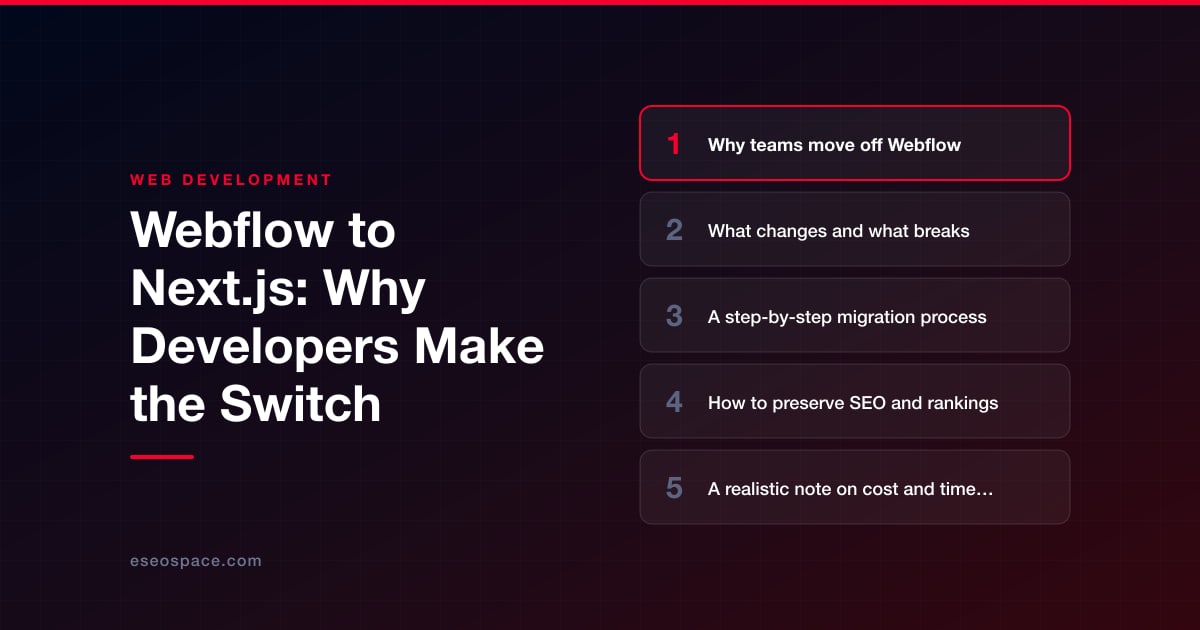
Key Takeaways
- Teams leave Webflow for lower cost at scale, a single codebase for marketing and product, better Core Web Vitals control, custom logic support, and true ownership of their code.
- Nothing migrates automatically: the CMS, interactions, forms, and styling all get rebuilt in code, and changing URLs is the biggest risk to your rankings.
- A disciplined process — audit, architecture choice, scaffold, rebuild, rewire, redirect map, stage and cut over — is what separates a clean launch from a traffic-losing scramble.
- Preserving SEO comes down to keeping URLs where possible, using permanent 301 redirects mapped one-to-one, porting all metadata and structured data, and monitoring Search Console after launch.
- A simple site migrates in three to six weeks; a large CMS-heavy site in two to four months, with recurring subscription costs traded for an upfront build and cheaper hosting.
Webflow is a phenomenal tool for getting a polished marketing site live fast. Its visual canvas, hosted CMS, and no-deploy workflow let designers ship without touching a build pipeline. But as products mature, many teams hit a ceiling: pricing that scales with visitors and CMS items, a component model that can't share logic with an app, and a hosting layer you don't control. At that point, engineers start asking whether a real framework would serve the business better.
Next.js is the destination most of them land on. It's a React framework with server-side rendering, static generation, a file-based router, API routes, and first-class image and font optimization — the foundation that powers everything from a landing page to a full SaaS dashboard. Migrating from a hosted visual builder to code is a genuine shift in how your team works, but it buys you performance, ownership, and the ability to grow the marketing site and the product in one codebase.
This guide covers why teams move off Webflow, what actually changes and breaks in the transition, a concrete step-by-step migration process, and — most importantly — how to preserve the SEO equity and rankings you've already earned.
Why teams move off Webflow
The motivations cluster into a few predictable categories. Understanding which ones apply to you tells you how ambitious the migration should be.
- Cost at scale. Webflow's CMS and business plans meter on CMS items, form submissions, and bandwidth. A content-heavy site can outgrow plan limits and push you into enterprise pricing, whereas a Next.js site hosted on a platform like Vercel or Netlify often costs less for the same traffic and gives you a predictable bill.
- The app-and-marketing split. The most common trigger: you've built a product in React, and your marketing site lives in a separate Webflow account. Two stacks, two deploy processes, no shared components or design tokens. Consolidating onto Next.js means one repo, one design system, and engineers who can touch both.
- Performance ceilings. Webflow injects jQuery, its interactions runtime, and Webflow.js on every page. For sites where Core Web Vitals materially affect conversion or rankings, the ability to ship lean, code-split React with granular control over hydration is a real advantage.
- Custom logic and integrations. Gated content, personalization, complex forms, third-party API calls, authenticated areas — these are awkward or impossible in Webflow but native to a framework with server-side rendering and API routes. If you're heading toward custom application and CRM development, Next.js is where that logic will live anyway.
- Ownership and portability. Webflow's exported code is static HTML/CSS/JS with no CMS binding — you don't truly own a maintainable codebase until you rebuild in a real framework. Teams that want their site under version control, in CI/CD, and free of vendor lock-in choose to migrate. If you're weighing the trade-offs in detail, our Webflow vs Next.js comparison breaks them down side by side.
What changes and what breaks
Be honest with stakeholders about what a code migration involves. Nothing about your live site transfers automatically — you are rebuilding the front end and re-wiring the moving parts.
- The Webflow CMS goes away. Your Collections (blog posts, team members, case studies) live in Webflow's database. You'll either export them to a headless CMS (Sanity, Contentful, Payload, or a simpler markdown/MDX setup) or model them in your own database. The Webflow CMS API can pull the data out programmatically, which is far more reliable than copy-paste.
- Interactions and animations must be rebuilt. Webflow's timeline-based Interactions don't exist in code. Scroll effects, hover states, and page transitions get reimplemented with Framer Motion, GSAP, or CSS — usually cleaner, but it's real work, not a copy.
- Forms need a new backend. Webflow form submissions route to Webflow's handler. In Next.js you'll wire forms to an API route, a serverless function, or a service (Formspree, Resend, HubSpot) and re-test spam protection and notifications.
- Styling gets re-expressed. Webflow's generated class-based CSS can be exported, but most teams rebuild styles in Tailwind or CSS Modules to get a maintainable system rather than inheriting auto-generated selectors.
- URLs and redirects are the danger zone. If any paths change — and Webflow's
/blog/and collection URL patterns often don't match a fresh Next.js structure one-to-one — you must map every old URL to its new home or you'll shed rankings. More on this below.
A step-by-step migration process
Treating this as a disciplined project, not an ad-hoc rebuild, is what separates a smooth cutover from a traffic-losing scramble. A proven sequence looks like this.
- 1. Audit and inventory. Crawl the existing Webflow site (Screaming Frog or Sitebulb) to capture every URL, title, meta description, canonical, and internal link. Export your CMS Collections. Pull top-performing pages from Google Search Console and Analytics so you know which URLs carry the most equity.
- 2. Choose your architecture. Decide on your rendering strategy (mostly static generation for marketing pages), your CMS approach, and your styling system. If you're unsure Next.js is the right target versus Astro or Remix, our guide to choosing a JavaScript framework walks through the decision.
- 3. Scaffold the Next.js project. Stand up the App Router, configure your CMS or MDX content layer, port your design tokens, and build a shared component library (header, footer, buttons, cards) before you build pages.
- 4. Rebuild pages and templates. Recreate each page and each dynamic template (blog post, case study). Use
generateStaticParamsto statically render CMS-driven routes, andnext/imageandnext/fontto recover the image and font optimization Webflow did for you. - 5. Rewire forms, animations, and integrations. Connect forms to API routes, reimplement interactions, and re-add analytics, chat widgets, and any pixels.
- 6. Build the redirect map. Map every old URL to its new one before launch — this is the single most important SEO step and deserves its own 301 redirect map process.
- 7. Stage, QA, and cut over. Deploy to a staging URL with
noindex, run a full crawl to catch broken links and missing metadata, verify redirects, then point DNS and remove the noindex.
How to preserve SEO and rankings
A migration is the highest-risk SEO event a site can undergo, and most ranking losses come from preventable mistakes, not from Google punishing the move. Protect your equity with a tight checklist.
- Preserve URLs where you can. The safest migration keeps every URL identical. Where that's impossible, a permanent 301 redirect from old to new passes the vast majority of link equity. Never use 302s for permanent moves, and never redirect everything to the homepage — map each URL to its closest equivalent.
- Match metadata exactly. Port every title tag, meta description, canonical tag, and Open Graph value. Next.js's Metadata API makes this explicit and version-controlled, which is an upgrade over Webflow's per-page fields.
- Rebuild structured data. Re-add JSON-LD for articles, breadcrumbs, organization, and FAQ schema. Don't let rich results silently disappear.
- Regenerate the sitemap and robots.txt and resubmit in Search Console the moment you cut over.
- Keep Core Web Vitals green. One reason to migrate is speed — don't squander it by shipping oversized images or blocking scripts. Use static generation and image optimization from day one.
- Monitor after launch. Watch Search Console coverage, crawl stats, and rankings daily for the first few weeks. Our website migration SEO checklist covers the full pre- and post-launch sequence, and our website migration services handle the entire process when you'd rather not risk it in-house.
A realistic note on cost and timeline
Set expectations honestly. A straightforward marketing site — say 10 to 20 pages plus a blog — typically takes a small team three to six weeks to migrate cleanly, including QA and redirects. A larger site with hundreds of CMS entries, complex interactions, gated content, or CRM integrations can run two to four months. The variables that move the number most are the volume of CMS content, how much custom interaction logic needs rebuilding, and how many URLs change.
On cost, you're trading a recurring Webflow subscription for an upfront build and cheaper ongoing hosting. Agencies typically price a migration as a fixed project, and the ownership and performance gains usually pay back within the first year for any site with meaningful traffic. The mistake to avoid is under-scoping the SEO and redirect work to hit a lower bid — that's exactly where migrations go wrong.
The confident close
Moving from Webflow to Next.js is not a step backward into complexity — it's a step toward owning your platform. You gain a codebase your engineers control, performance you can tune, a single home for your marketing site and your product, and freedom from per-visitor pricing and vendor lock-in. The visual convenience you give up is real, but it's replaced by a foundation that scales with your business instead of capping it.
The migration is very doable when it's run as a disciplined project with an airtight redirect map and an SEO plan built in from the start. If you'd rather hand it to a team that has done it many times, our dedicated Webflow to Next.js migration service takes you from audit to live cutover without losing a single ranking. Either way, the switch is one the best-performing teams keep choosing for a reason.
Get a FREE Audit
We'll perform a comprehensive SEO, AEO, GEO & CRO audit of your website — completely free — and show you exactly how to outrank your competitors.
Don't have a site yet? Get in touch →
Put this into action with eSEOspace
We help businesses grow with website development that actually performs. Explore the services behind this guide:
Frequently Asked Questions
Can I just export my Webflow site instead of migrating to Next.js?
Will migrating from Webflow to Next.js hurt my Google rankings?
What happens to my Webflow CMS content in a Next.js migration?
How long does a Webflow to Next.js migration take?
Is Next.js cheaper than Webflow in the long run?
Get a FREE GEO/AEO/SEO Audit
We'll analyze your site's SEO, GEO, AEO & CRO — completely free — and show you exactly how to get found across Google and AI answers.
Don't have a site yet? Get in touch →
Great — your audit is on the way!
We'll send your free SEO/GEO/AEO/CRO audit within the next few hours. Where should we send it?
You're all set! ✓
Your free audit is being prepared — check your inbox in the next few hours. Talk soon!