




The Complete On-Page SEO Checklist for 2026: 25 Factors That Still Matter
The Complete On-Page SEO Checklist for 2026: 25 Factors That Still Matter
Key Takeaways
- On-page SEO in 2026 rewards pages that match search intent precisely and add something no competitor offers, because generative search filters out content that merely restates the consensus.
- Title tags, a single clear H1, and a logical heading hierarchy remain high-leverage because they shape both rankings and the passage-level answers AI systems extract.
- Internal linking with descriptive anchor text is the most underused on-page lever; distributing authority to money pages often moves rankings within weeks at zero cost.
- Schema markup does not directly boost rankings but earns rich-result eligibility and gives AI systems a clean, machine-readable statement of what a page is about.
- Core Web Vitals, mobile-first rendering, and clean crawlability form the technical floor; every content improvement compounds once the foundation is solid.
On-page SEO has changed less than the headlines suggest. AI Overviews, generative search and endless algorithm updates have shifted how results are shown, but the fundamentals of a page that ranks are remarkably stable: match intent, prove expertise, make the content easy to parse for both humans and machines, and remove technical friction. What has changed is the margin for error. In 2026, sloppy pages get filtered out before they ever reach the top ten.
This is a working checklist, not a theory lesson. Below are the 25 on-page factors that still earn rankings in 2026, grouped into the areas we audit first when we take on a new site. Each one is something you can inspect, fix, and verify on a single URL today. Use it as a page-by-page audit sheet for your most important money pages before you touch anything else.
The order roughly follows impact. Nail search intent and content quality first, because no amount of schema or heading optimization rescues a page that answers the wrong question.
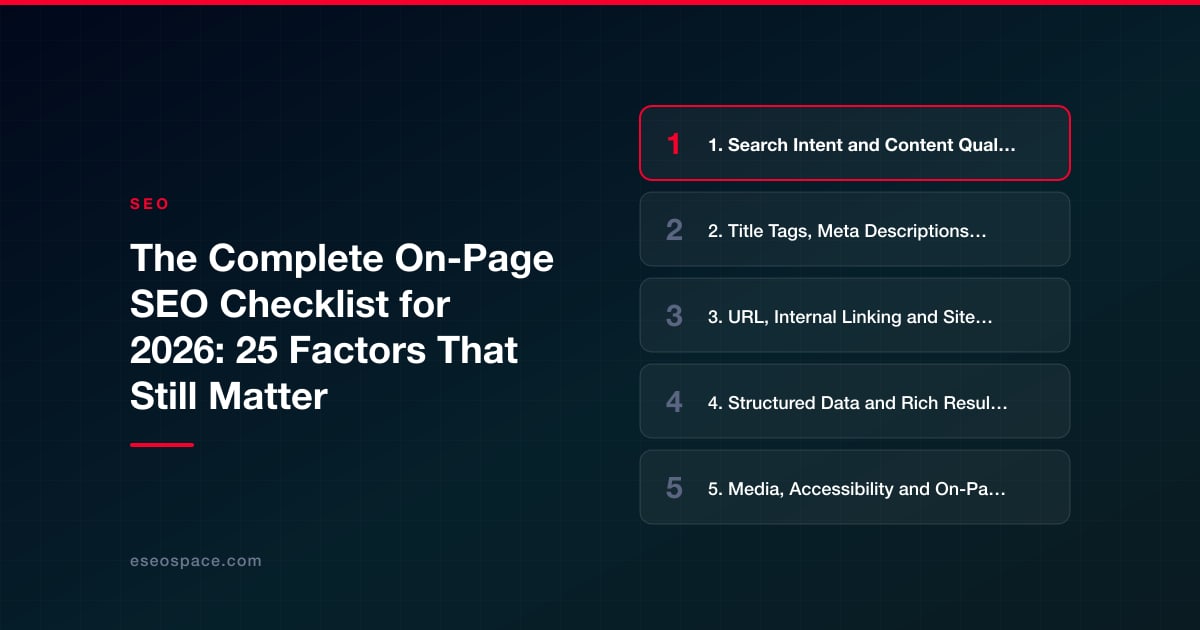
1. Search Intent and Content Quality (Factors 1-6)
Every ranking page starts by matching what the searcher actually wants. Google classifies intent as informational, commercial, transactional, or navigational, and a page that mixes signals confuses both the algorithm and the reader. Before writing a word, look at what currently ranks for your keyword. If the top ten are all comparison articles, a hard sales page will not break in.
- Intent match - Confirm your page format matches the dominant format in the SERP (guide, listicle, product page, tool).
- Query coverage - Answer the primary question in the first 100 words, then cover the related sub-questions people also search.
- Depth over length - Match the topic's true scope. A 600-word answer that fully resolves the query beats a padded 2,500-word article.
- E-E-A-T signals - Add a named author with credentials, cite primary sources, and show first-hand experience (screenshots, original data, real examples).
- Freshness - Update and re-date pages where recency matters; stale content on time-sensitive topics quietly loses ground.
- Uniqueness - Deliver at least one thing no competitor offers: a template, a calculation, a proprietary framework, or a genuinely contrarian take.
In 2026, this last point matters more than ever. Generative search engines synthesize the consensus answer instantly, so pages that merely restate the consensus have nothing to add. The pages that survive are the ones that become the source the AI cites.
2. Title Tags, Meta Descriptions and Headings (Factors 7-11)
These are the oldest items on the list and still among the highest leverage, because they shape both rankings and click-through rate. Google frequently rewrites titles, but a well-constructed one is rewritten far less often.
- Title tag - Keep it roughly 55-60 characters, lead with the primary keyword, and make it compelling enough to earn the click over the result above and below it.
- Meta description - Write 150-160 characters that expand on the title with a concrete benefit. It is not a ranking factor, but it drives CTR, which is.
- Single H1 - One H1 per page that clearly states the topic, distinct from (but consistent with) the title tag.
- Logical H2/H3 hierarchy - Structure headings so the page outlines cleanly. This is what AI extractors use to pull passage-level answers.
- Keyword-relevant subheads - Work secondary keywords and question phrases into H2s naturally, so each section can rank as its own passage.
A practical test: read only the headings top to bottom. If they tell the whole story on their own, you have structured the page well for both skimmers and machines.
3. URL, Internal Linking and Site Architecture (Factors 12-16)
On-page SEO does not stop at the page boundary. How a URL is named and how it connects to the rest of the site tells Google what the page is about and how important it is.
- Clean URLs - Short, lowercase, hyphenated, keyword-bearing, no dates or parameters where avoidable. Set them correctly the first time; changing them later means managing redirects.
- Internal links in - Point contextual links from related, authoritative pages to the target page using descriptive anchor text, not "click here."
- Internal links out - Link to your own supporting content and cornerstone pages to distribute authority and build topical clusters.
- Breadcrumbs - Implement breadcrumb navigation (and matching schema) so both users and crawlers understand hierarchy.
- Descriptive anchors - Anchor text should describe the destination. A strong SEO strategy treats internal links as a deliberate map of topical relationships, not an afterthought.
Internal linking is the most underused lever in on-page SEO. Most sites have strong pages that never pass authority to the pages that need it. Fixing that costs nothing and often moves rankings within weeks.
4. Structured Data and Rich Results (Factors 17-19)
Schema markup does not directly boost rankings, but it makes pages eligible for rich results and gives AI systems a clean, machine-readable statement of what the page contains. In an era of generative search, that explicit labeling is increasingly how you get surfaced and cited.
- Relevant schema types - Apply the types that fit the page: Article, FAQPage, Product, LocalBusiness, HowTo, Review, or Breadcrumb.
- Valid, error-free markup - Validate every implementation. Broken or spammy schema can forfeit rich-result eligibility entirely.
- Entity clarity - Use schema to connect your content to known entities (organizations, authors, products) so search engines understand context, not just keywords.
Getting this right at scale is fiddly, which is why we offer dedicated schema markup services - the difference between eligible and not-eligible for a rich result is often a single malformed property. Test with Google's Rich Results Test before and after every deployment.
5. Media, Accessibility and On-Page UX (Factors 20-22)
Images and media are ranking assets when handled correctly and dead weight when not. They also intersect with accessibility, which increasingly overlaps with how well machines parse a page.
- Descriptive alt text - Write alt attributes that describe the image for screen readers and give search engines context. Skip keyword stuffing.
- Optimized, next-gen formats - Serve WebP or AVIF, compress aggressively, and size images to their display dimensions to protect load speed.
- Readability and scannability - Short paragraphs, bullet lists, bolded key points, and generous whitespace keep users on the page and give AI extractors clean chunks to lift.
Formatting is not cosmetic. The same structure that helps a rushed reader find an answer is what helps a generative engine extract a clean, quotable passage from your page.
6. Core Web Vitals and Technical Foundations (Factors 23-25)
Technical health is the floor everything else stands on. A perfectly written page that loads slowly, shifts around as it renders, or cannot be crawled will underperform its potential every time.
- Core Web Vitals - Pass Largest Contentful Paint (under 2.5s), Interaction to Next Paint (under 200ms), and Cumulative Layout Shift (under 0.1) on mobile, measured on real-user field data.
- Mobile-first rendering - Google indexes the mobile version. Confirm content parity, tap-target spacing, and no intrusive interstitials on small screens.
- Crawlability and indexing - Check that the page is not blocked by robots.txt, carries a self-referencing canonical, returns a clean 200, and appears in an XML sitemap.
These items rarely get the attention they deserve because they are invisible until they break. A quarterly technical SEO audit catches the canonical conflicts, orphaned pages, and render-blocking scripts that silently cap what your content can achieve. Fix the foundation once and every content improvement you make afterward compounds instead of leaking away.
Work through all 25 factors on one important page and you will almost always find three or four quick wins. Do it across your top templates and you build a repeatable standard, so every new page ships already optimized rather than waiting to be rescued later.
Get a FREE Audit
We'll perform a comprehensive SEO, AEO, GEO & CRO audit of your website — completely free — and show you exactly how to outrank your competitors.
Don't have a site yet? Get in touch →
Put this into action with eSEOspace
We help businesses grow with website development that actually performs. Explore the services behind this guide:
Frequently Asked Questions
Is on-page SEO still relevant in 2026 with AI Overviews and generative search?
What is the single most important on-page SEO factor?
How long should content be for good on-page SEO?
Does schema markup improve rankings directly?
How often should I audit a page against this on-page SEO checklist?
Get a FREE GEO/AEO/SEO Audit
We'll analyze your site's SEO, GEO, AEO & CRO — completely free — and show you exactly how to get found across Google and AI answers.
Don't have a site yet? Get in touch →
Great — your audit is on the way!
We'll send your free SEO/GEO/AEO/CRO audit within the next few hours. Where should we send it?
You're all set! ✓
Your free audit is being prepared — check your inbox in the next few hours. Talk soon!


On this page
- Key Takeaways
- 1. Search Intent and Content Quality (Factors 1-6)
- 2. Title Tags, Meta Descriptions and Headings (Factors 7-11)
- 3. URL, Internal Linking and Site Architecture (Factors 12-16)
- 4. Structured Data and Rich Results (Factors 17-19)
- 5. Media, Accessibility and On-Page UX (Factors 20-22)
- 6. Core Web Vitals and Technical Foundations (Factors 23-25)






