This article is part of our MCP Guide: what the Model Context Protocol is, how to use it safely, and how to choose servers, tools and help. Want a second opinion on your setup? Request a free MCP readiness review.
To hire an MCP developer, look for someone who can show you a working MCP server, explain how they handle authentication and permissions, and talk clearly about the 2026-07-28 specification and the v2 SDKs. A certification like the MCPA helps, but it does not replace a code sample and a good security answer.
MCP (Model Context Protocol) is young, so job titles are loose. "AI engineer", "integration developer" and "agent developer" can all mean someone who builds MCP servers. Judge the work, not the title.
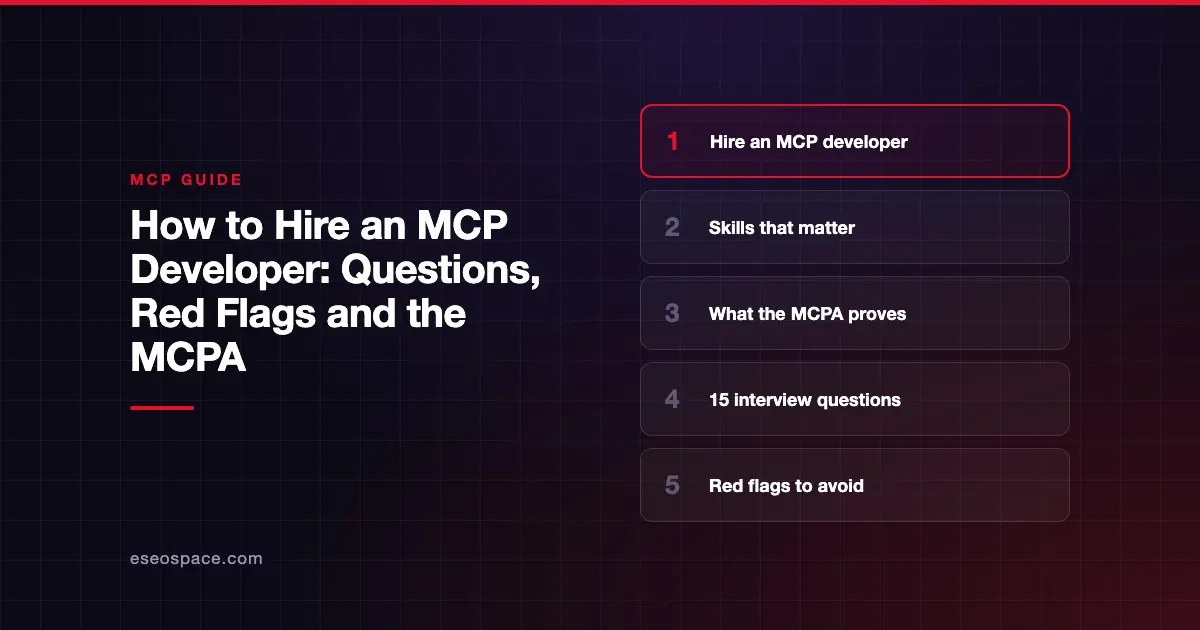
This guide gives you the skills to check, what the MCPA certification covers, interview questions, and the red flags that should end a conversation.
Key Takeaways
- The core skill is building secure integrations; MCP knowledge sits on top of solid API, auth and backend experience.
- The MCPA (Model Context Protocol Associate) is a Linux Foundation certification launched in September 2026 that tests protocol knowledge, not production experience.
- Ask every candidate how they handle OAuth, scopes and token validation; vague answers are a warning sign.
- Ask whether they have worked with the v2 Python or TypeScript SDKs, released in July 2026.
- MCP is an open standard, so treat a developer's claim to be an "official MCP partner" as a red flag until they prove it.
- Get a written tool list, auth plan and support plan before you sign.
What an MCP developer actually does
An MCP developer builds the servers that let AI apps like Claude or ChatGPT use your tools and data.
A typical project includes:
- Designing tools the AI model can understand and use safely.
- Connecting those tools to your APIs, databases or SaaS accounts.
- Adding authentication and permission scopes.
- Hosting the server and setting up logs and monitoring.
- Testing it in the AI apps your team uses.
- Documenting it and, if public, listing it in registries.
Skills to look for
| Skill | Why it matters | How to check |
|---|---|---|
| Python or TypeScript backend work | The official SDKs most teams use are in these languages | Review a code sample |
| API integration | Every tool wraps an API or database | Ask about a hard integration they shipped |
| OAuth 2.1 and token handling | Remote servers acting on user accounts need it | Ask them to walk through the flow |
| Security basics | MCP servers can take real actions | Ask about scopes, logging and prompt injection |
| Tool design | Good names and descriptions make models choose correctly | Ask how they write a tool description |
| Current MCP knowledge | The spec and SDKs changed in July 2026 | Ask what changed in the 2026-07-28 spec |
Why current knowledge matters
The latest MCP specification is dated 2026-07-28. Both official SDKs released version 2 that month. The Python SDK's v2 notes say the main server class was renamed from FastMCP to MCPServer and the old import path removed. A developer still writing v1-only code is not wrong, but should know about the change and have a migration plan. For the full change list, see what changed in the July 2026 MCP spec.
The MCPA certification
The MCPA (Model Context Protocol Associate) is a certification focused on MCP. The Linux Foundation announced that the Agentic AI Foundation and Linux Foundation Education launched it on 14 September 2026. The Agentic AI Foundation is the Linux Foundation fund that now hosts MCP, after Anthropic donated the protocol in December 2025.
Facts from the announcement and the MCPA exam page, checked 28 October 2026:
- Format: online, proctored, multiple-choice.
- Length: the announcement says 120 minutes; the exam page listed 90 minutes when we checked. Confirm on the exam page.
- Spec version: aligned to the 2026-07-28 MCP specification.
- Price: the exam page lists $250 for the exam, with one retake included.
- Validity: two years, per the exam page.
- Level: listed as Beginner, with no required prerequisites.
The exam domains and weights are:
| Domain | Weight |
|---|---|
| Interactions & Execution | 26% |
| Security & Governance | 24% |
| Use Cases & Ecosystem | 20% |
| MCP Fundamentals | 16% |
| Architecture & Components | 14% |
What the MCPA proves, and what it does not
The MCPA shows that someone studied the protocol and passed a proctored exam on it. That is useful, especially since nearly a quarter of the exam is security and governance.
It does not prove that someone has shipped a production server, handled a real OAuth integration, or supported a server after launch. The exam page lists the level as Beginner. Treat the MCPA as a plus, not a pass. For more detail, read our MCPA certification guide.
15 interview questions
Experience
- Show me an MCP server you built. What does it do, and who uses it?
- Which SDK and version did you use? Have you worked with the v2 Python or TypeScript SDKs?
- Which AI apps did you test it in? What broke, and how did you fix it?
Tool design
- How do you decide what becomes a tool? Listen for "fewer, clearer tools" thinking.
- Walk me through a tool description you wrote. Is it written so a model knows when to use it?
- How do you handle tools that change or delete data? Look for confirmation steps, validation and annotations like read-only and destructive hints.
Security and auth
- How does authorization work for a remote MCP server? A good answer mentions OAuth 2.1, Protected Resource Metadata and token validation, as described in the MCP authorization spec.
- What is token passthrough, and why is it a problem? The official security best practices say servers must not accept tokens that were not issued for them.
- How do you choose scopes? Listen for least privilege and step-up requests for risky actions.
- How do you protect against prompt injection from data your tools return?
- What do you log, and what do you never log? Secrets and tokens should never appear in logs.
Delivery and support
- How do you host remote servers, and how do you monitor them?
- What is your plan when the spec or SDK changes?
- Who owns the code and the repository when the project ends?
- What does support cost after launch, and what is included?
For deeper security background before the interview, read MCP security risks.
Red flags
Walk away, or at least slow down, if you hear any of these:
- "We're an official MCP partner." MCP is an open standard hosted by the Agentic AI Foundation under the Linux Foundation. Anyone can implement it. Ask exactly what "official" means and ask for proof. True claims sound like "MCPA-certified" or "listed in the Claude Connectors Directory."
- No working example. If they cannot show a server, a repo or a demo, you are paying for their learning.
- Hand-waving on auth. "We'll just use an API key" for a multi-user remote server that acts on customer accounts is not a plan.
- Broad scopes by default. Requesting full access "to keep things simple" increases the damage a stolen token can do.
- Guaranteed prices without discovery. A flat price before they know your systems is a guess. See what drives MCP server cost.
- No mention of maintenance. Servers need upkeep as the spec, SDKs and your APIs change.
- Unclear code ownership. You should own the code you pay for, or have a clear license.
- Invented numbers. Claims of huge install counts or "thousands of servers built" with no source.
Agency, freelancer or in-house?
Each option fits different needs. A freelancer can be fast for a small, low-risk server. An agency brings more roles, such as security review and project management. In-house makes sense if MCP is core to your product. Compare them in MCP agency vs freelancer vs in-house, and use our MCP RFP template to get comparable proposals.
How eSEOspace fits
eSEOspace is a web design, SEO and GEO agency. We offer Claude Code development and Claude Code consulting, and we can help you scope an MCP project and review proposals. We will answer every question on the list above in writing.
Next step
If you want to talk through your MCP project and get a scoped proposal, see eSEOspace MCP development.
Frequently asked questions
Does an MCP developer need the MCPA certification?
No. The MCPA launched in September 2026, so many experienced MCP developers built servers before it existed. It is a useful signal of protocol knowledge, but a working code sample and strong security answers matter more.
What does the MCPA exam cost?
The Linux Foundation's MCPA exam page listed the exam at $250 with one retake included when we checked on 28 October 2026. Prices and bundles change, so check the exam page before you budget.
Is there an official list of approved MCP developers?
We found no official approved-developer program in the MCP or Linux Foundation materials we checked. MCP is an open standard. Look for verifiable signals instead: the MCPA, public code, registry listings and references.
What programming languages should an MCP developer know?
Python and TypeScript cover most projects, since both have official v2 SDKs. Official SDKs also exist for other languages, including Java, Kotlin, C#, Go, Ruby and Rust. Match the language to your existing stack.
How do I test a candidate's MCP skills quickly?
Ask them to walk you through a server they built, live. Have them explain one tool's description, its inputs, its auth and what it logs. You will learn more in 20 minutes than from a resume.