Best Fibbler Alternatives for Tracking B2B Pipeline and Revenue
Best Fibbler Alternatives for Tracking B2B Pipeline and Revenue
The right Fibbler alternative depends on whether you need clearer deal reporting, more campaign controls, or both. This shortlist compares five tools for B2B teams, with ZenABM first for LinkedIn-focused account workflows.
Fibbler remains the comparison baseline. Its scope covers LinkedIn attribution, CRM sync, scheduling controls, and Google Ads and Meta Ads insights, so the alternatives below are judged on what they add beyond that.
Disclosure: This is a sponsored guest post featuring ZenABM. The recommendations reflect documented use-case fit, not measured advertising results.
Key Takeaways
- ZenABM is my top pick for LinkedIn-first teams that want CRM-connected account signals, initiative-level reporting, and AI campaign management with approval before changes go live. Pricing starts at $59/month.
- Factors.ai fits teams prioritizing account-level impression and click limits alongside cross-channel pipeline reporting. Check which controls require an annual Enterprise plan.
- Dreamdata fits multichannel journey analysis and conversion feedback. Its Free plan is separate from its custom-priced advanced attribution offering.
- HockeyStack fits teams that need configurable reporting, nine attribution models, and natural-language analysis. Official pricing requires a quote.
- DemandSense combines campaign controls with CRM-linked deal reporting from $89/month. Named-person visitor identification is restricted to US traffic.
How I Tested
This is a documentation-and-review-based evaluation, not a live advertising experiment. I compared product documentation, pricing pages, release notes, and G2 profiles. Prices and review counts are snapshots from October 20, 2026; I did not connect accounts, measure setup times, or test attribution accuracy.
Account-based marketing, or ABM, focuses on selected companies, and pairs well with B2B lead generation through SEO. A customer relationship management system, or CRM, stores their contacts and deals. Attribution connects marketing activity with those deals under defined rules; it does not establish that advertising caused a sale.
I used six criteria: CRM opportunity reporting, account-level visibility, coverage beyond LinkedIn, campaign actions available inside the tool, clarity of plan boundaries, and implementation fit for a small or midsize team without a data engineer. Ratings provide dated customer context, not statistically comparable performance scores.
For any demo, check attribution windows, CRM stage mapping, account matching, and duplicate deal handling. Ask how subsidiaries and domain variants are treated. Keep advertising spend separate from platform fees, and confirm add-ons and contract terms.
1. ZenABM
ZenABM Pros
- Engagement signals across LinkedIn Ads, Google Ads, Reddit Ads, organic traffic, and AI chatbot referrals
- Syncs ABM stages, engagement scores, intent, and campaign names to HubSpot or Salesforce
- Deduplicated pipeline and revenue attribution per campaign and per ABM initiative
- AI campaign creation and management from Claude, ChatGPT, or its own chat, with approval required before changes go live
- Starting price of $59/month with unlimited seats on all plans
ZenABM Cons
- Meta Ads is not among its listed engagement channels
- No organic LinkedIn page engagement insights
Why We Picked ZenABM
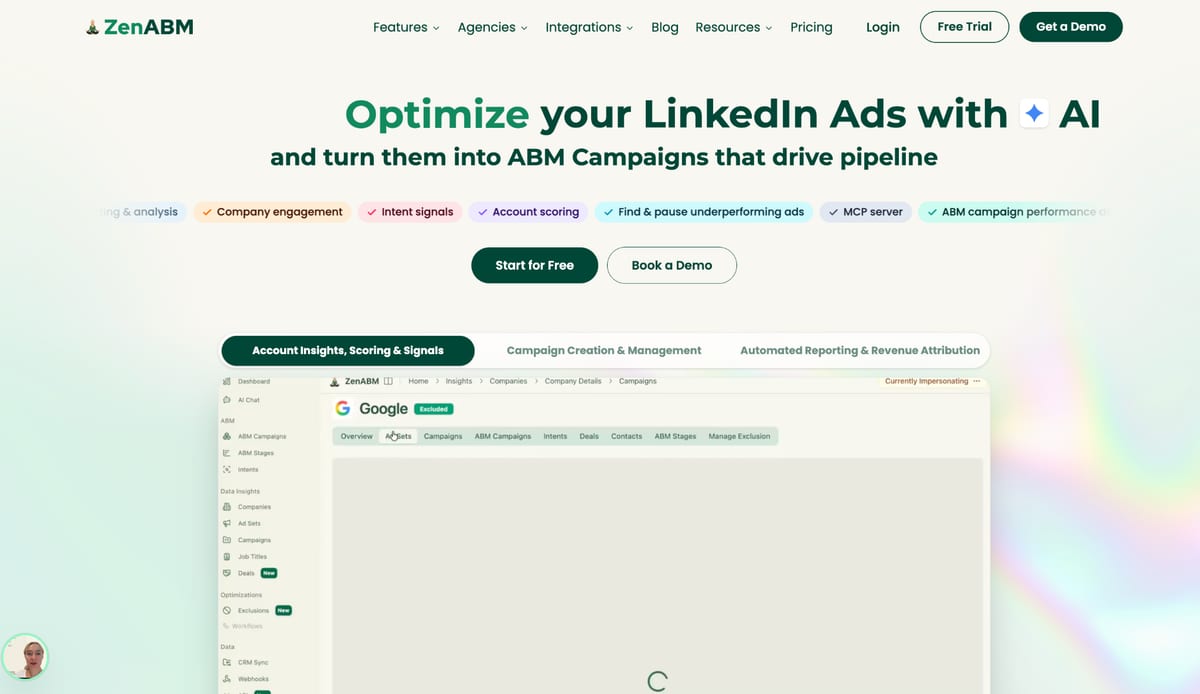
I put ZenABM first because its workflow connects account engagement with sales follow-up. ABM stages, engagement scores, and intent sync to the CRM as company properties, and deal events sit on each account's timeline next to its ad touchpoints. Attribution is deduplicated, so a deal influenced by several campaigns is not counted twice.
The campaign features make this a compelling shortlist choice for LinkedIn-first teams. ZenABM sets out how its account scoring, deduplicated revenue attribution, and AI campaign management compare with Fibbler, including running LinkedIn campaigns from Claude or ChatGPT through its MCP server, with every account change approved before it goes live. Its AI agent builds campaigns, ad sets, and ads, adjusts bids and budgets in bulk, and flags ads with declining click-through rates for pausing.
It also shows which contacts within target accounts are engaging, so sales development reps can follow up. ZenABM holds 5.0/5 on G2 from 6 reviews. In a demo, I'd ask to follow campaign engagement into a CRM account and its associated deal.
ZenABM Pricing
ZenABM starts at $59/month with multi-channel signals included, and an Agency plan covers teams managing multiple clients. All plans include unlimited seats. The vendor advertises a 37-day trial that converts to a Free plan, but ongoing free-tier quotas were not verified. Budget advertising spend separately and confirm the features you need in your chosen tier.
2. Factors AI
Factors.ai Pros
- Tracks ad and content engagement at the account level
- Offers custom account scoring on Growth
- AdPilot sets account-level impression and click limits, excluding accounts until the selected period ends
- Links LinkedIn, Google, Meta, and Bing spending to pipeline and revenue
- Offers a hosted MCP server for AI clients
Factors.ai Cons
- Impression control and dynamic audience syncing are listed on Enterprise, not the entry plan
- Basic, Growth, and Enterprise require annual commitments
- Person-level identification through RB2B covers US-based visitors
Why We Picked Factors.ai
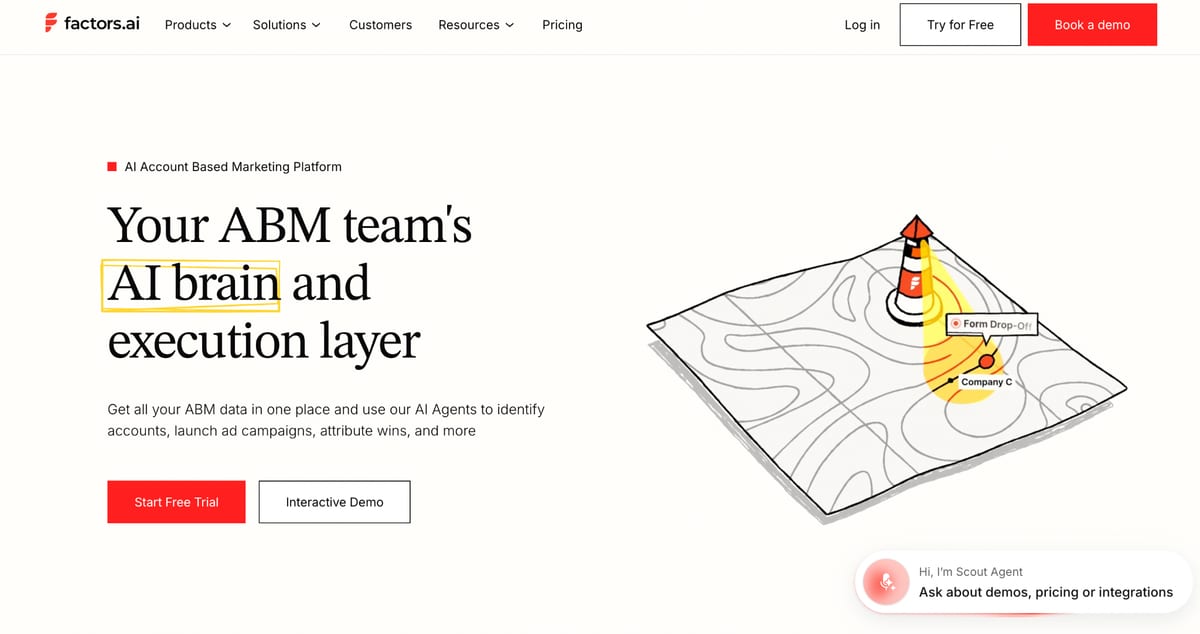
I would shortlist Factors.ai when account exposure rules are a central requirement. AdPilot limits impressions and clicks by account, with rules that can reflect account intent. These are account-level controls, not person-level frequency caps.
Its analytics connect engagement to marketing-qualified leads, sales-qualified leads, opportunities, and closed-won stages. Its product updates added scheduled LinkedIn bid changes in June 2026, alongside a hosted MCP server for querying account data from AI tools. Confirm which plan includes each of these features before relying on them.
Factors.ai holds 4.5/5 on G2 from 246 reviews. Before buying, ask the vendor to demonstrate your intended exposure rule and identify the plan that includes it. The features driving this recommendation sit above Lite.
Factors.ai Pricing
Lite is $199/month after a trial. Trial duration and an ongoing free tier were not verified. Basic is $6,000/year, Growth is $20,000/year, and Enterprise starts at $30,000/year. Growth adds custom scoring; Enterprise lists impression control and dynamic audience syncing. Treat these annual commitments differently from a monthly subscription, and budget advertising spend separately.
3. Dreamdata
Dreamdata Pros
- Includes paid and organic LinkedIn touchpoints in customer journeys
- Compares sources and campaigns by revenue and deals
- Reports advertising return on ad spend and lifetime value
- Supports daily LinkedIn audience syncing and pipeline feedback through the Conversions API
- Offers a bounded Free plan at $0/month
Dreamdata Cons
- Free includes only two months of user history, five seats, three stage models, and one sync
- Advanced attribution requires a quote; activation and data-warehouse features are presented as add-on scope
Why We Picked Dreamdata
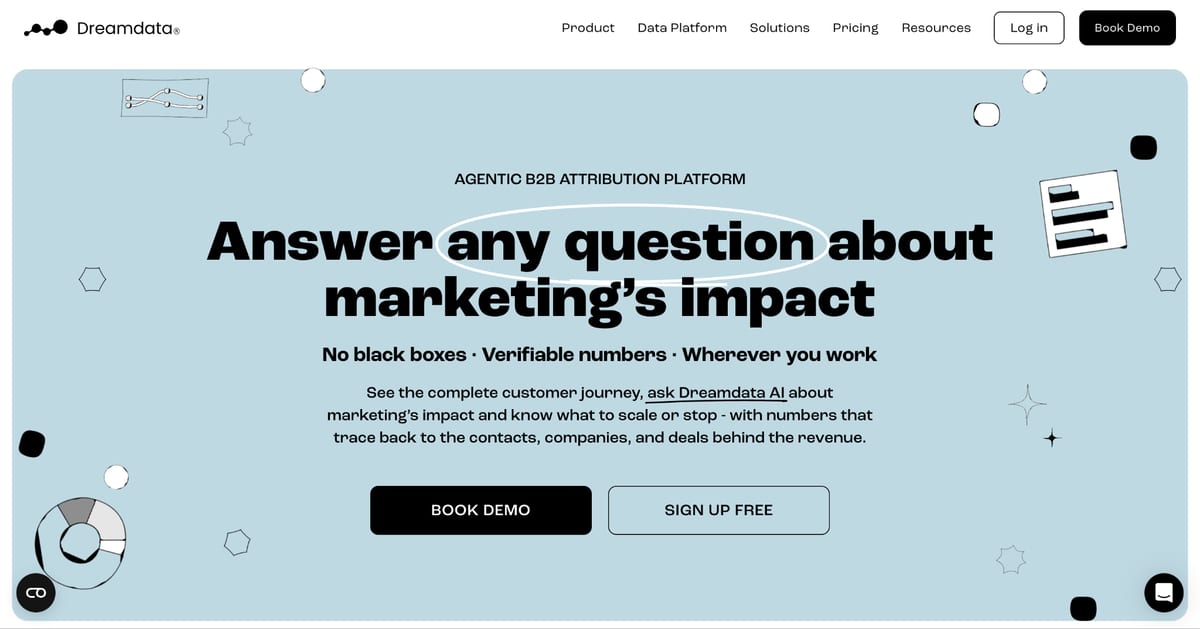
Dreamdata fits a shortlist where LinkedIn marketing is part of a broader revenue-measurement project. Its Performance product compares sources and campaigns by revenue and deals, including organic social activity. These reports describe attributed outcomes rather than causal lift.
The LinkedIn integration adds daily audience syncing and sends pipeline data through the Conversions API. I would ask the vendor to show paid and organic touchpoints for the same account, then explain how those touches receive credit.
Dreamdata holds 4.7/5 on G2 from 277 reviews. It ranks third here because the article prioritizes LinkedIn-focused operating workflows. Scope the required integrations and historical data before deciding whether its broader measurement approach fits your project.
Dreamdata Pricing
Free costs $0/month with the limits above. Its two-month history allowance may be insufficient for your sales cycle, and it should not be treated as the advanced revenue-measurement package. Advanced attribution uses custom pricing. Ask for a quote that separates platform access from activation and data-warehouse add-ons, with the required history and sync allowances stated explicitly.
4. HockeyStack
HockeyStack Pros
- Nine documented attribution models
- Custom no-code reporting
- Natural-language analysis through Odin
- Documented drill-down into underlying accounts and touchpoints
- CRM and go-to-market integrations connecting marketing and sales data
HockeyStack Cons
- No published package price on the official pricing page
- G2's review summary includes a learning-curve theme
- No free-plan or trial entitlement was verified
Why We Picked HockeyStack
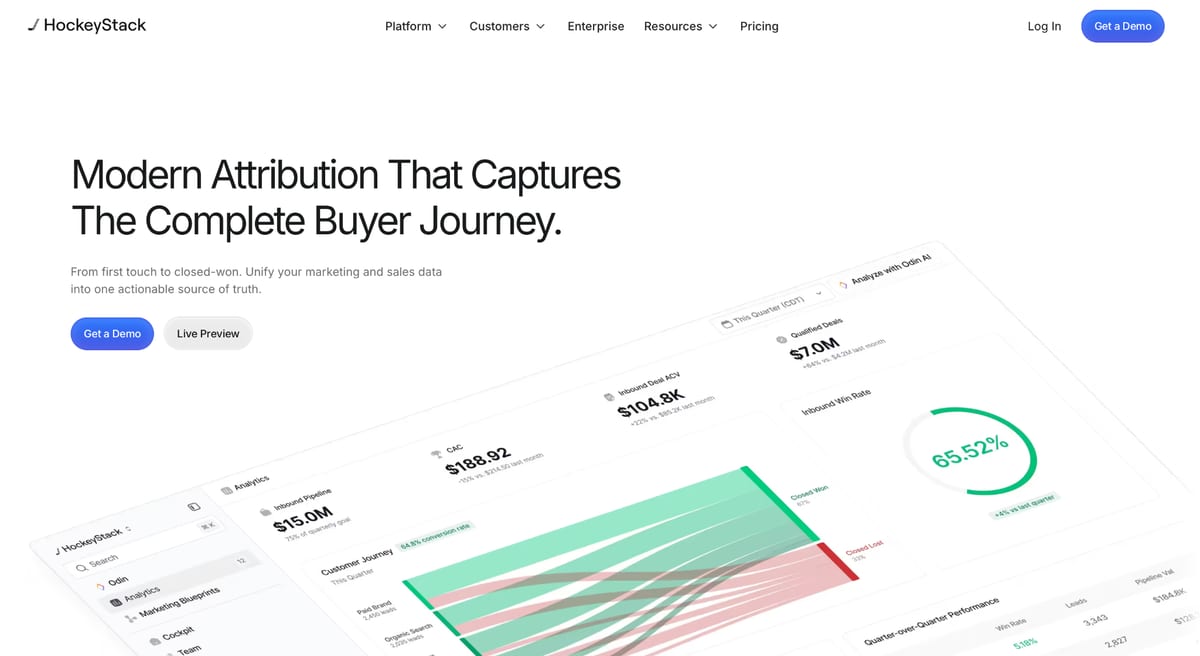
HockeyStack fits teams whose reporting questions require configurable analysis. Its vendor-authored description on G2 lists nine attribution models, custom no-code reports, and Odin for natural-language questions. That description documents functionality; it does not independently verify reporting accuracy.
The vendor also describes drilling into the accounts and touchpoints behind a metric. I would use a known deal in a demo and ask how changing the attribution model changes its reported marketing contribution.
HockeyStack holds 4.4/5 on G2 from 82 reviews. The review summary's learning-curve theme makes it worth checking who will own report setup and maintenance. Ask that person to evaluate the reporting workflow before signing.
HockeyStack Pricing
The official pricing page requires a quote rather than publishing a package price. It lists CRM and go-to-market integrations, customer-success support, custom setup support, and ROI reporting among plan inclusions. Confirm the contract term and implementation scope directly; older third-party price listings are not a current official quote.
5. DemandSense
DemandSense Pros
- Campaign scheduling
- Frequency controls and audience tuning
- CRM-linked influenced-deal and closed-deal reporting with configurable influence criteria
- Company visitor identification with intent and ideal-customer-profile segmentation
- Every module included on both paid plans; allowances differ by credits
DemandSense Cons
- Named-person visitor identification covers US traffic only
- Base is fixed at 200 monthly credits; higher reveal volumes require Plus, which scales from 500 credits at $149/month to 10,000 credits at $999/month
Why We Picked DemandSense
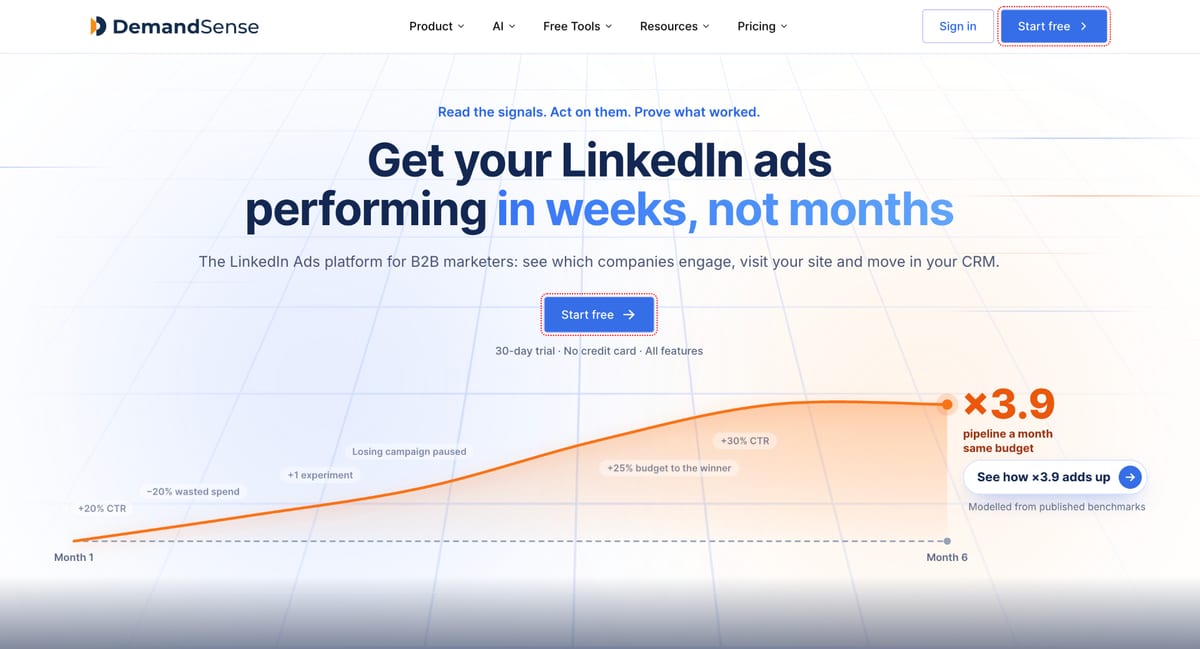
DemandSense fits teams focused on campaign operations with deal context attached. Both plans list scheduling and frequency controls, while CRM-linked reporting lets you define what counts as influenced. That definition needs to match your reporting policy; influence alone does not establish causation.
The visitor product separates company identification from named-person identification. The vendor discusses worldwide traffic for company identification, but named-person identification is explicitly US-only. Neither description guarantees that every visitor will be identified.
DemandSense holds 5.0/5 on G2 from 15 reviews, still a small review sample. I'd ask the vendor to demonstrate how changing influence criteria affects a known deal and confirm whether its documented HubSpot or Attio connection covers the fields your team needs.
DemandSense Pricing
Base is $89/month with 200 credits, and Plus starts at $149/month with 500 credits, scaling up to 10,000 credits at $999/month. Credits are spent on revealing visitors and contacts; every module is included on both plans. A 30-day free trial is available without a credit card. Choose based on expected reveal volume rather than assuming Plus unlocks additional modules, and confirm billing terms before committing.
Conclusion
ZenABM is my top pick for LinkedIn-first teams that want CRM-connected account signals, initiative-level reporting, and AI campaign management with approval before changes go live. Its workflow and starting price make it a sensible first demo. Factors.ai is the alternative to examine when account-level exposure controls are the priority.
Dreamdata fits broader journey measurement and conversion feedback; HockeyStack suits configurable reporting requirements. DemandSense fits campaign operations with deal context and US-only named-person identification. Before signing, trace a known closed deal through account matching, CRM stages, and attribution rules, then confirm the required features and contract terms in writing.
FAQ
Which Fibbler alternative should a LinkedIn-first team shortlist first?
Start with ZenABM if you want to act on account engagement through CRM sync and AI campaign management. Compare Factors.ai when account-level impression and click limits are essential. Keep Fibbler in the evaluation, since its current offering also includes scheduling controls and additional advertising channels.
Are there free Fibbler alternatives?
ZenABM advertises a 37-day trial followed by a Free plan, but its ongoing quotas were not verified. Dreamdata has a $0/month Free plan with limited history and functionality. Factors.ai advertises a trial, not a verified ongoing free tier. DemandSense offers a 30-day free trial without a credit card, while HockeyStack free-plan or trial entitlements were not established.
Does attributed pipeline prove incremental revenue?
No. Influenced pipeline links engagement to opportunities under selected rules. Closed-won revenue records completed deals. Incremental revenue is additional revenue caused by the advertising. An attributed or influenced deal alone cannot establish that causal effect, even when the deal has closed.
What should we check before switching?
Confirm CRM compatibility, historical-data availability, attribution windows, stage mapping, account matching, and duplicate deal handling. Check feature tiers, paid add-ons, and contract length. If visitor identification matters, verify geographic coverage and your privacy requirements; a complete country-availability or language-support inventory was not verified for this shortlist.
Put this into action with eSEOspace
We help businesses grow with marketing that actually performs. Explore the services behind this guide:
Get a FREE Audit
We'll perform a comprehensive SEO, AEO, GEO & CRO audit of your website — completely free — and show you exactly how to outrank your competitors.
Don't have a site yet? Get in touch →
Get a FREE GEO/AEO/SEO Audit
We'll analyze your site's SEO, GEO, AEO & CRO — completely free — and show you exactly how to get found across Google and AI answers.
Don't have a site yet? Get in touch →
Great — your audit is on the way!
We'll send your free SEO/GEO/AEO/CRO audit within the next few hours. Where should we send it?
You're all set! ✓
Your free audit is being prepared — check your inbox in the next few hours. Talk soon!