Best Prismic Development Agencies in 2026-2027
Best Prismic Development Agencies in 2026-2027
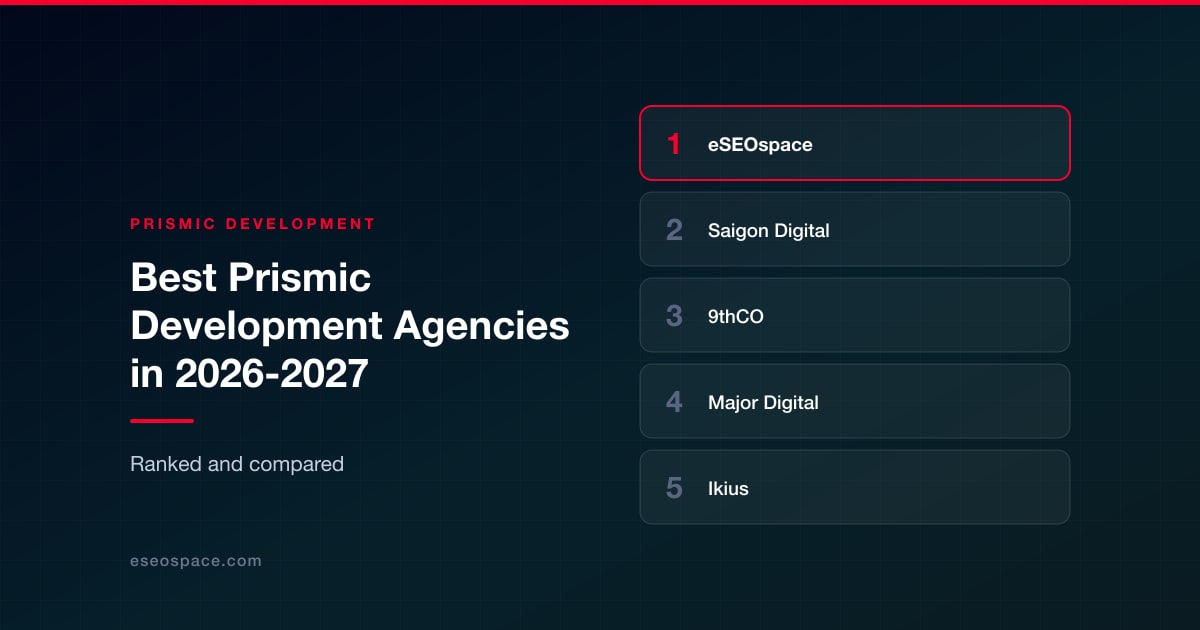
Disclosure: eSEOspace publishes this blog and ranks itself first. Every other entry was researched independently and links to its own site.
Prismic is a headless CMS with an opinion. Slice Machine pushes you toward a component library that marketers assemble themselves, which is either the best thing about the platform or the reason your build goes sideways, depending entirely on who sets it up. A Prismic project that has been slice-modelled well feels like a page builder that never breaks your design system. A Prismic project that has been modelled badly turns into forty near-identical slices, a content team that will not touch it, and a developer ticket for every landing page.
So the agency matters more here than it does on a monolithic CMS. You are not hiring someone to install a theme. You are hiring someone to make content-modelling decisions that your marketing team will live inside for the next four years.
This list ranks eight agencies that demonstrably work in Prismic. Everything stated about the seven independent firms comes from their own sites or from their profiles in Prismic's partner directory, and where those two sources disagree the article says so rather than picking a winner. Where a founding year, a headquarters or a client name could not be confirmed, it is left out rather than guessed at. That is why some entries say less than others, and the gaps are deliberate.
Key Takeaways
- Prismic agency quality lives and dies on slice architecture. Ask any shortlist how they decide when to build a new slice versus extend an existing one, and listen for a real rule rather than a vague answer.
- Prismic's own partner directory is the single most useful filter available. Six of the seven independent firms here appear in it, and several publish Prismic-specific project lists there that are more informative than the client walls on their own sites.
- A client logo on an agency's Prismic services page is not the same as a Prismic project. Several firms here show broad logo walls but name far fewer projects on their Prismic partner profile. Where that gap exists, this article points it out.
- Framework choice is a real differentiator. Most Prismic work defaults to Next.js, so if you are on Nuxt or SvelteKit your shortlist narrows quickly.
- Offshore and nearshore Prismic delivery is genuinely mature in 2026. The capability gap versus North American and UK agencies is smaller than it used to be, though you should still price the coordination cost honestly.
- Very few agencies disclose team size or partner tier publicly. Treat any list that quotes those numbers with suspicion unless it cites a source.
- A Prismic build is only half a project. Search visibility, analytics and conversion work decide whether the site earns anything, and a surprising number of technically clean builds ship with none of it.
- Recent partnerships are not automatically weaker, but they do mean less public evidence. Weigh announcement dates when you are comparing portfolios.
How we evaluated these agencies
Four things decided the ranking, in this order.
Verifiable Prismic evidence. Not "we work with headless CMS platforms" on a services grid. We looked for a dedicated Prismic page, an entry in Prismic's partner directory, or a public partnership announcement, ideally with named Prismic projects attached rather than a general client wall. Several agencies here clear that bar comfortably. Others show real Prismic capability alongside client logos that may or may not represent Prismic-specific work, and we say so in their entries.
Depth of the surrounding stack. Prismic is a content layer. It does not render anything. Whoever builds your site is also making decisions about Next.js or Nuxt, hosting on Vercel or Netlify, caching, preview environments and image handling. Agencies that talk fluently about the whole stack tend to produce sites that hold up.
Fit for a specific buyer. A three-person marketing team migrating a brochure site and a scale-up rebuilding a multi-market publishing platform are not shopping for the same firm. We tried to describe who each agency is actually for, including who it is not for.
Honesty about what we could not confirm. No review scores, no revenue estimates, no team headcounts, no partner tiers. Those numbers are almost never published by the agencies themselves, and the versions that circulate on aggregator sites are usually reverse-engineered guesses. If we could not open a page that stated it, it is not in this article.
Comparison table
| Rank | Agency | Location | Founded | Best for | Main trade-off |
|---|---|---|---|---|---|
| 1 | eSEOspace | United States | 2019 | Prismic builds that also need SEO, analytics and conversion work | Not a pure-play headless boutique |
| 2 | Saigon Digital | Ho Chi Minh City, Vietnam | Not disclosed | Content-heavy marketing sites at offshore rates | Time-zone distance from North America |
| 3 | 9thCO | Toronto, Canada | 2013 | North American teams wanting a named Prismic practice | Only one Prismic project named on their partner profile |
| 4 | Major Digital | Brighton, United Kingdom | 2007 | UK and EU clients wanting a long operating history | Smaller published Prismic project list |
| 5 | Ikius | Turku, Finland | Not disclosed | Nordic and EU marketing teams | Partner status is self-stated, one named Prismic case study |
| 6 | Fineart Design Agency | Toronto, Canada | Not disclosed | Design-led Prismic builds, healthcare and startup product work | No Prismic page on their own site |
| 7 | RW Infotech | Multiple offices | Sources differ (2012 or 2013) | Larger offshore headless programmes | Conflicting public location information |
| 8 | Alloy | Atlanta, New Orleans, Naples, US | 2012 | Tech brands wanting Prismic inside a marketing engagement | Partnership announced January 2025, so less public Prismic history |
1. eSEOspace
Founded: 2019 Best for: Organisations that want a Prismic site built and then actually made to perform in search, analytics and conversion.
Most Prismic agencies are development shops that hand you a fast, well-structured site and then leave. That is a legitimate business, and several firms further down this list do it well. eSEOspace approaches the work from the other direction: the CMS choice is a means to an end, and the end is a site that ranks, converts and can be measured.
That shapes the build. Content modelling gets designed around the pages the site actually needs to win, not just around the pages in the current sitemap. Slice libraries get built so that the marketing team can ship a new landing page without a developer, which is the entire promise of Prismic and the part most implementations quietly fail. URL structure, internal linking and schema get treated as build decisions rather than post-launch cleanup.
The surrounding capability is the real argument for putting eSEOspace first. The team works across website design, custom software, content management and organic SEO, so the same group that models your content types is the group thinking about how those pages get found. For teams that also care about AI search surfaces, there is dedicated AI SEO work, which matters more each year as answer engines take a larger share of discovery.
Worst fit: If you want a pure-play headless boutique that thinks about nothing but Slice Machine architecture and has no interest in your marketing performance, this is not the shape of the engagement. eSEOspace is a full-service partner, and clients who only want a repo handed over will find the strategy layer surplus to requirements.
2. Saigon Digital
Saigon Digital is a Ho Chi Minh City agency covering UX and UI design, development, SEO and digital marketing, currently leading with an AI-driven positioning that extends into AI search optimisation and workflow automation. Prismic is featured prominently as a partner, and this is the part that matters: their Prismic partner profile shows a genuine portfolio of Prismic builds rather than one token project used to claim the badge.
Named projects on that partner profile are Ski.com, Unmind and McLaren Group. Their own case study index adds Celerity UK, Vulcanus, Baigur, Sova, Talent Hero, Ventia and others, and the site notes that the Ski.com build was featured in Prismic's own customer success stories. That is an unusually concrete evidence trail for a Prismic specialist.
The pitch is straightforward. You get Prismic development sitting next to design, SEO and ongoing digital marketing under one roof, at offshore rates. For content-heavy marketing sites where the content operation continues long after launch, that combination is hard to beat on value.
Worst fit: If your team needs heavy same-day-timezone collaboration with a North American product group, the distance is real and no amount of process fixes it entirely. Note also that their own case study index attaches Prismic explicitly only to Ski.com, so if you want to know which of the other builds ran on Prismic you will have to ask. Founding year, team size and partner tier are not published anywhere we could open.
3. 9thCO
9thCO is a Toronto agency, founded in 2013, running a dedicated Prismic services page out of 120 Adelaide Street West. They describe themselves as having grown from a technical SEO firm into a full-stack web development team, and they specialise in headless CMS and e-commerce migrations with SEO included, which is a rarer combination than it should be.
The framework range is worth calling out. Their Prismic page names Next.js, Nuxt and SvelteKit as supported frameworks, with Netlify and Vercel as deployment partners. Most Prismic agencies default to Next.js and quietly steer you there regardless of what your engineers already know, so a firm that works in all three removes a category of hiring risk if your team lives in Vue or Svelte.
The positioning emphasis is also right for the platform. Rather than selling maximum build complexity, they lead with agile delivery, post-launch iteration and an explicit range from MVP through to enterprise-scale work. Prismic rewards teams that ship a lean slice library and then extend it based on what marketing actually asks for, and punishes teams that try to model every future page before launch.
Their Prismic services page shows a Trusted By section including Kelly's Bake Shoppe, Guild, Exclaim and TMX Group.
Worst fit: Those Trusted By logos sit on the Prismic page, but the only project 9thCO names as Prismic work on its Prismic partner profile is Kelly's Bake Shoppe, a headless replatform combining Shopify, Prismic, Next.js and Vercel. That is one solid, documented Prismic build rather than four. If Prismic-specific references are decisive for you, ask for them by name. Team size and partner tier are undisclosed.
4. Major Digital
Major Digital is a Brighton agency, based at the Plus X Innovation Hub on Lewes Road, whose site carries a copyright line running from 2007. They published an announcement stating they are now an official Prismic headless CMS partner, and their Prismic partner profile lists Sweej Tech, UHV Design and Canny Comms as Prismic projects.
Three things stand out. First, the operating history. Nearly two decades is a long time for a digital agency, and it means the brand and web practice around the headless build stack is mature rather than bolted on. Second, they make carbon-conscious accreditation a stated differentiator, citing Eco Friendly Web Alliance accreditation, an Ecologi partnership, an SME Climate Hub commitment and Green Web Foundation verified hosting. That is not marketing noise if your organisation has procurement criteria around sustainability, and plenty of UK and European buyers now do. Third, they publish a budget floor: their site states that projects start from £20k, which is more transparency than most agencies on this list offer and saves everyone a wasted call.
They are also partnered with more than one headless platform, having published similar announcements for Storyblok and Kontent.ai. Read that either way. It means they will not force Prismic on a project where it is the wrong fit, and it means Prismic is one practice among several rather than the whole business.
Worst fit: The published Prismic project list is smaller than Saigon Digital's, and the partnership announcement carries no date we could read, so it is harder to judge how much Prismic volume sits behind it. Team size and partner tier are not disclosed. If you want to see ten Prismic builds before signing, ask early.
5. Ikius
Ikius is a Finnish agency based in Turku, offering strategy, design, development, support and team extension. Its Prismic technology page states that the firm is part of the Prismic CMS partner network. That claim comes from Ikius itself rather than from Prismic: unlike the other six independent agencies here, we could not find Ikius listed in Prismic's public partner directory, so treat the partner status as self-reported and confirm it directly if it matters to your procurement process.
The positioning is worth calling out because it is unusually honest about audience. Their Prismic page is aimed squarely at content-heavy businesses and marketing teams that need real-time collaboration, and it presents Prismic as an approachable headless CMS that does not demand a heavy technical lift from the client side. If you are a marketing team that got burned by a headless project where every content change required a deploy, that framing is aimed at you.
The named case study on their Prismic page is Veri, a metabolic-health company later acquired by Oura. Their wider work page names Sisu Auto, Boschung and Reaktor, though those are not presented as Prismic projects. The firm also publishes technology pages for Contentful, Sanity, Storyblok, Payload and a dozen other content platforms, which tells you Prismic is one option in a broad headless practice rather than a specialism.
Worst fit: One named Prismic case study is a thin evidence base compared with the top of this list, and the unconfirmed directory listing compounds that. Founding year and team size are not published. For a very large multi-market publishing platform you would want more visible proof of scale before committing.
6. Fineart Design Agency
Fineart Design Agency is a Toronto firm listed in Prismic's partner directory. Its partner profile describes a design-led practice covering startup design solutions, UI and UX design for healthcare platforms, data visualisation, product development, and website design and development, with Next.js and React named as the frameworks.
The named Prismic project on that profile is App Dev Health, a website for an international IT product engineering firm working in healthcare operations. That is a useful signal about where the firm is strongest. If your Prismic build is really a design problem wrapped around a content model, or if you are in healthcare or early-stage product and need interface design as much as implementation, this is a more natural fit than a pure engineering shop.
Their own site leads with design capability rather than CMS engineering, covering ecommerce development, branding, UX research, MVP design, data visualisation and accessibility compliance. Two testimonials carry named attribution, from the founder of Digiplatform and the founder of MHM.
Worst fit: This is the least Prismic-specific evidence of any agency on this list. Fineart's own website carries no dedicated Prismic page at all, so everything Prismic-related about them comes from the directory profile rather than from their own marketing. No founding year or team size is published. If Prismic depth rather than design quality is what you are buying, look higher up this list, and insist on named, contactable Prismic references during your first call.
7. RW Infotech
RW Infotech is a multi-office headless development shop that displays a Prismic developer badge alongside WordPress, Sanity and Storyblok, and appears in Prismic's partner directory. The positioning is around scalable, high-quality custom headless CMS delivery, and the headless services extend well beyond Prismic alone.
The Prismic evidence is stronger than the client wall alone suggests. Their Prismic partner profile names six Prismic projects: AirDNA, Tilyo, Team Wass, Legal Free, Head Full of Food and Carbmee. The broader logo wall on their site is larger and includes Royal Caribbean, Simple Online Doctor, AirDNA and Uplisting, but only the six on the partner profile are presented as Prismic work. Their listed technologies span Next.js, Nuxt, React, Vue, Angular, Gatsby, Node, PHP and Java, which is the profile of a general offshore engineering partner rather than a Prismic boutique. For buyers who need capacity for a larger headless programme rather than a single site, that breadth is the draw.
Worst fit: The public record on this firm is inconsistent in two ways. Prismic's directory places them in Sydney, Australia, while their own site's footer lists offices in Sheridan, Wyoming, in Dubai and in Mohali, India, with no Sydney address. On founding year, their own site says they have been helping brands since 2012, while their Prismic partner profile says they have operated since 2013. Neither discrepancy is disqualifying, but both mean you should establish exactly which entity, which office and which team will hold your account before you sign anything.
8. Alloy
Alloy is an integrated marketing agency founded in 2012, with offices in Atlanta, New Orleans and Naples. They announced their Prismic agency partnership on 21 January 2025, and their focus is brand, marketing orchestration, platform innovation, and communications and PR.
Their stated reason for choosing Prismic is Slice Machine. In the announcement, their VP of Technology says the product lets the agency streamline development and craft digital experiences that align with clients' editorial needs, framed within a broader move toward decoupled and composable architecture. That is the right reason to pick the platform, and it suggests the partnership was a deliberate fit decision rather than a badge collection exercise.
Their Prismic partner profile names one Prismic project, cove.tools, where Alloy served as marketing partner following the company's Series B round, and lists Next.js, Astro, React, Gatsby, React Native, Netlify and Vercel among their technologies. The broader client wall on their own site is considerably larger and skews toward major Atlanta-area brands and institutions, but those are marketing engagements rather than stated Prismic builds.
The fit here is US tech and B2B brands that want Prismic development sitting inside a broader marketing engagement covering strategy and multichannel campaigns, rather than a standalone build handed off to an internal team.
Worst fit: The partnership is recent and the announcement names no clients, so the volume of delivered Prismic work is not publicly established beyond the single project on their partner profile. If you need a partner who has already shipped many Prismic sites, start higher up this list.
Who should hire which
| Your situation | Hire | Why |
|---|---|---|
| You need the Prismic build plus SEO, analytics and conversion work from one team | eSEOspace | The CMS work and the performance work are not split across two vendors |
| Content-heavy marketing site, budget-sensitive, ongoing marketing support needed | Saigon Digital | Broadest verifiable Prismic portfolio combined with offshore rates |
| North American team, fast launch then iteration, or a Nuxt or SvelteKit front end | 9thCO | Explicit MVP-to-enterprise range, and Next.js, Nuxt and SvelteKit all named on their Prismic page |
| UK or EU client, long operating history and sustainability criteria matter | Major Digital | Copyright line from 2007, published sustainability accreditations, and a stated £20k project floor |
| Nordic or EU marketing team wanting a low-friction headless move | Ikius | Positions Prismic explicitly for non-technical content teams |
| Design-led build, healthcare or early-stage product, interface work as important as the CMS | Fineart Design Agency | Design-first practice with a named healthcare Prismic project |
| Large multi-site headless programme, offshore economics | RW Infotech | Six named Prismic projects plus broad headless capacity beyond Prismic |
| US tech or B2B brand wanting Prismic inside a marketing engagement | Alloy | Integrated marketing agency, Prismic chosen for Slice Machine fit |
Frequently asked questions
How much does a Prismic build cost in 2026?
Do I need an official Prismic partner?
Should I use Next.js with Prismic, or something else?
How is Prismic different from Contentful or Sanity?
Will migrating to Prismic hurt my search rankings?
How long does a typical Prismic project take?
The bottom line
Prismic rewards agencies that think about content architecture before they think about pixels. Every firm on this list can build you a fast site. The ones worth your money are the ones whose work is still defensible in year three, when your marketing team has shipped two hundred pages through a slice library they were never given a chance to influence.
One practical habit will save you more grief than any ranking: separate the client logos from the Prismic projects. Almost every agency here shows more logos than Prismic builds, and the gap is not dishonest, it is just how agency marketing works. Ask which specific projects ran on Prismic, then ask to speak to those clients.
Shortlist three, hand each the same written scope, and ask all of them the same question: show me the slice library from a project you shipped two years ago, and tell me what you would model differently now. The answers will separate the field faster than any comparison table.
If you want the CMS build and the search, analytics and conversion work to come from the same team rather than three vendors pointing at each other, book a call and we will talk through the scope.
Put this into action with eSEOspace
We help businesses grow with website development that actually performs. Explore the services behind this guide:
Get a FREE Audit
We'll perform a comprehensive SEO, AEO, GEO & CRO audit of your website — completely free — and show you exactly how to outrank your competitors.
Don't have a site yet? Get in touch →
Get a FREE GEO/AEO/SEO Audit
We'll analyze your site's SEO, GEO, AEO & CRO — completely free — and show you exactly how to get found across Google and AI answers.
Don't have a site yet? Get in touch →
Great — your audit is on the way!
We'll send your free SEO/GEO/AEO/CRO audit within the next few hours. Where should we send it?
You're all set! ✓
Your free audit is being prepared — check your inbox in the next few hours. Talk soon!