




55.6% Use PostgreSQL: SQL vs NoSQL Guide for 2026
55.6% Use PostgreSQL: SQL vs NoSQL Guide for 2026
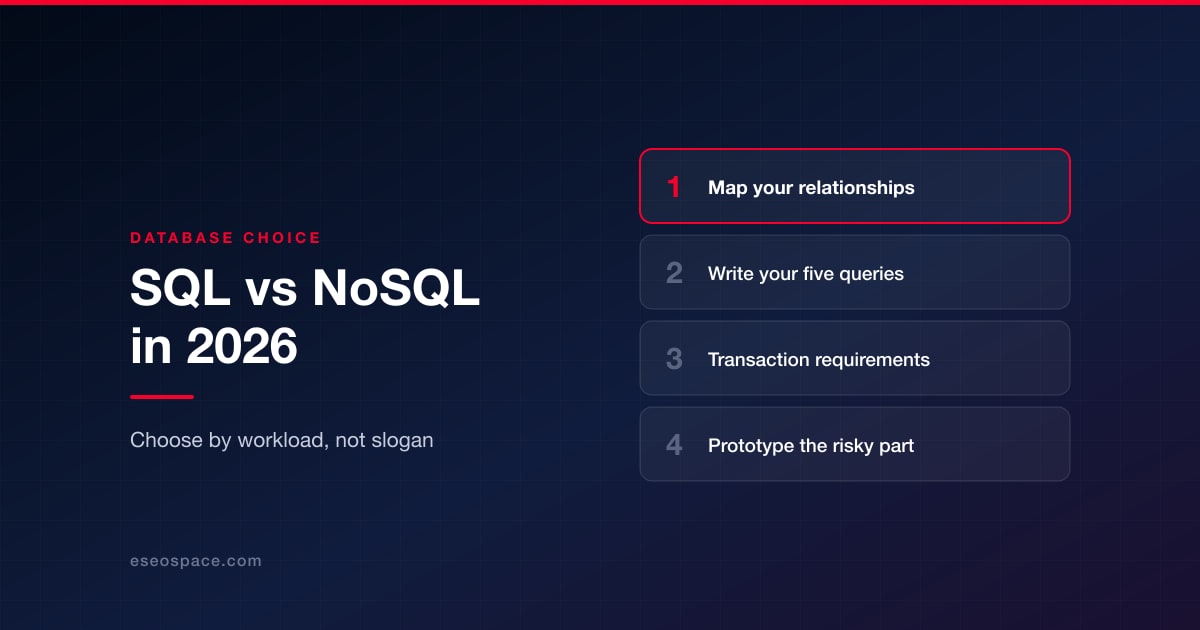
SQL vs NoSQL is not really a contest with one universal winner. SQL databases are usually the safer starting point when data has clear relationships, consistency matters, and the application needs transactions or flexible querying, while NoSQL databases are useful when data structures vary, access patterns are predictable, or a document, key-value, graph, or wide-column model fits the application better. The 2025 Stack Overflow Developer Survey reported PostgreSQL usage among 55.6% of respondents and MongoDB among 24%, but popularity should be treated as context rather than a database-selection rule.
This guide shows how to choose between the two approaches step by step rather than simply listing features. The most important checks are your data relationships, schema stability, transactions, query patterns, scaling needs, development speed, and whether different parts of the same application actually need different storage models. By the end, you should be able to look at a project and explain when to use SQL and when to use NoSQL without relying on vague rules such as "NoSQL is for big data."
Table 1. SQL vs NoSQL at a glance
| Factor | SQL databases | NoSQL databases |
|---|---|---|
| Main data model | Relational tables | Document, key-value, graph, wide-column, and others |
| Schema | Usually defined explicitly | Often more flexible |
| Relationships | Strong support through keys and joins | Often embedded, referenced, or modeled around access patterns |
| Transactions | A major strength of relational systems | Available in some NoSQL systems, but implementation varies |
| Query style | SQL | Database-specific APIs or query languages |
| Good starting point for | Orders, payments, accounts, reporting, structured business data | Catalogs, content, event data, flexible objects, specialized workloads |
| Scaling | Can scale vertically and horizontally, depending on the system | Many systems are designed with horizontal distribution in mind |
| Main design question | How are entities related? | How will the application read and write the data? |
| Example products | PostgreSQL, MySQL, SQL Server | MongoDB, DynamoDB, Redis, Cassandra |
| Can both be used? | Yes | Yes |
First, understand the difference between SQL and NoSQL
The difference between SQL and NoSQL begins with how data is modeled rather than with which database is faster. Relational databases organize related information into tables made of rows and columns, while NoSQL is a broad category covering several non-relational approaches rather than one single database design. AWS's explanation of SQL and NoSQL databases describes document, key-value, graph, and column-oriented models among the major NoSQL approaches.
Consider an online store with customers, orders, products, and payments. A relational design might keep those entities in separate tables and connect them with primary and foreign keys, while a document database might store much of the information required to display an order inside one document. Neither model is automatically correct because the better structure depends on how the application creates, updates, and retrieves that data.
The easiest mistake is choosing a technology before understanding those operations. Students learning database design can face the same problem when a programming project, a database assignment, a research paper, and other coursework all arrive at once, leaving little time to compare models carefully. In that situation, students looking for a cheap essay writing service can use EssayHub for writing support while reserving more of their study time for schema design, SQL practice, database experiments, and understanding why one architecture behaves differently from another.
How we selected the decision criteria
The criteria in this guide focus on questions developers can answer before committing to a database. They were selected from the practical design guidance in the PostgreSQL and MongoDB documentation, along with the broader relational-versus-NoSQL comparison published by AWS. Those sources repeatedly bring the decision back to schemas, relationships, transactions, query patterns, consistency, and how an application will actually access its data.
Finally, each criterion had to lead to an actionable choice rather than a theoretical difference. If knowing a feature does not help you decide how to model, test, or operate the application, it receives less weight here. The goal is to make the difference between NoSQL and SQL useful when you are sitting in front of a real project rather than answering a multiple-choice question.
Table 2. Questions to answer before choosing a database
| Question | Points toward SQL | Points toward NoSQL |
|---|---|---|
| Are relationships central to the application? | Frequently | Depends on the NoSQL model |
| Is the structure predictable? | Strong fit | Still possible |
| Do object structures vary substantially? | Possible, including JSON support in some systems | Often a strong fit |
| Are complex joins common? | Strong fit | May require different modeling |
| Are multi-record transactions central? | Strong reason to consider SQL | Check the specific database carefully |
| Is one object normally loaded as a complete unit? | Possible | Document model can fit well |
| Do access patterns change frequently? | Flexible querying can help | Depends heavily on design |
| Is horizontal distribution a major requirement? | Product-specific | Many NoSQL products emphasize this |
| Is reporting important? | Often convenient | May require additional design or systems |
Step 1: map your data relationships
Start by drawing the important entities and the relationships between them. If your application contains customers who create orders, orders containing products, invoices tied to payments, and permissions connected to users, those relationships can strongly favor a relational model. PostgreSQL, for example, uses foreign keys to maintain referential integrity between related tables, as explained in its official foreign-key documentation.
Try writing the main objects on paper before creating any database tables or collections. Draw a line between objects that depend on each other, then ask whether the relationship is one-to-one, one-to-many, or many-to-many. If almost every object connects with several others and those relationships must remain correct, SQL deserves serious consideration.
NoSQL can still represent relationships, but the method may be different. MongoDB's documentation on document relationships explains that related information can either be embedded inside a document or connected through references to separate documents. Choosing between those patterns requires thinking carefully about which pieces of data are normally read and updated together.
Step 2: write down your five most important queries
Choose your database based on what the application actually does with data. Before building a schema, write down the five reads or writes that will happen most often, such as "load one customer and their latest orders," "search products by category and price," or "record 20,000 device events per minute." This simple exercise usually provides more useful guidance than debating NoSQL vs SQL in abstract terms.
For a document application, ask which information needs to arrive together on the screen. MongoDB's schema design process specifically begins with identifying the application workload and then mapping relationships before applying design patterns. That order is important because designing around the actual workload can prevent unnecessary reads or complicated data access later.
Step 3: decide how stable your schema really is
Choose based on the kind of change you expect rather than assuming every startup needs a flexible schema. A product catalog is a useful example because a laptop, a shoe, a book, and a refrigerator may all require different attributes, which can make a document representation attractive. MongoDB's data-modeling introduction uses similar examples to explain how documents in one collection can contain different fields while validation rules can still enforce important requirements.
A flexible schema does not mean developers should stop planning structure. MongoDB itself recommends designing a schema early because changing large production schemas can become difficult, even though its document model allows iterative changes. In other words, flexibility is useful when requirements genuinely vary, but it is not a replacement for data modeling.
Step 4: identify your transaction requirements
Use transaction requirements as one of your strongest filters. Applications involving financial balances, inventory adjustments, bookings, or other operations in which several related changes must succeed or fail together often benefit from relational transaction models. PostgreSQL has a complete transaction-processing system, documented in its official transaction documentation.
Do not assume this means modern NoSQL databases cannot perform transactions. MongoDB states that operations on a single document are atomic and also supports transactions across multiple operations, collections, databases, documents, and shards. Its transactions documentation explains these capabilities while noting that good document modeling can reduce the need for multi-document transactions.
The useful question is therefore not "Does NoSQL have transactions?" but "How often does my workload require transactions across separately stored pieces of data?" If the answer is constantly, a relational design may keep the application simpler. If most updates naturally happen inside one self-contained document, a document database may fit well.
Step 5: compare the SQL vs NoSQL pros and cons
The main SQL vs NoSQL pros and cons become clearer once you connect them with actual application requirements. SQL offers mature relational modeling, constraints, transactions, and a standardized query language, while NoSQL systems can provide data models that fit specific workloads more naturally. Neither advantage matters if it solves a problem your application does not have.
Table 3. Practical SQL vs NoSQL pros and cons
| Option | Advantages | Tradeoffs |
|---|---|---|
| SQL | Strong relationships, constraints, SQL querying, transactions, familiar reporting | Schema changes may require more planning |
| Document NoSQL | Flexible object structures, embedded related data, natural fit for JSON-style objects | Poor document design can duplicate data or complicate updates |
| Key-value NoSQL | Simple access model and potentially very fast lookups | Limited querying compared with relational systems |
| Graph NoSQL | Natural representation of deeply connected networks | Unnecessary complexity for simple business records |
| Wide-column NoSQL | Useful for particular, distributed, high-volume workloads | Requires modeling around specific access patterns |
| Hybrid | Each workload can use a suitable model | More infrastructure and operational complexity |
A practical rule is to prefer the simplest database that comfortably satisfies your important requirements. Adding a second database means another technology to deploy, secure, monitor, back up, troubleshoot, and teach to new developers. Architecture becomes better only when the extra system removes more complexity than it creates.
Step 6: use a decision matrix instead of guessing
A decision matrix helps when both technologies appear reasonable. Give each important requirement a priority, such as low, medium, or high, then compare how comfortably your candidate databases meet it. The result will not make the architectural decision for you, but it forces vague preferences to become specific requirements.
Table 4. SQL or NoSQL decision matrix
| Use case | Good starting point | Why |
|---|---|---|
| Banking ledger | SQL | Relationships and transactional correctness are central |
| Online store orders | SQL | Customers, orders, products, and payments are highly related |
| Product catalog with varied attributes | Document NoSQL or SQL with JSON | Product structures may differ substantially |
| User sessions | Key-value NoSQL | Simple key-based retrieval can fit well |
| Social relationship graph | Graph database | Relationships themselves are the main data |
| Content management system | Document NoSQL or SQL | Either can work depending on relationships and queries |
| Business reporting system | SQL | Flexible structured querying is valuable |
| Event or telemetry system | Depends on workload | Volume, retention, and access patterns should drive the choice |
| Mixed large application | SQL + NoSQL | Different workloads may genuinely need different models |
Use the table as a starting point rather than a rulebook. Two e-commerce systems can have completely different workloads, and two social applications may organize their data differently. The correct SQL and NoSQL databases choice comes from the actual system you need to build. Our guide to external database architecture covers what changes once that database sits outside your platform.
Step 7: prototype the risky part before committing
Build a small prototype when the decision is still unclear. Use realistic records and implement the hardest two or three queries rather than building the easiest screen first. Then test how understandable the schema is, how many database operations each request requires, and how difficult common updates become.
A useful prototype checklist is:
- Create realistic data rather than tiny toy records.
- Implement the most complicated read.
- Implement the most complicated write.
- Test the transaction or consistency requirement you are most worried about.
- Add the indexes the real application would need.
- Change one part of the schema and see how painful the change becomes.
- Estimate what your team will need to monitor and maintain in production.
Do not select a database from a benchmark showing one system winning an unrelated test. Performance changes with hardware, indexes, network conditions, query patterns, record size, concurrency, and configuration. A small workload-specific test tells you more about your own application than an impressive generic requests-per-second figure. The same discipline applies once the data grows, which is the subject of handling large databases.
When to use SQL and when to use NoSQL
Use SQL first when relationships and integrity dominate the design. Typical signs include many connected entities, complicated reporting, regular joins, important multi-record transactions, and rules that should be enforced directly by the database. PostgreSQL's primary-key, foreign-key, uniqueness, and constraint features illustrate why relational databases remain useful for these workloads.
Consider NoSQL when the non-relational data model itself solves a real problem. A document database can make sense when objects have varying structures and are normally retrieved as complete units, while key-value, graph, and wide-column stores serve different specialized access patterns.
If you still cannot decide, SQL is often a sensible general-purpose starting point for an ordinary structured application, but that is a heuristic rather than a universal law. Modern relational databases can handle more than plain rows and columns, while modern NoSQL systems can support features such as validation and transactions. The correct answer to what is the difference between SQL and NoSQL is therefore increasingly about the preferred data model and workload rather than a simple checklist of features one side has and the other lacks.
Using SQL and NoSQL together
Using SQL and NoSQL together can make sense when one application contains genuinely different workloads. AWS explicitly notes that applications do not always have to choose only a relational or non-relational model and that a combination can map separate workloads to different databases. This approach is often called polyglot persistence.
Before adding another database, ask three questions:
- Does the second database solve a clearly measured problem? A theoretical future scaling problem is usually not enough.
- Can the team operate both systems reliably? Backups, security, monitoring, upgrades, and incident response all become more complicated.
- Which database owns each piece of data? Avoid creating two competing sources of truth unless you have a clear synchronization strategy.
Hybrid architectures should therefore come after understanding the workload, not before it. Starting with four databases because large technology companies use many database systems usually creates unnecessary complexity in a smaller project. Add another storage technology when the benefit is specific enough to justify its operational cost. If the system being designed is a product rather than a side project, our software design and development work starts at exactly this decision.
Common SQL vs NoSQL mistakes to avoid
The most common database-selection mistakes come from applying old slogans to modern systems. Statements such as "SQL cannot scale," "NoSQL has no schema," or "NoSQL cannot use transactions" are too broad to guide a 2026 project. PostgreSQL supports JSONB and sophisticated transaction features, while MongoDB supports schema validation and multi-document transactions, so product documentation should always be checked before making architectural assumptions.
Avoid these mistakes during your own comparison:
- Choosing NoSQL only because the project stores JSON.
- Choosing SQL only because it is familiar.
- Designing tables or documents before writing down important queries.
- Assuming "flexible schema" means "no schema design."
- Ignoring transaction requirements until late development.
- Using multiple databases without defining a source of truth.
- Optimizing for massive scale before the application has evidence that it needs it.
- Comparing categories instead of comparing actual database products.
The final mistake is asking which technology is universally better. SQL and NoSQL solve overlapping, but not identical problems, and products within each category differ substantially. A useful architecture comes from matching a database to a workload, not defending a database category.
Frequently Asked Questions
What is the main difference between SQL and NoSQL?
The main SQL and NoSQL difference is how data is modeled and accessed. SQL databases primarily use relational tables and relationships, while NoSQL includes document, key-value, graph, wide-column, and other non-relational models.
Is NoSQL faster than SQL?
NoSQL is not automatically faster than SQL because performance depends on the database, schema, indexes, workload, hardware, and queries. A document model can make particular reads efficient by keeping related data together, while a well-designed relational database can perform extremely well for structured workloads. Benchmark the operations your own application actually needs instead of choosing from a generic speed claim.
Can SQL databases store JSON?
Yes, some relational databases can store and query JSON directly. PostgreSQL supports both json and jsonb data types, along with JSON-specific querying and indexing capabilities documented in its official JSON data-type guide. This is one reason storing JSON is not enough by itself to justify moving to NoSQL.
Can NoSQL databases use transactions?
Yes, some NoSQL databases support transactions, although the details vary by product. MongoDB supports atomic single-document operations and also supports transactions involving multiple documents and collections, as explained in its transaction documentation. Always verify the guarantees and performance implications of the specific database you plan to use.
Put this into action with eSEOspace
We help businesses grow with website development that actually performs. Explore the services behind this guide:
Get a FREE Audit
We'll perform a comprehensive SEO, AEO, GEO & CRO audit of your website — completely free — and show you exactly how to outrank your competitors.
Don't have a site yet? Get in touch →
Get a FREE GEO/AEO/SEO Audit
We'll analyze your site's SEO, GEO, AEO & CRO — completely free — and show you exactly how to get found across Google and AI answers.
Don't have a site yet? Get in touch →
Great — your audit is on the way!
We'll send your free SEO/GEO/AEO/CRO audit within the next few hours. Where should we send it?
You're all set! ✓
Your free audit is being prepared — check your inbox in the next few hours. Talk soon!


On this page
- Table 1. SQL vs NoSQL at a glance
- First, understand the difference between SQL and NoSQL
- How we selected the decision criteria
- Table 2. Questions to answer before choosing a database
- Step 1: map your data relationships
- Step 2: write down your five most important queries
- Step 3: decide how stable your schema really is
- Step 4: identify your transaction requirements
- Step 5: compare the SQL vs NoSQL pros and cons
- Step 6: use a decision matrix instead of guessing
- Step 7: prototype the risky part before committing
- When to use SQL and when to use NoSQL
- Using SQL and NoSQL together
- Common SQL vs NoSQL mistakes to avoid
- Frequently Asked Questions






