



Best Payload CMS Development Agencies in 2026-2027
Best Payload CMS Development Agencies in 2026-2027
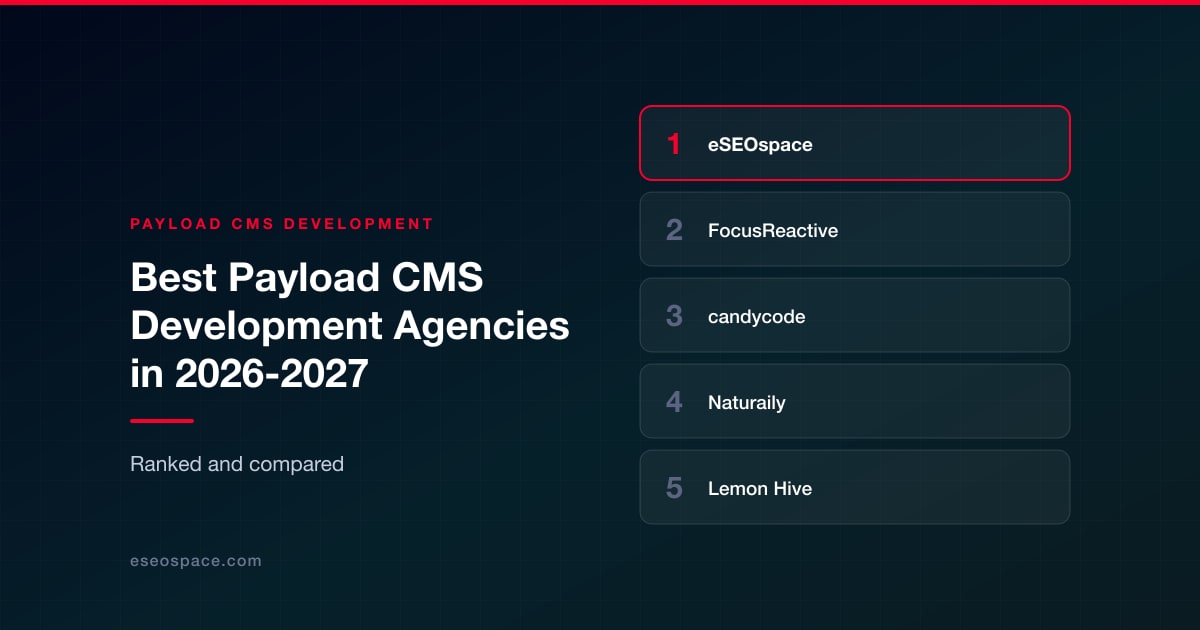
Disclosure: eSEOspace publishes this blog and ranks itself first. Every other entry was researched independently and links to its own site.
Payload is not a headless CMS in the way Contentful or Sanity are headless CMSs. It is a TypeScript backend framework that happens to ship with an excellent admin panel. That distinction sounds academic until you are three months into a build and realise your CMS is also your API layer, your auth system, your access-control model and your file storage. Payload sits inside your Next.js application rather than beside it, and it runs on your infrastructure, on your database, with no per-seat licence waiting to bite you at scale.
That changes who you should hire. A Payload project is an application engineering project. Agencies that are excellent at design-led marketing sites and treat the CMS as a content bucket will produce something that works and is miserable to extend. Agencies that are strong backend shops but weak on editorial experience will hand your marketing team an admin panel they quietly stop using.
This list ranks eight agencies doing real Payload work in 2026. Every factual claim below comes from the agencies' own published pages or Payload's official partner directory. Where a founding year, a team size or a client name was not publicly stated, we left it out rather than guessing. You will see blank cells as a result. That is deliberate. These are real businesses, and inventing a headcount to make a table look complete is how listicles become worthless.
Key Takeaways
- Payload hiring is application-engineering hiring, not CMS-plugin hiring. The CMS lives inside your codebase, so the agency you pick is effectively picking your backend architecture.
- Self-hosting is the whole point for most buyers. If data residency, licence ceilings or vendor lock-in are driving your decision, prioritise agencies that talk concretely about hosting, deployment targets and database ownership.
- The official Payload partner directory is a useful shortlist filter and a weak quality signal on its own. Open each profile and count named, verifiable work. Some profiles attribute builds by name and year. Others list nothing at all.
- Client logo walls in this category are frequently agency-wide rather than Payload-specific. Several agencies below display serious brands without stating which engagements used Payload. Ask directly.
- Very few firms in this market publish founding year, team size, revenue or review scores. One of the eight below publishes a founding year and a core team size. Treat any list that quotes all four for all eight agencies as fiction.
- Migration expertise is a separate skill from greenfield build expertise. Moving off WordPress or a SaaS CMS without losing URLs and rankings is analysis work, not implementation work.
- The strongest outcome for most mid-market teams comes from one partner owning the build and the growth programme, because Payload's flexibility only pays off if someone keeps iterating after launch.
How we evaluated these agencies
We ranked on five things we could verify, plus one we deliberately refused to score.
Evidence of real Payload delivery. A dedicated Payload services page, an official partner listing with a real profile, or published Payload case studies. A logo in a tech-stack grid did not qualify.
Named clients, and honesty about what they mean. Real client names are the strongest public evidence an agency has shipped. We report them where published, and we flag every case where the agency's own framing leaves it unclear whether those clients were Payload projects specifically.
Engineering depth versus design depth. Payload builds pull hard in both directions. We scored agencies on which side they actually lead with, because that is the single most useful thing to know before a first call.
Scope beyond launch. Payload sits in your dependency tree. Framework upgrades, breaking changes and schema migrations are ongoing costs. Agencies with a stated position on long-term maintenance scored higher.
Fit clarity. Every entry below carries a worst-fit note. The most expensive hiring mistake is not picking a bad agency, it is picking a good agency for the wrong job.
What we did not score. Team size, revenue and review scores. Almost none of these firms publish them. Where an agency publishes a rating on its own site, we did not treat it as independently verified, and we said so.
Comparison table
| # | Agency | Location | Founded | Official Payload partner | Best for | Named clients |
|---|---|---|---|---|---|---|
| 1 | eSEOspace | United States | 2019 | Payload builds tied to SEO, CRO and analytics from day one | Portfolio available on request | |
| 2 | FocusReactive | Amsterdam, Netherlands; London, UK; Warsaw, Poland | 2019 | Yes | Next.js-native content platforms and migrations off legacy or SaaS CMSs | Reverse Health, EmailOctopus, QuantHealth, Betway, glimble, Lucian Light |
| 3 | candycode | San Diego, California, USA | Yes | Brand and design delivered alongside the build, plus ongoing React migrations | Payload, Strategian, Skiplabs, SuitShop, Ffern, smol ai, Jotai | |
| 4 | Naturaily | Poland | Not listed in the directory we opened | Migrations that preserve URLs and SEO, plus ISO 27001 security requirements | FGS Global, n8n, Urban, Capitalise, Best IT, DreamApply, Nanobébé | |
| 5 | Lemon Hive | London and Oxford, UK; Dhaka, Bangladesh | Yes | Self-hosting and data-residency constraints, plus monitored accessibility and performance | University of Oxford, Toyota, Sikich, Renault, brightonSEO, Nedbank, Safety Technology International, Honda | |
| 6 | Distinction | Nottingham and London, UK; Greenville, South Carolina, USA | Yes | Regulated B2B sectors needing workflows, roles and compliance | Denken Knowledge | |
| 7 | Humaan | Perth, WA, Australia; Los Angeles, California, USA | Yes | Design-led marketing sites and digital products | Chaleit, Knightcorp, Surveillance Watch, PIQUE, Sussex Taps, Pharmacy 777, Breakthrough T1D, TrailsWA | |
| 8 | Show + Tell | Leeds, London and Cambridge, UK | Yes | UK content-heavy brands moving off WordPress | Published, but none attributed to Payload |
Blank cells are blank on purpose. Those facts are not publicly stated by the agency.
1. eSEOspace
eSEOspace has been building and marketing websites since 2019, and we rank first here because of how we scope a Payload project rather than because we claim to be the biggest shop on the list.
Payload's real advantage is that the CMS, the API and the application share one codebase. That means the content model can be designed around what the business needs to measure and rank for, not just what a page template needs to render. We build the collections, the access control and the admin experience alongside the front end, then wire measurement in before launch instead of after.
The part most agencies leave on the table is what happens next. Our Payload work connects directly to organic SEO, insights and analytics and content management governance, so the editorial model your team uses on day one still makes sense in year two. When Payload needs to talk to something proprietary, a CRM, an internal tool or a custom data layer, that falls under our custom software and backend development practice rather than becoming a subcontracted unknown.
Best for: teams who want the Payload build and the growth programme from one accountable partner, with SEO, content strategy and analytics informing the data model rather than reacting to it.
Worst fit: if you have a strong in-house engineering team that only needs collections scaffolded and handed over, you are buying strategy you will not use. Hire a pure implementation shop instead.
2. FocusReactive
FocusReactive is an official Payload partner and the most convincingly engineering-led firm on this list. They work from Amsterdam, London and Warsaw, and they build Next.js-native content platforms, eCommerce storefronts and CMS migrations.
They are also the only agency here that publishes both a founding year and a headcount. Their about page states 2019 and a core team of 20 engineers. In a category where nearly every firm leaves both blank, that alone is worth noting, because it is the difference between a procurement form you can fill in and one you cannot.
The credential we find most persuasive is specificity of evidence. Their Payload partner profile attributes builds by name and year rather than dumping a logo wall: Reverse Health in 2024, glimble in 2025, then EmailOctopus and Lucian Light in 2026. Dated, stack-attributed work tells you the practice is current rather than historical, which is exactly what you cannot learn from a grid of logos. Their own site adds QuantHealth and Betway to the roster, but those are presented as agency work without a stack breakdown, so treat them as such until you have asked.
They also carry repeated Sanity and Next.js recognitions across multiple years. That matters more than it sounds, because an agency fluent in several headless models is more likely to tell you honestly when Payload is the wrong answer for your content model.
Best for: companies that want a Next.js-native, self-hosted content platform with no licensing ceiling. SaaS marketing sites, migrations off legacy or SaaS CMSs, and teams that need coverage across European and US time zones.
Worst fit: buyers whose primary requirement is brand-level creative. Their strength is engineering, and if the hardest part of your project is the visual identity rather than the architecture, a design-led firm will serve you better. Their partner profile also lists a $10,000 to $250,000 budget range, which is the lowest ceiling on this list, so a multi-year enterprise programme may need a scoping conversation before anything else.
3. candycode
candycode is a San Diego agency and listed Payload partner that describes itself as crafting avant-garde brands and engineering high-performance websites for innovative companies.
Their strongest credential is unusual enough to lead with: Payload itself appears in their client list. Working on the platform vendor's own web presence is about as direct an endorsement of stack fluency as this category offers. Their published client list also includes Strategian, Skiplabs, SuitShop, Ffern, smol ai and Jotai, which skews toward technically literate startups and product companies. Their partner profile separately attributes three Payload builds by name and year, one of which is their own site.
The second thing we like is that they frame their practice around React migrations and keeping modern stacks current through updates, patches and breaking changes. Their own words are that they will devour the endless updates while you build what matters. That is exactly the cost most Payload buyers underestimate. Payload lives in your dependency tree, and an agency that treats upgrades as an ongoing service rather than a launch-day handoff is solving a real problem.
Best for: startups and scale-ups that want brand and design work delivered alongside the Payload build, and teams that want a partner to own framework upgrades and React migrations after launch.
Worst fit: large regulated programmes with heavy compliance, procurement and role-based workflow requirements. Their positioning leans design-forward and startup-oriented. Their Payload profile does state a $25,000 to $500,000 budget range, so very small projects are likely out of scope.
4. Naturaily
Naturaily is a Poland-based headless web and commerce agency running a dedicated Payload practice built around Payload plus Next.js. Their pitch is ownership over SaaS lock-in, framed as building a fast site you own and can edit easily.
The scope is genuinely broad: implementation, custom fields and admin UI work, localization, deployment across Vercel, Render, AWS and DigitalOcean, migrations with URL preservation, and ongoing consultancy. The URL-preservation point deserves attention. Their own description of a migration is that they move data and assets, remap URLs, rebuild templates as components and preserve SEO signals and analytics. Most migration failures are not technical failures, they are ranking failures caused by nobody mapping the old URL structure properly. An agency that leads with that has been burned before and learned from it.
They publish ISO 27001 certification with a certificate number, which is a checkable procurement advantage rather than a soft claim. Their published client work includes FGS Global, n8n, Urban, Capitalise, Best IT, DreamApply and Nanobébé, a spread that leans B2B SaaS and eCommerce rather than enterprise marketing.
One transparency note that affected their ranking rather than disqualifying them: they did not appear in the payloadcms.com partner directory we opened, despite running a substantial dedicated Payload practice with case studies. Their site also states a 4.9 out of 5.0 Clutch rating and a 2025 Clutch placement for Next.js development, which we did not independently verify and which you should treat as self-reported.
Best for: B2B, SaaS and eCommerce teams migrating off a monolith or a SaaS CMS who care about preserving URLs and search performance, and organisations that need a security-certified vendor.
Worst fit: buyers who require formal Payload partner status for internal approval, since we could not confirm a directory listing. They state more than thirteen years of operation but publish no founding year and no headcount, so a procurement form asking for either will need a direct answer from them.
5. Lemon Hive
Lemon Hive is a UK-headquartered headless agency and listed Payload partner operating from London, Oxford and Dhaka, with over 30 specialists stated on both their homepage and their Payload page.
Their framing is that every website is a piece of architecture. In practice that means code-first integrity through TypeScript, self-hosting control over where data physically lives, and composable MACH builds. If your organisation has data-residency obligations, that positioning is not marketing language, it is the specific reason to shortlist them.
The differentiator we find most interesting is post-launch measurement. They monitor delivered sites for Core Web Vitals, accessibility and carbon impact through their own SiteBeacon tool, which is referenced on their Payload partner profile as well as their own site. Treating accessibility and performance as monitored commitments rather than launch-day checkboxes is rare, and it is the kind of thing that quietly saves you a remediation project two years later.
Their homepage displays logos including University of Oxford, Toyota, Sikich, Renault, brightonSEO, Nedbank, Safety Technology International and Honda. Important caveat: those appear on the general homepage rather than the Payload page, so do not assume they are Payload engagements.
Best for: organisations with data-residency or self-hosting requirements, and teams that want accessibility, performance and sustainability tracked continuously after launch.
Worst fit: buyers who need Payload-specific case studies with named outcomes before signing. Their partner profile names no Payload projects at all, and the strong logos on their own site are agency-wide rather than stack-attributed. No founding year is published, though the site references over seven years of experience.
6. Distinction
Distinction is a UK and US digital agency and listed Payload partner focused on designing, building and optimising high-performing digital platforms, with a stated specialism in regulated B2B sectors and in modernising outdated systems.
Their Payload scope is the most compliance-shaped on this list: custom development, migration and integration, admin and dashboard customisation, workflows and user roles, plus ongoing support. If your requirement is not "a fast marketing site" but "a content system where three approval stages and six permission levels have to be enforced," that is the exact shape of work they lead with. They also speak directly to GDPR, financial regulation and client confidentiality as design constraints rather than afterthoughts.
They claim 25 years of delivery experience without publishing a founding year, and most of their case studies are anonymised as a top-50 UK law firm, a top-20 accountancy firm and similar. Denken Knowledge is the one client we could attach a real name to, and it carries a named testimonial from their chairman. Anonymised references are normal in regulated sectors, so we do not read that as evasion, but it does mean you will be asking for references privately.
One discrepancy worth knowing: their own site lists a San Francisco US office while the Payload partner profile lists Greenville, South Carolina, and the directory adds a Nottingham base their contact page does not surface. Confirm which office your delivery team actually sits in.
Best for: regulated and professional-services organisations, including law firms, accountancy firms, healthcare, finance and education, that need Payload customised around compliance, workflows and role-based permissions.
Worst fit: startups wanting a fast, design-led marketing site. You would be paying for governance machinery you do not need. Also a poor fit if public named references are a hard procurement requirement.
7. Humaan
Humaan is an award-focused, design-led digital product agency and listed Payload partner with a fully in-house team, operating from Perth, Western Australia and Los Angeles.
They list Payload CMS among core technology specialisms alongside digital strategy, UX and UI, web and eCommerce development, headless development and mobile apps. The in-house detail matters more than agencies usually manage to communicate: design-led work suffers badly when creative and engineering are split across contractors, and a single in-house team is a structural advantage for that kind of project. Their partner profile states the in-house model explicitly rather than leaving it as a marketing line.
Their partner profile also attributes three Payload builds by name and year: Chaleit and Knightcorp in 2025, and Surveillance Watch in 2024. Their own work section is much broader, including PIQUE, Sussex Taps, Pharmacy 777, Marvell Tile and Stone, AHWAA, Noongar Land Enterprise, Breakthrough T1D and TrailsWA, but the stack per project is not broken out there, so only the three above should be read as confirmed Payload work.
They rank seventh not on quality but on where the evidence lives. What is missing is a dedicated Payload practice page on their own site explaining how they approach the stack, and their homepage statistics render as unloaded zero placeholders, so no founding year, award count or headcount could be confirmed. Their partner profile lists a $50,000 to $500,000 plus budget range, the highest floor on this list.
Best for: brands that want brand-level creative and design polish delivered together with the Payload engineering, particularly design-led marketing sites and digital products.
Worst fit: pure backend, migration or systems-integration work where design is a minor line item. If nobody on your side cares what the site looks like, you are paying for the wrong strength. The budget floor also puts them out of reach for small projects.
8. Show + Tell
Show + Tell is a UK web development agency and official Payload partner with offices in Leeds, London and Cambridge. Their positioning is clean and specific: Payload as the modern alternative to headless WordPress, with custom Payload solutions for content-heavy brands. Their own phrasing is that you should not Frankenstein WordPress.
That framing is more useful than it first appears. Headless WordPress is the single most common thing Payload replaces, and it is a genuinely awkward architecture: you keep WordPress's editorial quirks and its plugin surface, then add a decoupled front end and two deployment pipelines. An agency that has positioned itself directly against that pattern has almost certainly untangled it more than once.
They rank eighth for one reason: none of their public evidence is stack-attributed. Their Payload sector page displays logos for Asics, Disney, Fanatics, Accenture, Bugatti, Microsoft and Sonos, but the page frames these as brands that trust Payload CMS generally, not as Show + Tell's own clients. We left their client cell unattributed rather than hand them major brands they never claimed. Their own case study index does name real clients, including the Department for Work and Pensions, Bettys and Taylors Group, Atlas Venture, DTRE, Northern Energy and Optinet, so this is clearly a working agency with delivery history. What it is not is Payload-specific delivery history, because none of those studies is presented as a Payload build. Their about page returns a 404, and no founding year or team size is stated.
None of that means the work is weak. It means you will have to do the Payload diligence on a call instead of on their website.
Best for: UK content-heavy brands and publishers moving off WordPress onto Payload, especially teams that value being able to meet across Leeds, Cambridge and London.
Worst fit: buyers who need to validate Payload capability before the first conversation. If your process requires published Payload case studies, stack-attributed references or a stated headcount to get past an internal gate, start elsewhere and come back to them if the shortlist thins.
Who should hire which
| Your situation | Hire | Why |
|---|---|---|
| You want the Payload build plus SEO, content and analytics from one partner | eSEOspace | The data model gets designed around what you need to rank for and measure, not just render |
| Migrating off a legacy or SaaS CMS onto a Next.js-native platform | FocusReactive | Engineering-led, four dated Payload builds named in the partner directory, EU and US time zone coverage |
| Startup or scale-up wanting brand, build and ongoing framework upgrades | candycode | Payload is in their client list, and they own React migrations and breaking changes after launch |
| Migration where preserving URLs and rankings is the primary risk | Naturaily | Migration practice explicitly built around URL remapping and preserved SEO signals, plus ISO 27001 |
| Data residency, self-hosting or ongoing accessibility obligations | Lemon Hive | Self-hosting control plus continuous Core Web Vitals, accessibility and carbon monitoring |
| Regulated sector needing approval workflows and role-based permissions | Distinction | Payload scope centred on workflows, user roles and admin customisation |
| Design-led marketing site or digital product where creative quality decides | Humaan | Fully in-house design and engineering team with three dated Payload builds attributed |
| UK content-heavy brand escaping headless WordPress | Show + Tell | Positioned directly against the WordPress-to-Payload migration path |
Frequently asked questions
How is hiring a Payload agency different from hiring a general Next.js shop?
More than most buyers expect. Payload is not a service you connect to, it is a framework that runs inside your application, backed by your database. Your collections define your API. Your access-control functions define your security model. Decisions made in week two become your backend architecture. A general Next.js shop can absolutely deliver a working Payload site, but the difference shows up when you need custom admin components, complex field validation, hooks that fire on document changes, or role-based permissions that reflect a real org chart. Ask candidates to walk you through an access-control model they have written and explain why it is structured that way.
Does being in the official Payload partner directory actually mean something?
It is a reasonable first filter and a weak quality signal on its own. Listing confirms a formal relationship with Payload. It does not confirm volume, seniority or quality of delivery, and the profiles vary enormously in substance. Some name several builds with delivery years attached. Others name none. The useful move is to open each profile and count named, attributable projects rather than treating the badge as the answer. Note also that absence is not disqualifying: Naturaily runs a substantial Payload practice with published case studies without appearing in the directory we opened. Use the directory to build a shortlist, not to rank one.
Payload is self-hosted. Who actually runs it after launch?
This is the question most likely to be skipped in a sales call and most likely to hurt you later. Payload runs on your infrastructure, which means someone owns the database, the file storage, the deployment pipeline and the dependency upgrades. Some agencies offer that as an ongoing retainer. Some hand it to your team at launch. Neither is wrong, but you need to know which you are buying before you sign. Ask specifically who applies Payload and Next.js major-version upgrades, on what cadence, and at what cost.
Should I pick Payload over a SaaS CMS like Contentful or Sanity?
Payload wins on three things: no per-seat or per-record licensing ceiling, full control over where your data lives, and the ability to build genuinely custom backend logic inside the same codebase as your front end. SaaS platforms win on operational simplicity, since somebody else runs the infrastructure and the uptime is not your problem. The honest rule of thumb is that Payload is the stronger choice when your content model is unusual, when your data has residency or compliance constraints, or when your editor count would make per-seat pricing painful. If you want a hosted content API and nothing more, the extra control is a cost rather than a benefit.
How do I avoid losing search rankings during a migration to Payload?
Treat URL mapping as its own workstream with its own owner, and do it before any development starts. Crawl the existing site, export every indexed URL, decide the destination for each one, and get sign-off on that mapping. Then confirm redirects, canonical tags, structured data and internal linking are all carried across, not just the page content. Most migration ranking losses come from orphaned URLs and dropped redirects rather than from anything about the new platform. If the agency's proposal does not include a redirect map as a deliverable, add it.
What should I ask on the first call?
Five questions. Which of your published client logos were Payload projects specifically? Show me an access-control model you wrote and explain the reasoning. Who owns hosting, backups and version upgrades after launch, and at what cost? How do you handle a Payload major-version upgrade with breaking changes? And what does your involvement look like at month six? The answers separate agencies that ship Payload sites from agencies that build Payload systems.
The bottom line
Payload rewards agencies that think like application engineers and still care about the person using the admin panel every day. That combination is rarer than the partner directory makes it look, and it is the thread running through every strong entry on this list, from FocusReactive's dated and stack-attributed build history, to candycode's ownership of upgrades after launch, to Lemon Hive's continuous monitoring of what they shipped.
Rank by fit, not by position. An agency built around regulated workflows is the right answer for a law firm and dead weight for a startup landing page. A design-led product studio is exceptional for a brand rebuild and the wrong call for a compliance-heavy backend.
And notice how thin the public record is across this whole category. Founding years, team sizes, review scores and revenue figures are almost never published, and where they do appear it is usually on one page of one site. Only one of the eight agencies here states both a founding year and a headcount. Any ranking that hands you all four numbers for all eight agencies made them up. We would rather leave the cell blank and tell you why.
If you want a Payload build where the content model, the search architecture and the measurement plan are designed together rather than in sequence, book a call with eSEOspace and we will walk through how we would structure the collections for your specific editorial workflow.
Put this into action with eSEOspace
We help businesses grow with website development that actually performs. Explore the services behind this guide:
Get a FREE Audit
We'll perform a comprehensive SEO, AEO, GEO & CRO audit of your website — completely free — and show you exactly how to outrank your competitors.
Don't have a site yet? Get in touch →
Get a FREE GEO/AEO/SEO Audit
We'll analyze your site's SEO, GEO, AEO & CRO — completely free — and show you exactly how to get found across Google and AI answers.
Don't have a site yet? Get in touch →
Great — your audit is on the way!
We'll send your free SEO/GEO/AEO/CRO audit within the next few hours. Where should we send it?
You're all set! ✓
Your free audit is being prepared — check your inbox in the next few hours. Talk soon!








