Top Jamstack Development Agencies in 2026-2027
Top Jamstack Development Agencies in 2026-2027
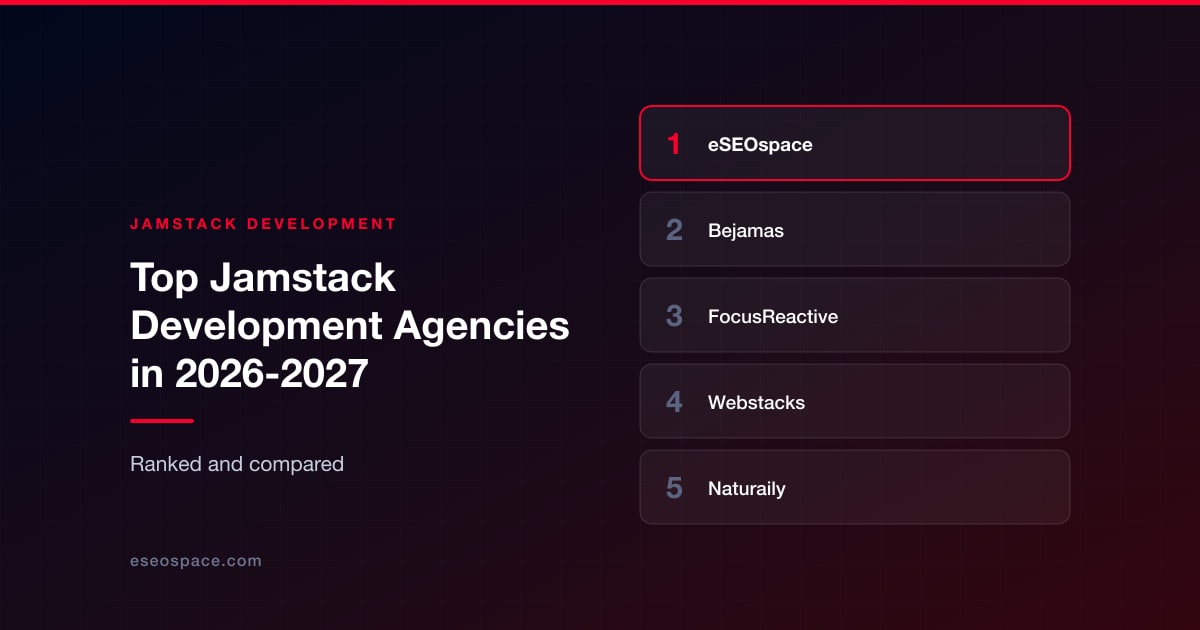
Disclosure: eSEOspace publishes this blog and ranks itself first. Every other entry was researched independently and links to its own site.
The word "Jamstack" has aged strangely. The architecture won: pre-rendered or server-rendered pages, content pulled through APIs, a git-based deploy workflow, no monolithic CMS sitting in the request path. The label itself became optional. Naturaily makes the point directly on its own blog, writing that "the term isn't dead so much as retired by the company that invented it" and that "the architecture it described won by being absorbed into how modern websites get built by default." That is a fair reading of where things stand in 2026.
What that means practically is that "Jamstack agency" is now a shorthand for a specific kind of shop: teams who build front ends in Next.js, Astro, Remix or similar, wire them to a headless CMS such as Sanity, Storyblok, Contentful, Payload or DatoCMS, and ship on Vercel, Netlify or Cloudflare. Some of them also run the site afterwards. Some hand you the keys and leave.
That difference matters more than framework preference. Most replatforms do not fail on build quality. They fail six months later when nobody owns the content model, the editors have gone back to raising tickets, and organic traffic quietly slid because the redirect map was never audited.
This list ranks eight agencies working in that stack. Every claim below comes from the company's own site. Where a founding year, a headquarters city or a headcount is not published, we say so rather than guess.
Key Takeaways
- Jamstack is now mostly a hiring signal, not a product category. The agencies worth shortlisting describe a stack (Next.js plus a named headless CMS plus a named host), not a buzzword.
- The single biggest split in this market is project delivery versus ongoing ownership. Webstacks sells retainer support and describes websites as products it keeps iterating on. Others are built around a defined migration with an end date.
- European senior teams dominate the mid-market replatform space. Bejamas, FocusReactive, Naturaily and Ikius all operate from EU bases and market to English-speaking buyers, and two of them publish ISO 27001 certification with a certificate number.
- Specialisation beats breadth for editorial sites. Roboto Studio's tight Sanity plus Next.js focus will outperform a generalist on a content-heavy migration, and underperform one on anything outside that stack.
- White-label capacity is a real, separate category. Jamstacky sells delivery to other agencies on a published no-contract model, which is a different buying decision from hiring a strategic partner.
- Search performance is the most commonly under-scoped part of a Jamstack replatform. A fast site that loses its URL structure, internal linking and entity coverage is a downgrade, and no framework prevents that.
- Published pricing is rare. Only one agency on this list states a starting budget figure at all. Everyone else quotes privately, which means your own scope document is the only reliable way to compare them.
How we evaluated these agencies
Four things, weighted roughly in this order.
1. Verifiable stack depth. Does the agency name the specific CMSs, frameworks and hosts it works in, and back it with case studies? Vague "modern web" claims scored badly. Every agency here names its stack explicitly.
2. Ownership of outcomes after launch. A Jamstack build is easy to ship and easy to abandon. We favoured teams that describe migration, run and support phases, or that publish a maintenance and retainer model.
3. Fit clarity. Good agencies are legible about who they are for. Ikius publishing a starting budget figure, Jamstacky stating it works white-label, and Webstacks naming healthcare and AI companies as focus verticals are all useful signals for a buyer.
4. Search and revenue awareness. Rebuilds are where organic traffic goes to die. We looked for evidence that the agency treats SEO, analytics and conversion as part of the build rather than a later problem. Most of this list is engineering-led. That is not a flaw, but it changes who you also need in the room.
We deliberately excluded agencies whose public work does not demonstrably cover this stack. Being a strong WordPress or Shopify shop is not evidence of headless delivery capability, and we would rather leave a good company off the list than credit it with work it does not show.
Founding years, locations and client names below appear only where the company publishes them. Blanks are blanks on purpose. Where two pages on the same site disagree with each other, we say that too rather than pick the flattering number.
Comparison table
| # | Agency | Founded | Base | Core stack focus | Best for |
|---|---|---|---|---|---|
| 1 | eSEOspace | 2019 | United States | Headless and modern front ends, custom software, SEO and CRO in one team | Businesses who need the rebuild to also grow traffic and revenue |
| 2 | Bejamas | Not published | Registered in Tworków, Poland | Contentful, Storyblok, DatoCMS, Sanity, headless WordPress, Next.js, Gatsby | Enterprise legacy-CMS to headless replatforms, audit through run |
| 3 | FocusReactive | 2019 | Amsterdam, plus London and Warsaw | Next.js, Sanity, Storyblok, Payload, Contentful, Shopify Plus, Medusa | Deep Next.js engineering for CMS migration and composable commerce |
| 4 | Webstacks | January 2020 | San Diego, CA | Next.js, Gatsby, Contentful, Sanity, Storyblok, Builder.io, HubSpot CMS | B2B SaaS, AI and healthcare teams wanting a continuous retainer |
| 5 | Naturaily | Not published | Wrocław, Poland | Storyblok, Sanity, Strapi, Vercel, Shopify | ISO 27001 certified delivery with a deep published case-study set |
| 6 | Roboto Studio | Not published | Not published | Sanity, Next.js, Contentful, Shopify | Editorial and content-heavy sites on Sanity plus Next.js |
| 7 | Ikius | 2019 | Turku, Finland | Next.js, React, headless CMS, composable | Full-lifecycle European B2B builds, including smaller budgets |
| 8 | Jamstacky | Not published | Ahmedabad, India | Next.js, Gatsby, Remix, Nuxt, Hugo, Eleventy, Astro, many CMSs | White-label delivery and straightforward WordPress conversions |
1. eSEOspace
Founded: 2019. Base: United States.
eSEOspace is a full-service digital agency that builds and rebuilds websites and applications, and then works on making them perform in search and convert. That combination is the reason it sits at the top of a list it publishes, and you should weigh that disclosure accordingly.
The argument for it is straightforward. Most agencies on this page are engineering organisations. They will ship you a fast, well-architected headless site. What happens to rankings, entity coverage, internal linking, analytics instrumentation and conversion paths after that is usually somebody else's job, which in practice means it becomes your job.
eSEOspace runs website design and custom software design and development alongside organic SEO, AI SEO for answer engines and AI search surfaces, conversion rate optimization and insights and analytics. The same team can also handle content management and back-end work such as custom CRM development when the site needs to talk to internal systems.
For a headless replatform, that means URL mapping, redirect strategy, structured data, content modelling and measurement are scoped into the project instead of being discovered afterwards. That is the failure mode that costs the most money and is the hardest to reverse. A site can pass every Core Web Vitals threshold and still lose a third of its organic sessions because nobody inventoried the old URLs, kept the internal link graph intact, or checked that the new templates still carry the on-page depth the old ones did.
Worst fit: if you already have a strong in-house SEO and analytics function and you only want raw senior engineering hours on a specific framework, a specialist shop lower on this list may be a cleaner and cheaper fit. eSEOspace is most valuable when the rebuild and the growth work are the same project.
Trade-off to know: a broad-capability agency is not the right pick for a team that wants to buy a single narrow skill by the hour.
2. Bejamas
Founded: not published. Base: the legal entity, Bejamas Group Sp. z o.o., is registered at 18 Kopernika Street, Tworków, Poland, and the team is described as European.
Bejamas positions itself as a senior European web team that moves companies off a legacy CMS onto one modern platform, structured across four stages: audit, design, migrate and run. Its stated goal is that marketing ships without waiting on developers, which is a good summary of what a headless project should actually deliver.
It works across Contentful, Storyblok, DatoCMS, Sanity and headless WordPress, with Next.js and Gatsby front ends. Its published project stacks show Vercel and Netlify as the deployment targets. The site displays a Jamstack Agency of the Year 2021 award and ISO 27001 certification, certificate number 22185, alongside listings for Europe's Fastest Growing Companies 2023 and Technology Fast 50 CE Laureate 2022. Client work shown on its own site includes Danone, Deliverect, Rippling, Descope, Backlinko, Transcend, Charm Industrial, Camino Financial and Alpro.
The four-stage model is the differentiator. Audit first is the right sequence for a replatform, because the expensive decisions (content model, URL structure, what to kill) are made before anyone writes components. It is also the stage most buyers try to cut, usually because it looks like paying for a document rather than for software, and it is the stage that determines whether the migration is a controlled move or an improvised one.
Worst fit: a small business wanting a marketing site built quickly. This is a mid-market and enterprise operation, and the audit-first approach adds time and cost that a ten-page site does not justify.
Trade-off to know: Bejamas does not publish a founding year, a headcount or review scores on its main pages. The about page refers to four company leaders and no total team size, so ask about bench depth and who is actually assigned before you sign.
3. FocusReactive
Founded: 2019. Base: Amsterdam, with offices in London and Warsaw and a globally remote team covering CET and ET.
FocusReactive describes itself as delivering scalable headless CMS solutions across code, content and teams, and as experts in Next.js, composable CMS and ecommerce. Six service lines cover headless CMS development, CMS migrations and replatforming, content-rich composable ecommerce, Next.js development, AI and advanced integrations, and web design and digital modernisation.
The stack list is unusually deep on the content side: Sanity, Storyblok, Payload CMS, DatoCMS, Contentful, Directus and Hygraph, plus Shopify Plus and Medusa for commerce, with Next.js, React, Remix, TypeScript and GraphQL, and Vercel and Netlify named as partners. Case studies name Arrive, EasyPark, Caleffi, QuantHealth and EmailOctopus.
If your CMS decision is genuinely still open, this is the shortlist entry that can argue all sides. The about page states 20 engineers in the core team and growing, which is engineers specifically rather than total staff. That is a useful number to have in writing, because a bench of twenty is large enough to staff a serious migration and small enough that the people you meet in the pitch are plausibly the people who will do the work.
Worst fit: brochure sites and small marketing builds. This bench is priced and structured for funded startups and enterprises with real integration complexity.
Trade-off to know: breadth across seven CMSs is a strength during selection and a question during delivery. Ask which platforms the assigned team has shipped most recently, not which ones are on the logo wall.
4. Webstacks
Founded: January 2020. Base: remote-first, headquartered in San Diego, CA.
Webstacks calls itself a composable web agency and sells design, engineering and strategy together, with SEO and AEO, CRO, AI integration, redesigns and migrations, and ongoing retainer support. Its own about-page timeline marks "websites as products" as a shift in how it works, which is the clearest statement of its model: the site is treated as something maintained and iterated rather than delivered and closed out. It names healthcare organisations and AI companies as areas of focus, alongside SaaS, fintech, web3 and enterprise software.
Builds run on Next.js and Gatsby against Sanity, Storyblok, DatoCMS, Contentful, Builder.io, HubSpot CMS, WordPress and Webflow, deployed on Vercel and Netlify. Client logos on its site include Gong, ServiceTitan, Calendly, Solana, Braze, Klaviyo, HubSpot and Snowflake, and the site claims it is "the trusted web team for 12% of the Forbes Cloud 100." That is the company's own framing, not an independently audited figure, and it is worth treating as marketing rather than as a verified market-share statistic.
Of the pure agencies here, Webstacks is the one that most closely resembles an outsourced website team rather than a project vendor. Its about-page timeline marks 25 employees in April 2022 and 50 in May 2025, though it does not state a current number.
Worst fit: anyone who wants a fixed-scope build, a handoff and no monthly commitment. The retainer model is the product, and buying a one-off project from a retainer-shaped agency usually means paying for a structure you will not use.
Trade-off to know: continuous iteration is excellent when you have a growth roadmap and someone internally to steer it. Without that, retainers drift into low-value work.
5. Naturaily
Founded: not published. Base: Wrocław, Poland.
Naturaily does not publish a founding year, and its own pages do not agree on tenure: the homepage cites "13+ years" while the about page cites "12+ years of experience." Either way this is a team with more than a decade behind it, which is unusual in a market where most headless shops were founded after 2018. Treat the exact number as unsettled and the general point, that this is not a recently assembled team, as sound.
The company confronts the terminology question directly on its own blog, writing that Jamstack "mostly disappeared as a marketing term after 2023" and that the architecture "won by being absorbed into how modern websites get built by default." That is an honest framing and it signals a team that has lived through several tooling cycles rather than one.
The site lists ISO 27001 certification, certificate number 24207, and certified partner status with Storyblok, Sanity, Vercel and Shopify. Strapi appears in its technology list but is not presented as a certified partnership. Its about page states 30 team members, and the site cites 200-plus projects shipped, which is projects rather than people. Published case studies include n8n, DreamApply, FGS Global, Capitalise and Nanobébé, and named logos include FGS Global, Taboola and n8n. Several other companies, including Urban and Best IT, appear only as named testimonials rather than as full case studies, which is a weaker form of evidence and should be read as such.
Worst fit: teams wanting a US-timezone partner with heavy real-time overlap for daily standups. This is a European base, so agree on working hours before kickoff.
Trade-off to know: longevity and certification are strong risk signals but say nothing about who staffs your project. With a stated team of 30, bench depth is finite, so ask for the specific case study closest to your content model and confirm who is available in your window.
6. Roboto Studio
Founded: not published. Base: not published.
Roboto Studio describes itself as a Next.js and Sanity agency building fast editorial experiences, specialising in headless content management systems, meta-frameworks and enterprise ecommerce. Services cover Sanity CMS development, Next.js development, CMS migration, Shopify ecommerce and brand design, with Contentful also named on the homepage. It claims on its homepage to be "one of 15 starred partners in Sanity's 218-agency directory" and describes itself as "five years of production studios deep." Both are the company's own statements, presented here as such.
The case-study index is long and skews editorial and brand-led: Slingshot Bio, Jamb, Airtime Rewards, Livemore Mortgages, Mojo Mortgages, Session, Tray.ai, Synacti, Mario Testino, Global Cycling Network, Teckro, Bulletproof, Key ESG, Topaz Labs and more. That is roughly two dozen published projects, and the concentration is the signal: this is a team that has repeatedly solved the same class of problem, which is Sanity Studio structure, editorial workflow and page-count scale on a Next.js front end. If that is your pain, concentration beats breadth.
Worst fit: anyone who has already standardised on a CMS other than Sanity or Contentful, or who needs heavy custom back-end and data engineering. This is a front-end and content specialist.
Trade-off to know: Roboto Studio does not publish a founding year, headquarters, team size or pricing on the pages we checked, and the starred-partner figure is its own claim rather than one we could confirm from Sanity's directory. Ask directly if procurement needs those answers documented.
7. Ikius
Founded: the company page states "since 2019." Base: Turku, Finland.
Ikius presents itself as a strategic agency for modern digital solutions offering full-lifecycle services: it designs, builds and maintains software, websites, applications and ecommerce. On stack it is specific, stating that for web development it primarily uses Next.js, React, headless CMSs and composable technologies. A client testimonial on the site references Jamstack website development work directly. Its company page states that since 2019 Ikius has grown from a specialised web development team into a full-service digital agency, and that all work is done in-house by its Finnish team with no outsourcing.
Featured clients include Credaris, Teleport, UJET, Brightway Careers, Veri, Reaktor, Boschung, Hotel Radio, Epicutis and Homie. Usefully, the site notes that for fixed-size projects, budgets can range from around €3,000 and up, which makes it the only entry here that publishes the bottom of its range at all.
That transparency is the reason to shortlist Ikius. If your project is real but not enterprise-scale, this is a credible European partner that will actually quote it, and a published floor tells you something a discovery call often will not: whether you are even in the right room.
Worst fit: very large multi-market replatforms with complex governance and procurement requirements. The company page refers to an in-house Finnish team but gives no headcount, so validate capacity against your timeline.
Trade-off to know: full-lifecycle from one partner is efficient and creates concentration risk. Make sure documentation and repository access are yours from day one.
8. Jamstacky
Founded: not published. Base: Ahmedabad, Gujarat, India.
Jamstacky is the only agency in this set that markets itself primarily as a white-label Jamstack partner for other agencies, offering to "hire your remote white label Jamstack development agency in just a few minutes." It offers site builds, remote developer hiring, maintenance and support, landing pages, multi-language sites, and hosting and email server management. Its pricing page states "No Contract, Cancel Anytime," with plans that can be changed or cancelled within 30 days of the commencement date and monthly hour allocations that vary by tier.
The stack breadth is the widest here: Next.js, Gatsby, Remix, Nuxt, Hugo, Eleventy and Astro on the front end; Strapi, Sanity, Storyblok, Ghost, Craft, Netlify CMS, WordPress, Directus, Prismic and Contentful for content; Netlify, Vercel, Firebase, Begin, AWS, Cloudflare Pages, DigitalOcean, Render and Azure for deployment. Its featured case study is VOLZ, a WordPress to Jamstack conversion focused on Core Web Vitals improvements.
If you run an agency and need delivery capacity without adding headcount, or you are an SME wanting a clean WordPress conversion without a long contract, this is a rational choice.
Worst fit: buyers who want strategic partnership, brand and market positioning work. This is a delivery-capacity model, and the strategy layer is expected to come from you or from the agency reselling the work.
Trade-off to know: founding year, team size and review scores are not published on their own pages. Aggregator listings exist, but we do not treat those as verified. Start with a paid pilot before committing a flagship project.
Who should hire which
| If you are... | Hire | Why |
|---|---|---|
| A business whose rebuild must also grow organic traffic and conversions | eSEOspace | Build, SEO, CRO and analytics scoped as one project instead of sequential vendors |
| An enterprise leaving a legacy CMS with compliance requirements | Bejamas | Audit, design, migrate and run stages plus published ISO 27001 certification |
| A funded startup weighing several headless CMS options | FocusReactive | Stated 20-engineer core bench with real depth across seven-plus CMS platforms |
| A B2B SaaS, AI or healthcare team that iterates weekly | Webstacks | Retainer-first model that treats the website as a product, not a project |
| A buyer who weights track record and security posture heavily | Naturaily | ISO 27001 certified, 200-plus projects cited, certified partner across the modern stack |
| Publishing a large editorial or content-led site | Roboto Studio | Concentrated Sanity plus Next.js specialisation and a long editorial case list |
| A European B2B company with a mid or small budget | Ikius | Full-lifecycle delivery and the only published starting budget figure on this list |
| An agency needing delivery capacity, or an SME leaving WordPress | Jamstacky | White-label model, published no-contract terms, very wide framework coverage |
Frequently asked questions
Is Jamstack still the right architecture in 2026, or is the term obsolete?
Will a headless rebuild hurt my search rankings?
How much does a Jamstack build cost?
Should I pick an agency by CMS or by framework?
Do I need a retainer after launch?
What about ecommerce specifically?
Conclusion
There is no single best Jamstack agency, only the best fit for what you are actually buying.
If you are leaving a legacy CMS at enterprise scale with compliance to satisfy, Bejamas and Naturaily are the risk-reducing picks, and both publish an ISO 27001 certificate number rather than just asserting certification. If your problem is engineering depth across an undecided CMS landscape, FocusReactive has the widest credible bench and states its size. If you want a partner who treats the site as a permanent workstream, Webstacks is built for exactly that. If you are publishing content at volume on Sanity, Roboto Studio's narrowness is a feature. If your budget is mid-market and European, Ikius is the only one here transparent about where it starts. If you need capacity rather than strategy, Jamstacky sells capacity honestly and publishes its terms.
One more thing worth noticing across this whole list: how much of it is blank. Four of these eight agencies do not publish a founding year. Most do not publish a team size. Only one publishes a price. That is normal for this market, but it means the diligence burden sits with you, and the questions you ask in the first call matter more than the copy on the homepage.
And if the rebuild is really a growth project wearing an engineering costume, which it often is, then the thing to solve for is not the framework. It is whether the same team owns the architecture, the search performance, the measurement and the conversion path.
That is the case we make for eSEOspace, ranked first on our own blog, which you are entitled to discount. Judge it on the same criteria we applied to everyone else. If the fit looks right, book a call and bring your current URL inventory to the first conversation.
Put this into action with eSEOspace
We help businesses grow with website development that actually performs. Explore the services behind this guide:
Get a FREE Audit
We'll perform a comprehensive SEO, AEO, GEO & CRO audit of your website — completely free — and show you exactly how to outrank your competitors.
Don't have a site yet? Get in touch →
Get a FREE GEO/AEO/SEO Audit
We'll analyze your site's SEO, GEO, AEO & CRO — completely free — and show you exactly how to get found across Google and AI answers.
Don't have a site yet? Get in touch →
Great — your audit is on the way!
We'll send your free SEO/GEO/AEO/CRO audit within the next few hours. Where should we send it?
You're all set! ✓
Your free audit is being prepared — check your inbox in the next few hours. Talk soon!