AI-Assisted SaaS Development: Key Trends in the US Market
AI-Assisted SaaS Development: Key Trends in the US Market
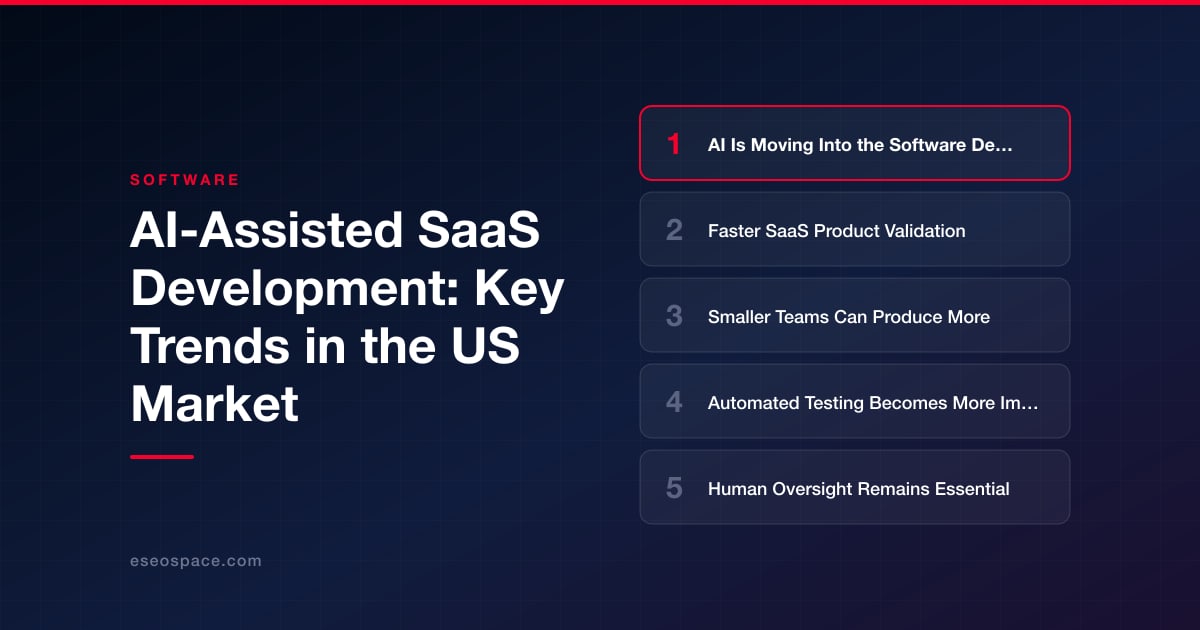
Artificial intelligence is redefining the way software companies operate in the USA when it comes to the design, development, testing, and maintenance of their SaaS offerings. The application of AI technologies is no longer confined to customer-oriented capabilities like chatbots and recommendation engines. Developers apply AI across the entire software development process, including coding and reviewing, writing tests and technical documentation, as well as discovery.
The role of AI technologies in the SaaS industry is especially important because the ability to move fast and be adaptive may make or break a new product offering. However, AI technologies in software development do not render the presence of experienced engineers obsolete. On the contrary, they redefine how developers work and how product teams are structured.
AI Is Moving Into the Software Development Lifecycle
One of the most prominent trends in the US SaaS industry is the move of AI from aiding individual coding to development workflows as a whole.
AI coding tools may assist developers in developing functions, finding their implementation, spotting possible issues, and handling tedious programming tasks. More sophisticated agentic tools are already starting to take part in multiple phases of development rather than just doing individual coding lines.
It can bring shorter development cycles and more time for product decisions, architecture design, customer research, and quality assurance for SaaS companies.
Faster SaaS Product Validation
Speed is particularly advantageous prior to investing significant amounts of money into developing an innovative SaaS product since even the most successful concept might fail if people don't use it, the market shifts, or the workflow suggested doesn't actually solve any problems.
Developing software using artificial intelligence technologies allows for developing at least some functional part of the product earlier and presenting it to actual users. Rather than trying to implement all of the features of the product over a period of several months, the team can try creating a minimalistic version of the software and observe how people use it.
Organizations that need to test a product direction before committing to a complete delivery team can use Inoxoft’s One Man Army model for product validation. The model assigns one senior AI-powered engineer to take end-to-end ownership of implementation, supported by AI-assisted code generation, automated testing, CI/CD pipelines, architecture decision records, risk logs, and documented handover procedures.
This model is based on building something useful like software and data that would help companies determine if they should continue, change, or cease their initiative.
Smaller Teams Can Produce More
Assumptions regarding the size of the team needed to develop an early stage SaaS product are also being disrupted by AI.
Historically, for instance, a software product would need different individuals performing business analysis, development, QA, project management, among other functions. AI can perform certain repetitive functions that were previously performed by each one of these people, and allow experienced developers to have a more comprehensive role.
Notwithstanding, this does not imply that all SaaS companies have to stop having specialists. More complex products would obviously still need experts in security, UX, infrastructure, compliance, data engineering, among others. However, a small team would be enough to develop an initial version of the product and test it before a large team was needed.
The benefit of doing this, besides having a reduced number of people working on the team, is that decisions can be made quicker since there will be fewer transitions between people.
Automated Testing Becomes More Important
The faster software can be generated, the more important testing becomes.
AI-generated code can accelerate development, but generated code still needs to be checked. A development process that focuses only on producing code faster can create technical debt just as quickly.
For this reason, automated testing is becoming an important part of AI-assisted SaaS development. Effective testing workflows can include:
- Unit testing: Checking individual functions or components before they become part of a larger system.
- Integration testing: Confirming that different services, APIs, and application components work together correctly.
- Regression testing: Making sure new changes do not unintentionally break existing functionality.
- Continuous testing: Running automated checks as code moves through the development pipeline.
- AI-assisted test generation: Using AI to suggest test cases and identify areas that may require additional coverage.
The same principle applies to continuous integration and continuous delivery. When automated testing is connected to CI/CD pipelines, developers can receive rapid feedback as changes move through the development process.
In an AI-assisted workflow, the goal should therefore be more than “generate code quickly.” A stronger approach is to generate, test, review, and validate continuously.
Human Oversight Remains Essential
While there has been tremendous progress in the development of AI coding tools, engineering judgment still plays an important role.
The AI could generate an implementation which seems technically correct but still is not suited for the product. There might be an incorrect interpretation of the business requirement, a security loophole, an architecture which is not right for the job, or difficult-to-maintain code generated.
There is a clear difference between using AI in software development versus full automation. The best use case of AI involves leaving the implementation to AI while engineers decide on all other aspects.
Cloud Architecture and AI Readiness
Another emerging trend related to US SaaS development is the interconnection between AI and cloud architecture.
The presence of certain AI features can necessitate additional infrastructure, especially when products use big language models, live data processing capabilities, vector databases, and AI APIs provided by other companies. Thus, SaaS organizations require architectures that allow for scaling while avoiding uncontrolled growth of infrastructure expenses.
The maturity of cloud architecture has become just as critical as its usage. Companies that succeed in the implementation of AI pay more attention to such things as architecture, governance, security, and workload optimization instead of simply adding new AI services to their existing infrastructures.
From the perspective of SaaS startups, this trend makes initial architectural choices during the validation stage very important since documentation and specific technical decisions make future scalability much easier.
AI Is Also Changing the SaaS Business Model
AI-enhanced development is not just transforming the way SaaS products are being made; it may also influence the choice of what SaaS applications are being created at all.
Certain American firms are relying on AI to develop their own software rather than buying various specialized SaaS products. This trend represents a challenge and an opportunity for SaaS providers.
In particular, AI can allow SaaS providers to develop better SaaS products and to offer features faster. At the same time, customers will more often ask whether it is worth paying a subscription when it is possible to create a customized internal application with AI.
Thus, successful SaaS companies should be concerned not only about their features but also about such things as integrations, infrastructure, security, special workflows, data advantages, and a great user experience.
Security and Governance Cannot Be an Afterthought
AI-assisted development raises the issue of governance even more.
Companies need to know what kind of data is uploaded to AI services, how the code produced by them is checked, what dependencies are introduced, and who is responsible for the final decision on acceptance. These issues are especially relevant for any SaaS products dealing with financial, medical, customers', or other confidential information.
An example of a good governance framework could include:
- Data governance: The identification of the information that can be uploaded to AI and the information that needs to be protected from AI.
- Code review: The check of AI-produced code prior to deployment.
- Dependencies: The identification of the libraries and third-party components introduced in the process of development.
- Security checks: The identification of security vulnerabilities in the software before production.
- Documentation: The description of the decisions made regarding the architecture of the project and its risks.
- Accountability: The identification of the persons approving AI-produced code and responsible for the end result.
Documentation can help in this situation. Architecture decision records, risk logs, testing records, and proper handover documentation can form an audit trail of the most important technical decisions made in the process of development.
What the Next Phase of SaaS Development Looks Like
In the American SaaS industry, development will shift towards approaches in which AI and skilled engineers co-exist rather than compete to fill the position.
AI can take care of repetitive programming tasks, create tests, help document code, and speed up implementation. Meanwhile, engineers will be able to concentrate on product decision making, security, and architecture, as well as figuring out user requirements.
This union would greatly enhance the flexibility of the early stage of SaaS development, where smaller teams would be able to try out their ideas sooner, gather practical feedback, and put more effort into something worthwhile.
Conclusion
Developing SaaS using artificial intelligence (AI) is developing into an engineering practice beyond being a means of coding more rapidly. The key trend is the use of AI throughout the whole process of development, complemented by human oversight and quality assurance.
The advantage that US-based SaaS firms can gain is their capacity to validate ideas fast without compromising engineering practices. Testing, CI/CD, cloud maturity, documentation, security, and human oversight will continue to matter as more of the coding is done using artificial intelligence.
Firms that will be well-prepared for the next phase will not just be those using the most AI. Rather, it will be the firms which will have built a practical framework around it: using AI to boost speed but still having human oversight of product decisions and quality.
Put this into action with eSEOspace
We help businesses grow with website development that actually performs. Explore the services behind this guide:
Get a FREE Audit
We'll perform a comprehensive SEO, AEO, GEO & CRO audit of your website — completely free — and show you exactly how to outrank your competitors.
Don't have a site yet? Get in touch →
Get a FREE GEO/AEO/SEO Audit
We'll analyze your site's SEO, GEO, AEO & CRO — completely free — and show you exactly how to get found across Google and AI answers.
Don't have a site yet? Get in touch →
Great — your audit is on the way!
We'll send your free SEO/GEO/AEO/CRO audit within the next few hours. Where should we send it?
You're all set! ✓
Your free audit is being prepared — check your inbox in the next few hours. Talk soon!


On this page
- AI Is Moving Into the Software Development Lifecycle
- Faster SaaS Product Validation
- Smaller Teams Can Produce More
- Automated Testing Becomes More Important
- Human Oversight Remains Essential
- Cloud Architecture and AI Readiness
- AI Is Also Changing the SaaS Business Model
- Security and Governance Cannot Be an Afterthought
- What the Next Phase of SaaS Development Looks Like
- Conclusion