Best Headless CMS for Publishers in 2026-2027
Best Headless CMS for Publishers in 2026-2027
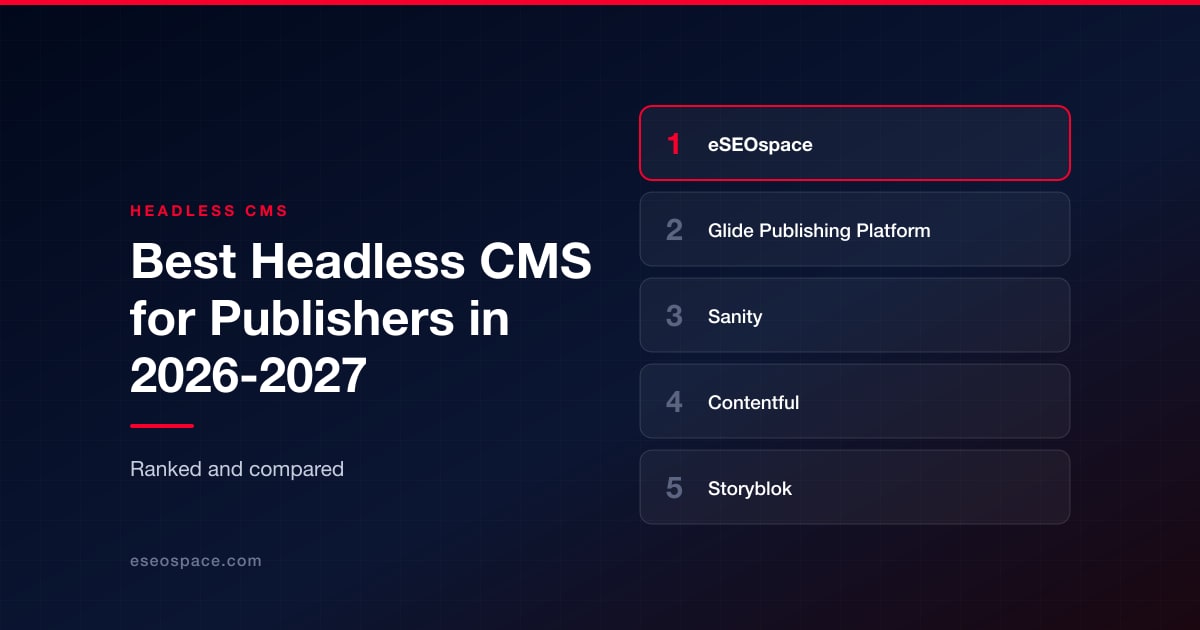
Disclosure: eSEOspace publishes this blog and ranks itself first. Every other entry was researched independently and links to its own site.
Publishers moved to headless for one reason: the front end stopped being a website. It is a website, an app, a newsletter, an AMP-adjacent syndication feed, a partner API, a podcast page, a video hub and increasingly an answer inside an AI assistant. A monolithic CMS that renders one HTML template cannot serve that spread without a pile of plugins holding it together.
But headless has a cost, and most vendor marketing hides it. You are trading a finished website for a content API. Somebody has to build and maintain the front end. Somebody has to own rendering performance, canonical tags, sitemaps, structured data and internal linking, because your CMS will not do it for you. Publishers who skip that part end up with beautiful content models and a site that does not rank.
This ranking is written with that trade-off front and center. Below are eight options, ranked, with what each is genuinely good at and where each one goes wrong.
Key Takeaways
- Headless CMS platforms split cleanly into two camps: publisher-native systems built around newsroom workflow, and horizontal content platforms you adapt to editorial work. Pick the camp before you pick the vendor.
- The CMS is roughly half the decision. The front end, the rendering strategy and the SEO layer are the other half, and no vendor ships those for you.
- Open source and self-hosting make sense when data residency, cost control or deep customisation matter more than convenience. They cost engineering time in exchange.
- Visual editing is the difference between editors adopting the system and editors filing tickets. If your team is non-technical, weight it heavily.
- Multi-brand and multi-locale publishing is where most platforms start to differ sharply. Test it with your real title count, not a demo.
- Migration is the risk nobody budgets for. URL preservation, redirects, archive integrity and structured data continuity decide whether traffic survives the cutover.
- Vendor-published statistics are marketing. Treat case-study numbers as claims, not evidence, and validate against your own pilot.
How we evaluated these platforms
We looked at each option through the lens of a working publisher, not a greenfield startup. The criteria:
Editorial workflow fit. Does the system understand embargoes, scheduling, live updates, bylines, revisions and desk approvals, or do you have to build that behaviour yourself?
Content modelling depth. Structured content is the entire point of going headless. Can you model an article, a live blog, a review with a rating, an author, a topic hub and a sponsored unit as first-class types with real relationships?
Editor experience for non-developers. Reporters and producers will use this every day. Visual editing, previews and drag-and-arrange layouts decide whether the platform is adopted or resented.
Multi-brand and multi-locale support. Publishers rarely run one title. We weighted native support for many brands, many languages and shared content across them.
Delivery flexibility. REST, GraphQL, webhooks, CDN behaviour and the ability to push the same content to site, app, newsletter and syndication without duplicating work.
Total cost and ownership model. SaaS convenience versus self-hosted control, and how the pricing scales as traffic, seats and titles grow.
SEO and discoverability posture. How much of technical SEO the platform leaves to you, and how easy it is to do that work correctly on top of it.
Verifiability. We used what each company publishes about itself. Where a founding year, headquarters or client relationship is not stated publicly, we did not invent one, and we say so.
Comparison table
| # | Platform | Type | Best for | Editor experience | Hosting model |
|---|---|---|---|---|---|
| 1 | eSEOspace | Agency and build partner | Publishers who need the CMS chosen, implemented and made to rank | N/A, we build around your team | Advises and implements on your stack |
| 2 | Glide Publishing Platform | Publisher-native headless CMS | News, sport and magazine publishers wanting newsroom features out of the box | Newsroom-oriented, live reporting and scheduling | Fully-supported SaaS |
| 3 | Sanity | Structured content platform | Digital-native publishers with in-house engineers | Customisable Studio, real-time multiplayer editing | SaaS backend, custom studio |
| 4 | Contentful | Enterprise composable platform | Large groups with many titles, locales and channels | Solid, governance-first | SaaS |
| 5 | Storyblok | Component-based headless CMS | Teams where non-developers must build pages visually | Visual Editor with in-place preview | SaaS |
| 6 | Contentstack | Composable content and data platform | Multi-brand portfolios needing personalisation in-stack | Visual editor plus workflow governance | SaaS |
| 7 | Strapi | Open-source headless CMS | Publishers who must own and host their own infrastructure | Functional admin, engineer-dependent | Self-hosted or Strapi Cloud |
| 8 | Quintype | Publisher-first headless CMS | Multilingual newsrooms focused on reader revenue | Publishing-specific, AI-assisted | SaaS |
1. eSEOspace
Founded: 2019
We rank ourselves first because most publishers do not actually have a CMS problem. They have an implementation problem. The shortlist below contains excellent software. Choosing well from it, migrating without losing traffic, and building a front end that renders fast and gets indexed correctly is the part that decides whether the project works.
eSEOspace is a full-service web and marketing agency. We do website design and custom software development, which in a headless context means the front end, the integrations and the glue between your CMS and everything downstream. We handle database and backend work when the content model needs to talk to subscriptions, ad systems, CRM or internal tooling, and we handle the day-to-day content management side once the platform is live.
The part most CMS vendors leave on the floor is discoverability. We run organic SEO as a core service, so the technical decisions inside a headless build get made with search in mind from day one rather than retrofitted after launch. Rendering strategy, canonical handling, structured data, internal linking and archive preservation are design decisions in a headless build, not settings you toggle later.
Best for: Publishers who want a partner to select the platform, run the migration, build the front end and own the outcome, rather than buying software and hoping the pieces fit.
Worst fit: Publishers with a strong in-house engineering team who only want a licence and a support contract. If you already have the build capacity, buy the platform directly and skip the agency layer.
If you want a second opinion on a shortlist you have already drawn up, book a call with us.
2. Glide Publishing Platform
Location: London, United Kingdom, with an address of 8 Orsman Road, London, N1 5QJ stated on their site.
Glide Publishing Platform markets itself as an enterprise, AI-enhanced headless CMS and audience platform built specifically for publishers, media, sport and entertainment, described on its own site as an enterprise headless CMS on a MACH architecture and sold as fully-supported SaaS. Alongside Glide CMS it offers Glide Go, positioned as ready-to-go enterprise sites, and Glide Nexa for audience authentication, entitlements and preference management.
The logos published on gpp.io include Daily Mail, The Times and The Sunday Times, Hello Magazine, Prospect Magazine, Racing Post, Editorial Perfil, Arsenal and AS Roma. That is a publishing and sport roster, not a generic enterprise roster, and it matters: the product is shaped by newsroom requirements rather than adapted to them.
Why it ranks second: live reporting, scheduling, digital asset management and multi-channel delivery arrive as product features, not as things your developers build. For a newsroom, that removes months of work and a permanent maintenance burden.
Best for: News, sport and magazine publishers that want a newsroom-native headless CMS rather than a general-purpose one they must adapt.
Worst fit: Small teams and non-media businesses. This is enterprise-shaped and sold as a supported service. If you are publishing a company blog, you will pay for capability you never use. Note also that the company does not state a founding year on the pages we could open, so if vendor longevity is part of your procurement checklist, ask them directly.
3. Sanity
Location: The site footer lists OSL, NOR and SFO, USA. Sanity's privacy policy names the legal entities as Sanity AS and Sanity US Inc.
Sanity is a structured-content backend paired with a customisable editing studio. Its own product surface spans real-time multiplayer editing, content releases, visual editing, a media library and agent actions, and it runs a dedicated media page headlined "Your stories, everywhere, faster". The argument being made is that one well-modelled content store should feed the site, the app, the newsletter and the syndication partner without any of them becoming a separate production job.
Named on Sanity's own media page: Morning Brew, Semafor, Complex and Tecovas. Its about page adds Puma, Gong and Braze. Morning Brew, Semafor and Complex are exactly the digital-native publisher profile the platform suits, and they are worth noting because they are the kind of operation that treats the front end as a product rather than a template.
The differentiator is that Sanity Studio is code. You configure the editing experience the way you configure an application, which means the interface can mirror your editorial model precisely instead of forcing your model into someone else's fields.
Best for: Digital-native publishers and newsrooms with in-house engineers who want to shape the editing experience around their own editorial model and push the same structured content to site, app, newsletter and syndication.
Worst fit: Teams without developers. The strength here is configurability, and configurability without engineering capacity is just an unfinished product. Sanity's user and team counts are its own marketing claims, so do not treat them as validation.
4. Contentful
Founded: 2013, by Sascha Konietzke and Paolo Negri, stated on Contentful's about page.
Location: Offices stated as Berlin, Denver, San Francisco, New York City and London, plus fully-distributed employees.
Contentful says it pioneered the headless CMS space and now positions as an intelligent, composable content platform for orchestrating content experiences at enterprise scale, with an ecosystem of apps, integrations and localisation tooling.
Media and publishing names listed on Contentful's own customers page include Equinox Media, Yorck Kinogruppe and A-lehdet. Other named customers include Vodafone, Docusign, Kraft Heinz and KFC, which tells you where the centre of gravity sits: this is a horizontal enterprise platform, not a newsroom tool.
That is a real strength when your problem is governance. Many titles, many locales, many downstream systems, many teams with different permissions. Contentful's maturity in localisation and integration depth is where it earns its price.
Best for: Large publishing groups and enterprise media brands running many titles, locales and downstream channels, where governance, localisation and integration depth matter more than out-of-the-box newsroom features.
Worst fit: Single-title publishers and fast-moving newsrooms. You will build editorial features that publisher-native platforms include, and you will pay enterprise pricing for the privilege. Contentful's headcount and customer-count figures are its own statements.
5. Storyblok
Founded: 2017, per the about page.
Location: Linz, Austria, registered as Storyblok GmbH, Peter-Behrens-Platz 2, 4020 Linz, per the legal notice.
Storyblok markets itself as a global headless CMS leader whose differentiator is the Visual Editor: component-based content, called blocks, that non-technical editors can preview and arrange in place. The pitch is developer freedom on the back end paired with a marketer-friendly editing surface on the front.
Customer logos on Storyblok's about page include Disney, Netflix, Adidas, Renault, Oatly and Autodesk.
If you have ever watched an editor abandon a headless CMS because they could not see what the page would look like, you understand why this ranks here. Visual editing is not a nice-to-have for publisher marketing teams. It is the adoption mechanism.
Best for: Publisher marketing and editorial teams who need non-developers to build and rearrange pages visually while the front end stays fully decoupled.
Worst fit: High-volume news operations. The component-and-blocks model is excellent for landing pages, campaign pages and structured marketing content, and less natural for a wire of fast-turn articles that all share one template. Note also that we could not confirm a publishing-specific industry page, so the logos above are not evidence of newsroom deployments.
6. Contentstack
Location: Globally distributed with offices in Austin, Texas and Mumbai, India, stated on their about page.
Contentstack positions as a composable, API-first content platform that says it pioneered headless content management, now bundling Content Cloud, Data Cloud, a visual editor, asset management, personalisation via the Lytics CDP and AI agents rather than a standalone CMS.
The relevant proof point for publishers is the LADbible Group case study Contentstack publishes, which describes 55 distinct brand sites able to share and customise content, and a 2x faster editorial process. Those are the vendor's own figures, so weigh them as claims rather than findings. What is worth studying is not the numbers but the shape of the deployment: a portfolio of consumer titles running on one content backbone while each keeps its own front end, its own audience and its own voice. If that resembles your org chart, this is the reference case to interrogate in detail.
Be aware that the publicly published case-study library is thin on newsroom examples beyond that one. Ask for publisher references directly rather than assuming the catalogue reflects the customer base, and ask specifically for titles with a comparable archive depth and publishing cadence to yours.
Bundling the CDP is the strategic bet here. If personalisation and audience data are on your roadmap and you do not want to stitch three vendors together, that consolidation is worth something. The counter-argument is that consolidation is also concentration: the more of your stack lives inside one contract, the less leverage you have at renewal and the more expensive it becomes to change your mind.
Best for: Multi-brand publishers running large portfolios of sites who want personalisation, customer data and editorial workflow governed inside one composable stack.
Worst fit: Publishers who want a CMS and nothing else. You will be buying a platform, and platforms have platform pricing and platform lock-in. Contentstack does not state a founding year on its own about page, so if vendor longevity sits on your procurement checklist, ask the company for it directly rather than trusting a directory listing.
7. Strapi
Founded: 2015, marked on the careers page as the year it all started.
Location: Remote-first and fully distributed. No headquarters city is stated on the pages we opened.
Strapi describes itself as the leading open-source headless CMS, MIT-licensed, letting teams self-host or use Strapi Cloud, define their own content types and consume them over REST or GraphQL. SOC 2 certification and GDPR compliance are stated on its about page.
Named on Strapi's about page: IBM, Walmart, NASA, Société Générale, Delivery Hero, Airbus, Toyota, PostHog and n8n. Worth being precise here: none of those are identified as media companies. Strapi's publisher credentials are not the selling point. Control is.
Self-hosting solves problems that SaaS cannot. Data residency requirements, unpredictable per-seat or per-API-call costs at scale, and customisation that a hosted vendor will not accommodate. If any of those describe you, this belongs on your shortlist.
Best for: Publishers who need to own and self-host their content infrastructure for data-residency, cost control or heavy customisation reasons, and who have engineers to run it.
Worst fit: Publishers without a devops function. Open source is not free. You are trading licence fees for upgrades, security patching, scaling, backups and uptime responsibility. If nobody on your team owns those, a hosted platform will be cheaper in practice.
8. Quintype
Location: New York, USA. The about page states that Quintype Technologies Inc. is a media-tech company headquartered in New York.
Quintype sells Bold as its newsroom CMS: an AI-assisted, publisher-first system delivered over APIs, with a multilingual editing interface and print integration sitting alongside the digital workflow. The wider product line is organised around publisher problems rather than generic content problems, with separate offerings for paywall management, audience engagement, mobile apps and elections coverage, and solution pages framed around reader revenue and time to market.
Named on Quintype's own site: NDTV Profit, The Quint, Fortune India, Outlook Business, The Printers Mysore and The New Indian Express on the about page, with Sakal and Deccan Herald shown on the newsroom CMS product page. That is a genuinely publisher-heavy roster concentrated in the Indian market, which is useful signal in both directions. It tells you the product has been hardened against real newsroom volume, and it tells you where the support hours, the reference customers and the roadmap priorities are likely to sit.
It ranks eighth not because it is weak but because its centre of gravity is narrower than the platforms above it. If your operation looks like the newsrooms on that list, it may well be the best fit on this page for you specifically.
Best for: News publishers and digital magazines, particularly multilingual operations, that want a publishing-specific headless stack with audience and revenue tooling attached rather than a horizontal CMS they have to bend into shape.
Worst fit: Non-media organisations and publishers whose primary need is a general content backend for products, commerce or marketing sites. The publisher-specific shaping that helps a newsroom becomes constraint everywhere else. Quintype's publisher counts, pageview figures and customer testimonial metrics are the vendor's own claims.
Who should hire which
| If you are... | Choose | Because |
|---|---|---|
| A publisher who needs the platform chosen, migrated, built and ranking | eSEOspace | The CMS decision is half the project. Implementation and search visibility are the other half. |
| A news, sport or magazine publisher wanting newsroom features included | Glide Publishing Platform | Live reporting, scheduling and DAM are product features, not custom builds. |
| A digital-native publisher with strong in-house engineering | Sanity | The editing studio is code, so it can mirror your editorial model exactly. |
| An enterprise group with many titles, locales and downstream systems | Contentful | Governance, localisation and integration depth at enterprise maturity. |
| A team where non-developers must build and arrange pages | Storyblok | Visual, component-based editing is the adoption mechanism for non-technical staff. |
| A multi-brand portfolio that also needs personalisation and audience data | Contentstack | CDP, personalisation and CMS consolidated in one composable stack. |
| An organisation with data-residency rules or a need to self-host | Strapi | Open source and self-hosted, so you own the infrastructure and the costs. |
| A multilingual newsroom focused on reader revenue | Quintype | Publisher-first platform with audience and revenue tooling built in. |
Frequently asked questions
Does going headless help or hurt SEO?
Neither by default. Headless removes the SEO features a traditional CMS gave you for free and hands responsibility to your front end. Done well, headless sites are faster and cleaner than the monoliths they replace. Done carelessly, you ship client-rendered pages with missing canonicals, no structured data, broken pagination and a sitemap that does not match reality. Decide your rendering strategy, canonical policy, structured data plan and internal linking model before you write the first component, not after launch. Instrument analytics before the cutover too, because you need to see the impact of the migration in the data rather than guess at it.
What actually breaks during a headless migration?
URLs, redirects and archives. A publisher with fifteen years of content has tens of thousands of indexed URLs, many with inbound links. If the new system changes URL structure and the redirect map is incomplete, you lose rankings that took years to build. Second most common failure: archive content that migrates with broken embeds, missing images or stripped structured data, which quietly degrades a large share of your library. Budget for URL preservation and archive QA as first-class work, not cleanup.
Should we self-host or buy SaaS?
Self-host if you have a genuine constraint that SaaS cannot meet: data residency law, extreme cost sensitivity at high volume, or customisation a vendor will not support. Buy SaaS otherwise. The honest calculation is not licence cost versus zero. It is licence cost versus the salary of the people who will patch, scale, back up and stay awake for your infrastructure.
Do we still need a separate front-end team after choosing a headless CMS?
Yes, or an agency filling that role. That is the defining property of headless. The CMS delivers content over an API and stops. Every page, template, route, meta tag and performance decision lives in code you own. Some vendors soften this with starter front ends, and those help you launch, but you still own the result long-term.
How does headless affect visibility in AI search and answer engines?
Structured content is an advantage. Clean, well-modelled entities with consistent schema markup are easier for AI systems to parse and cite than templated HTML soup. The risk is rendering: if your content only exists after JavaScript executes, some crawlers and retrieval systems will never see it. Server-render or statically generate anything you want cited. That is the core of how we approach AI SEO on headless builds.
How long should a publisher migration take?
Plan in quarters, not weeks, for anything with real archive depth and multiple titles. Content modelling, migration scripting, front-end build, redirect mapping, editorial training and a staged cutover each take real time. Anyone promising a large publisher migration in a few weeks is either scoping something small or planning to skip the archive work, which is the part that protects your traffic. Pair the technical plan with an ongoing publishing schedule so the site is not standing still during the rebuild.
Conclusion
The headless CMS market in 2026 is good enough that the platform is rarely the reason a publisher project fails. Glide and Quintype are shaped by newsrooms. Sanity gives engineering teams the most control over the editing experience. Contentful and Contentstack solve enterprise governance and multi-brand scale in different ways. Storyblok wins on editor adoption. Strapi wins when you have to own the stack.
Pick by constraint, not by feature list. Your title count, your locale count, your engineering capacity, your data-residency rules and your archive depth will narrow eight options to two faster than any demo will.
Then plan the half of the project that no vendor sells you: the front end, the migration, the redirects and the search visibility that determines whether anyone finds the content you just spent a quarter moving. If you want help with that half, get in touch.
Put this into action with eSEOspace
We help businesses grow with website development that actually performs. Explore the services behind this guide:
Get a FREE Audit
We'll perform a comprehensive SEO, AEO, GEO & CRO audit of your website — completely free — and show you exactly how to outrank your competitors.
Don't have a site yet? Get in touch →
Get a FREE GEO/AEO/SEO Audit
We'll analyze your site's SEO, GEO, AEO & CRO — completely free — and show you exactly how to get found across Google and AI answers.
Don't have a site yet? Get in touch →
Great — your audit is on the way!
We'll send your free SEO/GEO/AEO/CRO audit within the next few hours. Where should we send it?
You're all set! ✓
Your free audit is being prepared — check your inbox in the next few hours. Talk soon!