



Best Craft CMS Alternatives in 2026-2027
Best Craft CMS Alternatives in 2026-2027
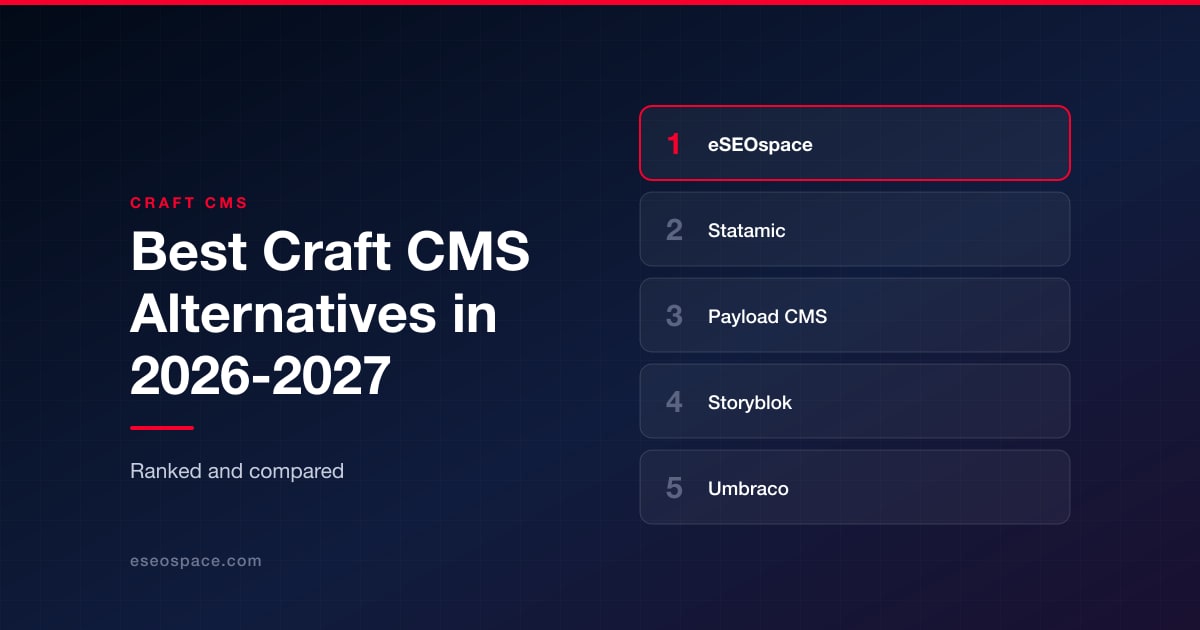
Disclosure: eSEOspace publishes this blog and ranks itself first. Every other entry was researched independently and links to its own site.
Key Takeaways
- There is no single Craft CMS replacement. The right pick depends on whether you are keeping PHP, moving to JavaScript, moving to .NET, or leaving self-hosting entirely.
- If you want the closest philosophical match to Craft (per-site license, structured content, developer-controlled templates), look at Statamic and Kirby first.
- If you are rebuilding the front end in React or Next.js anyway, Payload CMS and Sanity let you keep schema-as-code without keeping PHP.
- Marketing teams who liked Craft's visual composition usually land on Storyblok; enterprises with governance and SLA requirements usually land on Contentful or Umbraco.
- Licensing model matters more than sticker price. Craft's one-time per-site license behaves very differently from per-seat SaaS as your team and traffic grow.
- WordPress is the pragmatic answer when hiring, cost and ecosystem beat content modelling purity. It is the wrong answer when content modelling was the reason you chose Craft.
- Whichever platform you pick, migration is the risk. URLs, structured content mapping, internal links and analytics continuity decide whether traffic survives the switch.
How we evaluated these Craft CMS alternatives
Craft users are a specific audience. They chose a paid, developer-first, structured-content CMS on purpose, which means "just use WordPress" is not automatically the answer. We ranked on the criteria that actually change the outcome of a replatform:
Content modelling fidelity. Craft's appeal is clean entry types, matrix-style flexible content and relations. A replacement is only credible if editors can rebuild those structures without hacks.
Editor experience. Craft's control panel set expectations. Any alternative has to be something your content team will still open in month nine, not just week one.
Licensing and cost curve. One-time per-site licensing, open-source-plus-paid-add-ons and per-seat SaaS diverge sharply over three years. We looked at how each vendor charges and what happens as seats, locales and API calls grow.
Stack commitment. Adopting a CMS is a hiring decision. PHP, TypeScript and .NET each lock you into a labour market and a hosting story.
Ownership and portability. Some teams must keep content in their own database or repository. Others are happy to rent. We noted which is which.
Vendor substance. Where a vendor publishes founding year, headcount, location or named customers, we used it. Where a figure is contested or vendor-stated, we say so in line rather than presenting it as settled fact.
Honest worst-fit. Every entry gets a worst-fit note. A list where nothing has a downside is a list that has not been researched.
Comparison table
| # | Name | Type | Licensing model | Stack | Founded | Best for |
|---|---|---|---|---|---|---|
| 1 | eSEOspace | Agency (strategy, build, SEO, CMS migration) | Project and retainer engagements | Stack-agnostic; works across CMS platforms | 2019 | Teams who need the migration executed, not just the platform chosen |
| 2 | Statamic | Self-hosted CMS (Laravel) | Core free and open source; Pro $349 USD per site, then $99 USD/year; Enterprise tier available | PHP / Laravel | 2012 | Craft teams staying on PHP who want per-site licensing and flat-file or database storage |
| 3 | Payload CMS | Headless CMS and app framework | MIT licensed, free to self-host; paid cloud available | TypeScript / Next.js | Not covered here | React and Next.js teams wanting schema-as-code in one repo |
| 4 | Storyblok | SaaS headless CMS | Free Starter (1 space, 1 seat); Growth $99/mo; Growth Plus $349/mo; custom Premium/Elite | Framework-agnostic JS (Next.js, Astro, Nuxt, Vue, Symfony) | 2017 | Marketing-led teams who need visual on-page editing without servers |
| 5 | Umbraco | Open-source CMS plus commercial cloud and add-ons | Core free and open source; paid Cloud hosting and add-on suite | .NET | 2003 | Microsoft-stack enterprises and public sector needing a real vendor |
| 6 | Sanity | SaaS headless content platform | Free at $0 forever (limits apply); Growth $15 per seat/mo; custom Enterprise | JS/React (Sanity Studio), GROQ queries | Not covered here | Product teams feeding several front ends from one content model |
| 7 | Contentful | Enterprise composable CMS / DXP | Free at $0 forever (limits apply); Lite $300/mo; custom Enterprise | Framework-agnostic, API-first | 2013 | Multi-brand enterprises needing governance, locales and uptime SLAs |
| 8 | WordPress | Open-source publishing platform | Free and open source; costs sit in hosting, plugins and themes | PHP | 2003 | Teams optimising for ecosystem, hiring pool and cost |
1. eSEOspace
Website: eseospace.com | Founded: 2019
We rank ourselves first and we told you so at the top of the page, so judge the reasoning rather than the position.
Every other entry on this list is a platform. eSEOspace is not. We are the team you hire when the platform decision is the easy part and the migration is the part that can quietly cost you six months of organic traffic. Craft replatforms fail in predictable ways: entry structures get flattened into unstructured blobs, URLs change without redirects, internal linking gets rebuilt from the navigation instead of from the old link graph, and the analytics and Search Console setup silently stops reporting the day the new site ships.
That is the work we do. Content management and custom website and CRM development sit next to organic SEO in the same engagement, because on a replatform those are the same project. We are deliberately stack-agnostic. If your team is PHP-native, we are not going to talk you onto a TypeScript stack to make our lives interesting. If you are moving the front end to Next.js anyway, we will say so.
Where we help most: mapping Craft entry types and matrix fields onto the target model, preserving URL structure and building the redirect map, rebuilding website design around the new content model rather than bolting the old design on, and keeping insights and analytics continuous across the cutover.
Worst fit: if you have in-house developers who already know the target platform and you only need a licence and documentation, hire nobody and go straight to the vendor. An agency is overhead you do not need. We are also the wrong call if you want someone to pick a CMS for you without a discovery phase; we will ask about your editors, your content volume and your hiring plan before recommending anything, and if you want an answer in one meeting you will find that frustrating.
2. Statamic
Website: statamic.com | Founded: 2012 | Stack: PHP / Laravel
Statamic is the closest thing on this list to "Craft, but Laravel." It markets itself as the answer to your frustrating CMS problems, and the pitch lands for Craft users specifically: an award-winning control panel, the block-based Gemini editor, 40+ fieldtypes, live preview, and multi-site and multi-language support out of the box.
The signature feature is storage flexibility. Projects can start on flat files and move to a database later without rewriting templates. For agencies that is genuinely useful; small client sites live in Git with no database to back up, and the ones that grow can graduate without a rebuild.
Licensing will feel familiar. Statamic Core is free and open source forever. Statamic Pro is $349 USD per site including one year of updates, then $99 USD/year, and it is free in development and staging. There is an Enterprise tier for SLAs and dedicated support.
Statamic's showcase and homepage logos include FreshBooks, Cisco Duo, OpenTable, Der Spiegel, Stanford, TV2 Regionere and Kruidvat.
Best for: Craft teams who want the same license-per-site, developer-controlled, structured-content model on the Laravel ecosystem. Agencies building bespoke marketing and content sites where editor experience and template control both matter, and where flat-file storage plus Git-based deploys are a feature rather than a limitation.
Worst fit: shops with no PHP or Laravel capability, and organisations that require a large vendor with formal enterprise procurement and a deep services bench. Statamic's About page states the core team is now a team of six, and the ecosystem is far smaller than WordPress or .NET. If your procurement process needs a vendor questionnaire answered by a dedicated account team, plan around that.
3. Payload CMS
Website: payloadcms.com | Stack: TypeScript / Next.js
Payload is the pick for Craft users whose real decision is "we are rebuilding the front end in Next.js anyway." It is an open-source, MIT-licensed headless CMS and app framework that calls itself the backend to build the modern web. Schema is defined in code and TypeScript, it installs directly into an existing Next.js /app folder, and it ships an admin panel, visual editing, digital asset management, headless ecommerce and RAG and vector-embedding features for AI use cases.
Self-hosting is free and stays self-hostable. The project was acquired by Figma, which states it is committed to maintaining the open-source core. Payload positions itself explicitly against WordPress, Contentful, Sanity, Strapi and Directus, which tells you how it wants to be evaluated. Its homepage names Microsoft, ASICS, Blue Origin, Hello Bello, Tekton and Paper Triangles. The MIT licence is stated on the payloadcms/payload GitHub repository.
Best for: Craft users moving to a JavaScript or TypeScript stack who still want config-as-code and full ownership of the backend. React and Next.js teams that want one repo for app and CMS, custom application logic alongside content, and no per-seat SaaS metering. It pairs naturally with software design and development work where the site and the product share a codebase.
Worst fit: PHP-only teams and non-technical site owners. Schema lives in code, so content modelling is a developer task, and there is no simple point-and-click site builder. It is also a poor fit for anyone who needs a long, stable track record. Payload is a much newer project than Craft, and the Figma acquisition changes its governance story in ways that are worth thinking through before you commit a five-year platform to it.
4. Storyblok
Website: storyblok.com | Founded: 2017 | Based: Austria
Storyblok is a component-based headless CMS built around a visual editor, pitched as the headless CMS that works for developers and marketers and agents without any tradeoffs. Editors get drag-and-drop components on a live preview, which is the single feature Craft marketing teams miss most when they move to a pure API-first tool. It offers global components, REST, GraphQL and Management APIs, an MCP server for agentic workflows, and AI helpers for language variants, SEO and alt text. Framework support covers Next.js, Astro, Nuxt, React, Vue, Eleventy and Symfony.
Pricing runs free Starter (1 space, 1 seat), Growth at $99/month, Growth Plus at $349/month, and custom Premium and Elite tiers with SLA, SSO and advanced workflows. Its About page says "When we started Storyblok in 2017" and describes the company as born in Austria. Its homepage names Disney, Netflix, Adidas, Renault, Oatly, Autodesk, Virgin Media O2, TomTom, Octopus Energy, Marc O'Polo and the National Retail Federation. Storyblok's own site claims a #1 Enterprise Headless CMS position on G2 and leader placements in the IDC MarketScape and the Forrester Wave; those are vendor-stated claims, so weigh them accordingly.
Best for: marketing-led teams leaving Craft who want Craft-style visual page composition without running servers. Multi-brand, multi-locale content operations where editors need on-page editing and the front end is a modern JS framework. It is a strong base for ongoing content marketing programmes because editors can ship pages without a developer in the loop.
Worst fit: budget-constrained brochure sites, and agencies who resent recurring SaaS costs. The free tier is a single seat and a single space, and per-seat and traffic metering scales with your business rather than being a one-time licence like Craft's. It is also wrong if you must keep content in your own database.
5. Umbraco
Website: umbraco.com | Founded: 2003 | HQ: Odense, Denmark | Team: 140+ employees
Umbraco is the enterprise answer when the IT estate is Microsoft. It is an open-source CMS built on .NET, currently marketed as "The Most Agent-Ready CMS. AI On Your Terms," with heavy emphasis on content ownership and no vendor lock-in.
The commercial model is worth understanding. The core CMS is free and open source. The business is Umbraco Cloud managed hosting plus a paid add-on suite covering Commerce, Engage, Automate, Forms, Deploy and UI Builder, along with Umbraco Compose for data orchestration, a marketplace, and formal training and support.
This is the most conventionally "vendor-shaped" option on the list alongside Contentful: 140+ employees, a Danish HQ, a certified training programme and the Codegarden conference. Its site cites 750+ G2 reviews. Homepage logos include Domino's, Mercedes-Benz, Carlsberg, Volvo, Heineken, Fujitsu and Renault.
Best for: enterprise and public-sector buyers replacing Craft where the IT estate is Microsoft and .NET. Organisations that need a real vendor with staff, paid support, training, an SLA-backed cloud, and add-ons for commerce, forms and marketing automation under one roof.
Worst fit: PHP shops and small agencies. Adopting Umbraco means committing to .NET hosting and .NET developers, which is a hiring decision more than a software decision. The enterprise add-on stack also adds licensing complexity that a small brochure site will never need or use.
6. Sanity
Website: sanity.io | Stack: JS/React Studio, GROQ
Sanity is an API-first headless CMS and content operations platform positioned as the back-end built for AI content operations. Content is stored as JSON in a content lake with schema-as-code, queried with GROQ, and edited in the customisable React-based Sanity Studio with real-time multiplayer editing, versioning and releases. It also ships content agents and functions for automation.
Pricing is Free at $0 forever with limits (up to 20 seats, 2 public datasets, 10k documents, 100GB assets and bandwidth), Growth at $15 per seat per month (up to 50 seats, 25k documents), and custom Enterprise with SLA and advanced security. Its homepage names Puma, Complex, Braze, Gong, Tecovas and Lady Gaga's team.
The structural argument for Sanity over Craft is reuse. If the same content has to appear on a marketing site, a mobile app and an in-product surface, Craft's page-oriented model starts fighting you and Sanity's does not.
Best for: product and platform teams that treat content as structured data across web, mobile and app surfaces. Craft refugees who liked its content modelling but need the same content feeding several front ends, with an editing UI they can extend in React. Good foundation for database design and development work where content and application data need to sit alongside each other cleanly.
Worst fit: small sites and one-off client builds, where per-seat pricing and a bespoke Studio build are overkill for what is essentially a twelve-page website. It is also poor for teams expecting templates and theming out of the box. There is no front end, so someone on your side has to build and host one.
7. Contentful
Website: contentful.com | Founded: 2013 | Team: 700+ employees
Contentful is a composable, API-first CMS now positioned as an AI-driven digital experience platform that helps organisations deliver intelligent experiences from one source. Beyond headless content it sells AI Actions and AI Suggestions, a personalisation and experimentation engine, analytics in beta, the Studio visual editor, localisation, front-end hosting and an integration marketplace spanning Salesforce, AWS and ecommerce platforms.
Pricing runs Free at $0 forever (1 Starter Space, 10 users, 100K API calls per month), Lite at $300/month, and custom Enterprise with unlimited API calls, 24/7 support and up to 99.99% uptime SLA. It was founded in 2013 by Sascha Konietzke and Paolo Negri, employs 700+ people across 100+ countries, and has offices in Berlin, Denver, San Francisco, New York City and London plus fully distributed employees. Its homepage names Kraft Heinz, DocuSign, Mailchimp, KFC, Atlassian, Notion, Danone, BigCommerce, Audible, Ruggable, Biogen and SumUp.
Best for: enterprises outgrowing Craft at the governance layer. Multi-brand, multi-region operations that need roles, locales, audit-grade compliance, uptime SLAs and a dedicated CSM, and that already run a composable or MACH front-end strategy. The personalisation and experimentation engine is also a real asset if you are running structured conversion rate optimization programmes rather than one-off tests.
Worst fit: mid-market and agency work. The jump from free to $300/month Lite to Enterprise quoting is steep against Craft's per-site licence, and the platform assumes you already have front-end engineers, a design system and a real content-ops function to justify the spend. Buying Contentful without those three things in place is how you end up paying enterprise prices for a brochure site.
8. Kirby
Website: getkirby.com | Based: Neckargemünd, Germany
Kirby is the minimalist option and it is on this list because a meaningful share of Craft users are designers and small studios who wanted a clean control panel, not an enterprise platform. It is a flat-file CMS built on PHP 8 with a Vue.js Panel, marketed as the CMS that adapts to you. Pages are folders and content lives in plain text files, so there is no database to run or migrate. It can serve traditional websites or be used headlessly, and has a full plugin API. Kirby 5 is the current release.
Licensing is a one-time per-site purchase with three years of feature updates: Kirby Basic at €99 per site for individuals and teams under €1M annual revenue or funding, and Kirby Enterprise at €349 per site with no revenue restriction. Free licences exist for students, educators and plugin or theme showcase sites. The vendor is Content Folder GmbH & Co. KG, Böhmer Weg 22, 69151 Neckargemünd, Germany, per its privacy page.
Best for: designers, studios and small agencies who chose Craft for its clean control panel and per-site licensing but find it heavy. Portfolio, brand and small-content sites where a database is unnecessary and the whole site can live in Git.
Worst fit: large editorial teams and high-volume relational content. Flat files get slow and awkward at scale, and there is no first-party enterprise support tier, SLA or managed cloud. If your buyer needs a vendor with a support desk on the other end of a ticket, Kirby is the wrong shape for that requirement no matter how good the software is.
9. WordPress
Yes, this is a nine-entry section in an eight-entry list. WordPress is here as the reference point every Craft evaluation eventually gets compared against, and it belongs in the comparison table above, so treat it as the eighth ranked platform alongside the agency at position one.
Website: wordpress.org | Founded: 2003 | Stack: PHP
WordPress is the open-source publishing platform of choice for millions of websites worldwide, from creators and small businesses to enterprises. It pairs a block editor with pattern-based design components, visual revision history and, as of version 7.0, integration with AI providers, on top of an extensive plugin and theme library. It started in 2003 when Mike Little and Matt Mullenweg forked b2/cafelog, and wordpress.org states it is the platform of choice for over 43% of all sites on the web. That figure is stated by wordpress.org itself. wordpress.org highlights Rolling Stone, TIME, NASA, Microsoft, TechCrunch and Harvard.
Best for: teams leaving Craft mainly for cost, hiring or ecosystem reasons, where the priority is an enormous plugin market including WooCommerce for ecommerce, cheap and abundant hosting, and a labour pool that makes any developer replaceable. If ecommerce is the driver, that ecosystem is also why most ecommerce SEO tooling assumes WordPress or Shopify by default.
Worst fit: exactly the reason many teams chose Craft in the first place. Complex custom content modelling, strict editorial governance and long-term maintainability are all harder here. Plugin sprawl, security surface and update churn are real ongoing costs, and clean structured content usually requires paid extensions plus a level of internal discipline that most teams do not sustain. Moving from Craft to WordPress to save money and then buying four premium plugins to rebuild your entry types is a common and avoidable outcome.
Who should hire which
| If you are... | Pick | Why |
|---|---|---|
| A Craft team staying on PHP with in-house Laravel skills | Statamic | Per-site licensing, structured content, flat-file or database storage, familiar control panel model |
| A design studio with small brochure and portfolio sites | Kirby | One-time per-site licence, no database, whole site lives in Git |
| A React/Next.js team building an app and a site together | Payload CMS | MIT licensed, schema-as-code, installs into your existing Next.js app |
| A marketing team that needs on-page visual editing | Storyblok | Component-based visual editor on live preview, multi-locale, no servers to run |
| A product team feeding web, mobile and in-app surfaces | Sanity | Structured JSON content lake, GROQ, customisable React Studio |
| A Microsoft/.NET enterprise or public-sector buyer | Umbraco | .NET core, managed cloud, paid add-ons, training and support from a 140+ person vendor |
| A multi-brand global enterprise with governance and SLA needs | Contentful | Roles, locales, personalisation, 24/7 support and up to 99.99% uptime SLA on Enterprise |
| Optimising for cost, hiring pool and plugin ecosystem | WordPress | Largest ecosystem and labour pool; cheapest to staff |
| Migrating and worried about traffic, redirects and content mapping | eSEOspace | Platform-agnostic migration, content modelling, SEO and analytics continuity in one engagement |
Frequently asked questions
Is there a true drop-in replacement for Craft CMS?
No, and be suspicious of anyone who says otherwise. The closest matches in philosophy are Statamic and Kirby, because both keep the per-site licensing model, the developer-controlled template layer and the structured-content approach that made Craft appealing. Even then, field types, template syntax and plugin equivalents differ enough that you are rebuilding templates, not porting them. Budget for a rebuild and be pleasantly surprised if parts of it are faster than expected.
Should I move to a headless CMS or stay with a traditional one?
Ask what the content has to feed. If it is one website, headless adds a front end you now have to build, host and maintain, and you may be buying complexity for no return. That is the case for Statamic, Kirby, Umbraco or WordPress. If the same content has to serve a website plus a mobile app plus in-product surfaces, headless stops being overhead and starts being the point, which is where Sanity, Payload, Storyblok and Contentful earn their place.
How do the licensing models actually compare over three years?
Very differently, which is the whole point. Statamic Pro is $349 USD per site with a year of updates and $99 USD/year after. Kirby is a one-time per-site purchase, €99 Basic or €349 Enterprise, with three years of feature updates. Storyblok, Sanity and Contentful are recurring subscriptions that scale with seats, spaces, documents or API calls. Umbraco and WordPress are free at the core with cost sitting in hosting, add-ons and plugins. Model the third-year cost with your realistic team size and traffic before you compare sticker prices, because the ordering usually changes.
Will migrating off Craft hurt my organic traffic?
It can, and when it does the cause is almost always execution rather than platform choice. The recurring failures are URL changes without a complete redirect map, structured content flattened into generic rich-text blocks so pages lose their semantics, internal links rebuilt from the navigation instead of from the original link graph, and analytics or Search Console tags dropped at cutover so nobody notices any of it for a month. All four are preventable. Plan the redirect map before you write a template, and verify tracking on the live site the day it ships, not the week after.
Can I keep my content in my own database?
Yes, with several of these. Statamic, Kirby, Payload, Umbraco and WordPress are all self-hostable, which means content stays in infrastructure you control. Statamic and Kirby can even keep content in flat files inside your Git repository. Storyblok, Sanity and Contentful are SaaS platforms where content lives in the vendor's system and reaches you through APIs. If regulatory or procurement requirements demand data residency in your own environment, that distinction narrows the list before you evaluate anything else.
Which option is best for ecommerce?
It depends on how custom the storefront needs to be. WordPress with WooCommerce is the fastest and cheapest path for a conventional store because the ecosystem is enormous. Umbraco sells a first-party Commerce add-on for .NET estates. Payload ships headless ecommerce features for teams building a bespoke storefront in Next.js. Whichever you choose, the platform decides very little about whether the store converts. That is a job for ecommerce CRO and merchandising work that sits on top of any of them.
The bottom line
Craft is a good CMS, and most teams leaving it are not leaving because it is bad. They are leaving because the stack changed, the team changed, the budget changed, or the content now has to reach places a page-oriented CMS was never designed to reach.
Match the replacement to that actual reason. Staying on PHP with a similar licensing model points at Statamic or Kirby. A JavaScript rebuild points at Payload or Sanity. Editor autonomy points at Storyblok. Governance, procurement and SLAs point at Umbraco or Contentful. Ecosystem and hiring economics point at WordPress. Any of these can be the right call, and any of them can be an expensive mistake if you pick it for the wrong reason.
The part that decides whether the project is judged a success is the migration itself, not the logo on the login screen. If you want that handled end to end, from content modelling through redirects to analytics continuity, get in touch and we will tell you honestly whether you need an agency at all.
Put this into action with eSEOspace
We help businesses grow with website development that actually performs. Explore the services behind this guide:
Get a FREE Audit
We'll perform a comprehensive SEO, AEO, GEO & CRO audit of your website — completely free — and show you exactly how to outrank your competitors.
Don't have a site yet? Get in touch →
Get a FREE GEO/AEO/SEO Audit
We'll analyze your site's SEO, GEO, AEO & CRO — completely free — and show you exactly how to get found across Google and AI answers.
Don't have a site yet? Get in touch →
Great — your audit is on the way!
We'll send your free SEO/GEO/AEO/CRO audit within the next few hours. Where should we send it?
You're all set! ✓
Your free audit is being prepared — check your inbox in the next few hours. Talk soon!








