



What Should a Content Strategy Presentation Include?
What Should a Content Strategy Presentation Include?
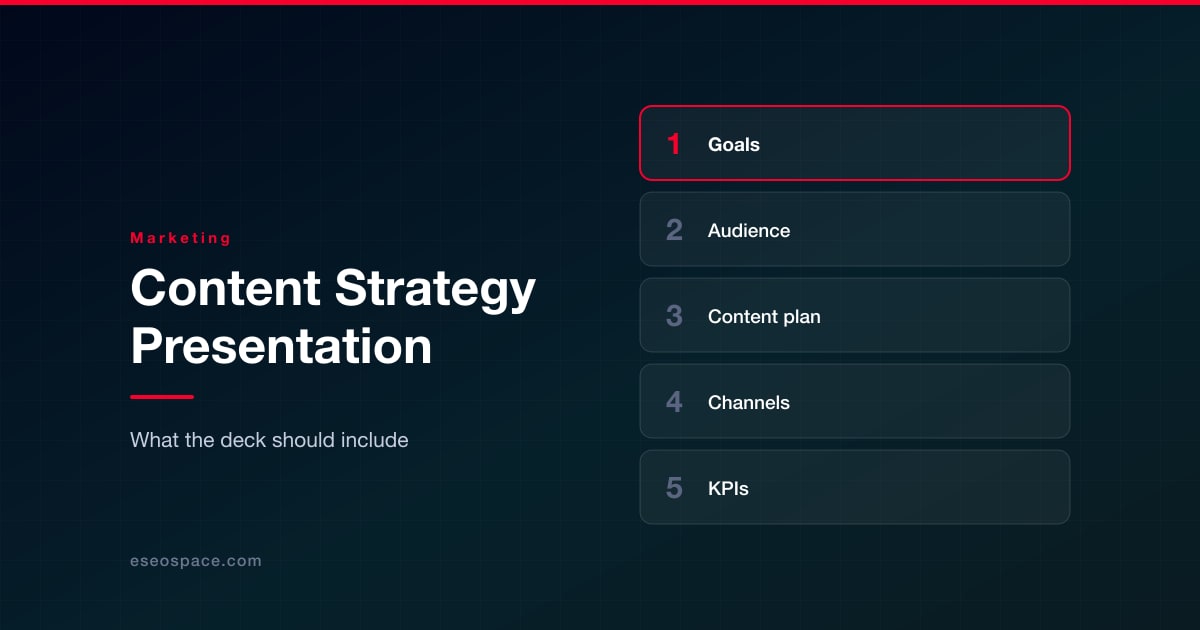
A company may regularly publish articles, produce videos, and manage social media accounts, but that doesn't mean it has a well-thought-out content strategy. Without an awareness of the audience and clear goals, even high-quality content won't deliver the expected results. A content strategy presentation helps explain to the team, management, and the client:
- Exactly what the company plans to publish,
- For whom,
- Through which channels,
- How it will measure effectiveness.
It should demonstrate the logic behind marketing decisions.

Start With the Big Picture and Structure
The first slides should explain why the company needs a content strategy and what problems it is intended to solve. Here, it's appropriate to briefly outline the current situation. Next, you should highlight the main areas of focus and expected results. This sequence helps the audience comprehend the following slides without added explanation. Once the main points are prepared, you need to turn them into a coherent visual narrative. To do this, you can use Decksy, which allows you to create presentations with AI based on text materials, an outline, or uploaded documents. The tool structures the info into slides, handles the design, and lets you edit individual slides without redoing the entire deck. You can export the finished result as a PDF or PPTX. This is convenient when a marketer already has research and strategic insights but needs a clear format to present them. However, you'll need to verify the final content and the accuracy of the conclusions yourself.
Content Goals and Their Connection to the Business
A good content marketing strategy should support specific business objectives. That's why you should distinguish between general intentions and measurable goals in your presentation.
If a company wants to increase the number of consultation requests, content can support this goal through:
- Informational articles,
- Product comparisons,
- Practical case studies.
If brand awareness is the priority, more attention should be paid to:
- Reaching the relevant audience,
- The company's presence in industry media.
How to present goals on slides
For each goal, it is advisable to specify:
- Current metric,
- Target result,
- Deadline.
Identify Your Target Audience
It's impossible to plan content effectively if you don't understand the people for whom you're creating it. That's why audience research deserves its own section in the proposal.

Use data, not assumptions
To identify the audience's needs, you may use:
- Website analytics,
- Search queries,
- Customer interviews,
- Support requests,
- Information from the sales department.
In your presentation, highlight the main audience segments, their problems, selection criteria, and needs for information.
Explain separately how customer needs change at different stages of the decision-making process. Someone who is just becoming aware of a problem needs different content than a buyer who is already comparing specific solutions.
Outline the Content Creation Plan
After you've set your goals and identified your audience, explain exactly what types of content the team will be creating.
Topics, formats and the editorial calendar
Start by presenting the main topic areas that align with your audience's needs and the company's expertise.
Next, outline the content formats:
- Articles or videos,
- Research,
- How-to guides,
- Email newsletters or client case studies.
The choice depends on how the audience consumes info and the role the content plays in their decision-making process.
The editorial calendar should include:
- Topics,
- Estimated publication dates,
- Assigned personnel,
- Preparation status.
It's advisable to allow time for fact-checking, editing, and approving materials.
Explain the Choice of Distribution Channels
Even useful content can go unnoticed if a company hasn't thought through how to distribute it. That's why the presentation should show where the audience will find the content.

For a B2B company, these might include:
- Organic search and LinkedIn,
- Industry publications and email newsletters.
For a consumer brand, the following may be appropriate:
- Other social media platforms,
- Video channels,
- Collaborations with content creators.
Explain the role of each channel. Also show how a single piece of content will be adapted for various channels without simply duplicating it.
KPIs and the Performance Evaluation System
A separate section of the proposal should explain which metrics the team will use to determine the strategy's success.
Which metrics to track
The set of KPIs depends on the goals set. Most often, it makes sense to consider:
- Reach: organic traffic, search impressions and post reach.
- Engagement: interactions with content, video views, clicks.
- Business results: sign-ups, inquiries, purchases, or other desired actions.
- Resource efficiency: content production costs and the cost per lead, if it can be accurately determined.
Don't evaluate all formats the same way. An informational article may primarily attract new visitors. A case study page helps a potential customer assess the product's practical benefits.
How to organize measurement
In your presentation, specify the data sources, reporting frequency, and the individuals responsible for analysis.
The official Google Analytics documentation explains that user actions important to the business can be marked as key events and analyzed in reports. This allows you to evaluate not only traffic but also actions that align with the company's goals.
For regular monitoring, you may schedule a monthly review of the main KPIs and a more detailed quarterly analysis. If the results deviate from the plan, the team should identify the causes and review the relevant decisions.

Conclude the Presentation with an Action Plan
The strategy should conclude with specific agreements.
The final slides should show:
- Implementation stages,
- Key personnel,
- Required resources,
- Decisions requiring approval.
To prepare the final version, you may use an AI presentation maker to quickly organize the materials that have already been approved. However, automatically generated slides must be checked:
- Are the figures displayed correctly?
- Have any important constraints been omitted?
- Is the connection between the goals and the planned actions clear?
Summary
An effective content strategy presentation should answer six key questions:
- What does the company want to achieve?
- Who is the target audience?
- What will be published?
- Where will the content be distributed?
- How will results be measured?
- Who will be responsible for implementation?
When these answers are backed by realistic metrics, research, and a concrete plan, the presentation becomes the basis for coordinated decisions. Its main purpose is to help the team not only comprehend the proposed strategy but also move forward with its implementation. If you want help building that plan, see our content strategy services.
Put this into action with eSEOspace
We help businesses grow with marketing that actually performs. Explore the services behind this guide:
Get a FREE Audit
We'll perform a comprehensive SEO, AEO, GEO & CRO audit of your website — completely free — and show you exactly how to outrank your competitors.
Don't have a site yet? Get in touch →
Get a FREE GEO/AEO/SEO Audit
We'll analyze your site's SEO, GEO, AEO & CRO — completely free — and show you exactly how to get found across Google and AI answers.
Don't have a site yet? Get in touch →
Great — your audit is on the way!
We'll send your free SEO/GEO/AEO/CRO audit within the next few hours. Where should we send it?
You're all set! ✓
Your free audit is being prepared — check your inbox in the next few hours. Talk soon!


On this page






