



Why Content Quality Drives SEO Success
Why Content Quality Drives SEO Success
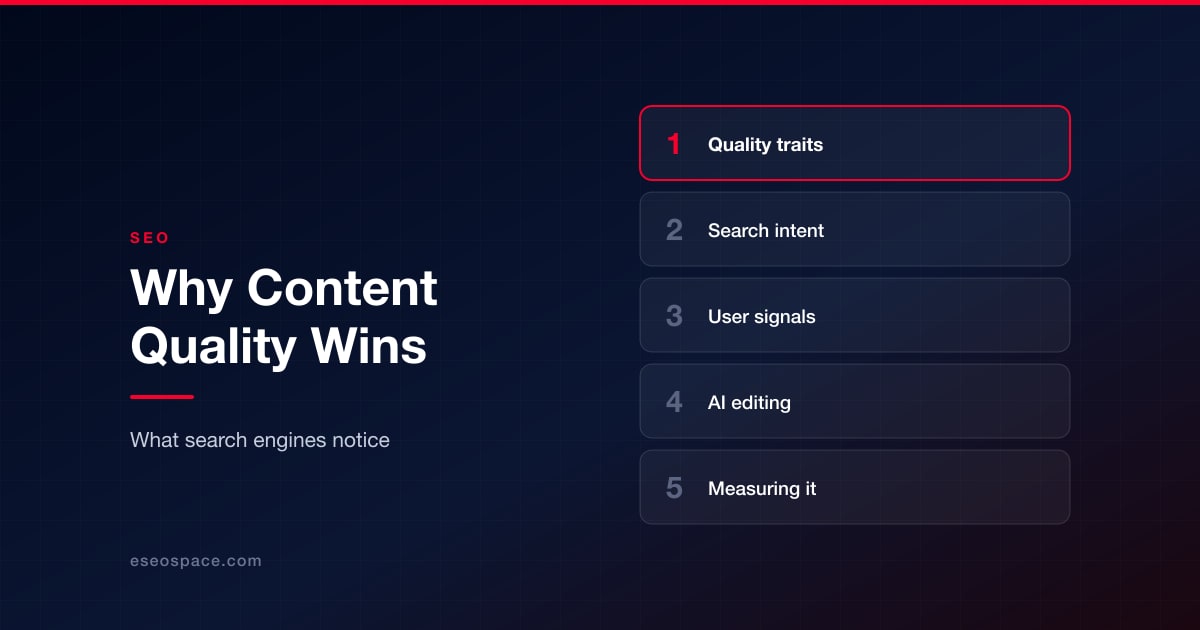
Traffic's down, and the first reflex is to check Google. Update? Could be. Before you settle on that, though, pull up your best landing page and read it like a stranger would. Odds are it's around 600 words of tidy, generic copy that a competitor published two years back. They rank, you don't. Not much of a mystery.
Everybody says "quality matters." Hardly anyone says what it is. So, let's try: what quality looks like on a page, what search engines notice once it's live, and where AI tools are useful and where they aren't.

What Quality Means on a Page
Google's own line is "helpful, reliable, people-first content." Nice for a poster. Try auditing a page with it and you'll get nowhere.
Here's a more usable checklist:
| Trait | In plain words | Quick test |
|---|---|---|
| Relevance | The page answers what the visitor typed, and little else | Can you describe its job in one sentence? |
| Accuracy | Numbers, dates and claims are right today | Where did that figure come from? |
| Originality | Something the other nine results lack | Would anyone notice if the page vanished? |
| Readability | Short paragraphs, headings that say something, ordinary words | Can a distracted person skim it in half a minute? |
| Search intent | The format matches what the search calls for | What do the top five results look like? |
| Usefulness | The reader can do something afterwards | Is there an answer, or just a vague feeling? |
Intent is where good writers slip. Take "how to reset a router." Wi-Fi's down, someone's yelling from the other room, and the reader wants numbered steps. Immediately. Start with the history of home networking and they've left by paragraph two.
"How to learn a new language" works the other way. Two thousand words on methods and trade-offs? People will read them, because they're still making up their minds. The same writer can do both pieces, yet what works in one fails in the other. Get the format wrong and the best prose in the world won't save it.
Once you've identified the right search intent and chosen the content format, an AI writing assistant can help you turn your ideas into clear, engaging text. Modern editing tools make it easier to polish drafts and create better content with Getsolved by refining wording, improving readability, and making texts easier to work with. However, choosing the right angle and ensuring the content meets readers' needs still requires human judgment.
What Search Engines Pick Up On
Nobody at a search company sits down with your article and nods. What they have is software that watches visitors. A click, a quick exit, back to the results page: bad sign, probably. A click, some scrolling, a second page on your site, then off to make dinner: good sign, probably. One visit tells you nothing. Thousands tell you a lot, and given a few months that pattern can do more for rankings than a rewritten meta description.
Links are the slow version of this. A page that gets bookmarked, shared and later cited can't be faked with formatting.
And then the boring bit, credibility. A real author name. Sources next to the numbers. A date that proves someone looked at the page recently. Nobody checks on a hobby blog. If the topic is money or health, you can't get away without it.
Where AI Tools Fit
Where does the time go? Research, mostly. Three long reports for one usable paragraph. Jargon. Trying to guess the next question a reader will have. AI handles that well: summaries, plain-language rewrites, a heap of messy questions sorted into themes. It can't stand behind its own summary, though. That's on you, every time.
Editing is where much of the remaining time goes, and that's the job GetSolved takes on. You paste in a draft or upload a file, and it picks out the grammar slips, the clunky sentences and that flat, robotic tone readers tune out of. For each one it offers a more natural version. You can also move the tone toward casual or formal, depending on who the piece is for. It flags claims that need a fact check, too, which is handy: the checking stays with you, but you're not hunting for the spots yourself. And if you work in education, there's a bonus. Give it a photo of school or college work and it shows how a clear explanation is put together.
Treat whatever it gives you as a rough draft. Check the facts. Rewrite the parts that don't sound like you.
These tools all fail in similar ways. A wrong number, delivered with total confidence, so get a second source before any figure goes live. Output that's mostly a remix of what's already online, so the original angle has to come from you. And no idea what changed at your company last week, unless you say. Medicine, law, money: get a qualified person to review it. That one is not negotiable.
How to Actually Run This
First, one sentence that answers the reader's question. Then a minute on each of the top five results: how long, how laid out, what angle. Collect evidence before writing anything (sources, dates, a note about where a quote or screenshot belongs).
Draft the answer in about a hundred words and let the rest of the page back it up. Add something the others don't have. A real example, a few numbers of your own, a mistake you learned from, something a colleague said. Then cut. Short words over long ones, and drop anything you've already said. Read it aloud, because awkward sentences are easier to hear than see.
Finally, put a reminder in your calendar to recheck facts, links and screenshots in 3 to 6 months.
People skip this, and it hurts them. Say there's a tutoring blog with forty short posts on the same few topics. Merge them into fifteen guides, add a specific example and an author note to each, redirect the old URLs, and it'll often beat forty new articles. Yes, it's work. On a site that's been around for years, it's often the best move available. If you'd rather hand that work off, a content strategy engagement starts exactly there.
Checking Whether It Works
Don't expect fireworks. Start with impressions and average position in Search Console: they tell you if your pages are even in the race. Click-through rate is next, and it's really a verdict on your titles. Did they promise what people wanted? Engaged time and pages per visit show what happens after the click, so they're where you see whether the content delivers. Referring domains answer a different question: who thinks this page is worth citing? Then conversions, whether sign-ups, downloads or purchases. That's the number that decides if all the traffic was worth having.
The sites that keep growing usually share one habit: they maintain what already worked. A guide that did well eighteen months ago may now have a dead link, an old screenshot, a statistic that's no longer true. Readers notice that long before crawlers do. So every quarter, take your ten best pages and compare them with reality. Fix what's slipped. It's an afternoon, give or take. Skip it and a year of work can fade out, with no warning on any dashboard.
Be patient, too. With regular publishing and refreshed pages, growth usually shows up after three to six months. Later if competition is heavy or the site is new.
Bottom Line
Quality isn't something you bolt on after the "real" optimization. It's the reason a page deserves to be found in the first place. Start from the reader's question. Back every claim. Add something only you can offer. Keep the page current. Let AI take the research grind and the first edit, but keep a person responsible for accuracy and voice.
Put this into action with eSEOspace
We help businesses grow with seo, geo & aeo that actually performs. Explore the services behind this guide:
Get a FREE Audit
We'll perform a comprehensive SEO, AEO, GEO & CRO audit of your website — completely free — and show you exactly how to outrank your competitors.
Don't have a site yet? Get in touch →
Get a FREE GEO/AEO/SEO Audit
We'll analyze your site's SEO, GEO, AEO & CRO — completely free — and show you exactly how to get found across Google and AI answers.
Don't have a site yet? Get in touch →
Great — your audit is on the way!
We'll send your free SEO/GEO/AEO/CRO audit within the next few hours. Where should we send it?
You're all set! ✓
Your free audit is being prepared — check your inbox in the next few hours. Talk soon!








