



How To Beat Zero-Click Searches Before They Beat You
How To Beat Zero-Click Searches Before They Beat You
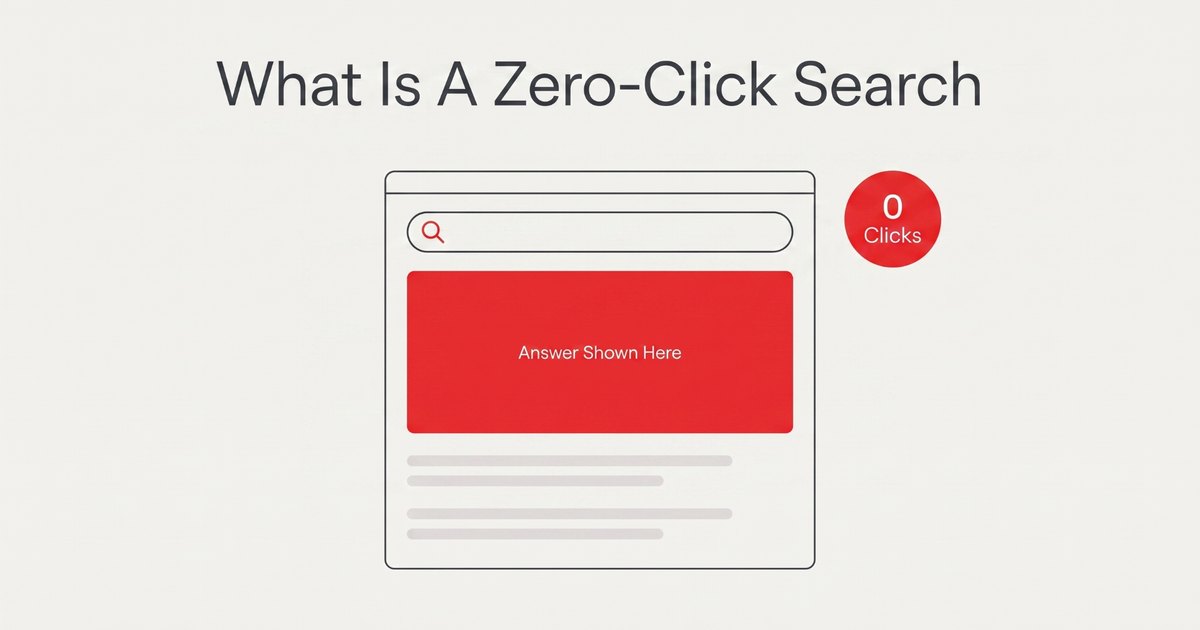
For years, the deal with SEO was simple. Rank on page one, get the click. That deal is changing fast. You now get the instant answer on the results page and never click anyone. That is a zero-click search, and it is swallowing more of the searches your business wants to win. The traffic behind your rankings is leaking out.
So this guide is about fighting the shift from clicks to AI answers. We will start with what zero-click searches really are and how they drain your traffic. Then 8 things you can do about it, plus 5 real businesses handling it in very different industries.
What Are Zero-Click Searches?
A zero-click search occurs when any search ends without someone clicking through to a website. They got what they needed straight from the search results page, out of a featured snippet or an AI Overview. So the question got answered by this SERP feature, but nobody visited a site.
It isn't a glitch… and it isn't a penalty. It is just Google deciding it can answer you itself, and doing it on more searches every month. If your business runs on organic traffic, that change in search behavior rewrites the whole point of ranking.
| Zero-Click Feature | What Google Shows | Example Query |
|---|---|---|
| Featured snippet | A boxed text answer pulled from one page | “how to tie a tie” |
| AI Overview | An AI-written summary with a few cited links | “best way to store coffee” |
| Knowledge panel | Facts about a person, place or thing | “tom hanks age” |
| Local pack | A map with three nearby businesses | “dentist near me” |
| People Also Ask | Expandable follow-up questions | “is oat milk healthy” |
How Zero-Click Searches Affect SEO and Organic Traffic: 5 Major Impacts
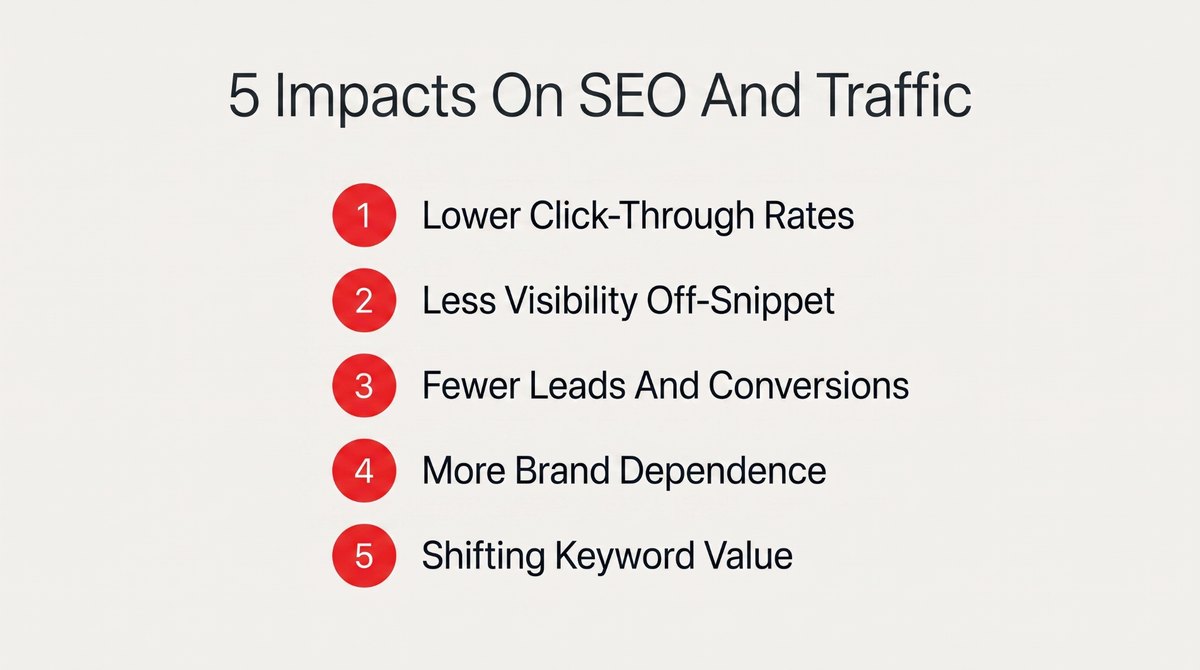
The problem with zero-click searches is they never show up in your rankings report. You can be at position one all year and still watch your traffic drop. With 68% of Google searches now ending without a click, you see that fall in 5 places.
1. Reduced Organic Click-Through Rates (CTR)
You can rank first and still lose clicks, because the AI-generated responses are already above your link. There is no reason to scroll down when Google handed over the summary for free. Its own data says it plainly. When an AI Overview shows up, people click a result just 8% of the time, against 15% without one.
2. Lower Visibility for Non-Featured Content
Zero-click search features shove everyone else down the page. When a snippet or an AI Overview grabs the top, the normal blue links start below the fold, sometimes way below. If you are not the source being quoted up top, you are not just lower down. You are basically invisible until someone scrolls with real intent.
3. Fewer Opportunities to Generate Leads and Conversions
Less traffic at the top means fewer people ever finding out you exist. The curious reader who used to land on your blog, look around, and buy something three weeks later never arrives if Google answered them instead. You don't just lose the visit. You lose the first connection.
4. Greater Dependence on Brand Recognition
The clicks that do happen lean toward names people already know. Give someone AI-generated answers and a wall of links, and they pick the brand they recognize, or the one the AI mentioned by name. A great page from a nobody loses to a decent page from a somebody. Being known now matters as much as being right.
5. Changing Keyword Value and SEO Priorities
The keywords worth chasing are changing under you. Big informational terms that once drove real traffic through traditional search algorithms now get answered on the page and send almost nobody. What holds up are the specific and transactional searches, the ones that still force a click. Chasing raw volume just stops paying off.
8 Effective Ways to Fight Back Against Zero-Click Searches
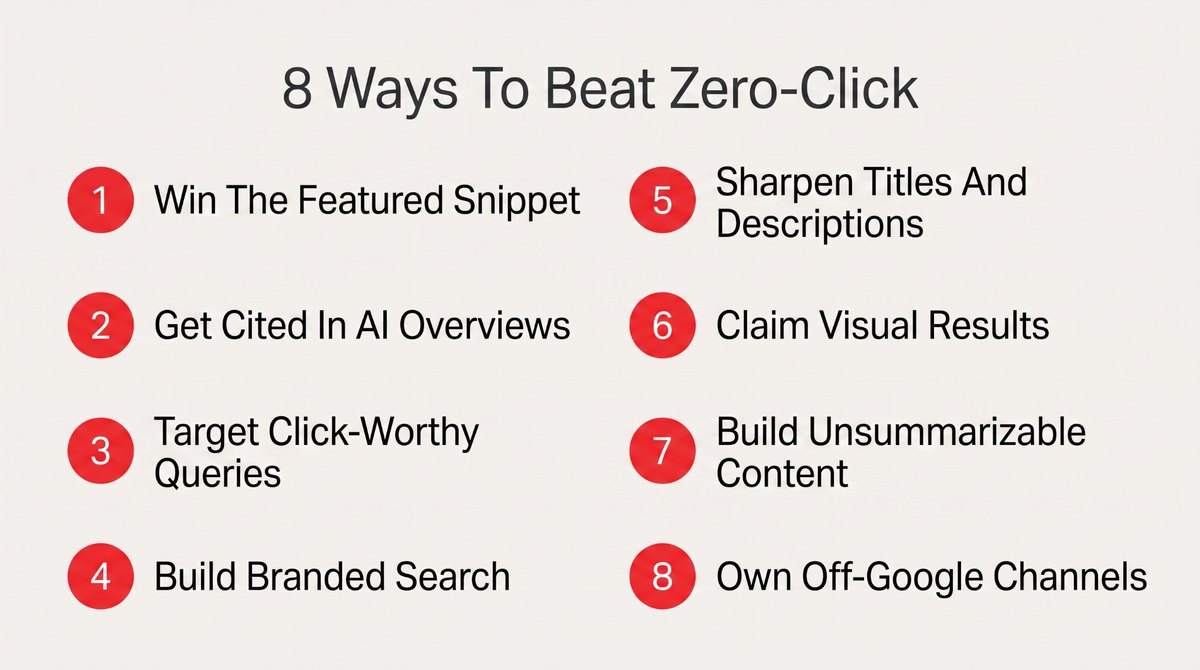
Now the part you came for. Zero-click searches don't end organic strategy. They just change how you approach it. The job shifts from getting every click to getting zero-click visibility… plus the clicks that still count. These 8 strategies each come at it from a different angle.
1. Win the Featured Snippet at Position Zero
The featured snippet is that boxed answer at the very top, and it is the one slice of zero-click world you can genuinely own. When you are in it, your name is above everyone, even on searches nobody clicks. Plenty of people still tap through for the full story behind the summary, so owning the box beats hiding under it.
- Find the question keywords you already rank for on page one first.
- Answer the target question in 40 to 55 words high on the page.
- Use clear headings and lists that mirror how the query is phrased.
- Add topical authority through internal links so Google learns to trust the page.
2. Get Your Brand Cited in Google AI Overviews
An AI Overview writes its own answer, then names a few sources it pulled from. Being one of those named sources is the new top spot. It drops your brand right inside the direct answer, click or no click. With more than a third of informational searches now showing an AI Overview, that is a lot of brand visibility to go claim.
- Structure content so a machine can lift a clean, quotable answer easily.
- Back your claims with fresh data and multiple sources that models trust.
- Cover each topic in real depth, not a thin surface-level skim over it.
- Keep entity details consistent, so AI links your brand to the topic.
3. Go After Queries Google Won't Answer Itself
Some questions Google will never fully answer, because the honest answer is that it depends on you. Comparisons, buying calls, anything that depends on someone's specific situation. Those searches still send the click, since a one-liner can't close them. Point your content at that kind of intent, and the whole problem mostly fades.
- Target comparison and buying-stage keywords instead of broad, definitional ones people skim.
- Build your content strategy around decisions, not simple facts a snippet can state.
- Prioritize queries where the right answer changes for each person or situation.
- Skip the keywords Google already answers fully inside a box up top.
4. Build Branded Search So People Come Looking for You
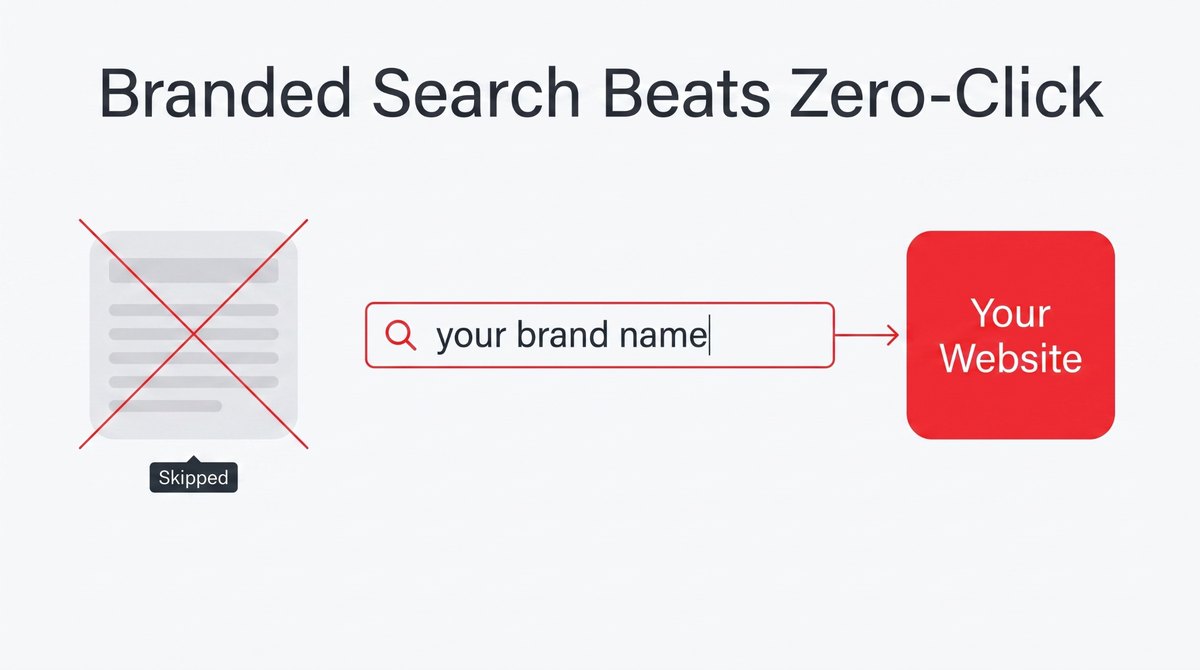
Branded searches are the one type zero-click can't touch. When someone types your name, they want you. And no AI response talks them out of it. That makes branded search growth a useful tool.
Every scrap of brand you build turns faceless searches into people looking for you on purpose. That is traffic Google can't step in front of. And the more often your brand appears during the research process, the more likely a non-branded search eventually turns into a branded one
- Publish with a consistent voice and a name people gradually start recognizing.
- Get your brand mentioned on the sites and podcasts your audience already trusts.
- Turn one-time visitors into subscribers who come back without searching at all.
- Make your name the thing people remember long after they leave the page.
5. Write Titles and Descriptions People Can't Scroll Past
When you do appear in the regular results, the click is a fight, and your title and description are your whole pitch. Next to a summary and ten rivals, a bland snippet gets skipped without a thought. A sharp, specific one gets the click that is still up for grabs. It is the cheapest fix on this whole list.
- Lead your title with the specific outcome or the number people actually want.
- Write descriptions that promise what the AI summary above simply cannot deliver.
- Match your title closely to the exact wording of the search query.
- Test and rewrite your low-CTR titles using your own Google Search Console data.
6. Claim the Visual and Rich Results
Text isn't the only thing on that page. Images, video, product listings, star ratings – they all pull eyes and clicks a plain answer box can't. These richer results are usually the first thing people notice, especially on a phone. And the right structured data markup and media win them. Most of your competitors won't even try.
- Add schema markup so Google can show your price and star rating.
- Create original images and short videos for queries that show visual results.
- Optimize your file names and alt text so the images get indexed properly and can appear in voice search results.
- Claim the product and review rich results on your key commercial pages.
7. Publish Content Google Can't Summarize Away
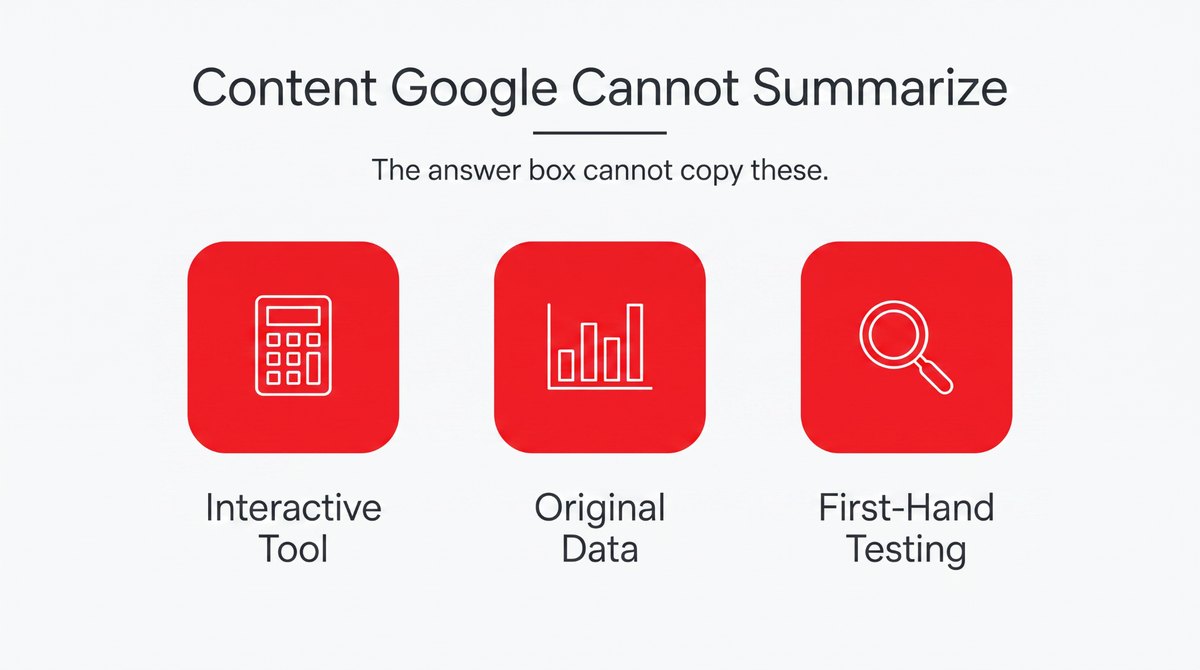
Some things just can't be squeezed into a snippet. Think a calculator people actually use, or research nobody else has run. Google can say it exists, but it can't hand it over on the search engine results page (SERP), so the searcher has to come to you.
A real hands-on review or a working tool is an edge that lasts. The goal is to create something more useful than the zero-click answers that appear above your listing.
- Build a simple calculator or tool that solves the query interactively for users.
- Run original surveys or studies that produce data nobody else can quote.
- Share first-hand testing and real results that a generated summary cannot fake.
- Publish templates or downloads that people have to actually open to use.
8. Build Traffic Channels You Don't Rent From Google
Every move so far still plays on Google's turf. This one doesn't. Think an email list or a following on whatever platform your audience is on. Those are yours, and a zero-click page can't lay a finger on them. The more of your traffic comes from places Google doesn't control, the less any of this stings.
- Turn your search visitors into email subscribers you can reach again anytime.
- Build a real presence on the one platform your audience uses the most.
- Grow a community or group that doesn't depend on Google rankings at all.
- Repurpose your content into video and social posts that drive direct traffic.
5 Business Cases Where Zero-Click Searches Demand a Different Approach
The right strategy changes a lot depending on what you sell. Zero-click impacts a local realtor nothing like it hits a subscription brand or a B2B service. So here are 5 real businesses in 5 industries, the exact problem each one runs into, and what they do about it that you can copy.
1. Replacement Parts: When the Query Is Too Specific for a Snippet
Sell replacement parts and your search traffic has a split personality. The broad things, like “how do I read a tire size,” now get answered right on the search page, and that visit is gone.
But the searches that actually ring the register can't be answered that way. They hang on one exact cart and one exact set of numbers.
You can see the fix in action at this online golf cart tire store. Instead of focusing on generic blog posts, it lets a buyer drill down by cart make and model, then by wheel size and lift height, until they find the exact combo that bolts onto their cart.
Many collection pages also explain which tire sizes work with standard carts versus lifted carts, so shoppers answer the compatibility question before they reach a product page. A summary can't do that. It can’t tell a Club Car owner with a six-inch lift which 14-inch wheel-and-tire packages are appropriate, and it can't check what is in stock.
So if you sell fitment parts, quit putting hours into how-to articles the AI systems now owns, and build ultra-specific pages for the exact combinations people buy. Sort your keywords into two piles. There are the transactional ones that still click, and the informational ones that don't, and then you spend where the clicks actually are.
2. Subscription DTC: Hedging Against a Category That Went Zero-Click
Beauty and personal care brands are among the hardest hit by zero-click search. Questions like “best cologne for a first date” or “what does this perfume actually smell like” are now exactly the searches an AI Overview answers in full. For a brand that survives on discovery, that is the top of the funnel drying up.
The businesses that cope best are the ones that give customers a reason to come back without starting a brand-new search every month. A perfume subscription like Scentbird is a useful example of that shift.
Instead of asking members to rediscover the brand every time they want another fragrance, the experience continues inside the account. Subscribers build a queue of fragrances they want to receive, rearrange upcoming shipments, swap selections before they are sent, pause deliveries, or skip a month without canceling the subscription altogether.
Those features sound small, but together they change the habit. Choosing the next product becomes part of an ongoing membership. Customers return to manage what is already in their queue instead of going back to Google to begin the search again.
That is the takeaway for any subscription business. Don't treat the subscription as automatic billing with repeat shipping. Build an account experience that keeps giving customers reasons to return between renewals. The more planning and product discovery happens inside your own platform, the less dependent you become on winning that next search.
3. High-Ticket Jewelry: Winning on Sight and Trust, Not the Answer
Jewelry shoppers research hard before they buy. The difference is where that research ends. Questions like "What is a Cuban link?" or "Moissanite vs. diamond" increasingly get answered before anyone visits a jeweler's website.
By the time someone clicks through, they are usually comparing actual products rather than looking for definitions. That changes what the product page has to accomplish.
IceCartel's diamond chain lineup is a good example. It doesn't stop at a thumbnail and a price. Shoppers can compare chains by metal type, carat weight, length, width, style, and price range before opening a product.
Once they do, the page shifts from explaining jewelry to helping someone become comfortable making a high-value purchase. Large product photography, customer reviews, financing options, certification details where applicable, a lifetime warranty – they all answer the questions people typically have right before buying, not weeks earlier during research.
That is the opportunity AI summaries leave behind. They can explain what a tennis chain is. They can’t help someone compare a 14 mm Cuban link against a 10 mm one or build enough confidence to justify spending several thousand dollars.
For expensive, highly visual products, assume the educational search has already happened. Put your effort into helping someone evaluate, compare, and trust what they're already looking at. That is where the click still earns its keep.
4. B2B Services: Competing at the Decision Stage, Not the Definition
Many B2B companies spent years building traffic with educational content. Explain the problem well enough, and eventually some of those readers would become customers. AI Overviews have shortened that journey. Basic questions get answered before someone ever reaches your site.
The traffic that still clicks usually has a different goal. It is no longer trying to understand the category. It is trying to choose between providers.
Take Uproas, which helps advertisers run campaigns through TikTok agency ad accounts. By the time someone reaches that page, they already know what an agency account is. What they need to compare are the practical details. That is exactly the information Uproas puts upfront.
Instead of spending the page defining agency accounts, it focuses on the operational questions buyers ask before committing, including account replacement, onboarding time, support, available plans, and the differences between service levels.
That is a useful pattern for almost any B2B service. Assume AI has already handled the introduction. Use your site to answer the questions that only matter once someone is actively comparing vendors. Those are the pages that still earn clicks because they help people make a decision, not just understand a concept.
5. Local Real Estate: Beating the Map Pack With First-Hand Knowledge
The first question homebuyers ask is rarely "Who should I hire?" It is usually something much more specific: Could I actually see myself living here? That is where local agents still have an advantage over AI-generated summaries and national listing portals.
Look at this guide to Sun City Hilton Head. It doesn't stop at saying the community is a popular active-adult neighborhood. It walks buyers through the practical details that influence a real relocation decision: the different home collections and floor plans, HOA fees, golf courses, dozens of clubs and activity groups, healthcare access, and the lifestyle residents can realistically expect.
Taken together, those details answer the follow-up questions buyers naturally have after reading a quick overview. Someone can learn what Sun City is from an AI summary. They still need local context before deciding whether it fits the life they want.
That is the pattern worth copying. Don't compete with AI search engines on the basic facts about your area.
Build pages around the questions only someone with genuine local experience can answer, then back it with a strong local SEO setup and connect that knowledge directly to the next step, whether that is booking a viewing or speaking with someone who knows the neighborhood firsthand.
Conclusion
Zero-click searches aren't the death of SEO. They are the death of lazy SEO, the kind that chased any keyword with volume and assumed the click would follow. The winners now think in search visibility and build the few things AI can't lift off their page. Rankings still count, just not as the finish line.
This is the exact shift we work in every day at eSEOspace. We create digital marketing strategies to help businesses stay visible everywhere it counts now, from Google's snippets to the answers inside ChatGPT, with SEO and GEO built to pull in the same direction. If your rankings are steady but your clicks aren't, let's close that zero-click behavior gap. Start now.
Put this into action with eSEOspace
We help businesses grow with website development that actually performs. Explore the services behind this guide:
Get a FREE Audit
We'll perform a comprehensive SEO, AEO, GEO & CRO audit of your website — completely free — and show you exactly how to outrank your competitors.
Don't have a site yet? Get in touch →
Get a FREE GEO/AEO/SEO Audit
We'll analyze your site's SEO, GEO, AEO & CRO — completely free — and show you exactly how to get found across Google and AI answers.
Don't have a site yet? Get in touch →
Great — your audit is on the way!
We'll send your free SEO/GEO/AEO/CRO audit within the next few hours. Where should we send it?
You're all set! ✓
Your free audit is being prepared — check your inbox in the next few hours. Talk soon!








