



Blog
Key Takeaways
- Answer Engine Optimization structures content so AI tools like ChatGPT, Google AI Overviews, and Bing Copilot cite and recommend you as an authoritative source.
- Unlike traditional SEO's focus on clicks and keyword rankings, AEO targets natural-language questions and values citations, references, and AI authority recognition.
- As more people use AI answer engines alongside traditional search, businesses ignoring AEO risk losing visibility as zero-click search keeps growing.
- A strong strategy optimizes across multiple platforms—Google AI Overviews, ChatGPT, Bing Copilot, Perplexity, and Claude—rather than betting on just one system.
- Question-based headings, comprehensive coverage, and clear upfront answers earn the highest citation rates in answer engines; FAQ or how-to schema markup is optional.
Answer Engine Optimization is transforming how businesses reach customers online. As AI-powered search tools like ChatGPT, Google AI Overviews, and Bing Copilot become mainstream, traditional SEO strategies alone aren't enough.
This comprehensive FAQ addresses the most common questions about AEO, helping business owners and marketers understand this critical new discipline. Whether you're just discovering AEO or looking to refine your strategy, you'll find practical answers to guide your optimization efforts.
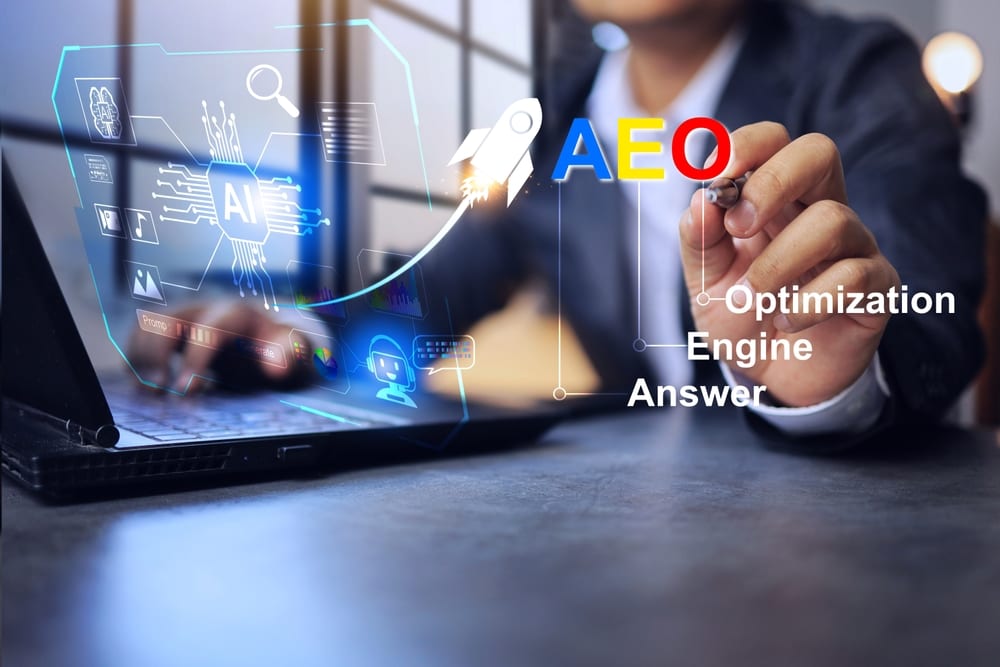
What is Answer Engine Optimization (AEO)?
Answer Engine Optimization is the practice of optimizing content to appear in AI-powered search results that provide direct answers to user queries. Unlike traditional search engines that return lists of links, answer engines use artificial intelligence to synthesize information from multiple sources and present comprehensive responses.
AEO focuses on making your content easily discoverable, understandable, and citable by AI systems. This involves structuring information in ways that AI can extract and reference when generating responses to user questions.
The goal isn't just to rank in search results—it's to become the authoritative source that AI systems quote and recommend when answering questions in your industry.
How does AEO differ from traditional SEO?
Traditional SEO optimizes for human searchers who scan results and click links. AEO optimizes for AI systems that read, understand, and synthesize information on behalf of users.
Key differences include:
Intent focus: Traditional SEO targets keyword phrases; AEO addresses natural language questions and conversational queries.
Content structure: SEO optimizes individual pages for specific keywords; AEO creates comprehensive content that addresses entire question ecosystems.
Success metrics: SEO measures clicks and rankings; AEO values citations, references, and authority recognition by AI systems.
Technical requirements: Structured data can help machines understand your pages, but it isn't essential; Google says no special markup is needed for its AI features, and clear on-page answers matter more.
User behavior: SEO assumes users will visit your website; AEO recognizes that users increasingly get answers without clicking through to sources.
Why is AEO becoming important for businesses?
User search behavior is fundamentally changing. A growing share of people now use AI-powered answer engines alongside traditional search.
Three critical factors drive AEO importance:
Changing user expectations: People now expect immediate, comprehensive answers rather than homework assignments that require visiting multiple websites.
Zero-click search growth: AI systems increasingly provide complete answers without requiring users to click through to source websites.
Competitive advantage opportunity: Most businesses haven't optimized for answer engines yet, creating significant opportunities for early adopters to establish authority positions.
Companies that ignore AEO risk losing visibility as customers shift toward AI-powered information discovery.
Which answer engines should I optimize for?
The major answer engines each have different strengths and user bases:
Google AI Overviews leverage Google's massive search index and appear above traditional search results. They're particularly strong for factual and local queries.
ChatGPT excels at conversational queries and complex, multi-part questions. Users often prefer it for explanations, analysis, and step-by-step guidance.
Microsoft Bing Copilot integrates OpenAI technology with traditional search, providing conversational answers while clearly citing sources. It performs well for research-oriented queries.
Other platforms like Perplexity AI and Claude are gaining traction in specific niches and use cases.
A comprehensive AEO strategy optimizes for multiple platforms rather than focusing on just one system.
What types of content perform best in answer engines?
Answer engines favor specific content characteristics:
Question-based content that directly addresses how people naturally ask questions performs exceptionally well. Structure headings as actual questions rather than keyword phrases.
Comprehensive coverage that addresses entire topic ecosystems rather than narrow keyword targets. AI systems prefer authoritative sources that demonstrate deep expertise.
Clear, direct answers followed by supporting details. Start sections with concise responses that AI systems can easily extract and cite.
Clear FAQ sections that answer real customer questions are easy for AI tools to quote, with or without FAQ markup.
How-to guides with step-by-step instructions work well because they match common query patterns.
Industry expertise content that provides unique insights and professional knowledge rather than generic information.
How do I implement structured data for AEO?
Structured data is a helpful supporting layer for answer engine optimization, not its foundation. It gives machines clear information about your content, but Google says it isn't required for its AI features and there's no special schema to add.
Commonly used schema types include:
FAQ schema for frequently asked questions with clearly defined question-answer pairs that AI systems can easily extract.
How-to schema for instructional content broken into sequential steps.
Article schema that helps answer engines understand your content's structure, topic, and authority signals.
Organization schema that establishes your business credibility and expertise areas.
Local business schema for location-based services and queries.
Use the Schema Markup Validator (validator.schema.org) to check any schema.org markup, and Google's Rich Results Test for types that still produce Google rich results.
What role does content structure play in AEO success?
Content structure significantly impacts whether AI systems will reference your information.
Logical hierarchy helps AI systems navigate and understand relationships between different pieces of information. Use clear H1, H2, and H3 headings that follow question patterns.
Direct answer format works best when you provide immediate responses followed by supporting details. AI systems often extract opening statements for citations.
Natural language optimization requires writing as people actually speak and ask questions, not abbreviated keyword phrases.
Comprehensive topic coverage within individual pieces performs better than fragmenting related information across multiple pages.
Supporting evidence integration includes relevant data, examples, and citations directly within main content rather than as sidebar elements.
How important is expertise and authority for AEO?
Answer engines place enormous emphasis on content authority and source credibility. AI systems evaluate not just what information you provide, but your qualifications as a source of that information.
Authority signals that matter:
Expert content creation that demonstrates deep subject matter knowledge rather than surface-level keyword targeting.
Author credentials with clear bylines and qualifications, especially for topics where expertise matters.
Comprehensive industry coverage that shows consistent knowledge across related subjects.
Accurate source citations when referencing data, studies, or other authoritative information.
Business credibility indicators like complete contact information, professional web presence, and established industry recognition.
Building topical authority takes time, making early investment in comprehensive expertise demonstration particularly valuable.
Can small businesses compete in answer engine optimization?
Yes, small businesses often have significant advantages in AEO compared to traditional SEO competition.
Local expertise advantages: Small businesses with deep local market knowledge can create highly relevant content for location-based queries.
Niche authority opportunities: Specialized businesses can establish authority in specific topic areas more easily than large companies trying to cover broad markets.
Authentic expertise: Small business owners often have genuine expertise and unique insights that AI systems recognize as valuable and citation-worthy.
Agility benefits: Smaller companies can adapt AEO strategies faster than large organizations with complex approval processes.
Personal relationships: Local businesses can create content based on actual customer questions and concerns, matching natural query patterns.
The key is focusing on comprehensive coverage of your specific expertise areas rather than trying to compete broadly.
What tools do I need for effective AEO?
Several categories of tools support comprehensive answer engine optimization:
Structured data tools like Schema.org guidelines and Google's Rich Results Test for implementing and validating markup.
Content optimization platforms such as Frase.io and SurferSEO that help create comprehensive, AI-friendly content.
Question research tools like AlsoAsked and AnswerThePublic that reveal natural language query patterns.
NLP analysis tools that help optimize content for AI comprehension and natural language processing.
Performance tracking tools for monitoring citations and references across multiple AI platforms.
The most effective approach combines multiple tools rather than relying on single solutions.
Get a FREE Audit
We'll perform a comprehensive SEO, AEO, GEO & CRO audit of your website — completely free — and show you exactly how to outrank your competitors.
Don't have a site yet? Get in touch →
How do I measure AEO success?
AEO measurement requires different approaches than traditional SEO metrics:
Citation tracking involves manually monitoring mentions of your content in AI-generated responses across major platforms. For Google, Search Console's Generative AI performance report now shows how your pages appear in AI Overviews and AI Mode, and Bing Webmaster Tools has an AI Performance report for Copilot.
Brand search increases often indicate improved authority recognition from AI citations, even when direct traffic doesn't immediately increase.
Question-based query performance analysis shows how well your content performs for natural language searches.
Qualified lead quality improvements may result from prospects arriving with better understanding of their needs after exposure to your content through AI responses.
Competitive citation analysis compares your AI mentions against competitors for similar topics and queries.
Success in AEO often builds gradually as authority recognition compounds over time.

What are common AEO implementation mistakes?
Several frequent mistakes can significantly hurt answer engine optimization efforts:
Keyword stuffing approaches that prioritize traditional SEO tactics over natural, helpful content that AI systems prefer.
Surface-level content that doesn't thoroughly address topics rarely achieves citation by answer engines that favor comprehensive, authoritative sources.
Poor technical implementation including broken or incomplete structured data that prevents AI systems from understanding your content.
Inconsistent information across your content ecosystem can hurt credibility with AI systems that value accuracy and consistency.
Promotional content focus gets filtered out of AI responses that prioritize educational value over sales messaging.
Individual page optimization misses AI systems' preference for comprehensive topical authority rather than isolated keyword targeting.
How does local SEO integrate with AEO?
Local businesses have unique opportunities in answer engine optimization:
Location-specific content that addresses local variations of common questions performs well for geographic queries.
Google Business Profile optimization becomes even more important as AI systems frequently reference local business data for location-based responses.
Local question patterns often differ from national queries, requiring content that addresses regional concerns and market conditions.
Community expertise allows local businesses to answer questions about area-specific challenges and opportunities.
Service area optimization using natural language descriptions of coverage areas matches how people describe locations when speaking.
Local AEO strategies should integrate with existing local SEO efforts rather than replacing them.
Is AEO just a trend or a permanent shift?
Answer Engine Optimization represents a fundamental, permanent shift in how search technology works, not a temporary trend.
User behavior changes toward expecting immediate, comprehensive answers are irreversible once people experience the convenience of AI-powered responses.
Technology advancement in artificial intelligence and natural language processing continues accelerating, making AI-mediated information discovery increasingly sophisticated.
Platform investment by major technology companies in AI search capabilities demonstrates long-term commitment to this direction.
Competitive dynamics create pressure for all search platforms to provide AI-powered answer capabilities to remain relevant.
While specific platforms and algorithms will continue evolving, the underlying shift toward AI-synthesized information discovery represents a permanent change in search behavior.
How does voice search relate to AEO?
Voice search and answer engine optimization are closely connected, as both involve natural language queries and conversational responses.
Natural language patterns in voice search align perfectly with AEO content optimization strategies.
Direct answer formats work well for both AI text responses and voice assistant spoken replies.
Question-based optimization serves both typed conversational queries and spoken voice searches.
Local intent appears frequently in both voice searches and AI-powered local queries.
Hands-free situations where voice search occurs often involve the same immediate answer needs that drive AI search adoption.
Voice search optimization should be considered part of comprehensive AEO strategy rather than a separate initiative.
What industries benefit most from AEO?
While all industries can benefit from answer engine optimization, certain sectors see particularly strong results:
Professional services including legal, healthcare, and financial businesses benefit from AI systems' preference for authoritative, expert content.
B2B technology companies can establish authority through comprehensive coverage of complex topics that require detailed explanation.
Consulting and advisory businesses can demonstrate expertise through thought leadership content that AI systems recognize and cite.
Local services can dominate location-based queries by providing comprehensive local market expertise.
Education and training organizations can leverage their instructional expertise for how-to and educational queries.
Manufacturing and technical industries can showcase specialized knowledge through detailed process and specification content.
How long does it take to see AEO results?
Answer engine optimization timelines vary significantly based on several factors:
Technical implementation improvements can show results within weeks once proper structured data and content structure are in place.
Authority building typically requires months of consistent, high-quality content creation and optimization to achieve significant AI citation rates.
Competitive landscape affects timeline, with less optimized industries offering faster results for early adopters.
Content comprehensiveness impacts speed, as thorough topic coverage achieves citation faster than surface-level optimization.
Existing authority provides advantages, with established businesses often seeing faster AEO results than new companies.
Many businesses see first AI citations within a few months and more meaningful results over six months to a year, though no one can guarantee AI citations.
Can I do AEO myself or do I need professional help?
The complexity of effective answer engine optimization makes professional expertise valuable for most businesses, though some elements can be handled internally.
DIY possibilities include basic question research, FAQ creation, and simple structured data implementation for businesses with technical resources.
Professional advantages include comprehensive schema markup expertise, advanced content strategy development, multi-platform optimization knowledge, and ongoing algorithm adaptation.
Hybrid approaches work well, with businesses handling content creation while professionals manage technical implementation and strategic optimization.
Investment considerations should weigh the learning curve and time investment against the competitive advantages of early, effective AEO implementation.
Risk factors include missed opportunities, incorrect technical implementation, and competitive disadvantages from delayed or incomplete optimization.
The rapidly evolving nature of AI search makes ongoing professional expertise particularly valuable for businesses serious about long-term AEO success.
Getting Started with Answer Engine Optimization
Answer Engine Optimization isn't just the future of search—it's happening now. Every day you delay optimizing for AI-powered discovery is a day your competitors might establish themselves as the authoritative sources that answer engines reference in your industry.
The questions answered in this FAQ provide the foundation for understanding AEO, but implementation requires systematic approach, technical expertise, and ongoing optimization that adapts to rapidly evolving AI technologies.
Your business has expertise that customers need and questions that AI assistants answer daily. The strategic question is whether you'll position that knowledge to be discovered and cited by answer engines, or watch competitors claim the authority that should be yours.
Ready to establish your business as the trusted source that AI systems reference in your industry? Professional answer engine optimization combines the strategic thinking, technical implementation, and ongoing optimization needed to succeed in AI-powered search.
Put this into action with eSEOspace
We help businesses grow with website development that actually performs. Explore the services behind this guide:
Get a FREE GEO/AEO/SEO Audit
We'll analyze your site's SEO, GEO, AEO & CRO — completely free — and show you exactly how to get found across Google and AI answers.
Don't have a site yet? Get in touch →
Great — your audit is on the way!
We'll send your free SEO/GEO/AEO/CRO audit within the next few hours. Where should we send it?
You're all set! ✓
Your free audit is being prepared — check your inbox in the next few hours. Talk soon!


On this page
- Key Takeaways
- What is Answer Engine Optimization (AEO)?
- How does AEO differ from traditional SEO?
- Why is AEO becoming important for businesses?
- Which answer engines should I optimize for?
- What types of content perform best in answer engines?
- How do I implement structured data for AEO?
- What role does content structure play in AEO success?
- How important is expertise and authority for AEO?
- Can small businesses compete in answer engine optimization?
- What tools do I need for effective AEO?
- How do I measure AEO success?
- What are common AEO implementation mistakes?
- How does local SEO integrate with AEO?
- Is AEO just a trend or a permanent shift?
- How does voice search relate to AEO?
- What industries benefit most from AEO?
- How long does it take to see AEO results?
- Can I do AEO myself or do I need professional help?
- Getting Started with Answer Engine Optimization






