



SEO Packages for Addiction Treatment Centers: What's Actually Worth Paying For
SEO Packages for Addiction Treatment Centers: What's Actually Worth Paying For
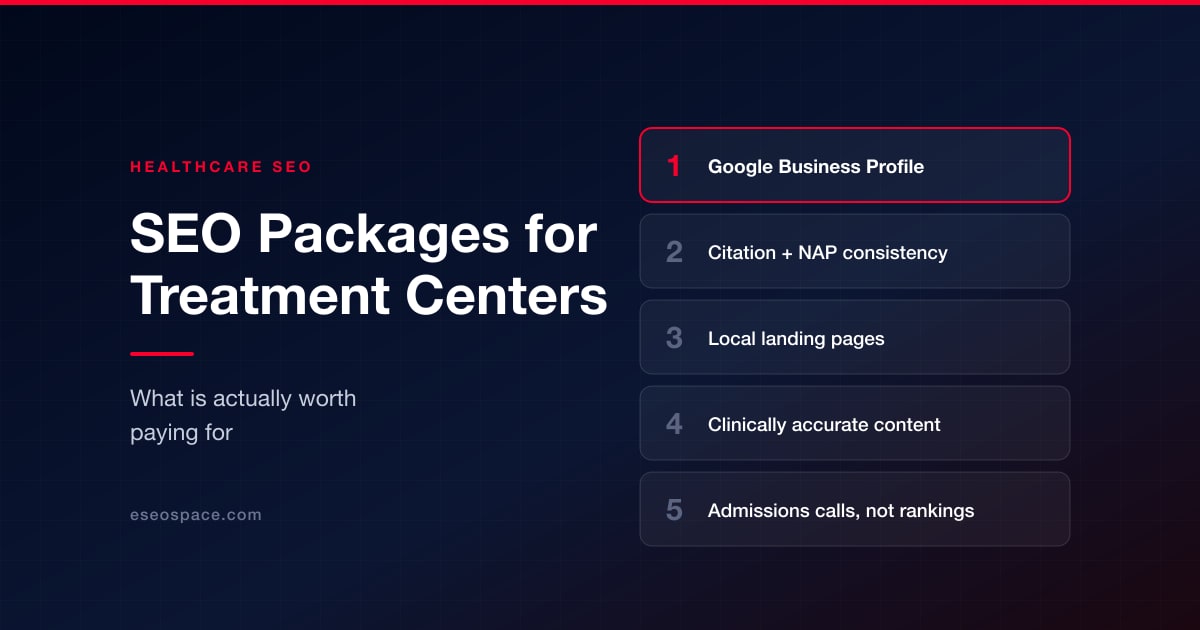
You're likely spending thousands each month on SEO and still watching your phone stay quiet. Most addiction treatment centers get sold packages full of activity that looks productive but doesn't move admissions. Before you renew another contract or sign a new one, you need to understand exactly what separates legitimate SEO investment from expensive noise.
What Most SEO Packages Actually Get You
When you purchase an SEO package for an addiction treatment center, you're generally paying for a bundle of foundational services: technical site maintenance, basic schema markup, and a limited amount of new content, often two to four pages per month.
Knowing what a real program should deliver is the starting point - SEO for addiction treatment centers operates under stricter compliance requirements and higher scrutiny than most verticals, which means the standard bundle of technical fixes and generic blog posts rarely moves the needle on admissions.
Many packages also include initial Google Business Profile setup and citation building.
However, these elements tend to have limited impact until the profile is thoroughly optimized with accurate categories, consistent hours, clear service descriptions, and a substantial set of authentic photos.
What is typically missing from these standard packages is the components most closely associated with measurable admissions growth:
- clinically accurate, in-depth content;
- systematic acquisition of high-quality, relevant backlinks;
- and location-specific landing pages designed to capture local search demand.
In many cases, the primary deliverables end up being keyword ranking reports and generalized blog articles that don't meaningfully address the information needs of prospective patients or referrers.
The Three Things Every Addiction Treatment SEO Package Must Include
A clear baseline for any addiction treatment SEO package should include three core elements.
First, it should provide comprehensive Google Business Profile optimization, including complete and accurate fields, appropriate categories, a substantial set of authentic photos, and a structured process for ongoing review generation and response. This is a primary driver of visibility in Google Maps and a common source of inbound admissions inquiries, and it sits at the centre of any serious local SEO program.
Second, it should address citation and NAP (name, address, phone) consistency across major directories and data aggregators. Inconsistent business information can reduce trust signals for both search engines and AI-driven systems, limiting visibility in local search results and in the AI answers that increasingly sit above them.
Third, it should offer reporting that connects SEO activity to measurable outcomes, such as tracked phone calls and form submissions, rather than relying solely on keyword rankings as the main performance indicator.
Why Local SEO Beats Broad Statewide Targeting for Admissions
Most families searching for addiction treatment typically use location-based queries like "near me" or include a city or neighborhood name, rather than conducting broad statewide searches. As a result, the most qualified admissions leads tend to be local.
Focusing on broad statewide keywords often means competing against a larger number of providers, which can dilute budget efficiency and reduce visibility among nearby searchers.
Local SEO concentrates on a defined geographic area where competition is narrower. This can improve your chances of appearing in the Google Maps 3-pack, which is displayed above many organic results and effectively gives your facility an additional, highly visible listing for high-intent users.
Efforts such as optimizing your Google Business Profile, building geo-targeted service pages, and maintaining consistent local citations contribute directly to Google's primary local ranking factors: distance, relevance, and prominence.
Treatment centers that have shifted resources from broad statewide targeting to local SEO have reported more sustainable performance, including year-over-year admissions increases in the range of 12%–15% across multiple years.
Why Any Package Without GBP Optimization Is Incomplete
If an SEO package doesn't include Google Business Profile (GBP) optimization, it omits a key component of local search performance. GBP heavily influences visibility in the Google Maps "map pack," which is where many "near me" and location-based searches result in calls and inquiries. Packages that focus only on technical SEO, citations, and schema often underperform for local admissions because GBP is a core relevance and prominence signal for local rankings.
Effective GBP optimization typically includes: verifying the listing, selecting accurate and specific categories (with "Addiction treatment center" as the primary category where appropriate), adding authentic photos of the facility and staff, and fully completing all available fields. These fields include business hours, services, amenities, and payment options.
Many interactions from Google Maps, such as calls, direction requests, and profile views, may not appear clearly in standard web analytics, but they still contribute to admissions and overall lead volume.
Which Metrics Actually Predict Admissions Calls
Tracking unsuitable metrics can make effective SEO appear unsuccessful. For example, organic traffic can decline by 60% while admissions calls increase by 60% at the same time.
This pattern is consistent with zero-click behavior, where users obtain what they need directly from search results or map listings without visiting the website.
For admissions-focused programs, it's more useful to monitor Google Business Profile (GBP) actions such as phone calls, driving-direction requests, and photo views.
Map pack visibility, especially consistent presence in the top three results, tends to correlate with higher volumes of "near me" searches that indicate stronger intent to contact a facility.
Implementing HIPAA-compliant call tracking with a dedicated GBP phone number allows you to distinguish calls generated from local search from those driven by other channels.
These calls should then be connected to your CRM as distinct lead sources and tracked through to admission decisions.
Rankings and raw traffic are indirect indicators; verified attribution from specific search interactions to confirmed admissions provides a more accurate measure of SEO effectiveness.
Red Flags That Signal a Package Isn't Worth the Price
Understanding which metrics correlate with admissions calls makes it easier to recognize when an SEO package is unlikely to affect those outcomes.
Be wary of any promise such as "guaranteed Page 1 rankings in 90 days," since YMYL (Your Money or Your Life) topics face strong competition and inherently unpredictable ranking dynamics.
Exercise caution with very low-priced packages (for example, those under roughly $2,000 per month), as comprehensive technical work, Google Business Profile optimization, and clinically reviewed content typically require more resources than such budgets allow.
Treat as warning signs any offers that rely mainly on bulk backlinks, low-quality or generic AI-generated content, or large numbers of near-duplicate city pages.
Finally, if the package doesn't include call tracking and CRM source tagging, you'll have limited visibility into which activities generate admissions calls, and may end up paying for traffic rather than measurable admissions outcomes.
What a Legitimate Treatment Center SEO Package Costs
For addiction treatment centers, legitimate SEO retainers generally fall into three tiers. Single-location practices typically range from $2,500 to $5,000 per month. Regional operators with multiple locations often fall between $6,000 and $15,000 per month.
National networks usually start at about $15,000 per month, with costs increasing based on scale and complexity. Packages priced under roughly $2,000 per month often rely on high-volume, low-quality content and may not address compliance or clinical accuracy adequately.
The cost is driven by several components: ongoing technical maintenance of the website, optimization of Google Business Profiles for each location, clinically reviewed content that aligns with YMYL (Your Money or Your Life) standards, HIPAA-aware call tracking and lead handling, and content production calibrated to the number of locations and services.
Effective packages also include measurement tied to admissions and census—linking SEO activity to inquiries, verifiable leads, and beds filled, rather than focusing only on traffic or rankings. For a broader breakdown of how these components compare across service tiers, the complete guide to SEO packages walks through what's typically included at each price point and how to evaluate whether the deliverables match the cost.
Conclusion
You've now got a clear picture of what separates legitimate SEO packages from overpriced fluff. Don't let vendors distract you with vanity metrics or vague deliverables. Focus on local visibility, GBP optimization, citation consistency, and tracking that connects directly to admissions calls. If a package can't show you how it drives real inquiries, it's not worth your budget. Protect your marketing dollars by holding every vendor accountable to outcomes that actually fill beds.
Put this into action with eSEOspace
We help businesses grow with website development that actually performs. Explore the services behind this guide:
Get a FREE Audit
We'll perform a comprehensive SEO, AEO, GEO & CRO audit of your website — completely free — and show you exactly how to outrank your competitors.
Don't have a site yet? Get in touch →
Get a FREE GEO/AEO/SEO Audit
We'll analyze your site's SEO, GEO, AEO & CRO — completely free — and show you exactly how to get found across Google and AI answers.
Don't have a site yet? Get in touch →
Great — your audit is on the way!
We'll send your free SEO/GEO/AEO/CRO audit within the next few hours. Where should we send it?
You're all set! ✓
Your free audit is being prepared — check your inbox in the next few hours. Talk soon!


On this page
- What Most SEO Packages Actually Get You
- The Three Things Every Addiction Treatment SEO Package Must Include
- Why Local SEO Beats Broad Statewide Targeting for Admissions
- Why Any Package Without GBP Optimization Is Incomplete
- Which Metrics Actually Predict Admissions Calls
- Red Flags That Signal a Package Isn't Worth the Price
- What a Legitimate Treatment Center SEO Package Costs
- Conclusion






