8 Best SERP Tracking Tools in 2026, Tested for Measurement Reliability
8 Best SERP Tracking Tools in 2026, Tested for Measurement Reliability
Pew Research Center's March 2025 panel found that 18% of Google searches returned an AI-generated summary, and 58% of users encountered at least one during the study window. The page that used to be ten blue links is now a stack of features, and the position your team reports is measured against a surface that keeps rearranging itself. That is the backdrop against which the best SERP tracking tools now have to prove themselves - not on dashboard design, but on whether the number they report matches what a real user sees. Zero-click Google searches near 68%, so a rank that looks flat can sit on a page that leaks traffic each quarter. This article judges 8 tools on measurement reliability alone: position accuracy, SERP-feature and AI Overview coverage, check cadence, and history depth. The criteria sit below, and every tool is scored against the same four so the comparison stays like-for-like rather than a ranking by reputation.
Problem 1: The Position Your Tracker Reports Isn't The One Users See
A reported position is unreliable when it comes from one location, one device, and one moment. Google personalizes and localizes results, and rankings can move several times within a day, so "position 4" is a point estimate with error bars. Two trackers disagree because they sampled different cities, devices, or times - not because one of them is broken.
Rank is not a fixed property of a URL; it is a reading taken under specific conditions. Change the location by a few miles, the language setting, or whether the query ran on a phone, and the same keyword can return a different order. A SERP tracker records a snapshot, and every snapshot carries the assumptions of where and how it was sampled. When two tools report position 3 and position 6 for the same term, the gap usually traces to divergent geolocation, device emulation, or check timing rather than a fault in either engine. Device split makes this concrete: Statcounter GlobalStats put mobile at 59.6% of global traffic against desktop's 38.8% in September 2025, and the two surfaces frequently rank the same page differently. A tool that reports a single blended number hides that spread. Reliable measurement means pinning location and language, tracking desktop and mobile as separate series, and treating any single figure as an estimate with a known sampling method behind it.
Problem 2: Blue-Link Rank is a Shrinking Share of the SERP
SERP-feature tracking in 2026 has to cover more than organic rank. It must log featured snippets, People Also Ask, local packs, image and video blocks, and AI Overviews - recording whether your page appears inside each feature and where that feature sits on the page. Blue-link position alone now describes a shrinking slice of the visible result.
Discovery has migrated into the elements that sit above and around the organic list. Featured snippets, People Also Ask, local packs, and AI Overviews can push the first blue link far down the viewport, so a tool that measures only organic position is measuring the wrong thing. SERP-feature tracking closes that gap by logging presence and placement inside each feature, not just the ranked ten. The traffic case is direct: Pew found that on pages showing an AI summary, users clicked a traditional result in just 8% of visits, against 15% when no summary appeared. The scale is not marginal. Google reported in its Q2 2025 earnings that AI Overviews reached 2 billion monthly users and AI Mode passed 100 million monthly active users (Alphabet Q2 2025 earnings). A SERP monitoring tool that cannot tell you whether an AI Overview appeared for a query, and whether your domain was cited inside it, leaves the most consequential part of the page unmeasured. Reliability here means feature-level coverage, refreshed often enough to catch features appearing and disappearing.
Problem 3: Weekly Checks Miss the Volatility that Moves Traffic
Cadence and history depth are accuracy features because rank is a time series, not a single value. Daily checks with on-demand recheck catch volatility that weekly snapshots alias into noise. Deep history lets you line a ranking drop up against a confirmed algorithm update instead of guessing whether the move was real or a sampling artifact.
Check frequency is a measurement parameter, not a billing tier. Sample a moving signal once a week and you record the position after it has already moved, so short-lived swings either vanish or masquerade as permanent shifts - the aliasing problem familiar from any undersampled series. Attribution is where this bites: the March 2025 Google core update took 14 days to fully roll out, one of several confirmed core updates across 2024 and 2025 (Search Engine Land). Without daily readings and enough history to overlay the rollout window, a team cannot separate an algorithm-driven drop from ordinary noise. The stakes are not trivial even for small moves: at the top of the page a single-position slip can swing a large share of the available clicks. Daily checks plus on-demand recheck are the floor for trustworthy attribution.
What a Reliable SERP Tracker Actually Needs to Do
A reliable SERP tracker earns trust on five measurable signals: location and device fidelity, SERP-feature and AI Overview coverage, check cadence and history depth, data independence, and workflow output. Each signal is verifiable against vendor documentation. A tool that fails two or more of the five produces position data you cannot audit.
SERP tracking software qualifies for this list only if it clears five signals:
- Location and device fidelity. City/ZIP targeting with desktop and mobile tracked separately, so a reported position matches one real query context rather than an averaged blend.
- SERP-feature and AI Overview coverage. 30+ SERP features plus AI-answer presence tracked, not the ten blue links alone.
- Check cadence and history depth. Daily checks on the base plan, on-demand recheck, and history deep enough to attribute movement before and after a named algorithm update.
- Data independence. The vendor runs its own SERP collection rather than reselling a single upstream feed.
- Workflow and export. API or MCP access plus scheduled reports, so the signal reaches stakeholders without manual glue.
Methodology: features were cross-checked against each vendor's own documentation, entry prices were taken from each vendor's pricing page in July 2026, and tools were weighted on measurement reliability.
The 8 Trackers Side by Side
| Rank | Tool | Best for | Check cadence | SERP-feature + AI coverage | Entry price |
|---|---|---|---|---|---|
| 1 | SE Ranking | In-house teams tracking SEO + AI visibility in one place | Daily (top 100) | 35+ features + AI Results Tracker (ChatGPT/AI Overviews/AI Mode/Gemini/Perplexity) | $129/mo Core |
| 2 | AccuRanker | Teams checking 2,000+ keywords daily with on-demand refresh | Daily + on-demand | SERP features + AI CTR/volume | $224/mo |
| 3 | Wincher | Focused keyword-position monitoring with feature tracking | Daily | SERP features + volatility | $49/mo |
| 4 | Nightwatch | Granular local tracking across many locations | Daily | SERP features + AI/LLM | €79/mo |
| 5 | Serpstat | Teams wanting rank tracking inside an all-in-one suite | Daily (desktop & mobile) | SERP features + AI Overview report | $50/mo |
| 6 | Advanced Web Ranking (AWR) | Pixel-precise position and above-the-fold analysis | Daily/on-demand | Pixel position + feature-weighted CTR | $139/mo |
| 7 | Semrush (Position Tracking) | Teams already in a broad SEO suite | Daily | SERP features + intent | $139/mo |
| 8 | seoClarity | Enterprise programs needing unlimited keywords | Real-time/daily | Real-time SERP + AI assistant | Custom quote |
The 8 Best SERP Tracking Tools for 2026
1. SE Ranking
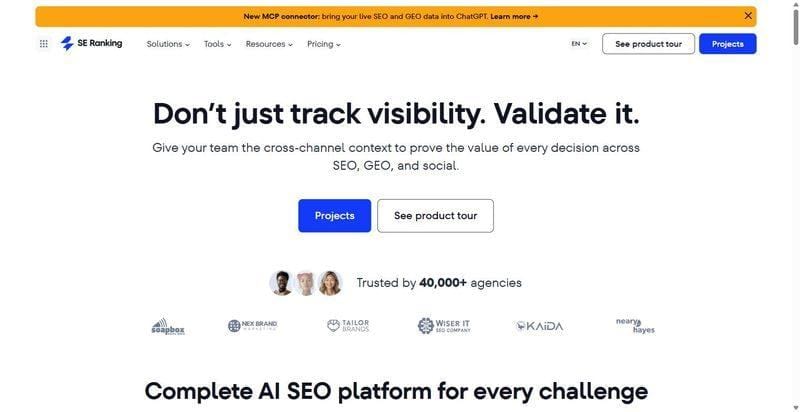
A full SEO platform whose SE Ranking's rank tracker checks the top 100 daily on every plan across Google, Bing, YouTube, and Maps.
Best for: In-house SEO teams and agencies tracking 500–2,000 keywords across desktop and mobile that need position data and AI-answer visibility in one workspace.
Standout: As a SERP rank tracking tool, it separates desktop and mobile results, flags 35+ SERP features, and detects target-URL cannibalization through blue, red, and grey states. Its AI Results Tracker follows brand mentions and links across ChatGPT, AI Overviews, AI Mode, Gemini, and Perplexity, and its own crawlers calculate search volume independently rather than reselling a single feed.
Pros:
- Check the top 100 daily on every plan, not only paid tiers.
- Separate desktop and mobile rankings across Google, Bing, YouTube, and Maps.
- Track brand presence in five AI engines from the same project.
- Call the API and official MCP server (160+ tools) on any plan.
Cons:
- Caps daily-checked keywords at 2,000 on Core.
- Requires the paid AI Search add-on for AI-prompt tracking at scale.
- Deletes ranking history permanently when you remove a search engine or region.
Pricing: $129/mo Core ($103.20/mo billed annually); Growth $279/mo; 14-day free trial, no card. API and MCP included in every plan.
The data says: Daily top-100 checks on the entry plan, five-engine coverage, and AI-answer tracking in one project cover most enterprise and agency reporting needs without a second tool. Budget for the AI Search add-on if you track prompts at scale, and export history before deleting any engine.
2. AccuRanker
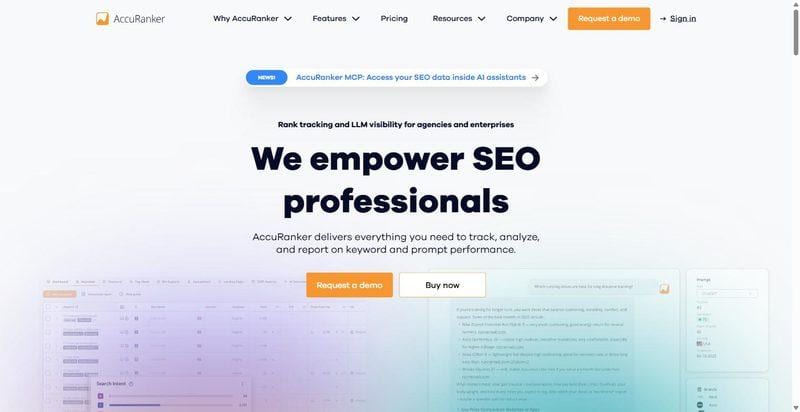
A dedicated rank tracker built around fast daily keyword updates and on-demand refreshes rather than a full SEO suite.
Best for: Agencies and in-house teams that check 2,000-plus keywords daily and want on-demand refresh plus a live SERP checker.
Standout: Daily updates land quickly and can be refreshed on demand, so you are not waiting for the next scheduled crawl. The live SERP checker returns current results on request, AI CTR and AI Search Volume metrics estimate click behaviour, and Enterprise plans expose raw SERP HTML for teams that parse results themselves.
Pros:
- Refresh rankings on demand instead of waiting for the daily cycle.
- Check any live SERP without adding the keyword to a project.
- Pull AI CTR and AI Search Volume metrics alongside positions.
- Access raw SERP HTML on the Enterprise tier.
Cons:
- Prices per keyword volume, with an entry tier higher than most trackers.
- Focuses on tracking only; it is not an all-in-one SEO platform.
Pricing: $224/mo (Professional, 2,000 keywords; roughly 10% off billed annually).
My read: If daily accuracy and on-demand refresh are the priority and you already run separate tools for audits and backlinks, the tracking here justifies the entry price. Teams that want keyword research, audits, and rank tracking under one login will end up paying for two products with this setup.
3. Wincher
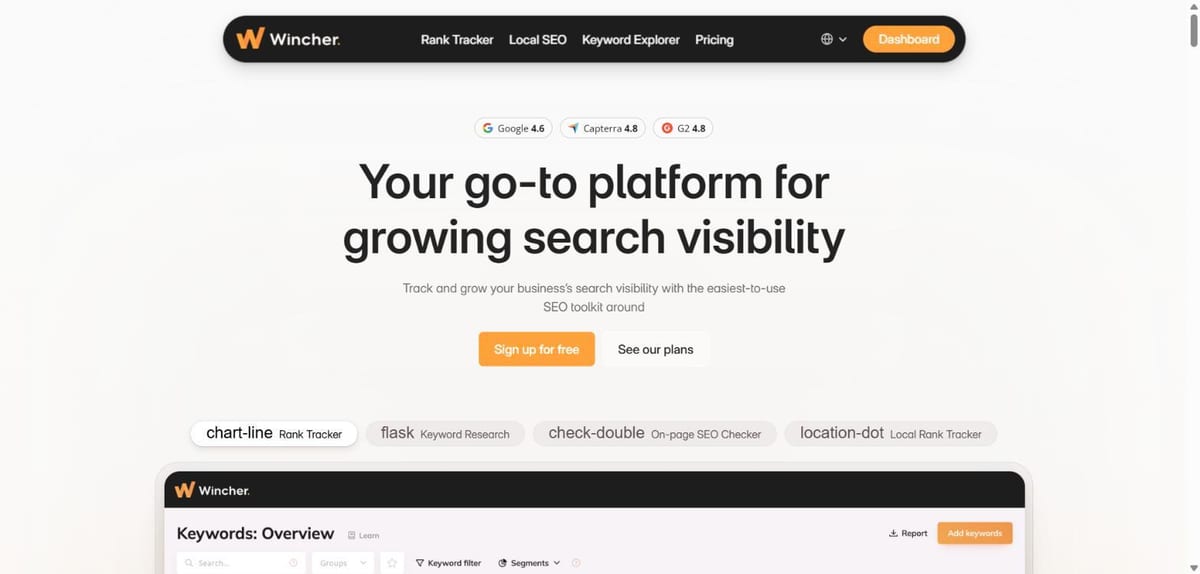
A focused rank tracker that pairs daily position updates with SERP-feature tracking and a free public volatility tool.
Best for: In-house teams and agencies that want daily position monitoring and Share of Voice without paying for a full platform.
Standout: As a Google SERP tracker, Wincher updates positions daily, records which SERP features appear, and tracks local Google Maps rankings for multi-location work. Its free public volatility tool reports daily SERP turbulence without an account, and Share of Voice becomes available on higher tiers for teams measuring aggregate visibility across a keyword set.
Pros:
- Update positions daily and log SERP-feature changes per keyword.
- Track local Google Maps rankings alongside standard results.
- Check SERP volatility free through the public tool.
- Measure Share of Voice on higher tiers.
Cons:
- Concentrates on position monitoring rather than a full SEO suite.
- Pushes you into higher tiers as keyword volume grows.
Pricing: $49/mo (Basic, from 500 keywords).
The data says: For teams that need daily positions, SERP-feature data, and local tracking without paying for audits and backlink tools, the Basic tier starts at 500 keywords and covers the core job. Larger keyword sets move you up the pricing tiers, so map your volume before committing.
4. Nightwatch
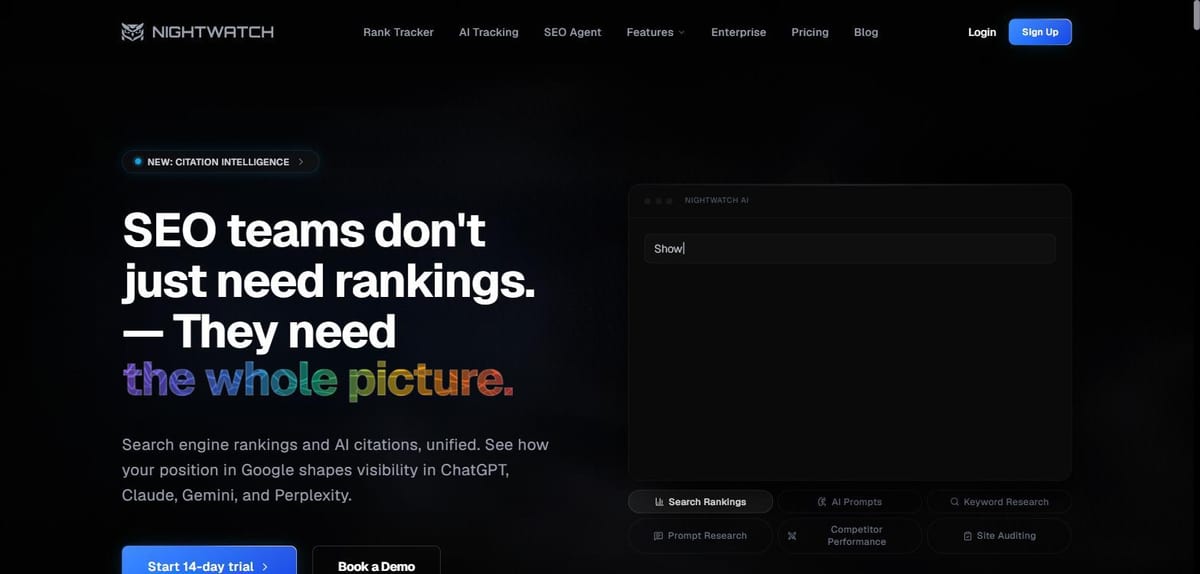
A rank tracker built for granular local coverage, with ZIP-code-level tracking across 107,000+ locations in 190+ countries.
Best for: Agencies managing many clients or locations that need ZIP-level local data and unlimited user seats.
Standout: Nightwatch tracks rankings across 107,000+ locations in 190+ countries down to ZIP-code level, which suits multi-location and multi-market clients. Every plan includes unlimited user seats with no per-seat fee, keeps three years of SERP history for trend analysis, and adds AI and LLM tracking for answer-engine visibility.
Pros:
- Track rankings at ZIP-code level across 190+ countries.
- Add unlimited user seats without a per-seat charge.
- Retain three years of SERP history for trend work.
- Monitor AI and LLM results alongside standard rankings.
Cons:
- Starts at 500 keywords, a small allowance for larger operations.
- Gears its interface toward power users, raising the learning curve.
Pricing: €79/mo (Starter, 500 keywords, unlimited seats).
The data says: Unlimited seats and ZIP-level tracking across 107,000+ locations make this a fit for agencies billing many locations rather than tracking many keywords. The 500-keyword Starter allowance runs out fast at scale, so price the higher tiers against your actual keyword count first.
5. Serpstat
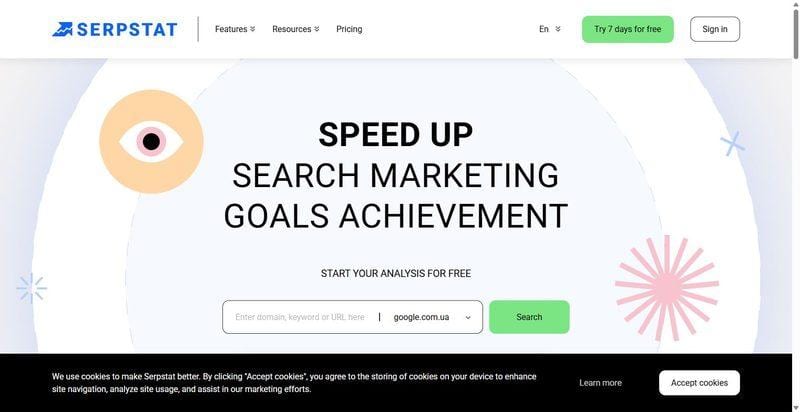
Serpstat bundles rank tracking with site audit, backlinks, and keyword research in one platform, tracking daily desktop and mobile positions.
Best for: In-house teams that want rank tracking plus three other SEO functions billed on a single invoice instead of four.
Standout: Serpstat runs rank tracker, site audit, backlink analysis, and keyword research from a single login, refreshing desktop and mobile positions daily. It exposes ChatGPT and Claude data through an MCP integration, and its AI Overview "Brand Opportunities" report, available on Team and higher tiers, flags queries where a brand can surface in AI answers.
Pros:
- Consolidates four SEO functions into one $50/mo entry tier.
- Refreshes desktop and mobile positions daily.
- Connects to ChatGPT and Claude through an MCP integration.
- Surfaces AI Overview opportunities via the Brand Opportunities report.
Cons:
- Tracks positions with less depth than tools built only for rank tracking.
- Gates AI Overview reporting to Team and higher tiers.
Pricing: $50/mo (Individual tier, 10,000 position checks).
The data says: At $50/mo for 10,000 checks, Serpstat's value is the four-in-one bundle, not the tracker in isolation. Teams already running a dedicated tracker gain little; teams consolidating a stack of single-purpose tools remove three invoices and one login boundary. Match it to the second group.
6. Advanced Web Ranking (AWR)
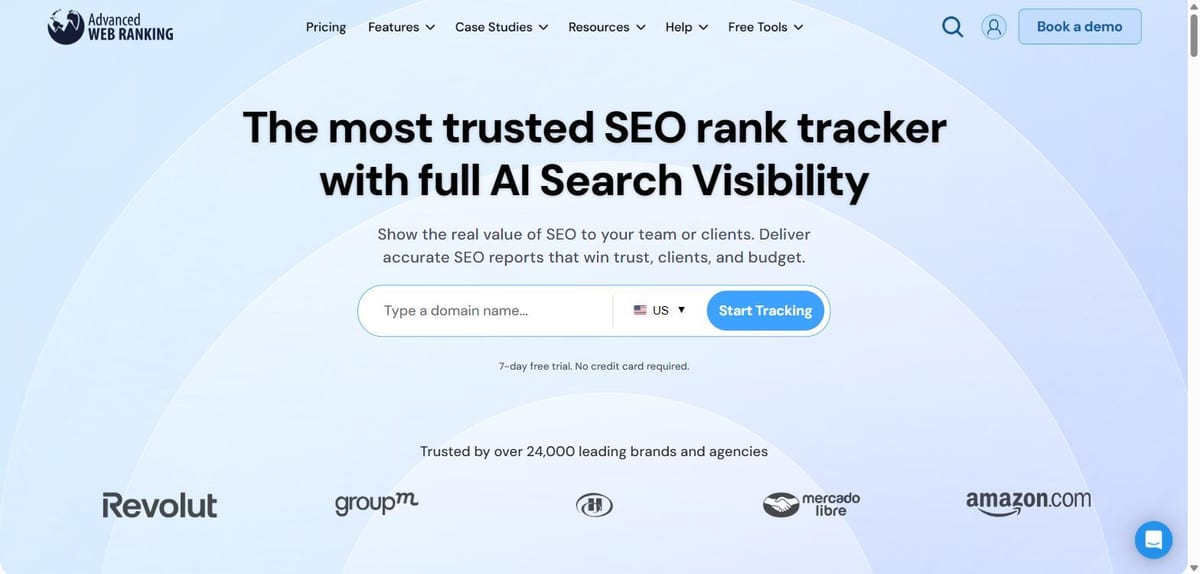
Advanced Web Ranking has tracked SERP positions for 20+ years across 4,000+ search engines, with pixel-level and above-the-fold analysis.
Best for: Agencies running many client projects that need unlimited users and unlimited projects on a single paid seat.
Standout: AWR reports pixel position - the exact vertical distance a result sits from the top of the page - and flags whether a listing appears above the fold. Its CTR trends weight click-through by which SERP features are present, so a position-three ranking under an AI Overview reads differently from a clean position three.
Pros:
- Tracks positions across 4,000+ search engines.
- Reports pixel position and above-the-fold placement.
- Weights CTR trends by SERP-feature presence.
- Includes unlimited users and projects on paid tiers.
Cons:
- Presents an interface that reads as dated next to newer platforms.
- Delivers more measurement depth than teams needing a single position number will use.
Pricing: $139/mo (Pro plan, 7,000 keywords, unlimited users).
My read: The pixel-position and SERP-feature-weighted CTR data is what separates AWR from trackers that report a rank integer and stop. At $139/mo for 7,000 keywords with unlimited users, the per-seat math favors agencies. A team tracking one site for a single number pays for resolution it will not read.
7. Semrush (Position Tracking)
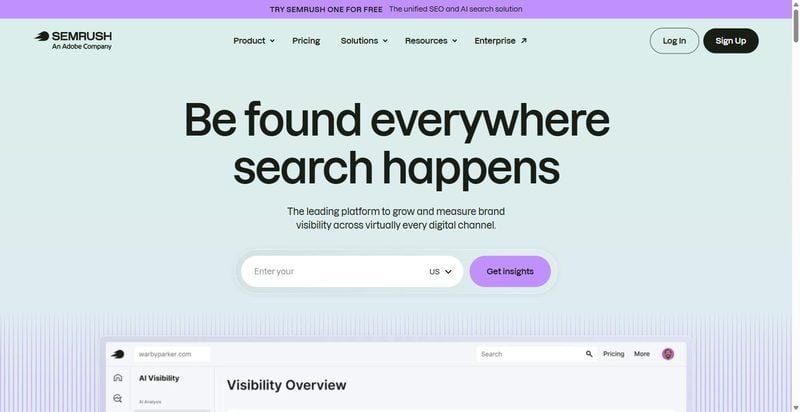
Semrush's Position Tracking module logs daily rankings across locations and devices, monitoring competitors, landing pages, and SERP features inside a broad SEO suite.
Best for: In-house teams already running the wider Semrush suite that want tracking on the same login.
Standout: Position Tracking updates daily, supports multiple locations and both devices, and monitors competitor domains, individual landing pages, and SERP-feature presence per keyword. It sits inside Semrush's larger SEO and AI toolkit, so tracking data shares a workspace with keyword, backlink, and site-audit modules rather than living in a standalone tool.
Pros:
- Updates tracked positions daily across locations and devices.
- Monitors competitors, landing pages, and SERP features per keyword.
- Shares one login with keyword, backlink, and audit modules.
Cons:
- Bundles tracking into a platform priced for the full suite, not the module.
- Caps the SEO plan at 500 daily-tracked keywords.
- Exceeds what teams needing only SERP tracking will use.
Pricing: $139/mo (SEO plan; $117.33/mo billed annually), Position Tracking included, 500 keywords tracked daily.
The data says: Position Tracking is competent, but at $139/mo you are buying the SEO plan, with 500 daily keywords, and tracking is one module of it. The math works when a team uses the keyword, backlink, and audit tools too. For SERP tracking alone, the bundle is unallocated spend.
8. seoClarity
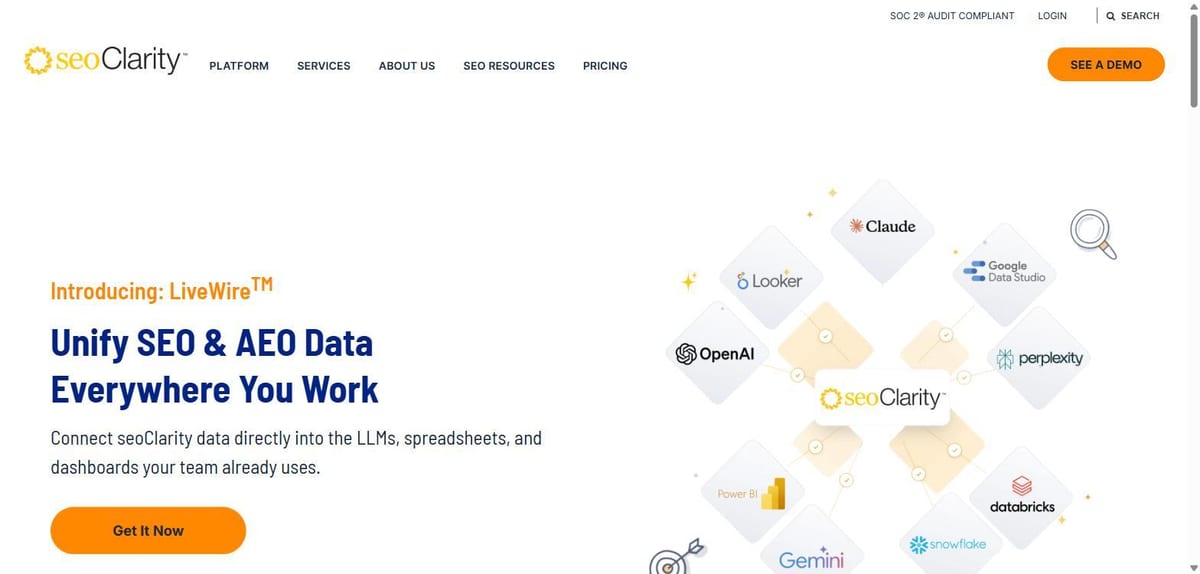
seoClarity tracks rankings at enterprise scale with unlimited keywords and users, real-time SERP data, a Research Grid, and the Clarity AI assistant.
Best for: Enterprise in-house teams tracking keyword sets large enough that per-keyword pricing would break the budget.
Standout: seoClarity removes keyword and user caps - both are unlimited on the platform - and pulls SERP data in real time rather than on a daily batch. Its Research Grid consolidates keyword and competitive data in one view, and the Clarity AI assistant answers queries against the account's own ranking data.
Pros:
- Removes keyword and user limits - both unlimited.
- Pulls SERP data in real time rather than daily batches.
- Consolidates keyword and competitive data in the Research Grid.
- Answers ranking questions through the Clarity AI assistant.
Cons:
- Publishes no pricing; every figure comes from a sales quote.
- Requires enterprise commitment and an onboarding process.
- Carries more scale than mid-market teams will use.
Pricing: Custom, quote-only - no public entry price; third-party listings cite an enterprise range, but the vendor does not publish one.
My read: Unlimited keywords and users plus real-time SERP data is an enterprise specification, and the quote-only pricing confirms the target. A team tracking a few thousand keywords will not clear the commitment or onboarding, and third-party range estimates are not a substitute for a published number. Request a quote before scoping.
My Read: Which Tracker to Trust with Your Data
For most in-house teams and agencies, SE Ranking is where I'd start. It runs daily top-100 checks, logs SERP features and AI Overview presence, and collects its own SERP data - so the position number and the AI-visibility signal come from one audited source, not two pipelines you have to reconcile. That single-source property is what makes a ranking change attributable to something you did rather than to a difference in how two tools sampled the page.
Skip if: you're weighing seoClarity without an enterprise program and the budget for a sales-quoted contract - below that scale the cost is hard to justify. Skip a free-only SERP checker too; it won't give you the cadence or history to attribute a change, so it fails the moment you need trustworthy trends.
Shortlist two or three, then run each against the same keyword set for two weeks before you commit.
One boundary: this list weights measurement reliability. A team optimizing purely for one narrow axis - pixel-level position, say - may re-order it.
Frequently Asked Questions
Why do two SERP trackers show different positions for the same keyword?
Different sampling. Each tool takes its own snapshot, and location, device, personalization, and check time all shift the result. To compare fairly, fix those variables: same location down to the city, same device and language, same engine, and checks at a comparable time of day. Differences that survive that are method, not error.
How many keywords should you track to get a reliable visibility trend?
A trend needs enough keywords for per-keyword noise to average out. Track your full priority set - often a few hundred to a few thousand - segmented by intent and cluster, not a handful of head terms. Cadence carries equal weight: daily checks resolve a real move faster than a longer list checked weekly.
Can a SERP tracker measure AI Overview and SERP-feature visibility, not just rank?
Yes. Modern trackers log presence and placement across 30+ SERP features - featured snippets, packs, panels - and record whether your domain is cited in AI Overviews and AI Mode across engines. Cited-source visibility is now table stakes for a rank tracker, not an add-on to blue-link position.
Does SERP tracking still matter when an AI answer sits above the results?
Yes. On pages with an AI summary, users still clicked a result in 8% of visits, versus 15% without one. Both paths still run through the SERP. Tracking now measures two things: whether you're cited inside the AI answer, and where you rank in the links below it.
How accurate are free SERP trackers?
Free SERP trackers and checkers are accurate enough for a single spot check. They usually cap the number of checks, sample one location and device, and keep no history - so they can't support trend attribution, which needs repeated measurement under fixed conditions. Use them to validate a number, not to measure a trend.
Put this into action with eSEOspace
We help businesses grow with website development that actually performs. Explore the services behind this guide:
Get a FREE Audit
We'll perform a comprehensive SEO, AEO, GEO & CRO audit of your website — completely free — and show you exactly how to outrank your competitors.
Don't have a site yet? Get in touch →
Get a FREE GEO/AEO/SEO Audit
We'll analyze your site's SEO, GEO, AEO & CRO — completely free — and show you exactly how to get found across Google and AI answers.
Don't have a site yet? Get in touch →
Great — your audit is on the way!
We'll send your free SEO/GEO/AEO/CRO audit within the next few hours. Where should we send it?
You're all set! ✓
Your free audit is being prepared — check your inbox in the next few hours. Talk soon!


On this page
- Problem 1: The Position Your Tracker Reports Isn't The One Users See
- Problem 2: Blue-Link Rank is a Shrinking Share of the SERP
- Problem 3: Weekly Checks Miss the Volatility that Moves Traffic
- What a Reliable SERP Tracker Actually Needs to Do
- The 8 Trackers Side by Side
- The 8 Best SERP Tracking Tools for 2026
- My Read: Which Tracker to Trust with Your Data
- Frequently Asked Questions