The Best AI Answer Presence Tracking Platforms for 2026
The Best AI Answer Presence Tracking Platforms for 2026
Your rankings look fine and your content is solid, yet traffic keeps sliding. Back in 2024, Gartner predicted that traditional search engine volume would drop 25% by 2026 as people turned to AI chatbots and virtual agents.
The catch is that AI answers don't show up in a normal analytics dashboard. You need tools built to check whether AI platforms mention your brand, cite your pages and describe you accurately.
This guide compares five platforms that handle that job. Each one approaches "presence" a little differently, so the right pick depends on what you need to measure.
Key Takeaways
- AI answer presence covers brand mentions, page citations and how AI platforms describe you.
- The strongest trackers combine prompt tracking, competitor benchmarking, sentiment and citation data.
- Engine coverage and prompt limits vary widely by plan, so check what your budget unlocks.
- Only some platforms pair AI tracking with a full SEO toolkit in one subscription.
- Free reports from Google and Microsoft add useful first-party data for your own site.
Quick Comparison
| Platform | AI visibility coverage | Competitor benchmarking | SEO toolkit included | Starting price |
|---|---|---|---|---|
| Semrush | ChatGPT, Gemini, Perplexity, Google AI Mode, AI Overviews | Yes | Yes, in SEO + AI Search plans | $99/month |
| Ahrefs | AI Overviews, AI Mode, ChatGPT, Perplexity, Gemini, Copilot | Yes | Requires a paid Ahrefs plan | $398/month |
| Profound | Up to nine answer engines on Enterprise | Yes | No | Custom |
| Peec AI | Three AI models of your choice | Yes | No | $95/month |
| Otterly.AI | ChatGPT, AI Overviews, Perplexity, Copilot | Yes | No | $29/month |
What Does "AI Answer Presence" Actually Mean?
A mention means an AI platform named your brand in its answer. A citation means it is linked to one of your pages as a source.
Sentiment is the third layer, since being named in a negative light can hurt more than being left out. Good presence tracking covers all three.
It's worth the effort because AI traffic tends to convert. Semrush research found the average AI search visitor is worth 4.4 times the average traditional organic search visitor, based on conversion rate.
Which Features Should a Presence Tracker Have?
Start with prompt tracking. A presence tracker should follow the questions your buyers ask AI platforms and record results over time, the way rank trackers follow keywords.
Next comes competitor benchmarking. Knowing you appear in 20% of answers means little until you see a rival appearing in 60%.
Citation data, sentiment analysis and broad engine coverage round out the list. Together they show not just whether you appear, but why.
How We Evaluated These Platforms
We compared engine coverage, presence signals, competitor features, prompt limits and pricing. Features and prices were checked against vendor pages, official documentation and current independent reviews.
Pricing in this category changes often. Treat the figures below as starting points and confirm them before you buy.
1. Semrush
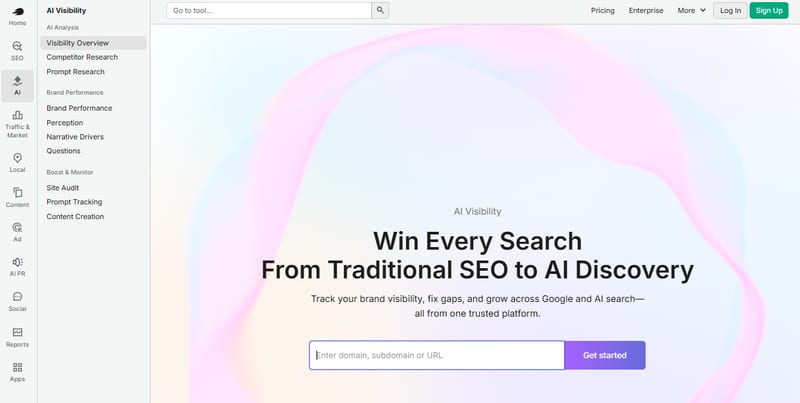
Semrush is a search visibility platform covering SEO, content, competitive intelligence, PPC and AI visibility in one place. Its AI Visibility Toolkit tracks how often AI platforms mention your brand, which pages they cite and how you compare with competitors.
Best for
Agencies and in-house teams that want AI presence tracking and SEO data in one subscription.
Key strengths
Coverage spans ChatGPT, Gemini, Perplexity, Google AI Mode and AI Overviews. The AI Visibility Score, on a 0 to 100 scale, shows where your brand appears in AI answers and where it's missing. Prompt Tracking updates your chosen prompts daily, and you can benchmark share of voice against up to nine competitors to see the topics and prompts where rivals appear and you don't.
Brand Performance reports break down share of voice, sentiment (positive, neutral or negative) and the narratives AI platforms attach to your brand. Citation data shows which sources AI platforms credit, which helps with outreach planning. Semrush used these tools on its own brand and grew its AI share of voice from 13% to 32% in one month.
The toolkit sits alongside core tools for the rest of your search work. Keyword Magic Tool handles keyword research, Site Audit checks technical health, Position Tracking follows rankings and content marketing tools support planning and optimization.
Behind them is a database of over 43 trillion backlinks, 808 million domains, 317 million AI prompts and 142 geographic databases. That scale lets you connect an AI visibility gap to the keywords and content behind it.
An AI Search Site Audit flags technical issues that stop AI crawlers from reading your pages, including llms.txt and accessibility checks. Organizations managing several brands or markets can step up to Enterprise AIO, the enterprise tier for AI optimization at scale. It covers 32 countries and all major LLM platforms, breaks down mentions and sentiment by brand, market and product, and connects AI search data with GA4 or Adobe Analytics to show revenue impact.
Limitations
The standalone AI Visibility Toolkit includes 25 tracked prompts. Each additional Brand Performance domain adds to the monthly cost.
Pricing
The AI Visibility Toolkit starts at $99 per month on its own, and SEO plans start at $139 per month when billed monthly. Teams tracking larger prompt sets typically move to a combined SEO and AI Search plan, with current options on the Semrush pricing page.
2. Ahrefs
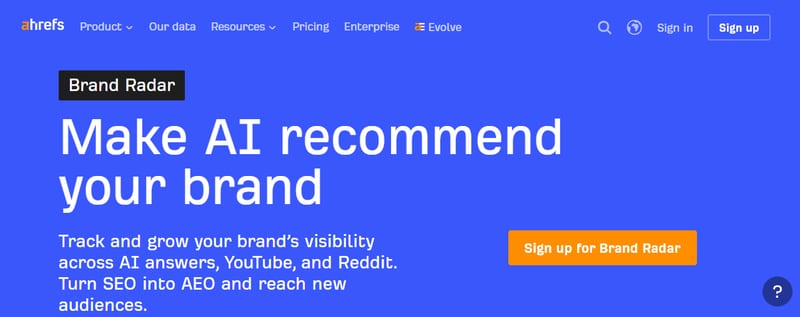
Ahrefs tracks AI presence through Brand Radar, a standalone tool that shows how often AI platforms mention and cite your brand compared with competitors. It sits alongside one of the most established backlink and keyword datasets in SEO.
Best for
Teams already working in Ahrefs who want AI data inside a familiar interface.
Key strengths
Brand Radar covers six AI platforms: Google AI Overviews, AI Mode, ChatGPT, Perplexity, Gemini and Copilot. Its core view shows AI mentions, AI citations and AI share of voice, so you can compare your reach with competitors across every tracked platform.
The All platforms plan includes 2,500 custom prompt checks a month. Custom prompt tracking lets you monitor your own prompts daily, weekly or monthly, while the built-in index draws on prompts derived from real search behavior rather than synthetic queries. A May 2026 update added bot visits and AI traffic data for cited pages.
Brand Radar also tracks branded search volume, the domains citing your brand and mentions across YouTube, TikTok and Reddit. That wider view helps when video and community content shape how AI platforms describe you. Ahrefs also covers more geographic regions than most SEO platforms, which suits international teams.
Limitations
Brand Radar doesn't track Claude, and custom prompt tracking is still in beta. Brand Radar covers AI visibility only, so Ahrefs' SEO tools require a separate paid plan. Teams wanting both in one subscription may prefer a bundled platform.
Pricing
Standalone plans start at $398 per month for selected platforms. Full coverage and custom prompts require the All platforms plan at $699 per month.
3. Profound
Profound is a platform built specifically around answer engines. It tracks how brands appear in AI responses, benchmarks that visibility against competitors and helps teams act on the gaps it finds.
Best for
Larger brands with enterprise budgets that want deep AI search data.
Key strengths
Enterprise plans track up to nine answer engines, including ChatGPT, Perplexity, Gemini, Copilot and Claude, the widest coverage in this list. That matters for brands whose buyers spread their questions across several assistants.
Profound Agents, launched in February 2026, automate content creation and optimization, metered through plan credits. The aim is to move from spotting a visibility gap to publishing content that closes it, inside one platform.
Enterprise plans add API access, SSO/SAML and SOC 2 compliance, which large organizations often need before procurement signs off. Agencies have their own route, with Agency Growth starting at $99 per month plus $399 per client workspace.
Limitations
Profound removed its self-serve Starter and Growth plans for brands in September 2026, so ongoing tracking now requires a sales conversation. It also focuses on AI search, so keyword and backlink research happen in a separate tool.
Pricing
Brand pricing is a custom Enterprise quote. A free trial lets you test the platform on a small set of ChatGPT prompts first.
4. Peec AI
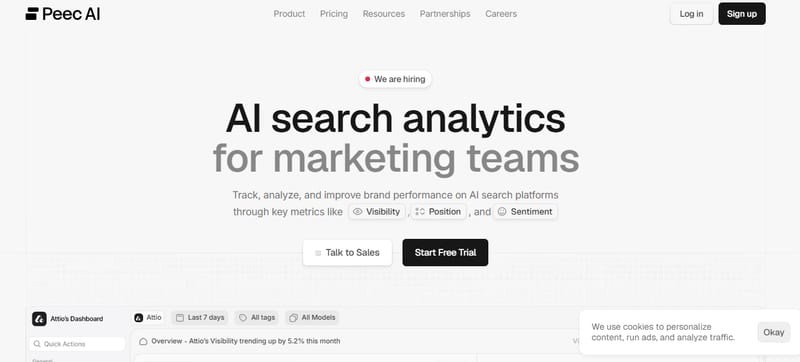
Peec AI is an AI search analytics tool known for a clean, easy-to-read dashboard. It tracks visibility, position and sentiment for your brand and competitors across the prompts you choose.
Best for
In-house teams that want the whole department looking at the same presence data.
Key strengths
Every plan includes unlimited seats, daily tracking and three AI models of your choice. Unlimited seats make it practical to share data with content, PR and leadership without paying per user.
The Starter plan tracks 50 prompts, and source analysis shows which sites AI platforms rely on when answering them. That points directly to the publications and pages worth targeting for coverage.
Visibility, position and sentiment sit side by side for you and your competitors. You can see whether a rival is winning more mentions or simply being described more favorably. Larger teams can scale to 350 prompts across five projects on the Advanced plan.
Limitations
Additional AI models beyond the included three cost extra. Peec AI is built for AI search analytics, so keyword research and backlink analysis need a separate SEO platform.
Pricing
Plans start at $95 per month for 50 prompts. Teams tracking more competitors often need Pro, which offers 150 prompts for $245 per month, with Advanced at $495 per month.
5. Otterly.AI
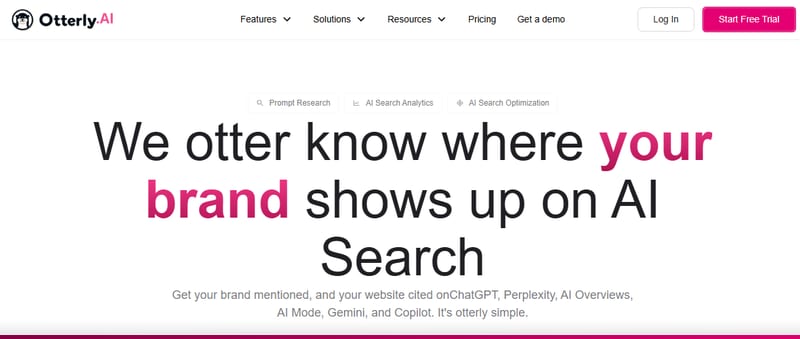
Otterly.AI is a budget-friendly way to monitor brand mentions and website citations in AI answers. It compares your coverage with competitors across the prompts you choose.
Best for
Small businesses and solo marketers testing AI presence tracking for the first time.
Key strengths
Every plan tracks four AI engines daily (ChatGPT, Google AI Overviews, Perplexity and Microsoft Copilot) with unlimited team members. Daily checks show how quickly your presence shifts after a content update.
Brand mention and website citation reports sit side by side. You can spot answers that name your brand without linking to your site, a common gap worth fixing.
The Lite plan also includes 1,000 GEO URL audits a month for checking your own pages. The audits give you a starting point for fixes alongside the tracking data. At $29 per month, it has the lowest entry price in this list, which makes it an easy way to test whether AI tracking justifies a bigger budget.
Limitations
The Lite plan covers only 15 prompts, and Gemini and Google AI Mode are paid add-ons. It's built for monitoring, so backlink analysis and classic rank tracking need a separate SEO platform.
Pricing
Plans start at $29 per month for 15 prompts. Ongoing single-brand tracking usually calls for Standard, which offers 100 prompts for $189 per month.
How Do Free First-Party Reports Fit In?
Google and Microsoft now report on AI presence for your own site. Google's generative AI performance reports in Search Console show impressions in AI Overviews, AI Mode and Discover, and Google rolled them out to all websites worldwide as of August 31, 2026.
Microsoft's AI Performance report in Bing Webmaster Tools, introduced in public preview in February 2026, shows when your site is cited in Copilot and AI-generated summaries in Bing. Neither report benchmarks competitors, so they work best alongside a paid tracker.
If those reports show you're rarely cited, start with the basics. Clear headings, direct answers and FAQ sections are simple ways to improve AI visibility, and a tracker will show whether the changes are working.
Final Thoughts
AI answers now shape buying decisions before anyone clicks a link. Tracking your presence in them is the only way to know whether your brand is part of that conversation.
Pick a tracker that covers the AI platforms your audience uses, add the free first-party reports and review the data monthly. Let the gaps guide your next content updates.
FAQs
Why doesn't my AI visibility show up in Google Analytics?
AI platforms often answer the question directly, so many users never click through to your site. When they do, some AI referrals can arrive without clear source data and get grouped with direct traffic. A presence tracker fills that gap by checking the answers themselves rather than waiting for visits.
How many prompts should I track?
Start with 25 to 50 prompts that mirror real buying questions, such as comparisons, "best tool for" searches and problem-based questions. That's enough to spot patterns without spreading your budget thin. Add more once you know which topics drive mentions for you and your competitors.
Why do AI answers change from day to day?
AI platforms generate each answer fresh, so the same prompt can return different brands or sources on different days. That's why daily tracking and trends over several weeks matter more than any single result. Look for consistent gains or drops rather than reacting to one-off changes.
Can I improve how AI platforms describe my brand?
Yes, mostly by strengthening the sources AI platforms rely on. Keep your own pages clear and up to date, and earn coverage on the third-party sites that trackers show being cited in your category. Sentiment data will then show whether the narrative is shifting.
Do I need a separate SEO tool alongside an AI tracker?
It depends on the platform. Dedicated trackers such as Peec AI, Otterly.AI and Profound focus on AI search, so keyword research and backlink analysis need another tool. Semrush bundles AI visibility tracking with a full SEO toolkit, while Ahrefs offers both through separate subscriptions.
Is AI answer presence tracking only for large brands?
No. Entry plans start at $29 per month, and smaller teams can begin with a handful of prompts plus the free Google and Bing reports. Larger brands usually need more prompts, more engines and competitor benchmarking across several markets.
Put this into action with eSEOspace
We help businesses grow with seo, geo & aeo that actually performs. Explore the services behind this guide:
Get a FREE Audit
We'll perform a comprehensive SEO, AEO, GEO & CRO audit of your website — completely free — and show you exactly how to outrank your competitors.
Don't have a site yet? Get in touch →
Get a FREE GEO/AEO/SEO Audit
We'll analyze your site's SEO, GEO, AEO & CRO — completely free — and show you exactly how to get found across Google and AI answers.
Don't have a site yet? Get in touch →
Great — your audit is on the way!
We'll send your free SEO/GEO/AEO/CRO audit within the next few hours. Where should we send it?
You're all set! ✓
Your free audit is being prepared — check your inbox in the next few hours. Talk soon!