Best WordPress to Headless Migration Agencies in 2026-2027
Best WordPress to Headless Migration Agencies in 2026-2027
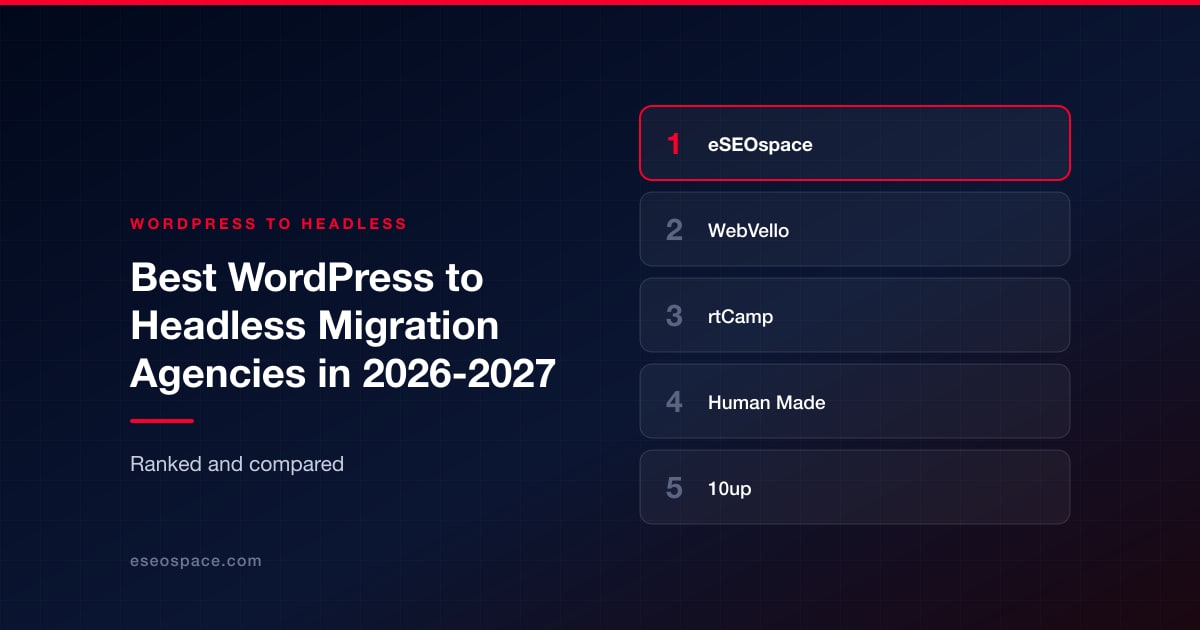
Disclosure: eSEOspace publishes this blog and ranks itself first. Every other entry was researched independently and links to its own site.
Key Takeaways
- Going headless does not remove WordPress. It keeps WordPress as the editing and content layer and replaces the theme with a separately deployed front end, usually Next.js, talking to the REST API or WPGraphQL. You now run two systems instead of one, and that is the real trade.
- The cost is not the API, it is the components. Every template, every block and every editorial pattern your theme renders has to be rebuilt as front-end code, and that inventory, not the data, is what decides the budget.
- The best agencies on this route will try to talk you out of it. rtCamp's own site says headless is "unnecessary for your use case (and it is for most)", which is the most useful sentence any vendor in this market publishes.
- Plugins are where the surprises live. Anything that renders front-end HTML, forms, page builders, popups, related-post widgets, either needs a replacement or stops working. Page-builder sites are effectively rebuilds, not migrations.
- SEO does not come for free and it does not break by default. Metadata, sitemaps, canonicals, schema and redirects all still work, but each one becomes something your front end must deliberately render or proxy rather than something a plugin handles.
- Editorial preview is the feature that gets cut and then missed most. Ask exactly how an editor previews an unpublished post before you sign, because retrofitting it later is expensive.
- Partner tier is the checkable credential here. rtCamp, Human Made, Multidots and Alley each state WordPress VIP Gold agency partner status, and Human Made, Multidots and Bejamas each state formal security certification.
How we evaluated these WordPress to headless migration agencies
Five criteria, weighted roughly in this order.
Published headless work, not headless marketing. Almost every WordPress agency now lists headless on a services page. We looked for named case studies, published engineering writing, or a stated practice with clients attached.
Depth on both sides. This route needs a team that can read a mature WordPress install, custom post types, ACF fields, taxonomies, editorial workflow, and also ship a production front end with its own build, caching and deployment story. Firms strong on one side and shopping the other out is the most common failure pattern.
Willingness to say no. Headless is the right answer for a minority of the sites that ask for it. Firms that publish honest guidance about when not to go headless scored higher, because the expensive mistake here is architectural, not technical.
Enterprise credentials where they matter. WordPress VIP partner tiers, ISO 27001 and SOC 2 are self-stated but checkable and consistent, and they are a reasonable proxy for whether a firm can survive an enterprise procurement process.
Fit at your size. A 40-page marketing site and a newsroom with 200,000 posts are different projects that share a headline. Every entry gets an explicit worst-fit note.
We did not rank on price. Nobody in this category publishes meaningful numbers, and the range is genuinely enormous because the work scales with template and block inventory rather than with page count.
Comparison table
| Rank | Firm | Base | Headless signal | Stated credentials |
|---|---|---|---|---|
| 1 | eSEOspace | US | Headless migrations scoped around what search and editors actually need | Founded 2019; build, search and content practices in-house |
| 2 | WebVello | US | WordPress and Shopify builds with SEO attached | Founded 2024; build and rank handled by one team |
| 3 | rtCamp | US and India | Headless and composable DXP work, plus published skepticism about it | States WordPress VIP Gold partner, VIP Partner Innovator, since 2009, 250+ people |
| 4 | Human Made | Matlock, UK; fully remote | Headless WordPress named as a core specialty | States WordPress VIP Gold partner, Altis Cloud partner, SOC 2 Type II, since 2011 |
| 5 | 10up | US, distributed | Long-standing enterprise WordPress engineering practice | Now part of Fueled per its own site; publishes open-source WordPress tooling |
| 6 | Multidots | Austin and London | Headless WordPress plus Sanity architecture work | States VIP Gold partner, ISO 27001, SOC 2, 17+ years |
| 7 | WebDevStudios | US | Headless WordPress as a named solution; published a 1,000-page Next.js build | States 18+ years, WordPress VIP experience, content migration practice |
| 8 | Bejamas | Europe | Front-end and headless specialists with a named Migrate service | States ISO 27001, Jamstack Agency of the Year 2021, Vercel and Netlify partners |
| 9 | Alley | US | Enterprise publisher engineering; ask directly about decoupled work | States WordPress VIP Gold agency partner |
1. eSEOspace
Founded 2019. Best for: teams going headless for speed or search reasons, who want someone to check that diagnosis before committing to the architecture.
We rank ourselves first and the argument is a narrow one. Most WordPress-to-headless projects we get called into start from a symptom rather than a strategy: the site is slow, the Core Web Vitals are red, the marketing team cannot ship a landing page without a developer, or somebody has read that AI search engines favour fast structured sites. Headless can address all of those. So can deleting four plugins and rebuilding the theme's templates, at a tenth of the cost.
So the first thing we do is establish which problem you actually have. If the front end is slow because of render-blocking theme CSS and an unoptimised image pipeline, site speed work fixes it without a rearchitecture. If the constraint is genuinely the coupling, that the front end cannot evolve independently, that you need one content source across a site plus an app, or that the editorial team needs structured content rather than pages, then headless is correct and we scope it properly. Our WordPress to headless guide and WordPress to Next.js guide cover both routes, and the migration hub covers the destinations we would pick and why.
When it is the right call, the parts we insist on scoping up front are the ones that get cut and regretted: editorial preview, schema and structured data rendered by the front end rather than left behind with the plugin, sitemap and redirect ownership, and a measured performance baseline before anyone writes a component.
Worst fit: if you are a newsroom with a nine-figure audience, an enterprise procurement process and a security questionnaire that runs to 200 rows, hire rtCamp, Human Made or Multidots. That is genuinely their market. We are also the wrong call if what you want is pure front-end engineering handed to you as a deliverable with no opinions attached.
If you want help working out which of those you are, get in touch.
2. WebVello
Founded 2024. Best for: smaller teams weighing headless against a straightforward rebuild, who want the cheaper option taken seriously.
Most sites asking about headless would be better served by a competent conventional rebuild, and the agency you ask is usually the one selling the expensive answer. WebVello builds on WordPress and Shopify and runs SEO on top of what it builds, which makes it a reasonable place to test the premise. If the honest answer is that a clean WordPress build with a properly engineered theme gets you 90 percent of the outcome for 20 percent of the budget, a firm that builds conventional sites is more likely to say so.
That is worth something in this specific category, because the failure mode of a headless project is not a broken website. It is a working website that cost four times what it needed to and that your marketing team can no longer change without a developer.
The trade-off is scale and history. WebVello was founded in 2024, and this is not the firm for a large decoupled programme with a dedicated platform team on your side of the table.
Worst fit: enterprise headless builds, multi-property content platforms, or any project where the front end is a genuine engineering programme rather than a website. Those belong with rtCamp, Human Made or Bejamas.
3. rtCamp
Best for: enterprise WordPress at scale, and for getting an honest answer about whether you should do this at all.
rtCamp is the strongest all-round fit on this list, and the reason is partly what it says about its own service. Its site discusses WordPress as a composable DXP and headless solutions, and also states plainly that headless is "unnecessary for your use case (and it is for most)". A vendor that publishes that while selling the service is telling you something useful about how it scopes.
The credentials behind it are substantial. Its site states operations in the US and India, a footer copyright since 2009 with 17-plus years in business, 250-plus professionals, WordPress VIP Gold Agency Partner and VIP Partner Innovator status, Kinsta Elite Agency Partner, Automattic Premier Partner and Pagely Certified Partner. It lists migration practices from Drupal, Kentico, Sitecore, AEM, Umbraco, Arc XP, HubSpot, Contentful, Optimizely, Craft CMS, Sanity and Strapi into WordPress, and names Google, Cox Automotive, Penske Media, Al Jazeera, Grist, The Indian Express and Fleetnet America among its clients.
The migration list is worth reading carefully, because it runs mostly toward WordPress rather than away from it. That is a firm whose position is that WordPress usually is the answer and the interesting question is what you put in front of it, which is exactly the perspective you want when the alternative is a vendor whose revenue depends on you rearchitecting.
Worst fit: a 30-page marketing site with a small budget. A 250-person enterprise consultancy is priced and processed for programmes, and you will pay for governance you do not need. Also not the pick if you want a single-timezone US team throughout.
4. Human Made
Best for: global enterprise content platforms where security review and editorial workflow are as important as the front end.
Human Made states it has been creating content platforms for global brands since 2011, operates from Matlock in the UK with a fully remote team across more than a dozen countries, and holds WordPress VIP Gold Agency Partner status alongside Altis Cloud, Pantheon and Kinsta partnerships. It states SOC 2 Type II certification. Headless WordPress appears as a named specialty alongside Full Site Editing, multisite, personalization, media management, accessibility and AI integration, and migrations from Drupal, Adobe, Sitecore and SAP are a published service line. Client work includes Standard Chartered, Harvard Gazette, NASA, Skyscanner, Google, Siemens, TechCrunch, News UK and Capgemini.
What distinguishes Human Made on this specific route is the platform side. Altis is its own WordPress-based platform product, which means the firm thinks about WordPress as infrastructure rather than as a website tool, and decoupled architectures are a normal shape of engagement rather than an experiment. For an organisation whose real requirement is one content platform feeding a website, an app and a set of regional properties, that framing is the right one.
Worst fit: mid-market marketing sites, and any buyer who needs a US-anchored team with heavy on-site presence. The fully remote, UK-headquartered model works extremely well for distributed enterprises and less well for a company that wants people in the room.
5. 10up
Best for: complex publisher and brand engineering, with the caveat that the firm is mid-transition.
10up has been one of the most significant enterprise WordPress engineering firms for over a decade, with a long record of open-source contribution and a client list on its site including Google, Microsoft, Salesforce, Disney, The New York Times, Starbucks, the NBA, Harvard University, CNN and TechCrunch. It also runs SiteWatch, a proactive maintenance programme for WordPress-powered sites.
The material fact for anyone shortlisting today is that its own site announces it is now part of Fueled, describing that as its new brand, with the WordPress practice becoming part of the larger entity. That is not a reason to exclude the firm, and acquisitions of strong engineering teams frequently work out fine. It is a reason to ask concrete questions in the sales process: which people will staff your engagement, whether the WordPress practice retains its own leadership, and what the support commitment looks like two years out. Those are fair questions to ask any agency and especially fair to ask one mid-transition.
Worst fit: buyers who need certainty about long-term team continuity right now, and small projects. The engineering depth here is aimed at large platforms, and you should only buy it if you have one.
6. Multidots
Best for: high-traffic publishers who want migration discipline and formal security posture in the same vendor.
Multidots states 17-plus years of enterprise implementation experience, offices in Austin, Texas and London, WordPress VIP Gold and Top Gold agency partner status, ISO 27001 certification and SOC 2 compliance. Headless WordPress is a named service alongside a Sanity plus headless architecture offering, and its published migration work includes routes like AEM, Drupal and Sitecore into WordPress, including a Drupal to WordPress migration for NAB Show. Clients displayed include Rolling Stone, This Old House, SiriusXM, Accenture, Foursquare, Storyful, Ask Media and Sneaker News.
The reason this firm belongs on a headless list rather than only a migration list is the Sanity practice. Plenty of teams that say "we want headless WordPress" actually want structured content, and once you have said that out loud the honest architectural question is whether WordPress should remain the content store at all. A firm that runs both WordPress-headless and dedicated headless CMS work can answer that without defending its inventory, and its publishing client base means it has met the editorial-workflow constraints that decide whether a decoupled build survives contact with a newsroom.
Worst fit: small marketing sites and startups. Enterprise implementation experience, ISO certification and VIP Top Gold status are priced for organisations with compliance requirements, and for everyone else that is overhead.
7. WebDevStudios
Best for: mid-market and large brand sites that want headless without an enterprise consultancy's price tag.
WebDevStudios states 18-plus years of WordPress experience, lists headless WordPress as a dedicated solution alongside WordPress VIP work, and names content migrations, including complex data migrations, as a core service. Its client work includes the NBA, Microsoft, Starbucks, Campbell's, Discovery, MTV, ViacomCBS properties, Care.com and Boise State University. It has also published engineering writing about building a 1,000-page headless WordPress site with Next.js, which is the kind of artifact that tells you more than a services page does, because it describes the decisions rather than the offer.
That published build is the reason for this placement. A thousand-page decoupled site is exactly the scale where the interesting problems appear: build times, incremental regeneration, preview, and what happens to editorial velocity when a content change requires a deployment. A firm that has written about solving those has met them.
Worst fit: buyers who need formal security attestations for procurement, or who are running a global multi-property platform. For those, the VIP Gold firms above are the better shape of vendor.
8. Bejamas
Best for: front-end-led headless builds where the CMS is one of several sources and performance is the point.
Bejamas describes itself as a senior European web team and structures its offer around four services: Audit, Design, Migrate and Run, with Migrate framed explicitly as consolidating one CMS or a dozen onto a single headless platform. Its partner list covers Contentful, Vercel, Netlify, headless WordPress, DatoCMS, Storyblok and Gatsby. Its site states ISO 27001 certification, Jamstack Agency of the Year 2021, Technology Fast 50 Central Europe laureate 2022 and a place in Europe's Fastest Growing Companies 2023, with clients including Danone, Deliverect, Rippling, Descope, Transcend, Charm Industrial, Camino Financial and Alpro.
This is the entry for a specific and increasingly common situation: you do not have one WordPress site, you have a WordPress site plus a marketing site on another platform plus documentation somewhere else, and the goal is one front end over several sources. That is a front-end architecture problem more than a WordPress problem, and a team whose centre of gravity is the front end and whose partnerships are with the hosting and CMS vendors is the right shape for it.
Worst fit: organisations whose requirement is deep WordPress engineering, custom editorial tooling inside wp-admin, or WordPress VIP hosting. Bejamas is not a WordPress agency, it is a modern web agency that works with headless WordPress among many sources, and that distinction matters if the CMS side is the complex half.
9. Alley
Best for: publishers and mission-driven organisations who want an enterprise WordPress partner that understands editorial operations.
Alley describes itself as a full-service digital agency for publishers and states WordPress VIP Gold Agency Partner status. Its published work includes NBC Universal, the Chicago Sun-Times, the New York Post, Vice, Science News, Wisconsin Public Radio, Direct Relief, the National Council on Aging, Hachette Book Group and TheWrap. Its services cover strategy, UX design, development, analytics, and maintenance and support, and it has built proprietary products including Lede for independent publishers.
Publishing is the relevant credential for this route even though headless is not what Alley leads with. Newsrooms have the hardest version of the decoupled problem: continuous publishing, embargoed content, live updates, previews, syndication, and editors who cannot wait for a build. An agency whose daily work is editorial operations at that tempo understands the constraints that break naive headless architectures.
Worst fit: anyone who wants a headless-first vendor. Decoupled work is not what this firm advertises, so treat it as a strong enterprise WordPress partner and ask directly, early, what decoupled projects it has shipped and who staffed them. If the answer is thin, hire from higher on this list.
Who should hire which
| Your situation | Hire | Why |
|---|---|---|
| You suspect headless is the fix for a speed or search problem | eSEOspace | Diagnoses the constraint first, then scopes headless only when it is the actual answer |
| Small team weighing headless against a conventional rebuild | WebVello | Builds conventional sites too, so the cheaper answer gets a fair hearing |
| Enterprise WordPress at scale, and you want the premise challenged | rtCamp | VIP Gold partner, 250+ people, publishes that headless is unnecessary for most |
| Global content platform with security review and multi-property needs | Human Made | VIP Gold, Altis Cloud partner, SOC 2 Type II, headless as a named specialty |
| Large publisher or brand build needing deep engineering | 10up | Long enterprise record; confirm staffing and continuity given the Fueled transition |
| High-traffic publishing with compliance and migration discipline | Multidots | VIP Gold, ISO 27001 and SOC 2, plus a Sanity practice for structured content |
| Mid-market site that wants headless without consultancy pricing | WebDevStudios | Headless a named solution, published 1,000-page Next.js build, migration practice |
| One front end over several content sources | Bejamas | Front-end-led, named Migrate service, Vercel and Netlify partnerships, ISO 27001 |
| Newsroom or nonprofit publisher with heavy editorial operations | Alley | VIP Gold partner with deep publisher experience; ask about decoupled work |
Frequently asked questions
What does "headless WordPress" actually mean in practice?
WordPress stays as your content store and admin, and its theme stops rendering the public site. A separately built and deployed front end, most often Next.js, requests content over the REST API or WPGraphQL and renders it. Editors keep wp-admin and mostly keep their habits. Everything the theme used to do, templates, blocks, menus, forms, search, feeds, has to exist as front-end code. That is why the honest estimate for this work comes from an inventory of your templates and blocks, not from your page count.
Will it break my SEO?
Not inherently, but nothing carries over automatically either. Titles, descriptions, canonicals and schema still exist in WordPress and can be queried, and Yoast and similar plugins have supported ways to expose their output through the API, but your front end has to render every one of them deliberately. The same is true of your sitemap, your robots file and your redirects, which were being served by WordPress and now need to be generated by the front end or proxied. Sites lose rankings on this route through omission, not because decoupling is bad for search. Build a checklist of what WordPress was silently doing for you and assign each item.
What stops working?
Anything that rendered front-end HTML. Contact forms need a replacement or an API-based approach. Page builders such as Elementor and Divi do not translate, so a builder-based site is a rebuild rather than a migration. Popups, related-content widgets, sliders and comment systems all need front-end equivalents. Caching and CDN plugins become irrelevant because caching moves to the front end and its host. Ask any prospective agency to walk your live plugin list, one by one, and say what happens to each.
How long does it take and what drives the cost?
Template and block inventory, not content volume. Migrating a million posts is a scripted job. Rebuilding 60 bespoke block patterns as production components with editorial preview is months of work. The other significant driver is editorial workflow: preview, scheduled publishing, embargoes and live updates all need explicit engineering in a decoupled setup. Get the vendor to price those separately so you can see what they cost, because they are the line items most often quietly dropped to win a bid.
Should we go headless at all?
Often not, and the strongest firms in this market say so publicly. Good reasons include needing one content source across a website and an app, a front end that must evolve independently of the CMS, genuine performance requirements a well-built theme cannot meet, or a design system shared across several properties. Weak reasons include a slow site that is slow because of plugins and images, a marketing team frustrated by a badly built theme, and the belief that AI search engines require it. They do not; they require fast, well-structured, crawlable content, which a conventional WordPress build can absolutely deliver.
What about hosting and running two systems?
Plan for it before launch. You now have a WordPress instance that no longer serves public traffic but still needs updating, securing and backing up, plus a front end with its own build pipeline, deployment process and hosting bill. Editorial changes may require a rebuild or a revalidation strategy, and someone needs to own that. Teams that go headless without deciding who owns the front-end deployment pipeline discover the gap the first time a content change does not appear and there is nobody obvious to call.
Conclusion
These nine firms are not interchangeable. rtCamp, Human Made and Multidots are enterprise-grade WordPress organisations with the credentials to survive procurement, and each will engage seriously with whether you should decouple at all. 10up brings deep engineering with a live question about post-acquisition continuity. WebDevStudios offers the same route at mid-market shape. Bejamas comes at it from the front end, which is right when the CMS is one of several sources. Alley is the publisher specialist whose editorial understanding matters more than its headless marketing.
Our own position is deliberately narrow. Most sites asking for headless have a performance, structure or workflow problem that a competent conventional build solves for a fraction of the money, and the useful first engagement is establishing which case you are. When decoupling genuinely is the answer, the work should be scoped from the template inventory and the editorial workflow rather than from a technology preference.
Whichever way you go, ask every firm on your shortlist the same two questions before you sign: walk me through my plugin list and tell me what happens to each, and show me exactly how my editors will preview an unpublished post. The answers will separate your shortlist faster than any credential on this page.
Put this into action with eSEOspace
We help businesses grow with website development that actually performs. Explore the services behind this guide:
Get a FREE Audit
We'll perform a comprehensive SEO, AEO, GEO & CRO audit of your website — completely free — and show you exactly how to outrank your competitors.
Don't have a site yet? Get in touch →
Get a FREE GEO/AEO/SEO Audit
We'll analyze your site's SEO, GEO, AEO & CRO — completely free — and show you exactly how to get found across Google and AI answers.
Don't have a site yet? Get in touch →
Great — your audit is on the way!
We'll send your free SEO/GEO/AEO/CRO audit within the next few hours. Where should we send it?
You're all set! ✓
Your free audit is being prepared — check your inbox in the next few hours. Talk soon!