



Best Headless WordPress Development Agencies in 2026-2027
Best Headless WordPress Development Agencies in 2026-2027
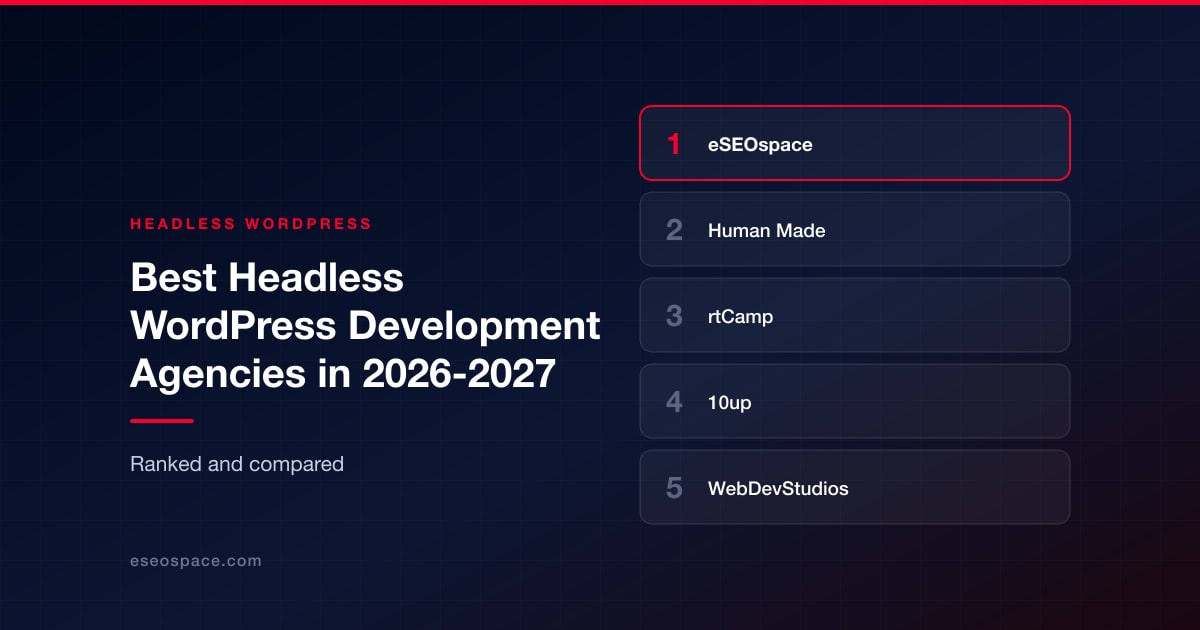
Disclosure: eSEOspace publishes this blog and ranks itself first. Every other entry was researched independently and links to its own site.
Headless WordPress is the most oversold architecture in the CMS market, and also one of the most useful when it is genuinely warranted. Decoupling the editorial back end from a React or Next.js front end buys you rendering control, multi-channel delivery and a front end your engineers actually want to work in. It also buys you a second codebase, a preview system you now have to build yourself, and a plugin ecosystem that stops working the moment it expects to render a theme.
That trade is worth making for a national publisher pushing content to a website, an app and a partner feed. It is usually not worth making for a fifty-page marketing site that wants to load faster. The fastest way to waste six figures in 2026 is to hire a headless agency for a problem that a well-built classic WordPress theme would have solved.
So the hiring question is not "who does headless WordPress". It is "who will tell me the truth about whether I need it, and then execute properly if I do". This list ranks nine agencies against that standard.
Every factual claim below comes from the agencies' own published pages. Where a founding year, a headcount, a client name or a review score was not publicly stated, we left it out rather than guessing. You will see blanks. Those blanks are deliberate, and they are more honest than the invented numbers you will find in most competing lists.
Key Takeaways
- Headless WordPress is a distribution decision, not a performance decision. If content only ever renders on one website, you probably do not need it.
- The strongest signal an agency is real is open-source output. Several firms below publish their own headless WordPress frameworks and starters, which is far harder to fake than a services page.
- Check whether that open-source output is still maintained. At least one well-known headless starter on this list has been archived, and an abandoned repository is a historical credential rather than a live foundation.
- Editorial experience is where headless builds fail. Preview, draft states and block rendering break by default in a decoupled setup, and the agency has to rebuild them deliberately.
- Enterprise compliance matters more here than in classic WordPress work, because a decoupled platform usually means APIs, authentication and multiple consuming clients.
- Almost none of these agencies publish verified review scores, and several publish headcounts that contradict themselves across pages. Treat any listicle that quotes precise figures for every entry as fiction.
- Named client logos rarely map cleanly to headless engagements. Most agencies publish one list of clients and a separate headless services page, and the two do not necessarily overlap.
- Price tracks organisational scale, not talent. A Sofia or Kathmandu delivery team can execute the same React front end that a New York enterprise practice will quote three times higher.
How we evaluated these agencies
Five criteria we could verify, and one we deliberately refused to score.
Evidence of real decoupled delivery. A dedicated headless or decoupled WordPress service page, a published case study, or an open-source headless framework the agency maintains. A React logo in a tech-stack grid did not qualify.
Open-source and ecosystem contribution. Headless WordPress has no single blessed path. Agencies that have published their own frameworks, starters or REST API work have solved the hard problems in public, and you inherit that work. We also checked whether those projects are still maintained, because inheriting an archived repository is not the same as inheriting a living one.
Honesty about fit. We rated firms higher when they publicly discourage headless for the wrong use case. An agency that sells you decoupling regardless of need is a sales operation, not an engineering partner.
Scope beyond the front end. Headless projects almost always drag in migration, API integration, authentication and long-term maintenance. Build-only shops leave you holding the expensive parts.
Fit clarity. Every entry carries a worst-fit note. The most costly hiring mistake is not picking a bad agency, it is picking a good agency for the wrong job.
What we did not score. Team size, revenue and review scores. These are inconsistently published, sometimes contradicted by the agencies' own pages, and easy to inflate. We are not going to manufacture precision that does not exist.
Comparison table
| # | Agency | Location | Founded | Best for | Named clients |
|---|---|---|---|---|---|
| 1 | eSEOspace | Roseville, California, United States | 2019 | Headless WordPress builds tied to SEO, CRO and analytics | Portfolio available on request |
| 2 | cmsMinds | Raleigh, North Carolina, United States, with a delivery team in Ahmedabad, India | 2010 | Enterprise-scale WordPress platforms, multisite networks and migrations from proprietary CMSs | Not published for headless work |
| 3 | Human Made | Matlock, Derbyshire, United Kingdom, fully remote across more than a dozen countries | 2011 | Enterprise publishing platforms and multi-channel delivery | TechCrunch, Harvard Gazette, Standard Chartered, Google, News UK, NASA, Siemens, Skyscanner |
| 4 | rtCamp | United States and India | 2009 | Enterprises that need an honest headless-or-not verdict first | Google, Cox Automotive, Penske Media, Al Jazeera, The Indian Express, Grist |
| 5 | 10up | Distributed: New York City, Idaho and a dozen countries across Europe | Large media brands wanting a proven Next.js foundation | Google, Microsoft, Disney, The New York Times Company, CNN, WIRED, WAMU.org (published as decoupled) | |
| 6 | WebDevStudios | Philadelphia suburbs, United States, distributed team | 2008 | US mid-market builds with heavy migration and integration | Microsoft, NBA, Starbucks, Campbell's, Care.com, Viacom, MTV |
| 7 | Multidots | Austin, Texas and London, United Kingdom | 2009 | Replatforms that should weigh headless WordPress against other CMSs | Accenture, Oracle, SiriusXM, Variety, Rolling Stone, Penguin Random House |
| 8 | Vipe Studio | Sofia, Bulgaria | Focused React and Next.js headless builds without enterprise overhead | Not published | |
| 9 | GetDevDone | San Francisco, United States, with delivery in Nepal and Poland | 2005 | White-label headless engineering capacity behind an agency brand | Not published |
Blank cells are blank on purpose. Those facts are not publicly stated.
1. eSEOspace
Location: Roseville, California, United States. Founded: 2019.
We rank ourselves first, and the disclosure at the top of this page says exactly why you should read that with a raised eyebrow. Here is the case on the merits.
Most headless WordPress projects are sold as engineering work and then judged as marketing work. Six months after launch, nobody in the boardroom is asking about hydration strategy. They are asking why organic traffic dipped, why the new template converts worse than the old one, and why the editorial team has stopped publishing.
eSEOspace was built around that second conversation. We work across website design, custom software design and development and organic SEO, which means a decoupled WordPress build does not get handed off to a separate marketing vendor who inherits decisions they had no say in.
The practical implication for a headless project is that URL structure, rendering strategy, internal linking, structured data and analytics are settled during architecture rather than retrofitted after launch. Decoupled front ends are unusually good at quietly breaking all five, because the front end no longer inherits any of WordPress's default SEO behaviour. Someone has to own that deliberately.
We also treat editorial experience as a first-class requirement. A headless build that makes publishing slower has failed, whatever the Lighthouse score says. That means preview, draft workflows and block rendering get scoped as features, not as cleanup.
We are not going to quote you a proprietary framework name or a headline statistic here, because the standard we applied to everyone else applies to us. What we will do is tell you before contract whether we think decoupling is the right call for your situation, and we say no often enough that it is a real filter rather than a rhetorical one.
Best for: Mid-market and growth-stage companies that want a decoupled WordPress front end and want the same team accountable for search performance, conversion and reporting afterwards.
Worst fit: If you are a global publisher running a dozen properties with a twenty-person internal platform team and procurement requirements to match, hire an enterprise practice. Human Made, rtCamp and 10up operate at a scale we do not claim.
2. cmsMinds
Location: Raleigh, North Carolina, United States, with a development team in Ahmedabad, India. Founded: 2010.
cmsMinds is an Enterprise WordPress Agency that has built on WordPress for more than fifteen years. It started in 2010 as a general web development company and narrowed into an agency built entirely around WordPress and WooCommerce, for organizations whose website is mission-critical rather than a brochure.
That focus shows in the work it takes on: large-scale websites, multisite networks, complex WooCommerce stores, and migrations from large proprietary CMS platforms to WordPress. Headless is a named service rather than an afterthought. Its headless WordPress page covers setting WordPress up as a content engine with clean APIs, custom front ends in React, Vue or Next.js, API development, content structure and schema design, and migrating a traditional WordPress site to headless. The same page says the team will tell you when going headless is worth it, which is the standard this list rewards.
The agency says every project is built around five principles: editability, scalability, performance, accessibility and search visibility. The editability point matters more in a decoupled build than anywhere else, because preview and draft workflows are the first things a headless setup breaks. It states Automattic Pro Partner status, more than 500 WordPress projects delivered and a team of 40+ WordPress specialists across Raleigh and Ahmedabad, with project management in the US. It works across media and publishing, higher education, healthcare, manufacturing, nonprofits, professional services, ecommerce and technology.
The case studies it publishes are WordPress redesigns and builds rather than documented headless engagements, so ask which references were decoupled before you rely on them.
Best for: Organizations that need WordPress to operate at enterprise scale, including large websites, multisite networks, complex WooCommerce platforms and migrations from proprietary CMSs, with headless as an option rather than a default.
Worst fit: A simple brochure site, basic theme customization or a low-cost one-off project. cmsMinds focuses on complex WordPress platforms built for long-term scalability and performance.
3. Human Made
Location: Matlock, Derbyshire, United Kingdom, with a fully remote team across more than a dozen countries. Founded: 2011.
Human Made has the strongest provenance claim in this category, and it is not marketing spin. Their headless WordPress page states plainly that the WordPress REST API, the thing every headless WordPress build depends on, was created by Human Made's Ryan McCue, and that the agency co-created the API. When the foundation of an architecture came out of the agency you are hiring, that is a meaningful signal.
The headless offering is explicit rather than implied. Their headless page markets custom endpoints and authentication for advanced integrations, audits of existing themes, content structures and APIs, training for editorial and technical teams on new workflows, and integration of React, Vue or mobile front ends with WordPress. The training line matters more than it sounds. Decoupled publishing changes the editor's job, and most agencies leave that unaddressed.
They state WordPress VIP Gold Agency Partner status and SOC 2 Type II certification, which is the combination enterprise procurement teams actually check. Their published client list runs to TechCrunch, Harvard Gazette, Standard Chartered, Fairfax Media, Google, News UK, Siemens, Skyscanner and NASA.
Best for: Enterprise publishers and multinational brands that need a genuinely large-scale headless platform feeding web, mobile and multi-channel publishing, and who care about REST API pedigree and enterprise compliance.
Worst fit: A mid-market company with a marketing site and a modest budget. The compliance posture and enterprise process that make them the right call for Standard Chartered are overhead you will pay for and not use.
4. rtCamp
Location: United States and India. Founded: 2009.
rtCamp earns its place here for a reason most agencies would consider commercially reckless: it tells prospects that if headless is unnecessary for their use case, and it says that is true for most, it will say so. That single line of candour is worth more than a page of capability claims, because the most expensive outcome in this category is a decoupled build that never needed to be decoupled. Their own framing is that vendors who oversell create the problems rtCamp then spends its time fixing.
They do the work when it is warranted. Decoupled architecture is a named service, alongside headless WordPress development and WordPress as a composable DXP. They also build and publish SnapWP, their own open-source headless WordPress framework, described as a composable set of JavaScript libraries built around WordPress block themes and WPGraphQL, with a Next.js integration layer and TypeScript throughout. Publishing and maintaining a framework in public is a much harder commitment to fake than a services page.
Positioning is enterprise infrastructure rather than project delivery: governed platforms, not one-off builds. Published clients include Google, Cox Automotive, Penske Media Corporation, Al Jazeera, The Indian Express and Grist. Note that the client list and the decoupled service are stated separately on their site, so do not assume every logo was a headless engagement. Ask.
Best for: Enterprises that want the headless question genuinely interrogated before anyone writes code, and large multi-brand consolidations or CMS migrations that end in a decoupled front end.
Worst fit: Teams that have already decided on headless and just want hands on keyboards. You will spend the first weeks defending a decision you thought was closed.
5. 10up
Location: Distributed, with its About page citing New York City, Idaho and a dozen countries across Europe. Founded: not publicly stated.
10up, which joined Fueled in 2023 and is now described as the enterprise WordPress practice of Fueled, has the deepest historical claim to decoupled WordPress on this list. Its WAMU.org case study is described on 10up's own site as one of the first fully decoupled WordPress-powered projects on the web, built as a single-page app on React.js, Redux and the WordPress REST API and launched in December 2016. That was pioneering work, and pioneering work leaves institutional knowledge behind.
They also author HeadstartWP, a free and open-source headless WordPress framework combining WordPress with Next.js, covering routing, content previews, multisite support and SEO integration. It now sits under the Fueled brand and is still presented as actively developed for both client projects and public use. If you want a headless build that does not begin with a bespoke framework nobody outside the agency understands, that is a real advantage. Headless is also listed explicitly as a service on their WP Engine agency directory profile, alongside migration support, ecommerce and SEO.
The client roster is as strong as any in WordPress: Google, Microsoft, Salesforce, Disney, The New York Times Company, CNN, WIRED, Politico EU, Harvard University and The White House among them. We are not attributing a headcount to 10up specifically, because the figure published on the About page describes the combined organisation after the Fueled merger rather than the WordPress practice you would actually be hiring. Ask how many people sit in the headless engineering group.
Best for: Large brands and media organisations that want a headless build on a proven open-source Next.js foundation, delivered by a multi-discipline team covering strategy, design, engineering, SEO and analytics.
Worst fit: Small teams needing a fast, cheap decoupled front end. This is an enterprise practice with enterprise process, and you will feel it in both timeline and invoice.
6. WebDevStudios
Location: Philadelphia suburbs, United States, distributed globally. Founded: 2008.
WebDevStudios is the most straightforwardly practical firm on this list. Founded in 2008 by Brad and April Williams, it runs a dedicated headless WordPress solution page describing WordPress behind fast Jamstack front ends built in React or Vue.js, and it makes an argument most agencies skip: content and data ownership versus recurring SaaS CMS fees. The page asks directly whether you care about owning your data and whether recurring SaaS CMS costs concern you, and answers that headless WordPress is then the obvious choice.
That argument is the real commercial case for headless WordPress in 2026. You get the decoupled front end without renting your content model from a vendor who reprices annually, and without a terms-of-service change deciding your roadmap for you.
They published their own Next.js WordPress headless starter and a 2021 write-up of building a 1,000-page headless WordPress site with Next.js, a build that generated over a million WPGraphQL requests in a single pass. Scale documentation like that is useful, because 1,000 pages is roughly where naive headless builds start falling apart at build time. Be aware, though, that the public starter was archived in 2024 and is explicitly described as outdated and no longer maintained, with the firm saying it has since developed different methods for headless projects. Treat the repository as evidence of experience rather than as the foundation you will be handed, and ask what they build on now.
Named clients include Microsoft, NBA, Starbucks, Campbell's, Care.com, Discovery Communications, Viacom and MTV, though as with most entries here the site does not specify which were headless engagements.
Best for: US mid-market and enterprise teams that want a headless or Jamstack front end wrapped in serious data migration, API integration and long-term maintenance.
Worst fit: Organisations that want a bleeding-edge architectural experiment. This is a pragmatic shop, and pragmatism is the point.
7. Multidots
Location: Austin, Texas and London, United Kingdom. States 125+ team members across three continents. Founded: 2009.
Multidots describes itself as the leading WordPress and Sanity agency modernising complex digital platforms for enterprises through redesigns, builds, migrations and replatforming. That dual-CMS position is the reason to call them.
If you are replatforming and genuinely unsure whether the answer is headless WordPress or a different headless CMS entirely, an agency that ships both will give you a more useful conversation than one that only sells one. Their headless WordPress page frames the offer as separating the front end from the back end so marketers can manage content independently while developers build faster, automate updates and handle digital platforms at scale, naming React, Angular and Vue.js on the front end.
The publishing client list is heavyweight: Accenture, Oracle, Foursquare, This Old House, SiriusXM, Variety, Rolling Stone, Penguin Random House, Storyful and The Stanford Daily. Content-heavy media is clearly the home turf. US and UK offices make timezone coverage genuinely workable for transatlantic teams.
Best for: Enterprise publishers and content-heavy brands doing a replatform or migration who want headless WordPress evaluated honestly against other headless CMS options.
Worst fit: Teams committed to WordPress who want a partner that lives and breathes only WordPress internals. The breadth that makes Multidots useful for platform selection is a dilution if selection is already settled.
8. Vipe Studio
Location: Sofia, Bulgaria. Founded: not publicly stated.
Vipe Studio is the specialist pick. Headless WordPress is one of a short list of named services on their web development services page, described as decoupling the CMS from the front end to unlock speed, security and development flexibility. The technologies named alongside it are React, Next.js and Vue on the front end, with REST API and GraphQL integration, plus deployment on platforms such as Vercel and Cloudflare Workers.
What separates them from a hundred other studios claiming headless capability is that the capability is structural rather than decorative. Headless sits in the service navigation as a first-class offering rather than a bullet buried in a WordPress page, and their published case studies include a hybrid learning platform built on headless WordPress and Next.js. A studio that leads with the architecture in its own information hierarchy is usually one that sells it regularly.
They do not publish client names and they do not state a founding year, so we are not asserting either. Ask for references directly. For a focused European studio, that is a normal and answerable request, and the absence of logos on a website is weak evidence either way when much of this work sits under NDA or subcontract.
Best for: Small and mid-size teams wanting a specialist headless WordPress build on React and Next.js without the cost structure of an enterprise agency engagement.
Worst fit: Enterprise procurement that requires public client references, published compliance certifications and a large bench. The absence of named clients will stall you at the vendor-review stage regardless of the engineering quality.
9. GetDevDone
Location: San Francisco, California, with a delivery centre in Nepal opened in 2013 and a hub in Poland opened in 2019. Founded: 2005.
GetDevDone is the odd one out, and useful precisely because of it. They position as the engineering partner for digital agencies: a white-label delivery arm that plugs into an agency's existing processes and works under the agency's brand rather than selling directly to end clients. The company began life as PSD2HTML doing design-to-code delivery, which explains both the production discipline and the subcontractor posture.
Their dedicated headless WordPress page covers migration to headless WordPress, custom headless development, headless site maintenance and WordPress API integrations, naming React.js, Vue.js, Angular, Next.js, Gatsby, Node.js and GraphQL. That page also states they launched WordPress services just two years after the CMS debuted, which fits a 2005 founding date and makes them among the longer-running WordPress shops in the market. Note that the years-in-industry figure differs between their headless page and their About page, so treat the round number as approximate and the 2005 founding date as the firmer fact.
They do not name clients, which is exactly what you would expect from a white-label operation, and we are not asserting a headcount because their About page gives more than one figure for the size of the team. Note the maintenance line specifically: headless sites need ongoing engineering in a way classic WordPress sites do not, and few agencies price for that honestly.
Best for: Agencies and studios needing white-label headless WordPress capacity behind their own brand, and clients migrating an existing WordPress site to a decoupled front end.
Worst fit: A brand wanting strategy, design direction and marketing accountability. This is an execution partner, and it does not pretend otherwise.
Who should hire which
| Your situation | Hire | Why |
|---|---|---|
| Mid-market company wanting headless plus accountability for traffic and conversion | eSEOspace | Build, SEO, CRO and analytics under one roof |
| Large, multisite or WooCommerce platform, or a migration off a proprietary CMS | cmsMinds | WordPress-only enterprise focus, Automattic Pro Partner |
| Global publisher with multi-channel delivery and procurement requirements | Human Made | REST API provenance, VIP Gold partner, SOC 2 Type II |
| Enterprise unsure whether headless is even the right call | rtCamp | Publicly argues against headless when it is not warranted |
| Large media brand wanting a proven open-source Next.js foundation | 10up | Maintains HeadstartWP, published early decoupled case study |
| US mid-market replatform with heavy migration and integration | WebDevStudios | Migration and maintenance depth, documented 1,000-page build |
| Replatform where the CMS choice is genuinely still open | Multidots | Ships both WordPress and other headless CMSs |
| Focused React or Next.js build without enterprise overhead | Vipe Studio | Specialist studio, headless as a first-class service |
| Agency needing white-label headless capacity | GetDevDone | Built specifically to deliver behind another brand |
Frequently asked questions
Do I actually need headless WordPress?
Probably not, and rtCamp says so publicly. The honest test is distribution: if your content needs to render in more than one place, a website plus a mobile app, a partner feed, in-store displays or a separate product surface, headless earns its cost. If everything renders on one website, a well-built classic WordPress theme will usually be faster to ship, cheaper to maintain and easier for your editors. Speed alone is a weak justification, because most slow WordPress sites are slow from bloated plugins and unoptimised images, and decoupling does not fix either of those things automatically.
Does headless WordPress hurt SEO?
It can, badly, if nobody owns it. In a classic setup, WordPress and its SEO plugins handle canonicals, meta tags, structured data, sitemaps and redirects by default. Decouple the front end and every one of those becomes something your developers must implement deliberately. Client-side rendering without proper server-side or static rendering is the most common failure, and it is not always obvious in testing because the page looks fine in a browser. Scope search requirements into the architecture phase, and make sure whoever owns rendering strategy also owns crawlability.
What happens to my WordPress plugins?
Assume most break. Any plugin that works by rendering output into a theme, page builders, form plugins, popup tools, most SEO plugin front-end features, has nothing to render into once you decouple. Some expose REST or GraphQL data you can consume. Many do not. Before committing, inventory every active plugin and sort it into three buckets: has an API you can use, needs rebuilding in the front end, can be dropped. That inventory frequently changes the business case, and it is better to discover it in week one than month four.
How do editors preview content in a headless setup?
Only if someone builds it. Live preview is one of WordPress's best features and it disappears the moment the front end lives elsewhere, because WordPress no longer knows how your React application renders anything. Reconnecting it means a preview route in the front end that fetches draft content through an authenticated request. It is entirely solvable, but it is a scoped feature with real cost. Ask every candidate agency how they handle preview and draft states, and treat a vague answer as a red flag. Editorial adoption is also worth planning through a proper content management approach rather than assuming your team will adapt.
How much does a headless WordPress build cost compared to classic WordPress?
Expect meaningfully more. You are building and maintaining two applications instead of one, rebuilding functionality that plugins previously supplied, and taking on hosting for a front end as well as the CMS. We are not going to publish a price band for these agencies, because almost none of them publish one and an invented floor is worse than no figure at all. Ask each firm directly for its minimum engagement size before you invest time in scoping. The delta varies enormously with scope, but the pattern is consistent: higher build cost, higher ongoing engineering cost, and lower marginal cost for each additional channel you add later. That last point is the whole argument. If you will never add another channel, the maths rarely works.
How do I check an agency's open-source claims are current?
Open the repository and look at two things: the date of the last meaningful commit, and whether the project is archived. Agencies rarely remove a framework from their marketing when they stop maintaining it, so a services page can advertise a starter that has been read-only for years. An archived project still tells you the team has shipped decoupled builds at scale. It just does not tell you what they will hand you on your project, which is a separate question you should ask out loud.
Should the same agency handle the build and the marketing afterwards?
Not necessarily, but the handoff is where value leaks. A build team that never has to live with its own information architecture, template performance or analytics implementation has no feedback loop. If you split them, insist the marketing team is in the room during architecture, and that conversion and analytics requirements are written into the build scope rather than raised after launch.
The bottom line
Headless WordPress in 2026 is a mature architecture with a persistent marketing problem: it gets sold to people who do not need it. The agencies worth hiring are the ones willing to say that out loud, and every firm on this list demonstrates real decoupled delivery rather than a keyword on a services page.
Pick by shape of problem, not by size of logo. Enterprise publishers with compliance requirements and multi-channel delivery should be talking to Human Made, rtCamp or 10up. Organizations running large, multisite or WooCommerce-heavy WordPress platforms, or leaving a proprietary CMS, should talk to cmsMinds. US mid-market teams facing a heavy migration should look at WebDevStudios. Replatforms with the CMS choice still open should call Multidots. Focused builds without enterprise overhead point to Vipe Studio, and agencies needing capacity behind their own brand should look at GetDevDone.
Whichever way you go, do the boring verification before you sign. Ask which of the named logos was actually a decoupled engagement. Ask who owns canonicals and structured data in the new front end. Ask how preview works, and ask what happens to the twenty plugins currently propping up your site. The agencies on this list will answer those questions cleanly, and the answers will tell you more than any ranking.
If you want a decoupled WordPress front end and you also want one team accountable for whether it ranks, converts and reports properly afterwards, that is the gap we built eSEOspace to fill. Book a call and we will tell you honestly whether headless is the right call for your situation.
Put this into action with eSEOspace
We help businesses grow with website development that actually performs. Explore the services behind this guide:
Get a FREE Audit
We'll perform a comprehensive SEO, AEO, GEO & CRO audit of your website — completely free — and show you exactly how to outrank your competitors.
Don't have a site yet? Get in touch →
Get a FREE GEO/AEO/SEO Audit
We'll analyze your site's SEO, GEO, AEO & CRO — completely free — and show you exactly how to get found across Google and AI answers.
Don't have a site yet? Get in touch →
Great — your audit is on the way!
We'll send your free SEO/GEO/AEO/CRO audit within the next few hours. Where should we send it?
You're all set! ✓
Your free audit is being prepared — check your inbox in the next few hours. Talk soon!








