Best Shopify Developers for Home Goods Brands in 2026-2027
Best Shopify Developers for Home Goods Brands in 2026-2027
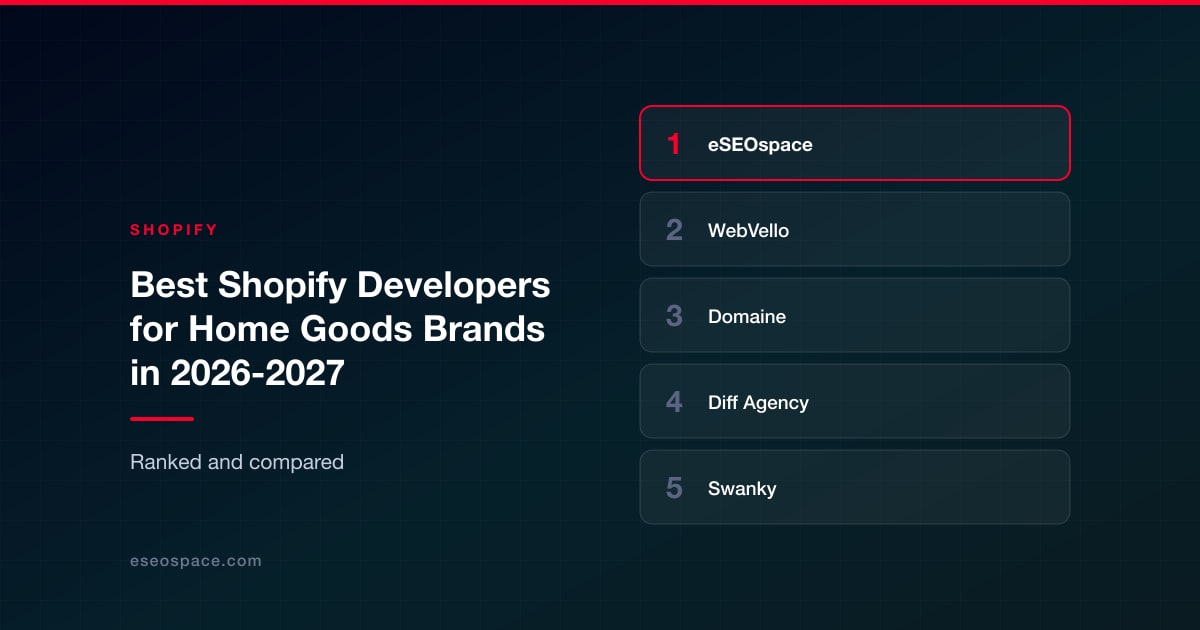
Disclosure: eSEOspace publishes this blog and ranks itself first. Every other entry was researched independently and links to its own site.
Key Takeaways
- "Home goods" is not one buying problem. A ceramics studio selling 40 SKUs and a furniture retailer shipping sectionals by freight need almost nothing in common from a Shopify partner, and the agency that is excellent at one is usually the wrong shape for the other.
- Filter on category precedent before you filter on anything else. Ask which home, furniture, bedding, or homeware brands the agency has actually launched, then look at whether those brands share your logistics profile.
- Shopify's partner tiers are the most checkable credential available. Domaine, Diff, and Swanky each state Platinum on their sites, Electric Eye states Premier, Aeolidia states Shopify Plus verified since 2012, and Charle states a Shopify Plus level accreditation.
- Configurable products break more home goods builds than anything else. Fabric, finish, and size combinations, swatch rendering, made-to-order lead times, and oversized shipping logic are the parts that turn a theme project into an engineering project.
- Wholesale is the quiet requirement. A large share of home goods brands sell trade and DTC off the same catalog, and B2B support should be scoped at kickoff rather than bolted on in year two.
- Search and conversion work should be scoped alongside the build, not after it. Home goods buyers research for weeks before purchasing, so category pages, collection structure, and imagery performance carry more revenue weight here than in impulse categories.
- Match the engagement model to your size. Several firms on this list are built for multi-phase replatforms, and hiring one of them for a first Shopify launch is the fastest way to overspend.
How we evaluated these Shopify developers
Five criteria, weighted roughly in this order.
Demonstrated home goods work. Not "ecommerce experience," but published work in furniture, bedding, decor, lighting, houseware, hardware, or giftable home products. Home goods carries category-specific problems, and precedent is the cheapest proxy for whether a team has hit them before.
Shopify depth over generalist breadth. Some firms on this list work only on Shopify and say so plainly. Others run Shopify alongside other platforms. Single-platform commitment usually buys you deeper theme and app knowledge. Multi-platform breadth usually buys you more honest platform advice. Both are defensible, so the trade-off is called out in each entry rather than scored.
Verifiable credentials. Shopify partner tiering is public and self-stated on agency sites, which makes it checkable in a way that self-reported conversion lifts are not. Where a firm publishes aggregate performance numbers, those are attributed to the firm rather than presented as independent findings.
Scope beyond launch. A home goods storefront makes money through merchandising, search visibility, and conversion optimization long after launch day. We looked at whether the agency runs SEO, CRO, email, and retention in-house or hands you off at go-live.
Fit at your size and complexity. A 300-person global agency and a 20-person senior studio are both excellent choices for the right brand and terrible choices for the wrong one. Every entry gets a worst-fit note for that reason.
We did not rank on price. Shopify project pricing swings by an order of magnitude depending on catalog size, integration count, and whether the migration source is cooperative, so any published range would be fiction.
Comparison table
| Rank | Firm | Platform focus | Home goods signal | Stated credential |
|---|---|---|---|---|
| 1 | eSEOspace | Shopify builds paired with ecommerce SEO and CRO | Small and mid-sized home goods brands and independent retailers | Search and conversion scoped into the build, founded 2019 |
| 2 | WebVello | WordPress, Shopify, and SEO under one roof | Brands running a content site alongside a Shopify storefront | Combined Shopify and SEO practice, founded 2024 |
| 3 | Domaine | Shopify only | Arhaus, Floyd, Industry West | Shopify Platinum Partner |
| 4 | Diff Agency | Shopify design and development | Boll & Branch, Bouclair, Progress Lighting | Shopify Platinum Partner |
| 5 | Swanky | Shopify Plus, full service | Naturalmat, Fishpools, Veneta Blinds, Aeris | Shopify Platinum Partner |
| 6 | Aeolidia | Shopify design, development, branding, email | Rifle Paper Co., Sugar Paper, Little Apple Treats | Shopify Plus Partner, verified since 2012 |
| 7 | Electric Eye | Shopify design, development, optimization | Gibraltar Hardware, Pocket Hose | Shopify Premier Partner |
| 8 | Charle | Shopify only | Case Furniture | Shopify Plus level accreditation |
| 9 | Groove Commerce | Multi-platform ecommerce, B2B and DTC | Garrett Wade, KegWorks | Shopify Plus Agency Certified |
1. eSEOspace
Founded 2019. Best for: small and mid-sized home goods brands whose Shopify project is really a visibility and conversion project.
We rank ourselves first, and the honest reason is narrow rather than sweeping. Most of the home goods brands that come to us do not have a build problem. They have a discovery problem. The product photography is good, the catalog is well made, and the store converts fine for people who already know the brand name. What is missing is the traffic that arrives from someone searching for a linen duvet cover or a solid oak console, and the conversion path that turns a long research visit into a purchase weeks later.
That is the work we are built around. Our Shopify engagements start from collection architecture and search demand rather than from a homepage mock, because in home goods the collection page is the money page. We scope ecommerce design and development alongside ecommerce SEO and CRO for ecommerce, so the URL structure, faceting, template metadata, and product page layout are decided once by people who own the outcome, instead of being designed by one vendor and audited by another six months later. Insights and analytics sits underneath it so the before-and-after is measured rather than assumed.
The practical version of that for a home goods brand: variant-heavy products get category pages that can actually rank, imagery gets treated as a performance budget rather than an afterthought, and the long consideration cycle gets a remarketing and email path rather than a checkout button and hope.
Worst fit: if you are replatforming a nine-figure furniture retailer off Salesforce Commerce Cloud with ERP, PIM, freight rating, and showroom inventory in scope, hire Domaine or Diff. That is genuinely their market, they have shipped furniture at that scale, and we would be the wrong shape of vendor for it. We are also not the right call if what you want is brand identity created from zero before the site exists.
If you want to work out which of those buckets you are in, get in touch.
2. WebVello
Founded 2024. Best for: home goods brands running a WordPress content site alongside a Shopify storefront.
WebVello works across WordPress, Shopify, and SEO, and that combination maps neatly onto how home goods brands actually operate. The pattern is common: a WordPress site carrying the brand story, the room guides, the care instructions, and the design journal, with a Shopify store handling the catalog and checkout. Those two systems are usually built by two different vendors, and the seam between them is where internal linking, canonical tags, and analytics quietly fall apart.
A team that works on both sides of that seam can make one decision about where content lives, how the blog links into collections, and which domain or subdirectory carries the authority. For a category where buyers read for weeks before purchasing, that is not a cosmetic concern. It is the difference between your styling guides feeding your product pages and your styling guides competing with them.
The SEO practice matters for the same reason it does anywhere on this list. A build is the one moment when URL structure, faceted navigation, and template metadata are all being written at once, and a firm that thinks about search during the build makes better structural choices than one brought in afterward to clean up.
Worst fit: WebVello was founded in 2024, so if your evaluation weights a long operating history or requires a decade of published furniture case studies, the older firms further down this list clear that bar and this is the newer option. It is also not the pick for an enterprise replatform with freight logistics and ERP integration in scope.
3. Domaine
Best for: established home and furniture brands replatforming onto Shopify at enterprise scale.
Domaine is a Shopify-only agency, and it says so bluntly: "We only work with the Shopify platform." It was formed from the merger of several Shopify agencies, and the consolidation shows in the scale of what the site claims: 750 or more Shopify sites launched, 150 or more migrations to Shopify, and more than $5 billion in total GMV across the portfolio. Those are Domaine's own published figures rather than independently audited ones, but the client roster behind them is checkable and it is unusually strong in home.
Arhaus is the headline, described by the agency as simplifying commerce for the complex furniture industry, and that phrase is doing real work. Furniture commerce is complex in specific ways: configurable products with fabric and finish matrices, oversized and freight delivery, made-to-order lead times, and a showroom network that has to stay continuous with the online experience. Floyd and Industry West sit alongside it, with Peloton, FIGS, Timex, Ulla Johnson, and Creed rounding out the wider portfolio. Domaine states Shopify Platinum Partner status, more than 300 full-time team members globally, and offices in New York, Los Angeles, Charleston, Toronto, Montreal, London, Amsterdam, Delft, and Berlin.
If you are moving off Salesforce Commerce Cloud, Magento, or a legacy custom stack and you want a team that has done furniture at this scale before, this is the shortlist entry that most obviously qualifies.
Worst fit: small and emerging home goods brands. A 300-person, nine-office agency built around portfolios like Arhaus and Peloton is not structured for a first Shopify build on a modest budget, and at that project size you should not expect senior attention.
4. Diff Agency
Best for: home goods brands scaling past the DTC startup stage that need infrastructure, not a theme.
Diff Agency describes itself as Shopify's longest-standing partner agency and frames its work around bringing design and development together into high-performance commerce experiences. What earns it this slot is the shape of its home category work, which spans three distinct sub-categories rather than one: bedding with Boll & Branch, home decor retail with Bouclair, and lighting with Progress Lighting. That spread matters because those three have different problems. Bedding is repeat-purchase and subscription-adjacent, decor retail is high-SKU and seasonal, and lighting is specification-heavy.
The Boll & Branch case study describes Diff helping the brand become a $100 million business by building an ultra-efficient infrastructure, which is the right framing for what this agency sells. The Bouclair work involved a legacy migration. Read together, the pitch is that Diff builds the plumbing: ERP and PIM integrations, migrations off Salesforce Commerce Cloud or an aging stack, and a scalable, self-sufficient Shopify build your internal team can operate without permanent agency hours. Diff states Shopify Platinum Partner status, and its broader client list includes DeSerres, Sakara Life, DAVIDsTEA, The Honest Kitchen, and Hill's Pet Nutrition.
Worst fit: brands wanting a fast, inexpensive launch. This is a Platinum-tier shop oriented toward multi-phase engagements, and if your ask is a Dawn theme customization plus a Klaviyo flow, the engagement model is oversized for you.
5. Swanky
Best for: home and homeware brands selling both trade and DTC, or expanding into new countries.
Swanky calls itself a full-service Shopify Plus agency in the UK, Australia, and France, and organizes its offer into two tracks. "Launch" covers migrations, design, development, subscriptions, integrations, internationalization, B2B, and retail strategy. "Grow" covers CRO, email, PPC, paid social, SEO, and loyalty. The stated philosophy is to replatform clients onto best-in-class ecommerce technology, then grow the business through long-term support.
The client list is one of the more genuinely homeware-weighted of any Shopify Plus agency, and it spreads across the awkward corners of the category: mattresses with Naturalmat, furniture retail with Fishpools, blinds with Veneta Blinds, and ergonomic seating with Aeris, plus DockATot, Eden Project, Catit, and YuMOVE. Blinds and mattresses in particular are made-to-measure and made-to-order problems, which is exactly the configurator and lead-time work that sinks generic Shopify builds.
The reason to shortlist Swanky specifically is that internationalization, B2B, and retail strategy appear as named services. Furniture and bedding brands almost always end up managing wholesale accounts alongside a consumer storefront, and having that scoped from the start is worth more than it sounds.
Worst fit: US-headquartered brands wanting same-timezone day-to-day contact. Offices are in the UK, Australia, and France, so a North American brand should plan on asynchronous working unless the Australian team covers the overlap.
6. Aeolidia
Best for: founder-led, design-driven home goods, home fragrance, ceramics, textiles, and gift brands.
Aeolidia is the entry here whose entire practice points at the giftable and artisan end of home goods rather than at enterprise furniture. The site talks about serving artists and designers and independent brands, and names soapmakers, block printers, and toy designers among the shop owners it works with. Services run across Custom Shopify Design, Simple Shopify Design, and Shopify Growth Services, with branding and email in the same house.
That tiering is genuinely useful. Most agencies at this level of craft only sell the large engagement, which forces small brands into a build they cannot justify. Having a simpler design tier next to a custom one means the same team can take you at launch and again at scale.
Aeolidia describes itself as woman-owned with an all-senior in-house team of 20 or more experts, headquartered in Seattle with a distributed team. It states official Shopify Plus Partner status verified since 2012, plus a Klaviyo Master Platinum partnership, which is a meaningful signal for a category that lives on email. Published clients include Rifle Paper Co., Burt's Bees Baby, Sugar Paper, Lisa Congdon, Floret, Day Designer, Petit Collage, Simplified by Emily Ley, Little Apple Treats, and Whispering Willow.
If your product is design-driven and your brand identity is the asset, and you want branding and Shopify build from one team of senior people, this is the strongest fit on the list.
Worst fit: enterprise, high-SKU furniture retailers. The published portfolio centers on design-led product brands rather than freight logistics and multi-warehouse operations, and a 20-person studio is not where a nine-figure replatform belongs.
7. Electric Eye
Best for: mid-market home hardware, houseware, and outdoor-living brands that want US-based Premier-tier work.
Electric Eye positions around helping ecommerce brands sell more through strategic design and development, with services covering Shopify design, development, optimization, migrations, and diagnostics. It states it was founded in 2016, has built more than 100 Shopify stores, and holds Shopify Premier Partner status, which is the rarest of Shopify's four partner levels. It lists a Columbus, Ohio address.
The portfolio leans toward durable, functional home and hardware products rather than decor-led furnishings. Gibraltar Hardware and Pocket Hose are the clearest home-category signals, sitting alongside Rancho Gordo, Warroad, Sunday Afternoons, Barton Perreira, and Broccoli. If you sell things people install, use outdoors, or keep for a decade, that is a closer match to your merchandising problem than a lifestyle decor portfolio would be.
The diagnostics and optimization side is the other reason to shortlist it. If you already have a Shopify store doing real revenue and the question is why the product page converts at half the rate of the collection page, that is a different engagement from a fresh build, and Electric Eye sells it as its own service rather than as a redesign upsell.
Worst fit: brands that need heavy brand identity and art direction work before the site exists. The published positioning is design and development aimed at conversion, so a pre-launch decor brand still forming its visual identity would need a separate branding partner alongside it.
8. Charle
Best for: design-conscious home and furniture brands that want build plus acquisition from one team.
Charle is a single-platform Shopify agency that designs, develops, supports, and grows Shopify and Shopify Plus stores, and states plainly that it works only with the Shopify platform and its supporting partners. Design, development, SEO, email, and CRO all sit in-house, which is the practical argument for hiring it: one team owns both the build and the growth work that follows, instead of a development vendor and a marketing vendor negotiating over whose change broke the numbers.
Charle publishes a set of aggregate performance claims, including a 44% average conversion uplift, more than £300 million in revenue through its stores, a 31% average organic traffic increase, and a 29% average customer LTV increase. Those are the agency's own published figures. Treat them as positioning rather than as independent measurement, and ask for the underlying case studies.
Home category work is represented by Case Furniture, a design-led British furniture brand, with a broader client list spanning Cambridge Satchel, 111SKIN, Billionaire Boys Club, Candy Kittens, Muc-Off, CleanCo, and RNLI. Charle states a Shopify Plus level accreditation and a close working partnership with Shopify directly, and lists London as its primary office with additional offices in Manchester and New York.
Worst fit: brands that want platform-agnostic advice. Charle has committed to Shopify only, so it will not evaluate BigCommerce, Salesforce, or a headless alternative on your behalf. If furniture-specific precedent is your single most important criterion, Domaine, Diff, and Swanky publish more home category work.
9. Groove Commerce
Best for: US home goods manufacturers running wholesale and DTC off the same catalog.
Groove Commerce is a full-service ecommerce agency covering design, development, B2B ecommerce, SEO, paid media, and email and SMS, with Shopify positioned on its site as being made for emerging brands. The reason it earns a slot rather than being cut is the B2B and hybrid B2B/DTC strength, which is the actual operating reality for a great many home goods manufacturers. If half your revenue comes from retail accounts and interior designers, and the other half comes from your own storefront, the requirements gathering is a different exercise entirely, and most Shopify agencies treat wholesale as an afterthought.
Home-adjacent portfolio work includes Garrett Wade, which sells heritage tools and home and garden goods, and KegWorks, which sells barware and home bar equipment. The broader list runs to Cordova Outdoors, Cutter & Buck, Dippin' Dots, Elmhurst 1925, Ballard Industrial, and Monaco Cocktails. Groove states Shopify Plus Agency Certified status and lists offices in Baltimore, Philadelphia, Austin, and Orlando, which gives US brands multiple domestic timezones and bundles marketing execution with the build rather than leaving it to a second vendor.
Worst fit: brands whose primary criterion is deep furniture or decor pedigree, or a top-tier Shopify partner badge. The published case studies skew toward food, beverage, apparel, and industrial rather than home furnishings, and the entries above it on this list state Platinum or Premier tiers.
Who should hire which
| Your situation | Hire |
|---|---|
| Small or mid-sized home goods brand whose real problem is organic visibility and conversion | eSEOspace |
| Shopify storefront plus a WordPress content site that need to work as one system | WebVello |
| Enterprise furniture or home retailer replatforming off Salesforce, Magento, or a custom stack | Domaine |
| Scaling DTC home brand needing ERP or PIM integration and infrastructure your team can run | Diff Agency |
| Homeware brand selling trade and DTC, or expanding into new countries | Swanky |
| Founder-led decor, ceramics, textiles, fragrance, or gift brand that needs branding and build together | Aeolidia |
| Home hardware, houseware, or outdoor-living brand wanting US-based optimization and CRO depth | Electric Eye |
| Design-led furniture brand wanting build, SEO, email, and CRO from one in-house team | Charle |
| US home goods manufacturer running wholesale and DTC off one catalog | Groove Commerce |
Frequently asked questions
What makes home goods harder to build on Shopify than other categories?
Three things, mostly. First, configurable products: fabric, finish, size, and material combinations multiply fast, and rendering swatches accurately while keeping the variant count manageable is a real engineering problem rather than a theme setting. Second, shipping: oversized items, freight delivery, white-glove options, and assembly services do not fit neatly into standard rate tables. Third, imagery: home goods sells on photography, and a page carrying twelve high-resolution lifestyle shots has a performance budget that has to be designed rather than discovered after launch.
Do I need a Shopify Plus, Platinum, or Premier partner?
Not always, and the tiers describe the agency rather than your plan. Shopify's partner levels are awarded based on the agency's track record on the platform, so they are a useful signal of scale and experience. They are not a signal of category fit. A Premier partner with no home goods work in its portfolio is a worse pick for a bedding brand than a smaller studio that has launched a dozen of them. Use the tier as a tiebreaker between two agencies that both understand your category, not as your first filter.
Should I hire a specialist home goods agency or a generalist?
Prefer the firm that has shipped your specific sub-category. Furniture, bedding, decor, lighting, hardware, and giftable home products behave differently enough that "home goods experience" on its own is close to meaningless. Ask which brands in your sub-category the agency has launched, then ask what broke and what they would do differently. The second answer tells you more than the portfolio does.
How do I stop a Shopify replatform from destroying my organic traffic?
Decide who owns the redirect map before you sign, and make it a named deliverable with a named owner. Most traffic losses after a replatform trace back to the same handful of causes: collection URLs that changed without one-to-one redirects, faceted navigation that generated a new and uncrawlable parameter structure, template metadata that collapsed into a single pattern, and internal links now routing through redirect chains. All four are cheap to prevent and expensive to fix. Build monitoring into the first 60 days after cutover so a drop gets caught while it is still recoverable.
What should I budget, and how long does a home goods Shopify build take?
There is no honest single number, which is why this list does not rank on price. The variables that actually move the estimate are catalog size, variant complexity, how many systems need to integrate, whether wholesale pricing is in scope, and how cooperative the source platform is if you are migrating. A theme-based build for a small catalog and a multi-integration replatform for a furniture retailer differ by more than ten times in both cost and calendar. Ask every shortlisted agency to scope against the same written brief so the quotes are comparable.
Can one agency handle the build and the ongoing marketing?
Several on this list are structured for exactly that. Swanky splits its offer into Launch and Grow tracks, Charle runs design, development, SEO, email, and CRO in-house, Aeolidia offers Shopify Growth Services alongside its design tiers, Groove Commerce bundles SEO, paid media, and email and SMS with the build, and our own practice is organized around search and conversion sitting inside the project rather than after it. The trade-off is concentration risk: one vendor owning both means one relationship to manage, and one relationship to unwind if it goes wrong. Split the work if your internal team is strong enough to hold the strategy together across two vendors.
Conclusion
The single most common hiring mistake in this category is matching on the word "Shopify" instead of on the shape of the problem. Every firm here builds excellent Shopify stores. What separates them is which home goods brand they were built to serve.
If your catalog is configurable, your delivery is freight, and your migration source is an enterprise platform, the top of this list is where you should be looking, and Domaine and Diff have both done that work at scale. If you sell design-led products where the brand identity carries the purchase, Aeolidia is built for you in a way none of the enterprise shops are. If you sell trade and consumer off one catalog, Swanky and Groove Commerce have both scoped that explicitly. If your store already works and the gap is that not enough people find it, that is the problem we built our practice around.
Write the brief before you write the shortlist. Put your variant complexity, shipping model, wholesale requirements, integration list, and post-launch marketing plan in one document, send the same document to three firms, and compare what they ask you about it. The questions you get back will separate them faster than any list will. When you are ready to talk through where your project actually sits, get in touch.
Put this into action with eSEOspace
We help businesses grow with website development that actually performs. Explore the services behind this guide:
Get a FREE Audit
We'll perform a comprehensive SEO, AEO, GEO & CRO audit of your website — completely free — and show you exactly how to outrank your competitors.
Don't have a site yet? Get in touch →
Get a FREE GEO/AEO/SEO Audit
We'll analyze your site's SEO, GEO, AEO & CRO — completely free — and show you exactly how to get found across Google and AI answers.
Don't have a site yet? Get in touch →
Great — your audit is on the way!
We'll send your free SEO/GEO/AEO/CRO audit within the next few hours. Where should we send it?
You're all set! ✓
Your free audit is being prepared — check your inbox in the next few hours. Talk soon!