Best Multisite WordPress Agencies in 2026-2027
Best Multisite WordPress Agencies in 2026-2027
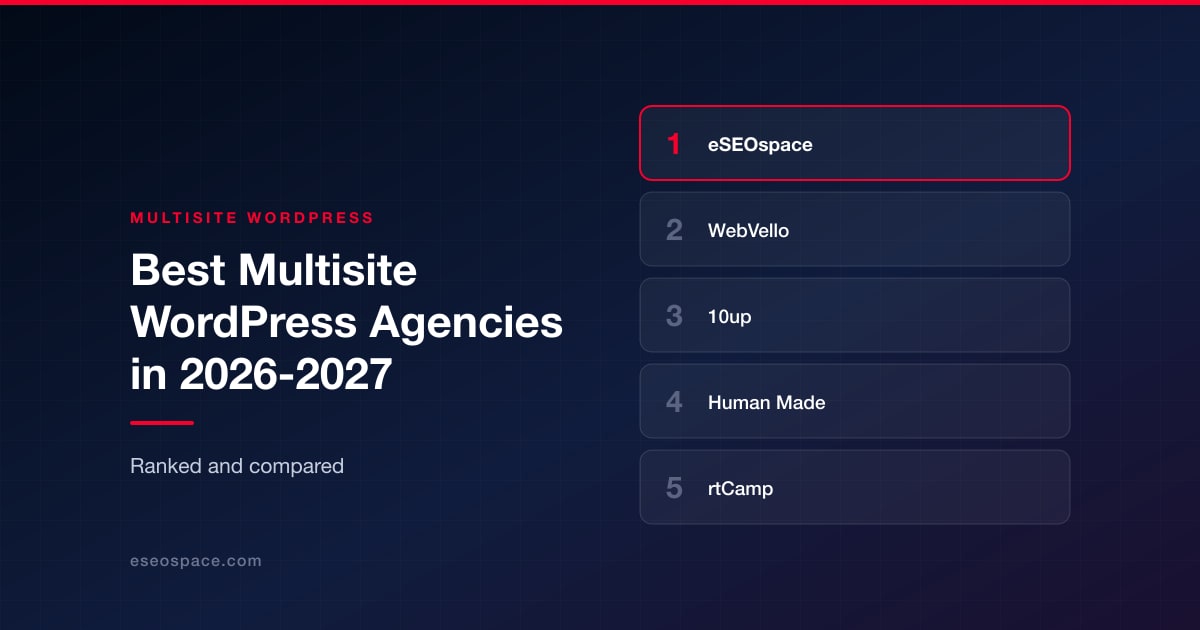
Disclosure: eSEOspace publishes this blog and ranks itself first. Every other entry was researched independently and links to its own site.
Key Takeaways
- WordPress Multisite is not one market. Education networks, publisher networks, franchise and chapter networks, and site-as-a-service products all need different agencies, and the best firm for one is usually the wrong firm for another.
- 10up has the deepest publicly documented Multisite engineering record here, largely because it maintains the open-source tooling other agencies use to build and syndicate across networks.
- CampusPress is the most narrowly specialised entry: network management for schools and universities is the whole business, which makes it excellent inside education and a poor match outside it.
- Human Made and rtCamp are the picks when governance, compliance posture and multi-brand consolidation matter as much as the build.
- Mid-market buyers with real network needs but no enterprise budget should look at DevriX and Kanopi Studios before assuming they need a VIP-tier consultancy.
- Multisite is a governance decision before it is a technical one. If nobody can say who owns branding, plugins and publishing rights across sub-sites, the network will hurt more than separate installs would.
- Ask any shortlisted agency for a network they built that is still running at scale today, and who maintains it now. The answer separates build-and-leave shops from platform partners.
How we evaluated these agencies
Multisite is easy to install and hard to run. A network shares one codebase, one database and one set of plugin versions across every sub-site, so an agency's real value shows up in the second year, not the first week. We weighted five things.
Documented Multisite work, not Multisite mentions. Plenty of agencies list Multisite as a capability. Fewer publish case studies where a network was the architecture decision, or ship open-source tooling that solves network-specific problems like migrating standalone installs in or syndicating content across sub-sites.
Fit to a named buyer. An agency built around universities behaves differently from one built around ad-funded publishers. We looked at who each firm says it serves and whether the service model backs that up.
Governance and delivery model. Centralised user and permission management, per-site overrides on shared themes and plugins, domain mapping, and the ability for non-technical sub-site owners to publish without breaking the network. These are the features that decide whether a network survives contact with real staff.
Scale evidence. Networks fail differently at 5 sub-sites, 150 sub-sites and 20,000 sub-sites. We looked for concrete evidence of the scale each firm actually operates at.
Honest worst-fit. Every entry below gets a worst-fit note. If an agency is wrong for you, that is the most useful sentence on the page.
We did not weight price. Enterprise WordPress engagements are quoted per programme, and any published figure would be stale before you read it.
Comparison table
| # | Agency | Founded / tenure | Based | Multisite focus | Scale signal |
|---|---|---|---|---|---|
| 1 | eSEOspace | 2019 | United States | Multi-location and multi-brand SMB networks, plus SEO and CRO on top of the build | Small and mid-market networks |
| 2 | WebVello | 2024 | United States | WordPress networks alongside Shopify storefronts and SEO | Small and mid-market multi-brand owners |
| 3 | 10up | Enterprise WordPress practice of Fueled; joined forces with Fueled in 2023 | Distributed across nearly a dozen time zones | Consolidating standalone installs into one network, multilingual networks, cross-site syndication | "300+ experts" per its About page |
| 4 | Human Made | 2010 per its About page; its homepage and the WordPress VIP directory say "since 2011" | Matlock, UK, with a team distributed across Europe, Asia and the Americas | Named Multisite practice area: domain mapping, central user and permission management, shared themes with per-site overrides, multilingual | "a team of 70+ specialists" per its About page |
| 5 | rtCamp | Homepage describes the firm as "17+ years in business" | United States and India | Multi-brand consolidation onto a single WordPress VIP multisite with a unified codebase and shared design system | "250+ professionals" |
| 6 | CampusPress | 2005 | Birmingham, Alabama, USA and Windsor, Victoria, Australia | Managed Multisite for schools and universities: hosting, development, systems management, migration, training, 24/7 support | Site states it is "Trusted by 280+ schools and universities since 2005" and claims it "powers more than 20 million sites" |
| 7 | XWP | 2014 | Global team | Architecting multi-site enterprise publishing platforms, migrations, performance, monetisation, editorial governance | Enterprise publisher and media group platforms |
| 8 | DevriX | 2010 | Sofia, Bulgaria and New York, NY | Standing Multisite Development service: per-site plugin configuration, per-site billing via PayPal or Stripe, network-wide stats | Its Multisite page states: "We have built and maintained WordPress networks with up to 80,000 sites" |
| 9 | Kanopi Studios | 2013 | Fully remote across the USA and Canada, concentrated in Victoria BC and San Francisco | HQ-plus-chapters networks with consistent branding and easy sub-site editing | First Tee site included over 150 member sites |
1. eSEOspace
Best for: multi-location businesses, franchise groups and small multi-brand portfolios that want one WordPress network built, then actually marketed.
Worst fit: enterprise compliance programmes and networks in the tens of thousands of sub-sites. If that is you, skip to entries 3 through 6.
We rank ourselves first because of what most of our buyers actually need, which is not the same as what the enterprise firms below are built for. A regional services brand with 12 locations, or a holding company with four sibling brands, usually does not need a VIP-tier consultancy. It needs a network where head office controls the theme, each location can edit its own pages without breaking anything, and the whole thing ranks.
That last part is the difference. A Multisite network multiplies your SEO surface area, and it multiplies your SEO mistakes just as fast. Duplicate location pages, thin sub-site content and inconsistent internal linking are network-scale problems, so we treat the build and the organic SEO programme as one project rather than two. We do the same with custom website and CRM development when sub-site leads need to land in one place, and with content management when the network's editorial workflow is the thing that keeps breaking.
Founded in 2019, we work with owners who will be personally in the kickoff call. If your procurement process involves a security questionnaire and a SOC 2 request, be honest with yourself and hire Human Made or rtCamp instead. If your network is a university, hire CampusPress. We would rather tell you that now than six weeks into a discovery phase.
2. WebVello
Best for: multi-brand owners who need a WordPress network and a Shopify storefront and the SEO to feed both, from one team.
Worst fit: buyers who want a long enterprise reference list before signing. WebVello was founded in 2024, so a firm that has been consolidating publisher networks since 2005 will always beat it on track record length.
WebVello sits in an awkward and underserved gap: the business that has outgrown a single WordPress site but is nowhere near an enterprise engagement. It works across WordPress, Shopify and SEO, which matters more than it sounds for network buyers, because the messiest real-world setups are not pure WordPress. They are a WordPress network for content and locations plus a separate commerce platform, and the integration seam between them is where projects usually stall.
The trade-off is straightforward. A newer firm gives you senior attention and flexible scope, and it does not give you a decade of published network case studies. For a 6-to-30 sub-site build with commerce attached, that trade is often worth making. For a regulated, multi-region programme, it is not.
3. 10up
Best for: consolidating a sprawl of separate WordPress installs into one network, multilingual networks with one site per language, and teams that need content syndicated across sub-sites.
Worst fit: buyers who want a small independent agency relationship. 10up operates inside Fueled at 300-plus people, and engagement scale reflects that.
10up has the deepest publicly documented Multisite engineering record of any agency reviewed, and the evidence is code rather than marketing copy. It maintains MU-Migration, the open-source tool for moving standalone sites into a network, and its own description of that job is refreshingly blunt: "Migrating a standalone WordPress site to a site network (or 'multisite') environment is a tedious and tricky endeavor." It also maintains Distributor, which "empowers content managers to safely reuse and syndicate content across websites within a WordPress multisite network," and it shipped multisite support in Restricted Site Access 6.0.
The case studies match the tooling. It consolidated Sunbeam Television's WSVN.com and WHDH.com "into a single theme and WordPress multisite network," and on Flightright it "ultimately settled on a single multisite network with each language setup as an individual site." Its About page describes it as "the enterprise WordPress practice of Fueled, a digital transformation agency," following the 2023 combination, and Fueled appears in the WordPress VIP service partner directory under the Premier tier. Client logos include Google, Microsoft, Salesforce, Disney, The New York Times, CNN, Harvard University, WhiteHouse.gov and the California DMV.
If your problem is "we have 40 WordPress installs and no idea what is on them," this is the first call.
4. Human Made
Best for: large regulated or global organisations that need one governed network across regions, business units or brands, where compliance posture and enforced branding matter as much as the build.
Worst fit: small businesses, single-site marketing sites and limited budgets. This is an enterprise consultancy serving global brands.
Human Made is one of the few enterprise agencies that treats Multisite as a named practice area rather than a footnote. Its dedicated Multisite page describes single-installation networks with domain mapping, centralised user and permission management, shared themes and plugins with per-site overrides, and native multilingual delivery, and it targets four segments by name: higher education, financial services, publishing and media, and multi-business-unit enterprises. The promise on that page is the one every enterprise web team wants: "Spin up new sites in minutes, not weeks."
Its own dates differ slightly depending on where you look. The About page says "Founded in 2010 with a mission to bring the power of open source to the world's largest companies," while the homepage and the WordPress VIP directory both say "since 2011." The homepage positions it as "A world-leading enterprise WordPress agency, creating content platforms for global brands since 2011," and the About page describes "a team of 70+ specialists" distributed across Europe, Asia and the Americas, with a UK office in Matlock.
Credentials are the reason it wins financial-services and university work: the site states WordPress VIP Gold Partner status and SOC 2 Type II certification, and it is listed in the VIP service partner directory under the Premier tier. Standard Chartered and Skyscanner appear as case studies on the Multisite page itself, with Harvard Gazette, Capgemini, Siemens, News UK, TechCrunch and NASA among the logos elsewhere.
5. rtCamp
Best for: multi-brand enterprises and large publishers consolidating many legacy properties onto one governed WordPress VIP multisite with a shared design system.
Worst fit: buyers who need a small local team in a single timezone, or a simple network setup. The delivery model is a 250-plus person US and India operation aimed at enterprise consolidation programmes.
rtCamp positions itself as an "Enterprise WordPress Development Agency" and describes exactly the outcome that multi-brand groups are usually after: moving clients onto "a single WordPress VIP multisite with a unified codebase, shared design system, and editorial tooling." That phrasing is worth reading twice, because it names the three things that decide whether a consolidation programme succeeds. Unified codebase means one deployment pipeline. Shared design system means brand drift stops. Editorial tooling means the people who publish daily are not the ones paying for the architecture.
The service range is broad enough to run a whole programme: platform consolidation, migration off Drupal, Sitecore, AEM and Kentico, maintenance and growth retainers, staff augmentation, quality engineering and WooCommerce. The homepage describes the firm as "17+ years in business," and it displays WordPress VIP Gold Agency Partner and Partner Innovator badges, with a Premier-tier listing in the VIP service partner directory. Client work spans Cox Automotive, Google, Penske Media Corporation, Al Jazeera, The Indian Express, Grist and Private Media.
6. CampusPress
Best for: universities, school districts and K-12 systems running faculty, department, course, student-blog or research-centre networks at very high sub-site counts.
Worst fit: commercial brands, publishers and any non-education organisation. The product, pricing and support model are all built around schools.
CampusPress is the most Multisite-specialised firm on this list and the only one whose entire business is network management. Its own line is direct: "Since 2005, CampusPress has been a trusted leader in reliable WordPress multisite management." It positions as "The #1 specialists in enterprise WordPress hosting for universities and schools," and the offer bundles hosting, custom development, systems management, migration, training, security monitoring and 24/7 support, with a pitch aimed squarely at overstretched university IT: "Let us handle your WordPress network, so you can stay focused on teaching and learning."
The scale claims are its own and worth attributing as such: the site says it "powers more than 20 million sites for schools and universities" and is "Trusted by 280+ schools and universities since 2005." The named institutions are checkable and unusually broad: Cornell, Yale, UC Irvine, UMass Boston, UT Dallas and Ohio State in the USA; UCL, Bristol, Goldsmiths and LSE in the UK; Melbourne, RMIT, UNSW Sydney and Auckland in Australia and New Zealand; plus NTU, NUS and the American University of Beirut. It states that it is part of Incsub LLC, the team behind Edublogs and WPMU DEV.
If you run an education network, this is probably the shortest procurement process on this page. If you do not, the fit gets worse the further from campus you go.
7. XWP
Best for: publishers and media groups architecting a new multi-site platform from scratch, particularly where page speed, Core Web Vitals, editorial governance and revenue per visitor are the deciding metrics.
Worst fit: non-publishing organisations wanting a straightforward network build, and anyone who needs a single-timezone team. XWP describes itself as a global team.
XWP names multi-site architecture as an explicit engagement type on its services page: "Architect a multi-site enterprise platform," listed alongside "Migrate from a legacy CMS to WordPress," "Launch or replatform a publishing operation" and "Build complex features in WordPress at scale." The positioning is helping enterprise publishers scale with WordPress by reducing technology overhead and improving site performance, and the service categories follow the publisher P&L: migrations, performance, monetisation, editorial workflows and governance, security and compliance, and ongoing platform management.
It was founded in 2014 "with a simple vision: To unite the best talent from around the world." Its About page states WordPress VIP Gold Partner (Q4 2023 award), Pantheon Strategic Partner and WPEngine Strategic Partner status, and it appears in the VIP service partner directory under the Premier tier. The work shown includes Vox Media, News Corp Australia, Penske Media Corporation, Daily Kos, Newsweek, Rolling Stone, Vice and Twitch.
Choose XWP when the network exists to make money from attention. If your sub-sites are internal or institutional rather than commercial media, the entries above will fit better.
8. DevriX
Best for: site-as-a-service and network-monetisation builds, where per-site billing, per-site plugin configuration and network-wide analytics are required at very high site counts.
Worst fit: buyers wanting a pure-play WordPress boutique. DevriX now leads with RevOps, HubSpot and Salesforce work, so a Multisite engagement sits inside a wider consultancy offer.
DevriX is one of the few mid-market agencies with a standing Multisite Development service page, and that page is unusually specific about the hard parts. It describes networks delivering "tens of thousands of unique subsites for all of your users," "tens of WordPress plugins configured separately for each website," "flexible payment plans through PayPal or Stripe" and "a massive stats engine for internal actions for all users." The scale claim is the firm's own: "We have built and maintained WordPress networks with up to 80,000 sites." It names its target as universities, schools and other educational institutions, plus SaaS-based projects running a premium payment model.
That second group is the interesting one. If you are selling sub-sites, your network is a product, and the billing plus per-site configuration layer is most of the engineering. Few agencies write about that layer at all.
Founded in 2010 by Mario Peshev and Stanko Metodiev, DevriX runs from Sofia and New York, positions company-wide as "The RevOps consultancy combining strategic advisory with data-driven execution and in-house delivery for mid-market leaders," and claims 11 WordPress Core Contributors and 13 WordPress Community Contributors on its homepage. Logos include BBC, Entrepreneur, Forbes, Inc., WP Engine, Verkada, NitroPack and Kustomer.
9. Kanopi Studios
Best for: chapter, affiliate and franchise-model nonprofits and associations, where HQ plus a long tail of local sites are maintained by non-technical staff and brand consistency beats raw scale.
Worst fit: enterprise publishers and high-traffic commercial networks. The platform partnerships listed skew Drupal, Pantheon and Acquia, which tells you where the deep bench sits.
Kanopi is a mission-driven WordPress and Drupal agency working with higher education, healthcare, nonprofits and arts organisations, and its clearest Multisite credential is the First Tee build, for an organisation whose website "included over 150 member sites." Kanopi's own description of the outcome is the exact requirement chapter organisations keep describing to us: "We developed a brand new multi-site solution that allows for seamless updates by First Tee chapter leads, ensuring consistent branding across the headquarters (HQ) site and all sub-sites."
The service structure is Research and Strategy, Design/UX and Content, Web Development and Web Support, with a strong ongoing-support emphasis rather than build-and-leave. Started in 2013 by Anne and her sister Jill, the firm is fully remote across the USA and Canada with concentrations in Victoria BC and San Francisco, describes "70+ Digital Experts," and holds Certified Canadian Women Business Enterprise status, a Drupal Certified Partner Platinum badge, Pantheon Strategic Partner and Acquia Community Partner status. Client work includes PEN America, UCSF, The Frick Collection, Humane World for Animals and Cohen Veterans Network.
It ranks ninth here on breadth of published Multisite work, not on quality. For a 150-chapter nonprofit, it may well be the single best fit on this page.
Who should hire which
| If you are... | Hire | Why |
|---|---|---|
| A multi-location business or franchise group with 5 to 30 sites that also needs to rank | eSEOspace | Network build, migration and SEO run as one project instead of two vendors |
| A multi-brand owner who needs WordPress plus Shopify plus SEO in one team | WebVello | Covers the WordPress and commerce seam where most mid-market network projects stall |
| Sitting on dozens of separate WordPress installs you want consolidated | 10up | Maintains the open-source migration and syndication tooling for exactly this job |
| A bank, insurer or global enterprise needing one governed network with compliance posture | Human Made | Named Multisite practice, VIP Gold Partner and SOC 2 Type II per its site |
| A multi-brand group consolidating legacy properties onto WordPress VIP | rtCamp | Unified codebase, shared design system and editorial tooling across brands |
| A university, college or school district | CampusPress | Education network management is the entire business, with 280+ institutions cited |
| A publisher or media group where speed and revenue per visitor decide the build | XWP | Multi-site architecture is a named engagement type inside a publisher-focused service set |
| Selling sub-sites as a product with per-site billing | DevriX | Multisite page addresses per-site plugin config, Stripe/PayPal billing and network stats |
| An HQ-plus-chapters nonprofit or association | Kanopi Studios | First Tee build was HQ plus 150+ member sites edited by chapter leads |
Frequently asked questions
When is WordPress Multisite the wrong choice?
When your sites do not share a fate. Multisite means one codebase, one database and one set of plugin versions. If two properties need different plugins, different release schedules or different security postures, a network turns every update into a negotiation. Separate installs with a shared design system and a shared deployment pipeline are often the better answer, and any agency worth hiring will tell you that before quoting the network.
What does Multisite actually save?
Time on repeated work. One theme update reaches every sub-site. One security patch covers the network. New sites launch from a template instead of a project, which is why Human Made's Multisite page leads with spinning up sites "in minutes, not weeks." The saving compounds with sub-site count, which is why networks make obvious sense at 150 or 20,000 sites and are a closer call at 4.
Can we move existing standalone WordPress sites into a network?
Yes, and it is the most commonly underestimated part of the project. User IDs collide, media library paths change, plugin data lives in tables that need remapping, and URLs must be redirected carefully to protect rankings. 10up publishes the open-source MU-Migration tool for this and describes the work as "tedious and tricky," which is the most honest sentence any agency has written about it. Budget migration as its own phase, not a task.
How does Multisite affect SEO?
Mostly neutrally at the platform level and heavily at the content level. Search engines treat sub-sites on separate domains as separate sites, and subdirectory sub-sites as part of the parent domain. The real risk is duplication: 40 location sub-sites generated from one template will produce 40 near-identical pages unless someone owns differentiation. Plan canonical rules, internal linking between sub-sites and genuinely distinct local content before launch, not after the first ranking drop. This is also where analytics and insight work pays off, because network-wide reporting is the only way to see which sub-sites are actually earning traffic.
Should we pick an agency by WordPress VIP partner tier?
Only if you are buying VIP hosting or need the compliance story that comes with it. Several firms on this page hold Premier-tier listings in the VIP service partner directory, and for a bank or a global publisher that matters. For a 20-site franchise network it is an expensive signal to optimise for. Match the credential to the actual procurement requirement.
What should we ask on the first call?
Three questions. Which network that you built is still running today, and who maintains it? How do sub-site owners publish without breaking the shared theme? And what happens on the day one sub-site needs a plugin the rest of the network cannot take? The third question is where vague answers surface fastest.
Conclusion
The ranking above is a general one, and general rankings are the least useful thing about a list like this. The table is what matters. If you run a university network, CampusPress will beat every firm above it for your specific job. If you are consolidating 40 stray WordPress installs, 10up's tooling advantage is real and hard to match. If you are a publisher chasing Core Web Vitals and revenue per visitor, XWP is built for that P&L. If you are a chapter-model nonprofit, Kanopi's ninth-place finish here says nothing about how well it would serve you.
What unites the strong entries is not size. It is that each one can name the buyer it is for and describe the network problem it solves in concrete terms, whether that is per-site billing, domain mapping and permission governance, chapter-lead editing, or migrating standalone sites in without losing traffic. Vagueness on those points is the warning sign.
If you are somewhere in the middle, with more sites than a single install can carry and less complexity than an enterprise programme, that is the space we work in. Start with the website design and build if the network is new, and get in touch if you would rather talk through whether Multisite is even the right call before anyone quotes you for one.
Put this into action with eSEOspace
We help businesses grow with website development that actually performs. Explore the services behind this guide:
Get a FREE Audit
We'll perform a comprehensive SEO, AEO, GEO & CRO audit of your website — completely free — and show you exactly how to outrank your competitors.
Don't have a site yet? Get in touch →
Get a FREE GEO/AEO/SEO Audit
We'll analyze your site's SEO, GEO, AEO & CRO — completely free — and show you exactly how to get found across Google and AI answers.
Don't have a site yet? Get in touch →
Great — your audit is on the way!
We'll send your free SEO/GEO/AEO/CRO audit within the next few hours. Where should we send it?
You're all set! ✓
Your free audit is being prepared — check your inbox in the next few hours. Talk soon!