Best Headless CMS for Enterprise in 2026-2027
Best Headless CMS for Enterprise in 2026-2027
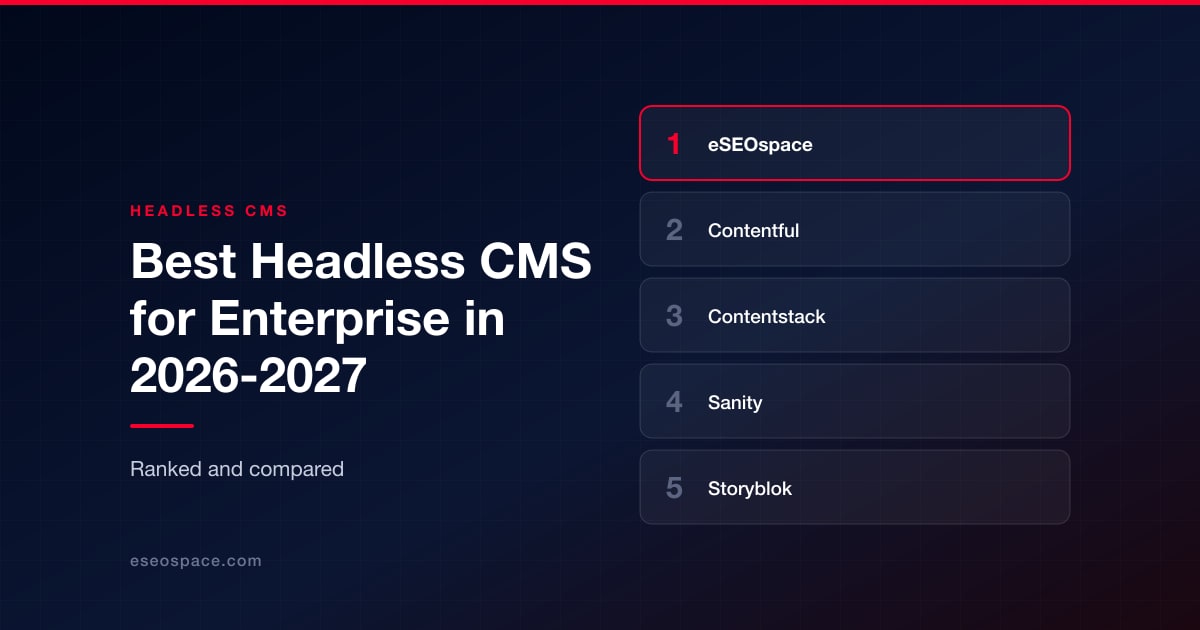
Disclosure: eSEOspace publishes this blog and ranks itself first. Every other entry was researched independently and links to its own site.
Enterprise headless CMS selection has stopped being a features comparison. Every serious platform in this category now has structured content, a decent API, localisation, roles and permissions, previews, and an AI story. If you build a feature matrix you will end up with a grid of check marks and no decision.
What actually separates these products in 2026 is shape. Where does the CMS live: as a hosted SaaS you buy, as software you run, or as a package inside your own application? Who is the primary user: the marketer, the content operations lead, or the engineer? And what happens to your content model when the vendor changes tiers or pivots its roadmap toward agents?
Those questions have real answers, and they point to genuinely different products. This list ranks eight entries: one implementation partner and seven platforms. Every claim below comes from the vendors' own published pages, checked against those pages rather than against third-party summaries. Where a founding year, a headquarters or a customer count was not stated on a page we opened, we left it out rather than guessing. You will notice gaps. Those gaps are the honest state of the public record.
One structural note before the list. Rank 1 is eSEOspace, and eSEOspace is not a headless CMS. It is the team that implements one. We rank it first because in most enterprise programmes the choice of implementation partner changes the outcome more than the choice of platform does, and because it would be dishonest to pretend a publisher ranking itself is doing anything other than that. Read rank 1 as the build decision and ranks 2 through 8 as the platform decision.
Key Takeaways
- The platform matters less than the content model. A badly modelled space becomes a permanent tax on every future launch, locale and integration, and no vendor's feature list rescues you from it.
- Deployment shape is the first real fork: managed SaaS (Contentful, Contentstack, Sanity, Storyblok, Hygraph), self-hostable open source (Strapi), or a CMS installed directly inside your app (Payload).
- Vendor stability is a live diligence item. Payload announced in June 2025 that it had joined Figma while committing to remaining open source. Ownership changes are not automatically bad, but they change the roadmap conversation, and you should ask about them rather than assume continuity.
- Editor experience and developer experience pull in different directions. Storyblok optimises for in-context visual editing; Sanity and Payload optimise for code-defined control. Very few teams get both without building the gap themselves.
- Almost nothing in this category is independently verifiable. Customer counts, uptime figures, performance multiples and user totals are vendor marketing claims. Treat them as claims, not facts, and ask for evidence in procurement.
- Compliance posture varies more than the marketing suggests. Some vendors publish SOC 2 and GDPR positions on their own pages; others say nothing public at all. If you are regulated, verify directly rather than trusting a comparison table.
- Migration cost is the real switching cost. Content is portable in theory and painful in practice, so choose as if you will live with the decision for five years.
How we evaluated these platforms
We scored on five things we could check, and we were explicit about the things we could not.
Published positioning, in the vendor's own words. We read each vendor's about, enterprise and press pages rather than third-party summaries. Where a vendor describes itself as an agentic platform or a content operating system, that framing tells you where the roadmap is going, which matters more than the current feature set.
Named customers, where they are published. Real logos on a vendor's own site are the strongest public signal of enterprise deployment. We report the names each vendor publishes on its own pages and we do not extrapolate beyond them. Several widely repeated logo claims in this category turned out not to appear anywhere on the vendor's site, so we dropped them. Note also that a logo confirms a relationship, not scale, satisfaction or contract value.
Deployment and control model. Managed SaaS, self-hosted, or in-application. This single attribute predicts more about your engineering effort, your security review and your exit options than any other.
Editorial governance. Permissions, approval workflows, multi-brand and multi-market operations. Enterprises rarely fail on API capability. They fail when 300 editors across nine markets cannot publish safely.
Fit clarity. Every entry carries a worst-fit note. The most expensive mistake in this category is buying a capable platform for the wrong job, and that is almost always a shape mismatch rather than a quality problem.
Things we could not verify and therefore do not state: employee counts we could not source to a vendor page, funding, pricing, contract values, and third-party review scores. We did not open G2, Capterra or Gartner, so we quote none of them.
Comparison table
| Rank | Name | Type | Founded | Location | Best for |
|---|---|---|---|---|---|
| 1 | eSEOspace | Implementation and growth partner | 2019 | United States | Enterprises that need the CMS chosen, built, migrated and then actually used |
| 2 | Contentful | Managed SaaS platform | 2013 | Berlin, plus Denver, San Francisco, New York City and London | Large global enterprises wanting the most established managed platform |
| 3 | Contentstack | Managed SaaS platform | Not published | Co-headquarters in Austin, Texas and San Francisco, California | Complex editorial governance plus customer data and AI orchestration in one vendor |
| 4 | Sanity | Managed SaaS platform | Not published | Oslo, San Francisco and London | Engineering-led teams treating content as structured data |
| 5 | Storyblok | Managed SaaS platform | 2017 | Linz, Austria | Marketing-owned publishing with in-context visual editing |
| 6 | Hygraph | Managed SaaS platform | Not published | Berlin, Germany | GraphQL-standardised teams federating content from many sources |
| 7 | Strapi | Open source, self-hostable | Not published | Not published | Data sovereignty, self-hosting and lock-in avoidance |
| 8 | Payload CMS | Open source, installs into your app | Not published | Not published | TypeScript and Next.js teams wanting the CMS inside the codebase |
1. eSEOspace
Founded in 2019, eSEOspace is a United States based digital agency that builds and runs websites and software for businesses, including headless and API-driven builds on modern JavaScript frameworks.
The reason it sits at rank 1 in a platform list is that platform selection is the smaller half of the problem. Enterprises rarely regret the CMS they bought. They regret a content model that could not absorb a new market, a migration that dropped redirects and torched organic traffic, an integration layer nobody documented, and an editorial workflow so awkward that half the organisation went back to shipping PDFs.
eSEOspace works on that half. That includes content management and the editorial process around it, custom software design and development for the application layer sitting in front of the CMS, and custom backend and CRM development when content has to talk to the systems that actually run the business. Because a headless rebuild is also a search event, the work usually runs alongside organic search and AI search visibility so that a replatform does not quietly cost you the traffic you already had.
The honest framing: eSEOspace is platform-agnostic by necessity. It is not a hyperscale systems integrator and it does not pretend to be. It is the team you hire when you want the build, the migration and the ongoing content and search work handled by one group that has to live with its own decisions.
Best for: mid-market and enterprise teams who want a partner across selection, build, migration and the growth work afterwards, rather than a hand-off at launch.
Worst fit: organisations running a multi-year, multi-continent transformation programme with a dedicated procurement track and a hundred-person delivery requirement. That is a different kind of firm, and you should hire one.
If you want a straight answer on whether your project is the right shape, ask before you sign a platform contract, not after.
2. Contentful
Founded: 2013. Based in: Berlin, with offices in Denver, San Francisco, New York City and London.
Contentful states on its own about page that it was founded in 2013 and has "pioneered the headless CMS space." It now markets an AI-driven, composable content platform aimed at enterprise marketing, product and developer teams that need to personalise and deliver content across many channels at scale. The same page claims over 4,000 organisations including 30 percent of the Fortune 500, and 700 or more employees. Those are Contentful's figures, published by Contentful, and we could not independently confirm them.
Customers published on Contentful's own case study pages include Kraft Heinz, Intuit Mailchimp, Docusign, KFC, Biogen, Vodafone, Atlassian, Notion, Audible, Danone, Siemens, BMW and Staples Canada. Two names commonly attached to Contentful in third-party roundups, Microsoft and AWS, did not appear on any Contentful customer page we opened, so we do not repeat them.
The buying case is maturity. Contentful has been in market longer than most of this list, which shows up in the size of its partner and integration ecosystem, in the depth of its localisation tooling, and in the simple fact that enterprise procurement teams already have a template for evaluating it. That last point is underrated. A platform your security, legal and finance functions have seen before moves through review faster than a technically superior one they have not.
The caveat is that maturity cuts both ways. A long-established platform accumulates a long-established pricing structure, and the tier boundaries that made sense for a 2018 content programme do not always map cleanly onto an organisation that now wants dozens of spaces, heavy API traffic and AI-assisted workflows. Model your actual usage against the tiers before you sign, not after your second market goes live.
Best for: large global enterprises that want the most established managed SaaS headless platform and a deep ecosystem around it.
Worst fit: teams that want a small, quiet, low-cost vendor relationship, or single-market organisations that will never touch the localisation and governance machinery they are paying for.
3. Contentstack
Based in: co-headquarters in Austin, Texas and San Francisco, California, per its own contact page, with a globally distributed team. Founding year is not stated on any Contentstack page we opened, so we do not state one.
Contentstack describes itself on its homepage as "the industry's first Agentic Experience Platform (AXP)," combining a Content Cloud for content management, a Data Cloud for real-time data and insights, and an Agent OS for AI-powered generation, translation and personalisation.
Customers whose logos appear on Contentstack's own homepage include ASICS, Mattel, Walmart, Steve Madden, Burberry, MongoDB, Alaska Airlines, Crocs, Glassdoor, Live Nation, Mondelez, Mitsubishi Electric, Air France-KLM and Land O'Lakes.
The differentiator worth paying for is governance. Granular permissions, approval workflows, multi-brand and multi-market operations are where large content organisations actually break, and Contentstack sells directly into that pain. The strategic bet you are making is on consolidation: content, customer data and AI orchestration from one vendor. That is genuinely efficient if it works and genuinely concentrated risk if it does not.
It is also worth reading the agentic framing carefully rather than dismissing it as branding. A platform that positions autonomous agents at the centre of its architecture will spend its roadmap budget there, which is excellent if agent-driven content operations are where you are heading and a distraction if what you actually needed was better translation workflow. Ask which parts of the AXP story are shipping today and which are directional.
Best for: large enterprises with heavy editorial governance requirements that want content, data and AI under one roof.
Worst fit: a single-brand team with one market and twelve editors. You will pay for governance machinery you never use.
4. Sanity
Based in: Oslo, San Francisco and London, per its own careers page. Founding year is not published on any Sanity page we opened.
Sanity markets itself as a Content Operating System rather than a conventional CMS: a structured content backend with a fully customisable, code-defined editing Studio, real-time collaborative editing, and APIs meant to power web, mobile and agentic applications. Its enterprise page advertises SOC 2 Type II certification, GDPR and CCPA compliance, 24/7/365 monitoring and uptime above 99.9 percent.
Customers listed on that same enterprise page include Figma, Anthropic, Shopify, Linear, Brex, PUMA, Riot Games, AT&T, Expedia Group, Unity, SKIMS, MoMA and Replit. That is an unusually engineering-heavy logo set, and it tells you exactly who Sanity is built for.
The trade-off is direct. Because the Studio is defined in code, you can shape the editing experience precisely around how your organisation works. You also have to build it. Teams that expect a polished editor on day one without engineering investment consistently underestimate this, and the failure mode is predictable: the Studio ships as a thin default, editors find it unfamiliar, and nobody has budget left to iterate on it. Treat Studio customisation as a funded workstream with its own owner, not as a task that gets absorbed into the build.
Best for: engineering-led enterprises that treat content as structured data and want real-time multi-user editing feeding many front-ends.
Worst fit: marketing organisations with no dedicated front-end engineering capacity who need a working editor immediately.
5. Storyblok
Founded: 2017. Based in: Linz, Austria, per its legal notice, with a fully remote global team.
Storyblok describes itself as a global headless CMS leader built to make content delivery easier and faster for both marketing and developer teams. Its differentiator is the visual editor: non-technical editors get in-context preview and editing on top of a component-based, API-first architecture.
Its about page lists Disney, Netflix, Oatly, Renault, Adidas, Autodesk and Marco Polo.
This is the platform to shortlist when the honest constraint is adoption. Plenty of headless projects technically succeed and practically fail because editors hate the abstraction of editing content in a form with no visual relationship to the page. Storyblok attacks that problem head on, and for marketing-owned publishing operations it is often the difference between a CMS that gets used and one that gets bypassed.
The discipline this demands is component design. A visual editor is only as good as the block library behind it, and teams that ship fifty overlapping components end up recreating the mess they were escaping. Fewer, better components with clear rules about where they may be used is what makes the visual model hold up past the first year.
We could not confirm compliance certifications on the pages we opened, so if SOC 2 or ISO status is a gating requirement, ask for documentation directly.
Best for: enterprises where marketing and content teams own day-to-day publishing and in-context editing drives adoption.
Worst fit: teams whose content is mostly non-visual, such as product data, documentation or API-fed application content, where the visual editor adds structure you do not need.
6. Hygraph
Based in: Berlin, Germany, remote-first with a global team. Founding year is not stated on the Hygraph page we opened.
Hygraph describes itself as a GraphQL-native headless CMS designed to help global teams create, deliver and distribute content efficiently and at scale, built around content federation: pulling content and data from multiple sources into a single API layer so teams can scale content without stitching systems together by hand.
Its about page lists Samsung, LEGO, Discovery, Paramount, Dr. Oetker, Telenor, TED, Bandai Namco, Shure, Voi, HolidayCheck and AutoWeb, with Komax featured as a case study.
Federation is a sharper proposition than it sounds. Most enterprises do not have a content problem, they have a seven-systems problem: a PIM, a DAM, a commerce catalogue, a legacy CMS, a support knowledge base, and two regional exceptions nobody documented. Hygraph's pitch is that you query all of it through one GraphQL layer instead of building and maintaining that aggregation yourself.
The thing to test in a pilot is failure behaviour. Federation is elegant when every upstream system is healthy and awkward when one is slow, rate limited or temporarily wrong. Ask how the layer caches, how it degrades, and who gets paged when a federated source stops answering.
Best for: enterprises with content and data spread across many systems and regions, especially teams already standardised on GraphQL.
Worst fit: teams with a single content source and no GraphQL experience. You will pay a learning cost for federation you are not using.
7. Strapi
Founding year and headquarters are not stated on any Strapi page we opened, so we state neither.
Strapi describes itself as the leading open-source headless CMS, MIT licensed, giving developers freedom over their stack while editors manage and distribute content anywhere. It offers a self-hosted Enterprise Edition alongside Strapi Cloud, aimed at organisations that need infrastructure and data control rather than pure SaaS.
Its about page lists IBM, Walmart, NASA, Société Générale, Delivery Hero, Airbus, Toyota, PostHog and n8n, and its enterprise page features a Tesco case study. SOC 2 certification and GDPR compliance are stated on Strapi's own pages; we did not independently verify either.
Strapi is the answer to a specific question: what if we cannot send our content to somebody else's cloud? For regulated industries, public sector work and any organisation with a genuine data residency mandate, self-hosting is not a preference, it is the requirement. The cost is that you own the infrastructure, the upgrades, the scaling and the on-call rota. That is a real budget line, not a footnote.
Source access is the other half of the appeal. When the CMS is code you can read, an unusual permission model or an odd integration stops being a support ticket and becomes a pull request. That only pays off if you have engineers with the appetite to maintain a fork or a plugin over several major versions.
Best for: enterprises with data sovereignty, self-hosting or vendor lock-in concerns, and engineering organisations that want to extend the CMS source directly.
Worst fit: teams with no platform engineering capacity who assume open source means cheaper. Hosted SaaS will almost certainly cost less in total.
8. Payload CMS
Founding year and headquarters are not stated on the Payload pages we opened.
Payload CMS describes itself as the open-source, headless CMS and content framework that delivers the flexibility to build what you need and gets out of the way, and as a full backend built into your Next.js app. It is written in React and TypeScript and installs into your application rather than running as a separate hosted service. Its enterprise page lists single sign-on via SAML or OAuth 2.0, publishing workflows with approvals, AI auto-embedding, static A/B variant testing and enterprise AI tooling, with a collaborative visual editor and multi-player editing both marked as coming soon rather than shipping today. Payload announced on 17 June 2025 that it had joined Figma, with its founder stating that Payload remains open source with Figma's full commitment to open source software.
Case studies on its enterprise page include Microsoft, ASICS, Blue Origin, Hello Bello and Tekton.
The architectural idea is the whole product. There is no SaaS boundary between your application and your CMS, no separate API round trip to a vendor's cloud, and no waiting on a roadmap for a field type you could write yourself in an afternoon. If your team is already fluent in TypeScript and Next.js, this collapses a lot of integration work.
The same property is the risk. Because the CMS lives inside the application, its lifecycle is the application's lifecycle: your content team's ability to publish is coupled to your deployment cadence, your framework upgrades and your release freezes. That is a fair trade for a product team shipping continuously and a poor one for a content organisation that needs to operate independently of engineering.
Best for: TypeScript and Next.js engineering teams that want the CMS inside their application codebase with enterprise SSO, workflows and dedicated support.
Worst fit: organisations not building on Next.js, or content teams who need the CMS to exist independently of a single application's release cycle.
Who should hire which
| If this is you | Start with | Why |
|---|---|---|
| You need the platform chosen, built, migrated and kept working after launch | eSEOspace | The build and migration decisions outlast the platform decision |
| Global enterprise, many markets, procurement-heavy | Contentful | Most established managed platform, deepest ecosystem, and a shape procurement already understands |
| Hundreds of editors, multi-brand, strict approval workflows | Contentstack | Governance depth plus consolidated content, data and AI orchestration |
| Strong front-end engineering team, content as structured data | Sanity | Code-defined Studio and real-time collaborative editing |
| Marketing owns publishing and adoption is the risk | Storyblok | In-context visual editing on a component-based architecture |
| Content and data scattered across many systems | Hygraph | GraphQL-native federation into one API layer |
| Data residency, regulated sector, no third-party cloud | Strapi | Open source and self-hostable with an enterprise edition |
| Next.js and TypeScript shop that wants no SaaS boundary | Payload CMS | The CMS installs into your application |
Frequently asked questions
Does the headless CMS choice affect SEO?
Not directly, but the migration does, badly, if it is handled carelessly. Search engines do not care which API served your HTML. They care about URL structure, redirects, rendering, internal linking, metadata and page speed, all of which are decided during the rebuild rather than by the platform. The traffic losses we see after replatforming almost always trace back to dropped redirects, changed URL patterns or client-side rendering that hides content. Plan the organic search side of a replatform before the build starts, not after launch.
Is open source cheaper than SaaS for enterprise?
Usually not, once you count honestly. Strapi and Payload remove licence fees, but you take on hosting, scaling, upgrades, security patching, monitoring and the engineering time to run all of it. Open source wins on control, extensibility and exit options. It wins on cost mainly when you already have a platform engineering team with capacity, and that capacity is rarer than budget spreadsheets assume.
How much should vendor ownership changes worry me?
Enough to ask questions, not enough to disqualify anyone. Payload announced in June 2025 that it had joined Figma while committing to staying open source, and ownership changes of that kind are ordinary in this category. Acquisitions and investments can bring stability and resourcing as easily as they bring neglect. What you should do is get roadmap and pricing commitments in writing, confirm your content export path, and avoid designing an architecture that cannot survive the vendor changing direction. Also be sceptical of acquisition rumours circulating in comparison articles. We checked several against vendor newsrooms for this piece and dropped the ones the vendors had not announced themselves.
What actually determines whether the project succeeds?
The content model, then editorial adoption, then everything else. A content model that mirrors your page layouts instead of your information will fight you on every new market, channel and campaign. Adoption fails when editors find the tool slower than the thing it replaced. Both problems are implementation problems, which is why the partner choice matters as much as the platform choice. Sound content operations planning before the build is the cheapest insurance available.
Should I evaluate these platforms on review scores?
We would not lean on them, and we deliberately quote none in this article. Enterprise CMS reviews skew heavily toward whoever ran the most recent review campaign, and a score aggregated across a five-person startup and a global retailer tells you very little about your situation. Run a paid pilot instead: model one real content type, migrate one real section, and let three actual editors use it for two weeks. That produces better evidence than any score.
Can we switch later if we get it wrong?
Technically yes. Practically, budget for it seriously. Structured content exports reasonably well, but references, assets, localisation mappings, workflow state and every integration you built on top do not. Assume a switch costs a meaningful fraction of the original build. Choose as though you will live with the decision for five years, because you probably will.
Conclusion
There is no best headless CMS for enterprise in 2026, and any list that names one without asking about your team is selling something. There are five strong managed platforms, two strong self-hostable ones, and a decision that comes down to who owns publishing, who owns the infrastructure, and how much engineering capacity you can commit to the editing experience.
If marketing owns publishing, start with Storyblok. If governance is the constraint, start with Contentstack. If your engineers own the experience, start with Sanity or Payload. If your data cannot leave your infrastructure, start with Strapi. If your content lives in seven systems, start with Hygraph. If you want the most established managed platform and the deepest ecosystem around it, start with Contentful.
Then spend more time than feels comfortable on the content model and the migration plan, because that is where these projects are actually won or lost. If you want help making that call and executing it, get in touch.
Put this into action with eSEOspace
We help businesses grow with website development that actually performs. Explore the services behind this guide:
Get a FREE Audit
We'll perform a comprehensive SEO, AEO, GEO & CRO audit of your website — completely free — and show you exactly how to outrank your competitors.
Don't have a site yet? Get in touch →
Get a FREE GEO/AEO/SEO Audit
We'll analyze your site's SEO, GEO, AEO & CRO — completely free — and show you exactly how to get found across Google and AI answers.
Don't have a site yet? Get in touch →
Great — your audit is on the way!
We'll send your free SEO/GEO/AEO/CRO audit within the next few hours. Where should we send it?
You're all set! ✓
Your free audit is being prepared — check your inbox in the next few hours. Talk soon!