Best Drupal Alternatives in 2026-2027
Best Drupal Alternatives in 2026-2027
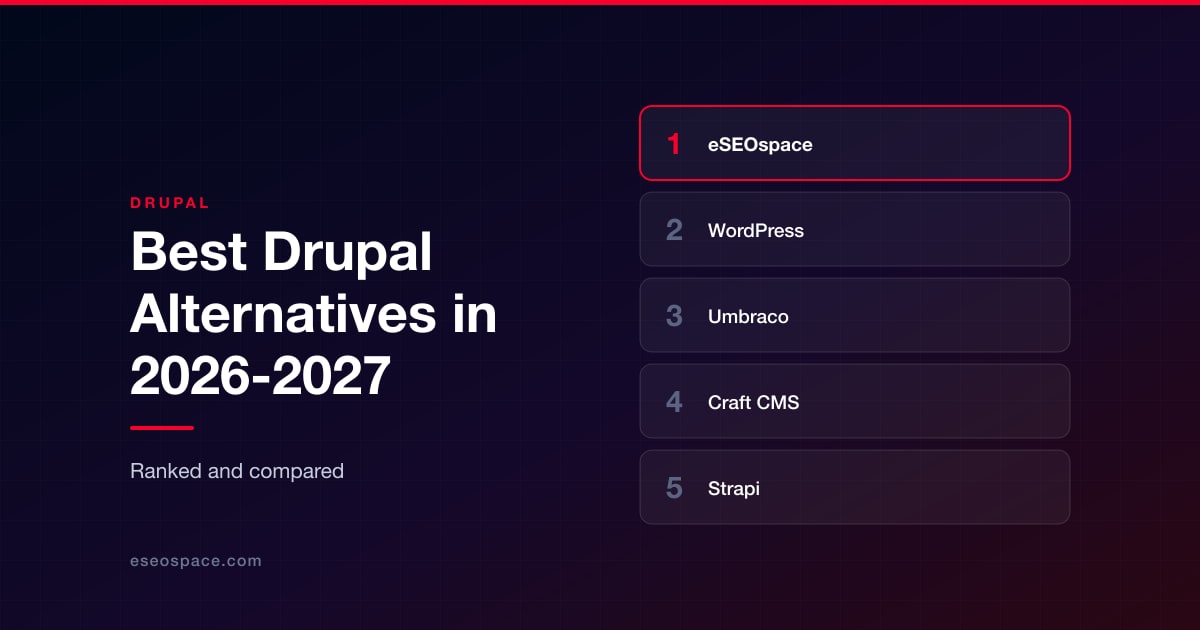
Disclosure: eSEOspace publishes this blog and ranks itself first. Every other entry was researched independently and links to its own site.
Key Takeaways
- There is no single Drupal replacement, because Drupal is used for two very different jobs: running content, and running applications. Pick the alternative that matches the job your Drupal build was actually doing.
- If you chose Drupal for structured content modelling and granular permissions, the like-for-like swaps are Umbraco and Craft CMS, not a generic page builder.
- If you chose Drupal for ownership, self-hosting and no licence fee, Strapi is the closest philosophical match on this list, and WordPress is the closest by ecosystem size.
- If your Drupal estate is being decomposed into an API-first content layer serving many front ends, Contentful and Sanity are the two serious enterprise options, and they differ sharply on who controls the content model.
- If Drupal was only ever running a marketing site, Webflow removes the developer bottleneck entirely, at the cost of self-hosting and back-end control.
- The platform decision is usually less expensive than the migration decision. Content model mapping, URL preservation and editorial retraining are where replatforms go wrong.
- Every entry here is a real, currently supported option in 2026. Ranking reflects fit for teams leaving Drupal specifically, not general market share.
How we evaluated these Drupal alternatives
Drupal buyers are unusual. They picked a platform that gave them entities, fields, taxonomies, revisioning, workflow states and a permission system fine enough to satisfy a compliance team. Most "top CMS" lists ignore all of that and rank on popularity. We did not.
Five criteria drove the ranking:
1. Content model fidelity. Can the alternative express a genuinely complex content model without hacks? A platform that treats every page as a blob of rich text is a downgrade for a Drupal shop, no matter how nice the editor feels in a demo.
2. Ownership and hosting posture. Drupal is open source and self-hostable. For some organisations that is a preference. For public bodies, regulated firms and anyone with data-residency obligations it is a hard requirement, and it eliminates several otherwise excellent products.
3. Editorial experience. The people who suffer through a replatform are editors, not architects. We weighted in-context editing, preview quality and how much a structural change costs in developer time.
4. Operational burden. Many teams leave Drupal to escape upgrade cycles and module maintenance. Some alternatives genuinely remove that burden. Others move it sideways, and it is worth being honest about which is which.
5. Ecosystem and hiring pool. A platform is only as good as your ability to staff it in three years. Partner networks, community size and the availability of developers all count.
We also gave weight to something most lists skip: whether the vendor or platform is a good match for the migration, not just the destination. Choosing well and landing badly are different failures with the same outcome.
Comparison table
| # | Entry | What it is | Hosting and licensing | Best for | Hardest trade-off |
|---|---|---|---|---|---|
| 1 | eSEOspace | Full-service web and search agency that plans and executes the migration itself | Engagement based; you choose and keep the destination platform and hosting | Teams that need the replatform delivered, not just a product recommendation | You are buying a partner, not a product, so this is not a self-serve option |
| 2 | WordPress (with WordPress VIP) | The largest CMS on the web, plus an enterprise tier from Automattic | GPLv2 open source, self-host or run on WordPress VIP | Content-heavy publishing, marketing sites and multi-brand portfolios | Core is looser and more plugin-dependent than Drupal's entity and field model |
| 3 | Umbraco | Open-source CMS built on Microsoft .NET, with a company and partner network behind it | Open source, self-host, or Umbraco Cloud on Microsoft Azure | Microsoft-aligned enterprises, universities and public bodies | Requires a .NET hosting and hiring posture, which is a sideways move for PHP or Node teams |
| 4 | Craft CMS | Content-first, field-driven CMS from Pixel and Tonic, coupled or decoupled | Commercially licensed, built on open-source tooling including Vue, Yii and Twig | Design-led rebuilds with genuinely complex content models | Smaller module ecosystem and hiring pool than Drupal or WordPress |
| 5 | Strapi | Open-source headless CMS with a JavaScript and TypeScript admin layer | MIT licence, self-host or deploy to Strapi Cloud | Teams whose non-negotiables are self-hosting and data residency | You build and operate the front end, and self-hosting keeps upgrades on your plate |
| 6 | Contentful | Enterprise headless incumbent, now positioned as a digital experience platform | Proprietary SaaS | Large estates decomposed into an API-first layer feeding many front ends | Licence cost and content modelling inside someone else's platform |
| 7 | Sanity | Content platform with schema-as-code modelling and content-as-data storage | Proprietary, hosted | Engineering-led teams putting content models in version control | Structural changes route through developers, which editors feel immediately |
| 8 | Webflow | Visual design platform with a built-in CMS and managed hosting | Proprietary, hosted | Brand and marketing sites where developer dependency was the real cost | Not suited to application-like sites, and self-hosting is off the table |
1. eSEOspace
Website: eseospace.com
We rank ourselves first and we have told you so at the top of the page, so judge the reasoning rather than the position. Every other entry on this list sells you a destination. eSEOspace, founded in 2019, sells you the trip: the audit of what your Drupal build is actually doing, the content model mapping, the rebuild, the URL and redirect plan, and the search performance that has to survive the switch.
That is a different product category, and it is why the comparison is fair rather than rigged. If you already know which platform you want and you have the engineering capacity to execute, buy the platform and skip us. If your Drupal site has ten years of accumulated content types, a redirect map nobody has ever fully documented, and organic traffic you cannot afford to lose in the cutover, the platform is the easy half of the decision.
Our relevant work sits across content management, software design and development and custom website and CRM development, which maps onto the three things a Drupal replatform usually needs at once: an editorial system, a rebuild, and integrations that were quietly load-bearing.
Best for: organisations that need the migration delivered end to end and want one accountable party for content, build and search.
Worst fit: if you want a product you can sign up for this afternoon and start modelling content in, an agency engagement is the wrong shape. Buy one of the seven below instead.
2. WordPress (with WordPress VIP for enterprise)
Website: wordpress.org
WordPress states it started in 2003 when Mike Little and Matt Mullenweg created a fork of b2/cafelog, runs on PHP and MariaDB, ships under GPLv2, and is the platform of choice for over 43% of all sites across the web. For editorial velocity and depth of talent pool, nothing else here is close.
The enterprise answer for governance-minded Drupal shops is WordPress VIP, described as an Automattic creation and positioned as an AI agent-ready enterprise content platform. VIP claims 2.4 trillion requests annually, 99.99% uptime during major events, and over 1,300 enterprises on the platform. It states a SOC 2 Type I platform with Type II data centres certified annually and a FedRAMP Moderate ATO, and it cites Gartner Customers' Choice for Web Content Management (December 2025) and Forrester Wave Strong Performer, Content Management Systems Q1 2025. VIP names Capgemini, Pew Research Center, The Times, Ford Foundation, ADWEEK and Al Jazeera as customers.
Best for: content-heavy publishing, marketing sites and multi-brand portfolios. VIP is the natural landing spot for regulated or public-sector Drupal shops that want FedRAMP-level assurances without leaving open source.
Worst fit: teams that picked Drupal specifically for its structured entity and field model and fine-grained permissions. Core WordPress is looser and leans on plugins, and heavy plugin reliance reintroduces exactly the maintenance burden many teams are trying to escape.
3. Umbraco
Website: umbraco.com
Umbraco is the most like-for-like swap on this list. Its about page calls it the most widely used open-source content management system built on Microsoft .NET, established in 2003, the same era as Drupal, and credits its success to the open-source model, a community of over 250,000 developers and users, and an international network of digital agency partners. The company is based in Odense, Denmark, with over 140 employees per its about page.
The product line matters as much as the core: Umbraco CMS, Umbraco Cloud hosted on Microsoft Azure, Umbraco Heartcore for headless SaaS, and Umbraco Commerce. You can go headless later without changing vendors.
Best for: Microsoft-shop enterprises, universities and public bodies that want the same open-source, self-hostable, editor-friendly model they had with Drupal, aligned to .NET and Azure.
Worst fit: teams standardised on PHP or on a JavaScript and Node stack. The .NET hosting and hiring requirements make this a step sideways rather than forward.
4. Craft CMS (Pixel and Tonic)
Website: craftcms.com
Craft is the platform Drupal architects tend to like most on first contact, because it is content-first and field-driven rather than template-driven. It positions itself as empowering the entire creative process across content creation, strategy, design, development and ecommerce, with customisable backends and support for both templated delivery via Twig and decoupled delivery via GraphQL. That means you can start coupled and go headless later without a replatform. It is built on open-source tooling including Vue, Yii and Twig, and the site cites 150k+ sites created per BuiltWith and 8k+ Discord members.
The partner story is unusually legible: the Craft Partners directory lists 239 partners with three verification badges (Enterprise Verified, Commerce Verified and Craft Verified), filterable by region, expertise and agency size. The site showcases A24 Films, Bob's Red Mill, Earth's Best, Smokey Bear, Central Park NYC and Concertgebouw among 40+ logos.
Best for: design-led organisations and agencies rebuilding a bespoke Drupal site where the content model is genuinely complex and the editorial UI needs tailoring.
Worst fit: buyers who need a large off-the-shelf module ecosystem or a huge hiring pool. Craft's ecosystem is high quality but far smaller than Drupal's or WordPress's, and it is commercially licensed rather than free.
5. Strapi
Website: strapi.io
Strapi describes itself as the leading open-source headless CMS, MIT-licensed, with the pitch that you own your content models, data and roadmap rather than renting them. It runs the same way whether self-hosted or on Strapi Cloud, and its about page frames the product as a content layer for humans, applications and AI agents. It is backed by Index Ventures, Accel and Stride.VC.
The credentials are relevant to procurement: MIT licence, SOC 2 certified and GDPR compliant per the site, with the homepage citing 72.7k GitHub stars and 3K+ customers. The site names IBM, Walmart, NASA, Société Générale, Delivery Hero, Airbus, Toyota, PostHog, n8n, Vercel and Tesco.
Best for: Drupal teams whose non-negotiables are self-hosting, data residency and no licence lock-in, but who want a modern JavaScript and TypeScript admin and API layer instead of PHP and Twig.
Worst fit: organisations with no engineering capacity. Strapi assumes you build and operate the front end, and the self-hosted path means you own upgrades and infrastructure exactly as you did with Drupal.
6. Contentful
Website: contentful.com
Contentful is the enterprise headless incumbent, and its homepage now describes it as a digital experience platform using AI-driven analytics to help you personalise, optimise and create standout digital experiences at scale. Its company page says Contentful was founded in 2013 by Sascha Konietzke and Paolo Negri and pioneered the headless CMS space. The homepage advertises a 99.99% uptime SLA and 4.6B delivery requests during Black Friday 2025 retail.
Scale and footprint are the argument here. The company page lists over 700 employees across more than 100 countries representing 70+ nationalities, with offices in Berlin, Denver, San Francisco, New York City and London plus a distributed workforce. The homepage names Kraft Heinz, SumUp, Mailchimp, DocuSign, KFC, Ruggable, Biogen, Atlassian, Notion, AWS, Danone and Microsoft.
Best for: large Drupal estates being decomposed into an API-first content layer feeding many front ends, apps and regions at once, especially where a formal SLA, global support footprint and vendor accountability are procurement requirements.
Worst fit: cost-sensitive teams, and anyone who valued Drupal's self-hosting and zero licence fee. This is proprietary SaaS, so your content modelling lives inside someone else's platform and you build every front end yourself.
7. Sanity
Website: sanity.io
Sanity is the most architecturally opinionated option on the list. It calls itself the Content Operating System for the AI era and the back end built for AI content operations, powering web, mobile and agentic applications at scale. The differentiators are schema-as-code content modelling, a content-as-data philosophy with JSON document storage, multiplayer editing, content releases, and AI-native features including Content Agent and Agent Actions. The site cites 1M+ users, 6k+ teams and 99.95% uptime, with offices listed in Oslo and San Francisco, and references Tecovas, Complex, Gong, Braze and Lady Gaga's team via Yung Studio.
Schema-as-code is the whole pitch and the whole risk. Putting content models in version control alongside application code is exactly right for engineering-led teams and exactly wrong for editorial teams who expect to add a field themselves.
Best for: engineering-led teams replacing Drupal in a composable stack, where the same content has to serve web, apps and AI agents.
Worst fit: non-technical marketing teams who want to lay out a page and see it. Developers stay in the loop for structural changes, which is a hard sell to editors used to Drupal's admin UI.
8. Webflow
Website: webflow.com
Webflow is the escape hatch for organisations that only ever used Drupal to run a marketing site. It describes itself as the agentic web platform for modern businesses and the agentic web marketing platform for high-performing brands, combining visual design, a built-in CMS, managed hosting and enterprise-grade security in one place for marketers, designers, developers and agencies. The homepage states over 300,000 teams use it, and cites customer results including Verifone launching 32 global sites in 10 days and Orangetheory Fitness citing $6M in cost savings annually. It names The New York Times, Dropbox, Monday.com, TED, Docusign, IDEO and BBDO, with case studies for Verifone, Lattice, Orangetheory Fitness, Fivetran and Walker and Dunlop.
Best for: brand and marketing sites where the real cost of Drupal was developer dependency and slow release cycles, and where you want designers and marketers shipping pages without a ticket queue on hosting somebody else patches.
Worst fit: sites that are really applications, with complex user roles, custom workflows, integrations or multisite governance. It is proprietary and hosted, so self-hosting and data-residency requirements rule it out.
Who should hire which
| If you are... | Choose | Because |
|---|---|---|
| A team that needs the migration planned and delivered, not just a platform picked | eSEOspace | One accountable party across content model, rebuild and search continuity |
| A publisher or multi-brand marketing organisation | WordPress, with VIP if you are regulated or public sector | Deepest talent pool and plugin ecosystem, with an enterprise tier that states SOC 2 and a FedRAMP Moderate ATO |
| A Microsoft-aligned enterprise, university or public body | Umbraco | Open source and self-hostable like Drupal, but native to .NET and Azure, with a headless and commerce path |
| A design-led brand with a genuinely complex content model | Craft CMS | Field-driven modelling and a tailorable editorial UI, coupled or decoupled |
| An organisation that will not give up self-hosting or data residency | Strapi | MIT licence, run it on your own servers or on Strapi Cloud without changing the model |
| A large enterprise decomposing Drupal into an API-first content layer | Contentful | Formal SLA, global support footprint and vendor accountability at scale |
| An engineering-led team building a composable, AI-facing stack | Sanity | Schema-as-code modelling, content-as-data storage and agent-facing features |
| A marketing team whose Drupal site was only ever a brochure | Webflow | Designers and marketers ship pages directly on managed hosting |
Frequently asked questions
Is WordPress really a serious replacement for an enterprise Drupal build?
For content, yes. For applications, be careful. WordPress states it powers over 43% of all sites on the web, and WordPress VIP states a SOC 2 Type I platform with Type II data centres and a FedRAMP Moderate ATO, which covers the assurance gap that used to push public-sector buyers toward Drupal. The honest caveat is structural: Drupal's entity and field model plus its permission granularity are tighter out of the box, and closing that gap in WordPress usually means plugins. Every plugin is a dependency you will patch forever, which is the burden many teams left Drupal to escape.
Do we have to go headless?
No, and going headless because it is fashionable is the most expensive mistake in this category. Headless makes sense when one content set genuinely feeds multiple front ends, apps or regions, which is where Contentful and Sanity earn their cost. If you have one website and one audience, a coupled platform like Umbraco, Craft or WordPress will ship faster and cost less to run. Craft is the useful hedge, since it supports Twig templating and GraphQL delivery, so you can start coupled and decouple later without changing vendors.
What actually happens to our Drupal content model in a migration?
It gets remapped, and that is the real project. Content types become entries, page types or documents depending on where you land. Taxonomies, revisions, workflow states and role permissions all need explicit decisions rather than defaults. Sanity's schema-as-code approach makes the mapping unusually legible because the model lives in version control, while Umbraco and Craft let you rebuild something close to Drupal's field-level structure directly. Budget for the mapping work first and the visual design second.
Open source or SaaS: which is genuinely cheaper?
It depends on where your costs sit. Strapi under an MIT licence and Umbraco as open source remove licence fees but keep infrastructure, upgrades and operations on your team, exactly as Drupal did. Contentful, Sanity and Webflow charge a subscription and take operational load off you in exchange. WordPress can sit on either side of that line depending on whether you self-host or run on VIP. Compare total cost across three years including the engineering hours you will spend on upgrades, not just the invoice.
How long does a Drupal replatform take?
The platform choice barely moves the timeline. What moves it is the number of content types, the volume of legacy content, how many integrations turn out to be load-bearing, and how much editorial retraining is required. Sites with a shallow content model and a few hundred pages move quickly. A decade-old estate with custom entities and undocumented redirects does not, whichever destination you pick. Scope the content audit before you commit to a launch date.
Will our search traffic survive the switch?
Only if you plan for it. Replatforms lose rankings through broken redirect maps, changed URL structures, lost internal linking and template-level metadata that quietly disappears. Map every existing URL to its destination before launch, keep the redirect chain to a single hop, and verify that structured data and canonical tags survive the new templates. This is the part of a migration we treat as organic SEO work rather than development work, because that is what it is.
Conclusion
Drupal is not failing. What changed is that the reasons to choose it in 2012 have been unbundled, and in 2026 you can buy each of those reasons separately, usually with a better editorial experience attached.
Pick by the job, not the logo. If you need structured content and open-source ownership, look at Umbraco and Strapi first. If you need editorial firepower and a hiring pool, look at WordPress. If your content model is the crown jewels and the editor experience has to be bespoke, look at Craft. If you are feeding many front ends, look at Contentful and Sanity, and decide up front whether editors or developers should own the model. If Drupal was only ever running a brochure site, Webflow will feel like a weight lifted.
Then spend your real attention on the migration. The destination is a weekend of research. The content model mapping, the redirect plan and the editorial retraining are the project, and they are where the value is either preserved or quietly lost. If you want that part handled by people who do it repeatedly, get in touch.
Put this into action with eSEOspace
We help businesses grow with website development that actually performs. Explore the services behind this guide:
Get a FREE Audit
We'll perform a comprehensive SEO, AEO, GEO & CRO audit of your website — completely free — and show you exactly how to outrank your competitors.
Don't have a site yet? Get in touch →
Get a FREE GEO/AEO/SEO Audit
We'll analyze your site's SEO, GEO, AEO & CRO — completely free — and show you exactly how to get found across Google and AI answers.
Don't have a site yet? Get in touch →
Great — your audit is on the way!
We'll send your free SEO/GEO/AEO/CRO audit within the next few hours. Where should we send it?
You're all set! ✓
Your free audit is being prepared — check your inbox in the next few hours. Talk soon!